

Understanding Your Rights: When Property May Be Protected from Government Taking
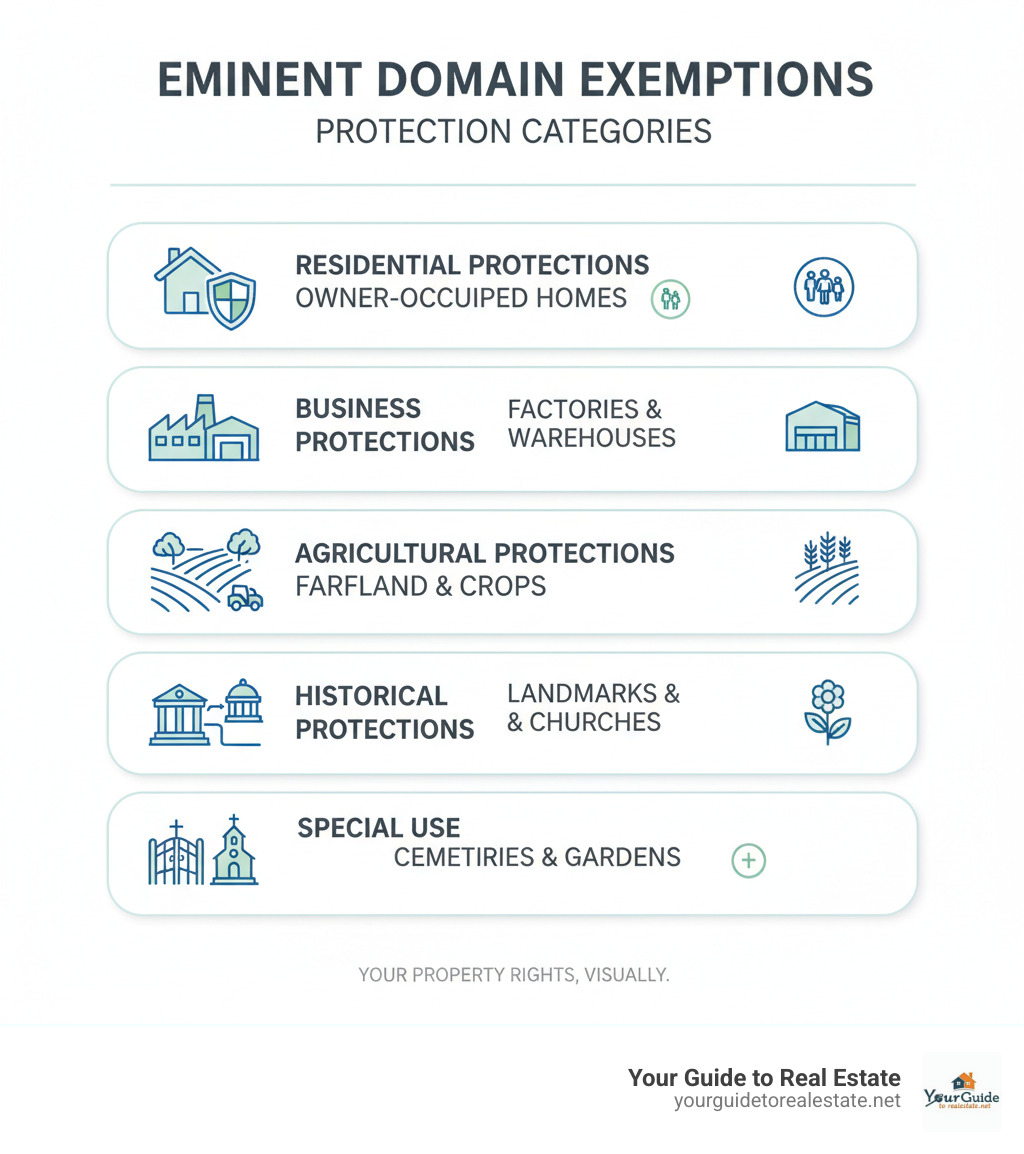
What property is exempt from eminent domain varies by state, but common protections include:
- Owner-occupied residences (primary homes in many jurisdictions)
- Cemeteries, gardens, and orchards (prohibited in many states)
- Properties essential to business operations (warehouses, factories)
- Active agricultural and farmland (in certain states with agricultural protections)
- Historical sites and cultural landmarks (properties with historical significance)
- Religious properties (places of worship, religious schools)
- Non-profit organization properties (certain charitable organizations)
Important note: No property is 100% exempt if the government can prove strong public need and no alternatives exist.
When the government wants your land for a highway, school, or other public project, you might wonder if your property could be protected. The power of eminent domain allows governments to take private property for public use, but it’s not unlimited.
The reality is more nuanced than a simple yes or no answer. While certain types of property receive stronger legal protections, the government’s power to take land for legitimate public purposes remains broad. State laws vary significantly in what they protect, and even “exempt” properties can sometimes be taken under extraordinary circumstances.
Understanding these protections becomes crucial when you receive that first letter from a government agency. The difference between knowing your rights and being caught off guard can mean thousands of dollars in compensation – or even keeping your property altogether.
What property is exempt from eminent domain vocab to learn:
The Foundation: Understanding Eminent Domain
Think of eminent domain as the government’s legal “trump card” – a power that lets them acquire private property even when you’d rather keep it. It might sound a bit intimidating, but this power isn’t unlimited or arbitrary. Understanding how eminent domain works is the first step to knowing what property is exempt from eminent domain.

What is Eminent Domain and Its Purpose?
Eminent domain is the government’s constitutional power to take private property for public use, even if you don’t want to sell. This power comes straight from the Fifth Amendment of the U.S. Constitution, which includes what lawyers call the Takings Clause: “nor shall private property be taken for public use, without just compensation.”
Notice those two key requirements? The government can only take your property for public use, and they must pay you just compensation. These aren’t just legal technicalities – they’re your fundamental protections.
The whole point of eminent domain is to make sure important public projects can move forward. Imagine trying to build a highway if just one property owner could block the entire route. Roads, schools, hospitals, and utility lines often require specific pieces of land to serve the community effectively.
Over the years, courts have expanded what counts as “public use.” Today, it might include economic development projects, environmental conservation, or urban renewal efforts. The basic idea remains the same: sometimes the community’s needs outweigh individual property rights. For more background on these concepts, check out our guide on What is Eminent Domain?.
What Property Can Be Acquired?
Here’s where things get interesting – and potentially concerning for property owners. The government’s eminent domain power reaches much further than most people realize.
Real property is the most obvious target. Your residential home, whether it’s your primary residence or rental property, can be subject to eminent domain. The same goes for commercial buildings like office spaces and retail stores, plus industrial facilities such as factories and warehouses.
But the government’s reach extends beyond buildings and land. They can also acquire what lawyers call tangible personal property and even intangible assets. This might include contract rights, franchises, patents, and copyrights if they’re necessary for a public project.
One of the most famous examples of this broad interpretation happened in California. The City of Oakland actually tried to use eminent domain to claim the Raiders football team when they wanted to relocate. The California Supreme Court ultimately blocked this creative attempt in 1982, but it shows just how far some governments have tried to stretch their eminent domain powers.
The legal process itself is called condemnation, and it can theoretically target almost any type of property. This broad scope is exactly why understanding what property is exempt from eminent domain becomes so crucial for property owners across the country.
The good news? While the government’s theoretical power is extensive, there are real protections and exemptions that can shield certain properties from being taken. Let’s explore those protections next.
What Property is Exempt from Eminent Domain? A Closer Look
Here’s where things get interesting for property owners. While the government’s eminent domain power might seem overwhelming, it’s not a free-for-all. Think of it like a game with rules – and some properties get special shields that make them much harder to take.
The truth is, what property is exempt from eminent domain depends heavily on where you live and what type of property you own. Different states have crafted their own protective laws, creating a patchwork of exemptions across the country.
Common Statutory Exemptions
Some types of property have earned special status in many states, often because they serve important community functions or hold deep cultural significance. Cemeteries top this list in most jurisdictions – after all, disturbing final resting places raises serious ethical concerns that most governments prefer to avoid.
Gardens and orchards also frequently appear on protected lists, particularly in agricultural states where these productive spaces contribute to local food systems. Similarly, factories and industrial properties essential for local economies often receive statutory protections, recognizing that their loss could devastate entire communities.
But here’s a crucial point: you can’t suddenly declare your backyard a cemetery or plant a few apple trees after receiving an eminent domain notice and expect protection. These exemptions typically apply only to properties with established, legitimate uses. Courts see right through attempts to game the system, and such actions usually lack the good faith required for legal protection.
Understanding what property is exempt from eminent domain for residential and business owners
Your home truly is your castle in many states, and the law often reflects this sentiment. Primary residence protections exist in numerous jurisdictions, making it significantly more difficult for governments to take owner-occupied homes, especially for private development projects.
Take California, for example. Their state constitution specifically prohibits taking an owner-occupied residence just to hand it over to a private developer. The government can still take your home for genuine public works like highways or schools, but they face much higher legal problems when private interests are involved.
Essential business operations also receive consideration in many areas. If your warehouse stores specialized equipment that can’t be moved, or your factory contains custom machinery built specifically for that location, you might have grounds for protection. The key is proving that losing the property would genuinely cripple your business operations, not just inconvenience them.
The challenge lies in demonstrating necessity. Courts want to see that your business truly depends on that specific location and that suitable alternatives don’t exist nearby.
Protections for Farmland and Agricultural Land
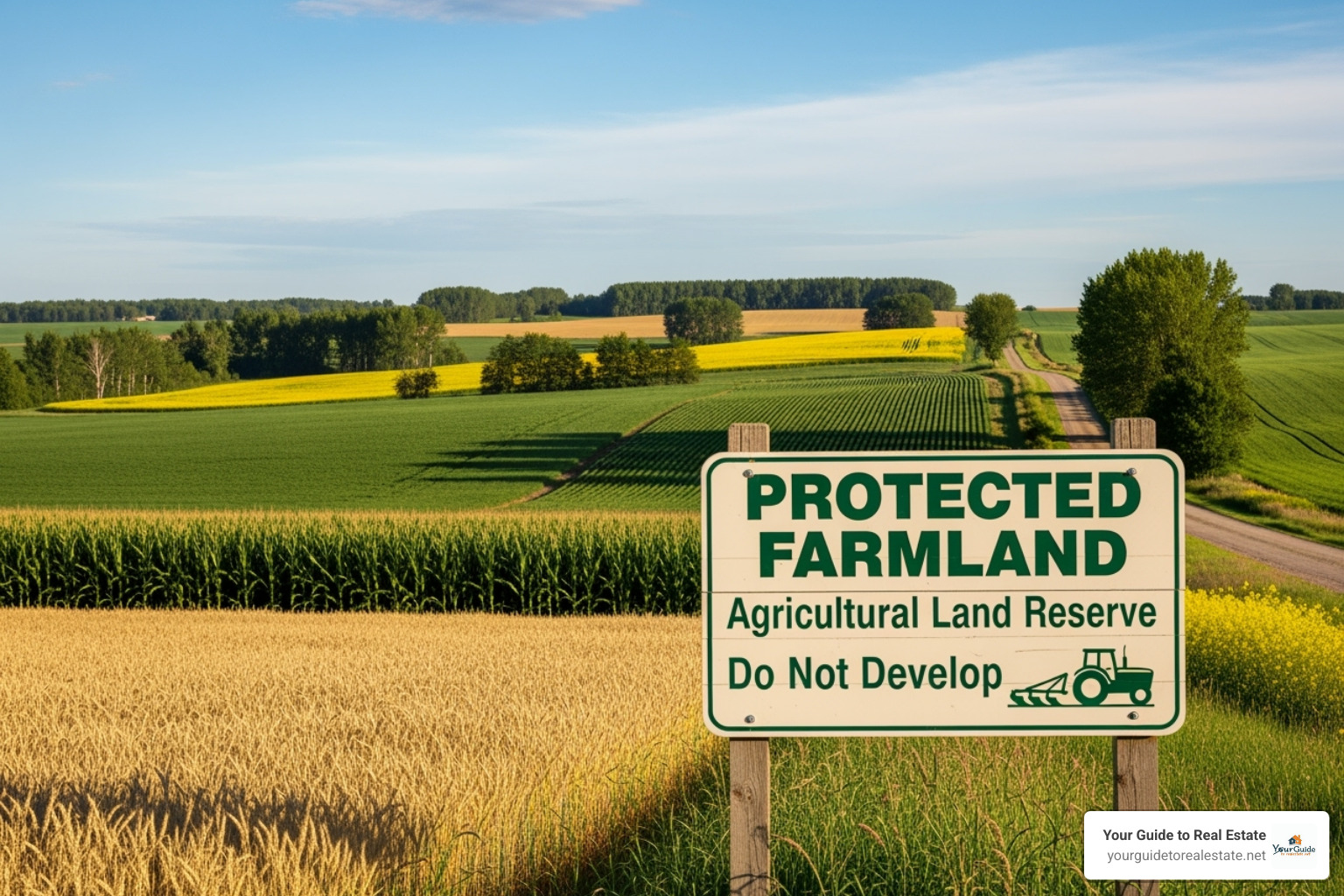
Agriculture feeds communities, and many states recognize this vital role through special farmland protections. Active agricultural use can shield your property in certain states, but emphasis falls on “active” – the land must genuinely contribute to agricultural production.
Conservation programs add another layer of protection. If your land participates in programs like the Conservation Reserve Program (CRP), the government typically needs stronger justification for taking it. These programs reflect public policy decisions to preserve agricultural resources and environmental benefits.
Proving farm status often requires documentation of productive use, income from agricultural activities, and sometimes minimum acreage requirements. It’s not enough to own rural land; you need to show it’s actually farming. Understanding property valuation becomes crucial here, and you can learn more about real estate valuation and market analysis to better protect your interests.
Special Status: Historical Sites and Religious Properties
Some properties carry value that money can’t measure. Historical significance often provides strong protection, especially for properties listed on the National Register of Historic Places or designated as local landmarks. Governments face intense public scrutiny when considering taking historically significant sites.
Religious properties occupy particularly protected ground, thanks to constitutional guarantees of religious freedom. Places of worship, religious schools, and properties owned by religious organizations create complex legal challenges for condemning authorities. Courts require compelling public necessity and proof that absolutely no alternatives exist.
Non-profit organizations often enjoy similar protections, especially when their properties serve clear charitable purposes. The legal reasoning recognizes that these organizations provide public benefits that would be lost if their properties were taken.

Remember though – “exempt” rarely means “bulletproof.” Even these protected properties can be taken under extraordinary circumstances. The difference is that governments face much higher legal bars, stronger public opposition, and significantly more expensive legal battles. Most agencies prefer easier targets when alternatives exist.
Landmark Cases That Shaped Property Exemptions
The question of what property is exempt from eminent domain didn’t develop overnight. It’s been shaped by decades of court battles, with judges wrestling over where to draw the line between government power and individual property rights. These landmark cases have created the framework that protects (or fails to protect) property owners today, influencing laws from coast to coast, including right here in Dallas and Oklahoma City.
Understanding these pivotal decisions helps explain why some properties receive stronger protections than others – and why the rules keep evolving.
Early Precedents: Establishing Federal Power
Back in the 1800s, the Supreme Court was still figuring out just how far the government’s eminent domain powers could reach. Two cases from this era laid the groundwork for everything that followed.
Kohl v. United States (1875) settled a fundamental question: could the federal government directly take private property, or did it have to work through state governments? The city of Cincinnati wanted to build a new post office and needed private land to do it. When property owners pushed back, the case eventually reached the Supreme Court.
The Court’s decision was clear – the federal government absolutely had the right to exercise eminent domain for necessary public projects, as long as it provided fair compensation. This ruling gave the federal government direct power to acquire property for its projects, setting a precedent that still influences eminent domain cases today. This case established the federal foundation we still operate under.
Twenty-one years later, United States v. Gettysburg Electric Railroad Company (1896) expanded what “public use” could mean beyond just building roads and post offices. Congress wanted to preserve the historic Gettysburg battlefield sites, which meant taking land from a railroad company. The railroad argued this wasn’t a legitimate public use.
The Supreme Court disagreed, ruling that preserving places of historical and cultural significance absolutely counted as public use. This decision was groundbreaking because it recognized that public benefit isn’t just about physical infrastructure – sometimes the intangible value of preserving our national heritage justifies taking private property. This case opened the door for protecting historical sites that we see today.
The Modern Effect: Economic Development and State Law Reforms
Fast-forward to the 21st century, and one Supreme Court case changed everything about how Americans think about eminent domain – and it wasn’t a popular change.
Kelo v. City of New London (2005) became the most controversial eminent domain case in modern history, fundamentally shifting discussions about what property is exempt from eminent domain. The City of New London, Connecticut, wanted to revitalize its economy by taking private homes and transferring the land to a private developer for a commercial project. The homeowners, led by Susette Kelo, fought back.
In a narrow 5-4 decision, the Supreme Court sided with the city. The justices ruled that economic development projects – even those that primarily benefit private companies – could qualify as “public use” if they created broader economic benefits for the community. Essentially, the Court decided that as long as the government could show some public benefit, they could take private property and hand it to private developers. You can read the full details of Kelo v. City of New London and this case here.
The public backlash was swift and fierce. Americans across the political spectrum were outraged that their homes could be taken and given to private companies, especially since the promised economic benefits in New London never materialized – the development project ultimately failed, leaving empty lots where family homes once stood.
This controversy sparked an unprecedented wave of state law reforms. Recognizing that the federal Supreme Court had gone too far, state legislatures rushed to protect their residents. This case resulted in sweeping legislative changes across multiple states, including Alabama, Georgia, Idaho, Indiana, Kentucky, Michigan, Ohio, South Dakota, Texas, Utah, West Virginia, and Wisconsin, all of which passed laws forbidding the government from taking land for private economic development.
Both Texas (where we serve Dallas clients) and Oklahoma (home to Oklahoma City) implemented strong reforms to prevent Kelo-style abuses. These new laws typically narrowed the definition of “public use” and created additional problems for governments trying to take property for economic development projects.
The legacy of these landmark cases shows us that property rights aren’t static – they evolve through the ongoing tension between government needs and individual rights. Today’s protections exist because property owners fought back, courts made difficult decisions, and legislators responded to public outcry. Understanding this history helps explain why certain properties receive stronger protections and why those protections continue to change.
Navigating the Process: Your Rights as a Property Owner
Facing an eminent domain action can feel overwhelming, especially when you’re wondering what property is exempt from eminent domain and whether your situation qualifies for protection. Even if your property doesn’t fall into an exempt category, you’re far from powerless. The law provides you with significant rights and protections throughout the process.
Think of eminent domain like a negotiation where you hold more cards than you might realize. The government may have the power to take your property, but they must follow strict procedures and compensate you fairly. Understanding these rights can make the difference between accepting a lowball offer and receiving the full compensation you deserve.
From Notice to Acquisition: The Eminent Domain Timeline
The eminent domain process unfolds in predictable stages, and knowing what to expect can help you stay ahead of each step. Most property owners are caught off guard by that first official letter, but understanding the timeline gives you time to prepare and protect your interests.
The initial offer is typically your first real indication that the government wants your property. This might come as a formal letter from a government agency or a phone call from their representative. Don’t be surprised if this first offer seems reasonable – it’s designed to encourage a quick, voluntary sale. However, initial offers are often below what you’re truly entitled to receive.
Negotiation follows naturally from that first contact. You’re under no obligation to accept their opening offer, and this is where many property owners make their first mistake by saying yes too quickly. The government expects negotiation. They’ll likely conduct their own appraisals and studies during this phase, but remember – you can do the same.
If you and the government can’t reach an agreement, they may file a condemnation lawsuit. This sounds scarier than it is. It’s simply the formal legal process that allows them to acquire your property through the courts. This is where having legal representation becomes crucial.
Some states allow quick-take procedures for urgent projects like highway expansions or emergency infrastructure repairs. This means the government can take physical possession of your property before the final compensation is determined. They must deposit what they believe is fair compensation with the court, but the final amount can still be negotiated or determined by a judge.
Throughout this process, both sides will present appraisals to establish your property’s value. The government will have their appraisers, and you should have yours. These competing valuations often form the heart of compensation disputes.
The process typically resolves through continued negotiation, mediation, or ultimately a court trial where a judge or jury determines your final compensation. For more background on how this entire process works, check out our comprehensive guide on What is Eminent Domain?.
The Right to “Just Compensation” and How to Fight for It
The Fifth Amendment promises you “just compensation” if the government takes your property, but what does that actually mean in dollars and cents? It’s more comprehensive than most property owners realize, and understanding these components can significantly impact your final settlement.
Fair market value forms the foundation of just compensation. This represents what a willing buyer would pay a willing seller in an open market transaction. However, this is often just the starting point, not the complete picture of what you’re owed.
Severance damages come into play when the government only takes part of your property. If they take a strip of your front yard for a road widening, for example, how does that affect the value of your remaining property? Maybe it eliminates your privacy, creates noise issues, or makes your driveway dangerous. These impacts deserve compensation beyond just the value of the land they took.
Business losses can be substantial for commercial property owners. If you’re forced to relocate your restaurant or retail store, you might lose regular customers, face higher rent elsewhere, or suffer business interruption during the move. These real costs should be part of your compensation package.
Relocation costs include not just moving expenses, but also the costs of re-establishing yourself in a new location. This might cover everything from new utility deposits to the cost of updating your business cards and marketing materials.
The government’s initial offer rarely accounts for all these factors. That’s why rejecting the first offer is often the smartest financial decision you can make. You have every right to challenge both the taking itself (if it doesn’t meet legal requirements) and the compensation amount.
Fighting for fair compensation typically requires professional help. We strongly recommend consulting with an experienced eminent domain attorney who can review the government’s offer, identify all forms of compensation you’re entitled to, and negotiate on your behalf. They understand the nuances of condemnation law and can spot issues you might miss.
While you may not be able to stop a legitimate taking, you absolutely have the right to ensure you receive every dollar you’re entitled to. A qualified real estate professional can also help you understand your property’s true value and identify factors that might increase your compensation.
Your property rights matter, and the law provides meaningful protections when the government exercises eminent domain. Don’t steer this complex process alone – the stakes are too high, and professional guidance can make a substantial difference in your final outcome.
Frequently Asked Questions about Eminent Domain Exemptions
When property owners first learn about eminent domain, they naturally have questions about protection and exemptions. We’ve helped countless homeowners and business owners understand their rights, and these are the questions that come up most often when people wonder what property is exempt from eminent domain.
Can I make my property exempt to stop a taking?
This is probably the most common question we hear, and unfortunately, the answer is no. You cannot convert your property to a “protected” use once eminent domain proceedings have begun or are clearly on the horizon.
We’ve seen desperate property owners try creative approaches – suddenly declaring their backyard a “cemetery” or quickly planting fruit trees to claim their land is now an “orchard.” Courts see right through these tactics. The legal system requires that pre-existing use be genuine and established well before any condemnation proceedings begin.
The prohibitions on conversion exist for good reason. If property owners could simply change their property’s designation to avoid eminent domain, it would undermine the entire system of public infrastructure development. Courts look for good faith requirements – meaning the protected use must be legitimate, ongoing, and established for legitimate purposes rather than as a last-minute defense strategy.
Is any property 100% exempt from eminent domain?
Here’s the reality that surprises many people: no absolute exemption exists for any type of property. Even the most protected properties – historic landmarks, churches, or your family home – can potentially be taken under extraordinary circumstances.
However, this doesn’t mean these protections are meaningless. When the government wants to take protected property, they face a much higher burden of proof. They must demonstrate public necessity and show that absolutely no alternatives exist.
Think of it this way: if a major earthquake damaged critical infrastructure and the only way to restore emergency services was through a specific piece of protected land, even a historic church might be subject to taking. But the government would need to prove this was truly the lack of alternatives and that the public need was so urgent that it outweighed the property’s special status.
What is the first step if I receive an eminent domain notice?
Getting that first letter from a government agency can feel overwhelming. Take a deep breath – you have time to respond thoughtfully, and you have rights that protect you throughout this process.
Your most important first step is simple: do not sign immediately. That initial offer sitting in front of you? It’s just an opening bid, not a final determination of your property’s value or your rights.
Start by carefully reviewing the offer to understand what’s being proposed. Look at the property boundaries they want to acquire, the compensation amount, and any deadlines mentioned in the documents.
Next, and this cannot be overstated, understand your rights by consulting with an experienced eminent domain attorney. This isn’t just legal advice – it’s practical protection for what might be your most valuable asset.
A qualified attorney can evaluate whether your property might have special protections, assess if the government’s offer is fair, and guide you through the negotiation process. They understand the specific laws in your state and can spot issues you might miss.
The key is acting promptly while also being thorough. Consult a local real estate expert who understands eminent domain law in your area. They can help you steer this complex process and ensure you receive the compensation you deserve.
Receiving an eminent domain notice doesn’t mean you’re powerless. It means you’re entering a legal process where knowledge and professional guidance can make a significant difference in the outcome.
Conclusion
As we wrap up this comprehensive look at what property is exempt from eminent domain, it’s clear that property ownership comes with both rights and vulnerabilities. The government’s power to take private land isn’t unlimited, but it’s also not something to take lightly.
Throughout our exploration, we’ve finded that certain properties do receive meaningful protections. Primary residences often have special safeguards, particularly owner-occupied homes. Essential business operations like specialized warehouses and factories can sometimes claim exemptions. Active farmland enjoys protection in many agricultural states, while historical sites and religious properties carry their own unique shields against government takings.
But here’s the reality check: no property is completely bulletproof. Even the most protected cemetery or historic church can potentially be taken if the government can prove overwhelming public necessity and show that absolutely no alternatives exist. It’s a high bar, but not an impossible one.
The legal landscape keeps shifting too. The controversial Kelo v. City of New London decision sparked a nationwide backlash that led to stronger property protections in states across the country, including Texas and Oklahoma where we serve many clients. These reforms show that public opinion and legislative action can strengthen property rights over time.
If you ever receive that dreaded eminent domain notice, remember this: knowledge is your first line of defense. Don’t panic, don’t sign anything immediately, and definitely don’t try to steer this alone. The compensation offered in that first letter is rarely the full amount you’re entitled to receive.
Your property rights matter, and understanding them puts you in a much stronger position. Whether you’re a homeowner worried about a proposed highway expansion or a business owner concerned about urban redevelopment, being informed about these protections can make all the difference.
For property owners looking to understand their investments better, we encourage you to learn more about real estate valuation and market analysis. At Your Guide to Real Estate, we’re committed to providing you with the proven framework and stress-free guidance you need to succeed in today’s real estate market.