

Why Investment is the Foundation of Building Wealth
What is investment and why does it matter for your financial future? At its core, investment is the commitment of current financial resources with the expectation of achieving higher gains in the future. It’s about trading what you have today for something that will be worth more tomorrow.
Quick Answer: What is Investment?
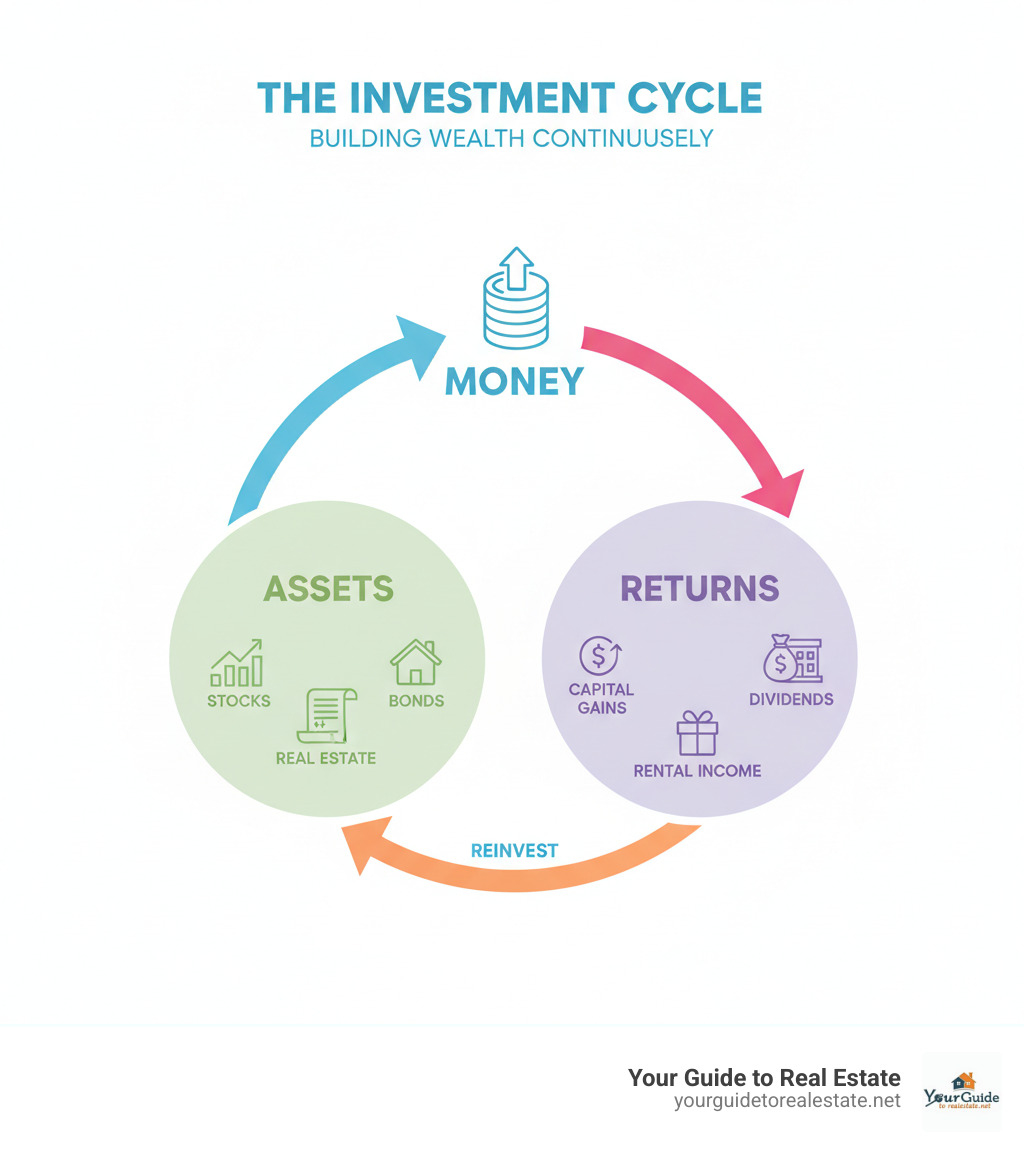
- Definition: Allocating money to assets (stocks, bonds, real estate) to generate returns
- Purpose: Create wealth through capital appreciation, dividends, or rental income
- Key Principle: Forgoing current consumption for greater future returns
- Time Factor: Requires patience – investments grow over time through compounding
- Risk Element: Higher potential returns typically come with higher risk
Think of investment like planting a seed. Early humans understood this concept when they saved grain for future planting instead of eating it all. Today, the principle remains the same – you’re sacrificing immediate gratification for long-term financial growth.
The power of investment lies in compounding. If you invest $100 per month for 30 years at a 5% return, research shows you’d end up with about $198,300. That’s the magic of putting your money to work instead of letting it sit idle.
Whether you’re interested in stocks, bonds, or real estate, understanding investment fundamentals helps you make informed decisions about your financial future. The key is starting with clear goals and a strategy that matches your risk tolerance and timeline.
What is investment helpful reading:
Understanding the Fundamentals: What is Investment?
Let’s get clear on what is investment really means in everyday terms. At its heart, investing is about putting your money to work today so it can grow into something bigger tomorrow. It’s like planting a tree – you’re not going to eat the fruit today, but you’re counting on a harvest down the road.
Here’s where things get interesting. Many people confuse investing with saving or think they’re the same thing. They’re not. Saving is parking your money – it sits there safely earning a tiny bit of interest, maybe 3-4% if you’re lucky. Investing is putting your money to work – it actively seeks to grow through appreciation, dividends, or income generation.
Then there’s consumption, which is simply spending money on things you use up right away. Your morning coffee? That’s consumption. Your monthly rent? Also consumption. These give you immediate satisfaction but don’t build future wealth.
| Feature | Investment | Saving | Consumption |
|---|---|---|---|
| Purpose | Generate future wealth, income, or appreciation | Set aside funds for future use or emergencies | Immediate satisfaction of wants and needs |
| Risk Level | Varies from low to high; higher returns typically mean higher risk | Generally low risk, but inflation can eat away at purchasing power | No financial risk, but no return either |
| Return Potential | High potential for capital gains, dividends, interest, or rental income | Low, fixed interest rates (around 3-4% annually) | No financial return |
| Time Horizon | Usually long-term for significant growth | Short to medium-term for emergencies or upcoming goals | Immediate |
| Example | Buying stocks, purchasing rental property, contributing to retirement funds | Keeping money in bank accounts | Buying groceries, paying utilities, dining out |
Now, let’s talk about the difference between investing and speculating. Investors are in it for the long haul – they research companies, analyze markets, and make calculated decisions based on fundamental value. Speculators are more like gamblers, trying to make quick profits from short-term price swings. Both involve risk, but investing is typically more methodical and patient.
The concept of organized investing isn’t new. The Amsterdam Stock Exchange opened its doors in 1602, making it the world’s first official stock market. The Dutch East India Company was the first to go public there. Here in America, our stock market began with the Buttonwood Agreement in 1792, when 24 stockbrokers met under a buttonwood tree on Wall Street and agreed on rules for trading securities.
The Economic Perspective on Investment
When economists talk about what is investment, they’re thinking bigger picture than just your portfolio. To them, investment means creating things that will help produce other things in the future. It’s about building the economy’s muscle, so to speak.
This economic view includes physical capital – the tangible stuff like factories, machines, and infrastructure that keeps our economy humming. When Amazon builds a new warehouse, that’s physical capital investment because it’ll help them deliver packages for years to come.
There’s also human capital – investing in people’s skills, education, and health. When you go back to school or learn a new trade, you’re investing in human capital. It’s like upgrading your personal operating system to earn more in the future.
Government investment rounds out the picture with public projects like roads, bridges, and research programs that benefit everyone. These investments create the foundation that allows private businesses and individuals to thrive.
The key insight here is that for any economy to invest, it must produce more than it consumes. That surplus gets channeled into building new productive capacity. The more we invest as a society, the more we can produce tomorrow – which is why investment drives economic growth. You can dive deeper into this concept by reading about Investment defined by economists.
The Financial Perspective on Investment
From a personal finance standpoint, what is investment is all about making your money grow. When you invest financially, you’re aiming to generate returns in several ways.
Capital gains happen when you sell something for more than you paid for it. Buy a stock at $50, sell it at $75, and you’ve got a $25 capital gain. Dividends are like thank-you payments that profitable companies send to their shareholders – it’s your share of their success.
Interest payments come from lending your money, whether through bonds or even high-yield savings accounts. And if you’re interested in real estate, rental income is the monthly cash flow you get from tenants living in your investment property.
All this action happens in financial markets, which are basically organized places where people buy and sell investments. The primary market is where new securities are born – companies issue fresh stocks or bonds to raise money for the first time. Think of it as the delivery room for new investments.
The secondary market is where existing securities change hands between investors. This is the stock exchange you see on TV, where prices fluctuate throughout the day as people trade shares back and forth. These secondary markets provide liquidity, meaning you can usually sell your investments when you need to turn them back into cash.
Understanding these fundamentals gives you the foundation to make smart investment decisions, whether you’re interested in traditional stocks and bonds or exploring real estate opportunities.
Exploring the Main Types of Investments

Now that we’ve covered what is investment fundamentally, let’s explore the exciting world of investment options available to you. Think of this as your investment menu – each option has its own flavor, risk level, and potential rewards.
The investment world is beautifully diverse, and we typically organize it into two main categories: real assets and financial assets. Real assets are things you can actually touch – like a house, a gold bar, or farmland. These have intrinsic value because they’re physical items that serve real purposes. Financial assets, on the other hand, are paper (or digital) claims that represent ownership or debt – like stocks and bonds.
Here’s what makes this distinction important: liquidity and market regulation. Financial assets are usually easier to buy and sell quickly (more liquid), and they trade in highly regulated markets with clear rules. Real assets might take longer to sell but often provide more stability during economic uncertainty.
Traditional Financial Investments
When most people think about what is investment means, these are the classics that come to mind. They’re like the reliable friends of the investment world – well-understood, accessible, and forming the foundation of many successful portfolios.
Stocks represent tiny slices of ownership in companies. When you buy Apple stock, you literally own a microscopic piece of Apple! You make money when the company grows in value or pays you dividends from their profits. It’s like being a silent partner in thousands of businesses.
Bonds work differently – they’re essentially IOUs. When you buy a bond, you’re lending money to a government or company, and they promise to pay you back with interest. Think of it as being the bank for a change! Bonds typically offer steadier, more predictable returns than stocks.
Mutual funds pool your money with thousands of other investors to buy a diversified mix of investments. It’s like going in on a group dinner where everyone contributes, and a professional chef (fund manager) decides what to order. Index funds take this concept further by simply copying a market index like the S&P 500, usually with lower fees.
Exchange-Traded Funds (ETFs) combine the best of mutual funds with the flexibility of stocks. You can buy and sell them anytime during market hours, and they often track specific sectors or strategies.
Here’s something interesting: these traditional investments can actually complement a real estate-focused portfolio beautifully. While real estate provides tangible assets and rental income, stocks and bonds add liquidity and diversification. You might explore monthly dividend stocks to create steady cash flow alongside your real estate investments.
What is Investment in Real Assets?
This is where things get tangible and exciting! Real assets are investments you can see, touch, and often use. They’re the “meat and potatoes” of the investment world.
Real estate is our specialty here at Your Guide to Real Estate, and for good reason. When you invest in property, you’re buying something real and useful. People always need places to live and work, making real estate a fundamental human need. You can generate income through rent while building wealth through property appreciation over time.
Whether you’re interested in how to invest in real estate or exploring specific property investment strategies, real estate offers incredible versatility. You might choose a buy and hold real estate approach for steady long-term income, or explore more active strategies.
Commodities include raw materials like gold, oil, and natural gas. These investments often move differently than stocks and bonds, providing diversification. Gold has been a store of value for thousands of years, while energy commodities like natural gas play crucial roles in our daily lives. Understanding markets like fintechzoom.com natural gas can help you make informed decisions about energy investments.
Alternative Investments
Think of alternative investments as the “specialty dishes” on the investment menu. They’re not for everyone, but they can add unique flavors to your portfolio.
Private equity involves investing in companies that aren’t traded on public stock exchanges. This might include funding startup companies or buying established businesses to improve them. These investments typically require larger amounts of money and longer time commitments, but they can offer substantial returns.
Collectibles turn hobbies into investments. Art, rare coins, vintage wine, and classic cars can all appreciate in value over time. The key is having genuine knowledge and passion for what you’re collecting. After all, if a painting doesn’t increase in value, at least you can enjoy looking at it!
Even if your primary focus is real estate, alternative investments can diversify a real estate portfolio by providing exposure to completely different market forces. They might perform well when traditional real estate markets are struggling, helping smooth out your overall returns.
The beauty of understanding all these investment types is that you’re not limited to just one. Many successful investors combine real estate with traditional financial investments and perhaps a sprinkle of alternatives, creating a well-rounded approach to building wealth.
Mastering Risk, Return, and Strategy

Here’s something every investor needs to understand: there’s no such thing as a free lunch in the investment world. When you’re exploring what is investment really means, you’ll quickly find the fundamental Risk-Return Tradeoff principle. Simply put, if you want higher returns, you’ll need to accept higher risk. Want to play it safe? Your returns will likely be more modest.
Think of it like driving. You can take the scenic route at a comfortable speed and enjoy the journey (low risk, steady returns), or you can take the highway and drive fast to reach your destination quicker (higher risk, potential for higher returns). Both approaches can get you where you want to go, but they require different comfort levels with uncertainty.
Measuring your investment success is crucial, and that’s where Return on Investment (ROI) comes in handy. This simple calculation shows you how well your money is working for you.
How to Calculate Return on Investment (ROI):
The formula is straightforward: (Final value of investment – Initial value of investment + Cash distributions over investment period) / Initial value of investment
Let’s say you bought a rental property for $200,000, sold it a year later for $220,000, and collected $10,000 in rent during that year. Your ROI would be: ($220,000 - $200,000 + $10,000) / $200,000 = $30,000 / $200,000 = 0.15 or 15%
Now, risk itself comes in two main flavors. Systematic risk affects the entire market – think economic recessions, rising interest rates, or major political events. This is the kind of risk that makes everyone’s portfolio take a hit, and diversification won’t save you from it. Unsystematic risk, on the other hand, is specific to individual companies or industries. A company’s CEO scandal or a product recall falls into this category, and smart diversification can help protect you here.
How to Manage Investment Risk
Managing risk isn’t about avoiding it entirely – that’s impossible if you want meaningful returns. Instead, it’s about being smart with the risks you take.
Diversification is your best friend here. It’s the investment equivalent of not putting all your eggs in one basket. When you spread your money across different types of investments, industries, or even countries, you protect yourself from any single disaster wiping out your wealth. If your tech stocks are having a rough month, maybe your real estate investments are doing well.
Asset allocation takes diversification a step further. This involves deciding what percentage of your portfolio goes into stocks, bonds, real estate, and other investments. Your age, goals, and risk tolerance all play a role here. Someone in their twenties might put 80% in stocks and 20% in bonds, while someone nearing retirement might flip those percentages.
Hedging is like buying insurance for your investments. It’s more complex and typically used by experienced investors, but it involves taking positions that will gain value if your main investments lose value.
Staying informed about market conditions is another form of risk management. For real estate investors, understanding current market trends through resources like our U.S. Housing Market Update 2025: Prices, Inventory, and Buyer Behavior can help you make smarter decisions and avoid unnecessary risks.
What is Investment Strategy?
Think of an investment strategy as your game plan – it’s how you’ll approach the market to reach your financial goals. Different strategies work for different people, and many successful investors combine elements from multiple approaches.
Value investing is like being a bargain hunter, but for investments. Value investors look for companies or assets trading below their true worth. Warren Buffett, perhaps the most famous value investor, built his fortune by finding great companies at discount prices and holding them for years. These investors dig deep into financial statements and use metrics like price-to-earnings ratios to spot undervalued opportunities.
Growth investing focuses on companies expected to grow faster than the overall market. These companies often reinvest their profits back into the business rather than paying dividends, betting that future growth will reward patient investors. Growth stocks might look expensive today, but investors believe their rapid expansion will justify higher prices.
Dollar-Cost Averaging (DCA) is perfect for people who want to invest regularly without worrying about market timing. You invest the same amount each month regardless of whether prices are high or low. When prices drop, your money buys more shares. When prices rise, you buy fewer shares. Over time, this can smooth out market volatility and reduce your average cost per share.
Buy and Hold is exactly what it sounds like – you purchase investments and hold onto them for years or decades, ignoring short-term market ups and downs. This strategy banks on the long-term growth of quality assets and the power of compounding returns. It’s particularly popular in real estate investing, where properties can generate rental income while appreciating in value over time.
The right strategy depends on your goals, how much risk you can stomach, and how long you have to invest. Many successful investors blend these approaches, and you can learn more by exploring Investment Strategies to Learn Before Trading.
There’s no one-size-fits-all approach to investing. The best strategy is one you can stick with through good times and bad, helping you build wealth steadily over time.
How to Start Investing: A Step-by-Step Guide

Ready to take the plunge and start building your financial future? It can feel a bit overwhelming at first, but understanding what is investment and how to begin doesn’t have to be complicated. Think of it as starting on an exciting journey. With a clear map and a few simple steps, you’ll be well on your way to making your money work harder for you.
This guide will walk you through the practical steps, from setting your sights on your goals to choosing the right places for your money and keeping an eye on its growth. We’ll also touch on assessing your comfort with risk, a key part of smart investing.
Step 1: Define Your Financial Goals
Before you even think about which investments to pick, let’s get clear on your “why.” What do you want your money to achieve? Your goals are like the North Star for your investment journey. They’ll guide every decision you make, from how much risk you take to how long you plan to invest.
Maybe you’re dreaming of a comfortable retirement where you can relax and enjoy life. Or perhaps you’re planning for your child’s education funding, ensuring they have a bright future. Big major purchases, like buying your first home or a vacation property, often require strategic saving and investing. And for many, the simple goal of wealth creation – just seeing your net worth grow over time – is a powerful motivator.
Knowing exactly what you’re aiming for helps you stay focused and motivated. It also helps you understand your timeline. A helpful tool like the Dave Ramsey Investment Calculator can give you a peek into how your investments might grow toward these dreams.
Step 2: Choose Your Investment Accounts
Once your goals are crystal clear, it’s time to find the right homes for your investments. Different accounts come with different rules and benefits, especially when it comes to taxes. Picking the right one can save you a lot of money down the road!
You have a few main options:
- Brokerage Accounts: These are your general-purpose investment accounts. They’re super flexible, letting you buy and sell a wide variety of investments whenever you like. The catch? They don’t offer special tax breaks just for saving.
- Retirement Accounts (401k, IRA): These accounts are specifically designed to help you save for retirement, and they come with some fantastic tax advantages.
- A 401(k) is usually offered through your employer. Money goes in pre-tax, lowering your taxable income now, and grows without taxes until you retire. Plus, many employers offer matching contributions – that’s like free money for your future!
- An IRA (Individual Retirement Account) is one you open yourself. A Traditional IRA offers tax-deductible contributions and tax-deferred growth, while a Roth IRA lets you put in money you’ve already paid taxes on, meaning your withdrawals in retirement are completely tax-free!
Just like you’d get expert help when making a big real estate decision, finding the right professionals is key. If you’re diving into property, understanding how to find good guidance is crucial, similar to Choosing a Real Estate Broker to help you find that perfect investment property.
Step 3: Build and Monitor Your Portfolio
Now for the fun part: picking your investments and watching them grow! With your goals set and accounts ready, it’s time to choose what you’ll invest in and then keep an eye on it.
- Asset Selection: Based on your goals and how much risk you’re comfortable with, you’ll pick a mix of investments. This might include a blend of stocks, bonds, mutual funds, ETFs, and, of course, real estate. Golden rule: diversification! Don’t put all your eggs in one basket.
- Periodic Review: The market is always changing, and so is your life! So, your investment portfolio needs regular check-ups. We usually suggest reviewing your investments at least once a year. Or, if something big happens in your life (like a new job or a new baby) or in the market, it’s a good time to take a look.
- Rebalancing: Over time, some of your investments might grow faster than others. This can throw your original plan out of whack. Rebalancing means adjusting things back to your target mix. You might sell a little of what’s grown a lot and buy more of what’s lagged behind. This helps you manage risk and keep your portfolio aligned with your long-term vision.
For those of you keen on real estate, this monitoring step is super important. It might involve doing a deep dive with a Competitive Market Analysis Complete Guide to make sure your property investments are staying strong and competitive in the market. Consistent effort and smart monitoring are key to long-term success.
Frequently Asked Questions about Investment
What is the simplest way for a beginner to start investing?
If you’re just starting to understand what is investment, don’t worry – you don’t need to become a Wall Street expert overnight. The best approach is to start simple and gradually build your knowledge and confidence.
Low-cost index funds and ETFs are often the perfect starting point. Think of them as buying a tiny piece of hundreds or thousands of companies all at once. Instead of trying to pick winning stocks, you’re essentially betting on the entire market’s growth over time. The fees are typically very low, and you get instant diversification without the headache of research.
Your employer’s 401(k) plan deserves special attention, especially if there’s a company match. This is literally free money – if your employer matches your contribution up to 3%, that’s an immediate 100% return on that portion of your investment. Even if you’re not sure about other investments, this one’s a no-brainer.
Micro-investing apps have made investing incredibly accessible. Some platforms let you invest your spare change from everyday purchases or start with as little as $5. While the amounts seem small, they help you build the investing habit without feeling overwhelming.
For those drawn to real estate, you don’t need to buy an entire property to get started. Real Estate Investment Trusts (REITs) let you invest in real estate through the stock market, while real estate crowdfunding platforms pool your money with other investors. If you’re ready for direct property investment, exploring options like a DSCR Loan can help you understand financing for rental properties.
How much money do I need to begin investing?
Here’s some great news: the old days of needing thousands of dollars to start investing are long gone. Technology has democratized investing in ways that would have seemed impossible just a decade ago.
Many platforms have no minimum requirements at all. You can literally start with whatever you have in your pocket right now. Some brokerage firms eliminated minimums to attract new investors, making the barrier to entry essentially zero.
Fractional shares are a game-changer. Want to own a piece of that expensive tech stock trading at $3,000 per share? No problem – you can buy a fraction of it with just $50. Your ownership percentage might be tiny, but you’re still participating in that company’s growth.
The real power comes from starting small but staying consistent. Investing $100 every month might not sound impressive, but over 20 years with average market returns, you could be looking at a substantial nest egg. The magic isn’t in the size of your initial investment – it’s in the habit of regular investing and the power of compound growth over time.
Every wealthy investor started somewhere. Warren Buffett bought his first stock at age 11 with $114.75 he had saved up. The key is starting, not waiting until you have the “perfect” amount.
What is the difference between investing and speculating?
Understanding this distinction is crucial when learning what is investment really means for building long-term wealth. While both involve putting money at risk, they’re fundamentally different approaches with different goals and outcomes.
Investors think in years and decades, not days and weeks. When you invest, you’re buying into the long-term success of a company, real estate market, or economic sector. You’re comfortable holding your investments through market ups and downs because you believe in their fundamental value over time.
Speculators are chasing quick profits from price movements. They might buy a stock on Monday hoping to sell it for a profit by Friday, based on rumors, trends, or technical chart patterns. While some speculators do well, it’s closer to gambling than investing.
The risk levels reflect these different approaches. Investors accept calculated risks based on research and analysis. They might lose money in the short term, but they’re betting on proven long-term trends like population growth, technological advancement, or the historical appreciation of real estate.
Speculators often take much higher risks for the chance of bigger, faster returns. They might make money quickly, but they can also lose it just as fast.
Analysis methods differ too. Investors dig into company financials, study market trends, and evaluate management quality. They want to understand what they’re buying and why it should be worth more in the future. Speculators focus more on price charts, trading volume, and market sentiment – they’re less concerned with what something is worth and more interested in which direction the price might move next.
Think of investing like planting an oak tree – you’re in it for the long haul, nurturing steady growth. Speculating is more like betting on which way the wind will blow tomorrow. Both have their place, but for building lasting wealth, investing is typically the more reliable path.
Conclusion: Your Journey to Financial Growth
Understanding what is investment is truly the cornerstone of building lasting wealth. Think of it as learning a new language – once you grasp the basics, a whole world of financial opportunities opens up before you.
Throughout this guide, we’ve walked together through the essential concepts that define smart investing. We started with the simple but powerful idea that investment means trading what you have today for something more valuable tomorrow. From there, we explored how investment differs from simply saving money or spending it on immediate pleasures.
The beauty of investment lies in its diversity. Whether you’re drawn to traditional options like stocks and bonds, excited about the tangible nature of real estate, or curious about alternative investments, there’s a path that fits your personality and goals. Each type of investment carries its own risk-return profile, and understanding this relationship helps you make choices that align with your comfort level and timeline.
Risk and return dance together in every investment decision you’ll make. The key isn’t to avoid risk entirely – that’s impossible if you want meaningful growth. Instead, it’s about managing risk intelligently through diversification, proper asset allocation, and staying informed about market conditions like those outlined in our U.S. Housing Market Update 2025: Prices, Inventory, and Buyer Behavior.
Perhaps most importantly, we’ve emphasized that consistency trumps perfect timing every single time. The investor who starts small but stays committed will almost always outperform someone who waits for the “perfect moment” that never comes. Dollar-cost averaging and the magic of compounding work best when given time to flourish.
Starting your investment journey doesn’t require a fortune or a finance degree. With today’s technology and accessible platforms, you can begin building wealth with modest amounts and simple strategies. The most crucial step is simply beginning.
At Your Guide to Real Estate, we’re passionate about empowering you with knowledge that leads to confident action. Our proven framework takes the stress out of real estate decisions, whether you’re buying your first home or building a property portfolio. We believe that informed investors make better decisions, and better decisions lead to financial freedom.
Your financial future is written by the choices you make today. Every dollar you invest is a vote of confidence in your tomorrow. For those ready to explore homeownership as part of their wealth-building strategy, understanding financing options is essential. Dive deeper with our comprehensive resource: Understanding Mortgages: A Beginner’s Guide to Home Loans.
The best investment you can make is in your own financial education. Keep learning, stay curious, and take action. Your future self will thank you.