

A 40-Year Fight Finally Won: Understanding the Historic WEP Repeal
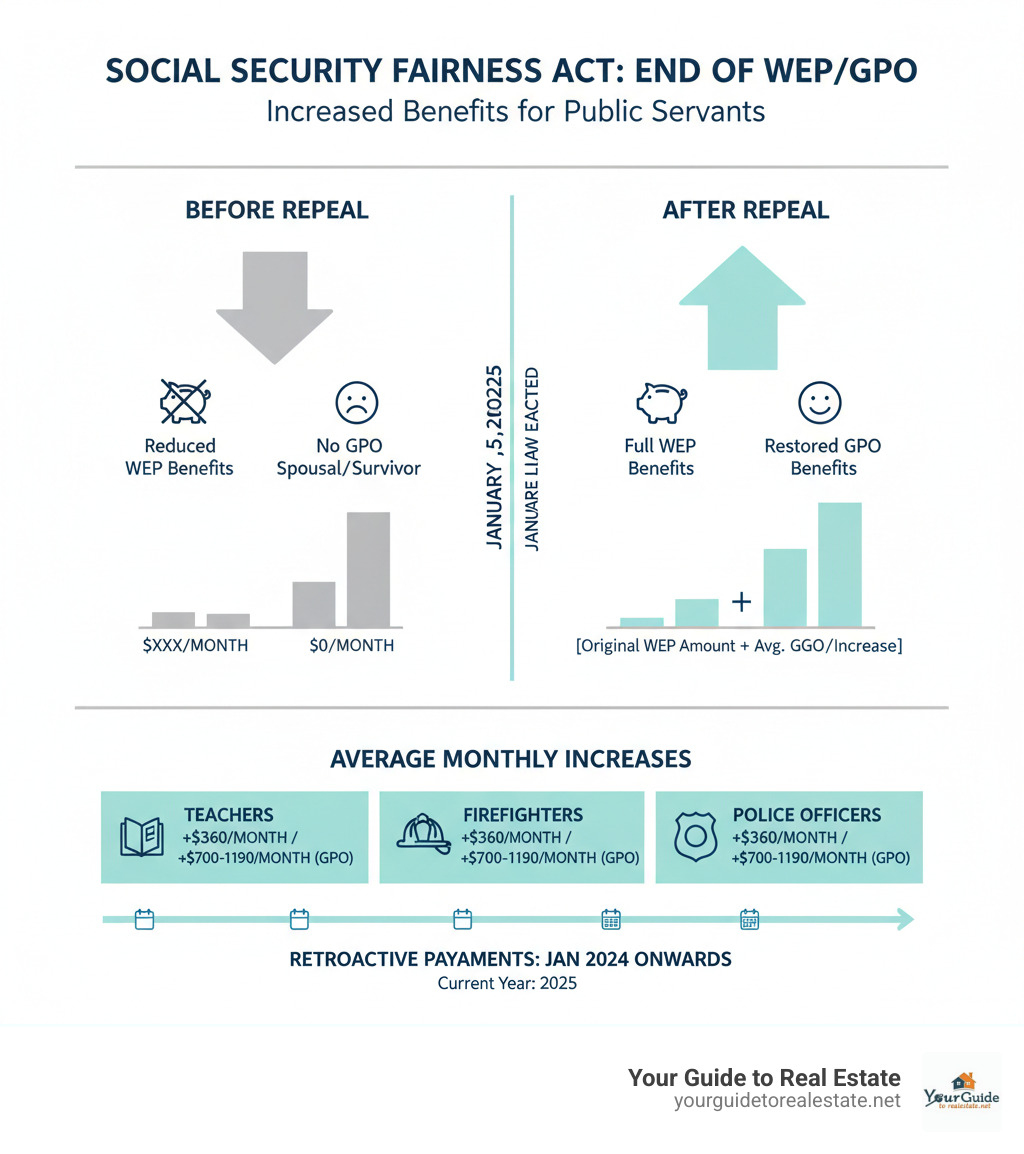
The WEP repeal became reality on January 5, 2025, when President Biden signed the Social Security Fairness Act into law, ending decades of unfair benefit reductions for public sector workers.
Quick Facts About the WEP Repeal:
- What it does: Eliminates the Windfall Elimination Provision (WEP) and Government Pension Offset (GPO)
- Who benefits: Over 2.8 million public sector workers including teachers, firefighters, and police officers
- When it takes effect: Retroactive to January 1, 2024
- Benefit increases: Average $360/month for WEP, $700-$1,190/month for GPO
- Total payments: SSA has already distributed over $17 billion to 3.1 million beneficiaries
For more than 40 years, public servants like teachers and firefighters faced a cruel irony. After dedicating their careers to serving their communities, they watched their hard-earned Social Security benefits get slashed – or eliminated entirely.
As retired Medford teacher Margaret “Peggy” Kane testified in 2007: “I receive no survivor benefits because I was a teacher… Now that we have restored fairness to Social Security, retired educators like me will no longer be unfairly denied benefits they or their spouses have earned.”
The WEP reduced Social Security benefits for workers who also received government pensions, sometimes by as much as $587 per month. Even worse, the GPO eliminated spousal and survivor benefits for over 70% of those affected, leaving widowed public servants struggling financially.
This legislative victory didn’t happen overnight. Organizations like the National Education Association, firefighter unions, and grassroots groups like Mass Retirees fought tirelessly for this change. The final push saw overwhelming bipartisan support – the House passed it 327-75, and the Senate approved it 76-20.
Important wep repeal terms:
- social security fairness act update
- what changes are coming to social security in 2025
- social security fairness act payments update
Understanding the Unfair Penalties: GPO and WEP Explained
Before we celebrate this historic WEP repeal, let’s take a moment to understand exactly what these provisions were and why they caused so much heartache for millions of Americans.
The Government Pension Offset (GPO) and Windfall Elimination Provision (WEP) were two Social Security rules that essentially punished public sector workers for their dedication to serving their communities. These complex provisions reduced or completely eliminated Social Security benefits for teachers, firefighters, police officers, and other public servants who received pensions from jobs where they didn’t pay Social Security taxes.
The cruel irony? These hardworking Americans often held second jobs where they did pay Social Security taxes, yet they were still penalized. Over 2.8 million public sector employees across 26 states found themselves caught in this unfair system, watching benefits they’d rightfully earned disappear.
Imagine working summers as a lifeguard while teaching during the school year, paying Social Security taxes on that summer income for decades, only to have your benefits slashed because of your teaching pension. That’s exactly what happened to countless educators and other public servants.
For more comprehensive coverage of these and other Social Security changes, check out more info about Social Security news.
What Was the Windfall Elimination Provision (WEP)?
The Windfall Elimination Provision, enacted in 1983, targeted workers who had both Social Security-covered jobs and non-covered pensions from government work. The government’s reasoning seemed logical on paper: prevent people from getting “windfall” benefits by receiving Social Security calculations designed for low-wage earners when they actually had substantial government pensions.
But here’s where it got unfair. The WEP formula didn’t account for the reality of many public employees’ lives. Teachers, for instance, often worked second jobs during summers or evenings where they paid Social Security taxes. Despite paying into the system for years, they faced reduced retirement benefits that could slash their monthly payments by up to $587.
Let’s put this in human terms: A Missouri teacher who worked in retail for 15 years before entering education reported losing over $110,000 in benefits due to WEP. That’s money she earned and deserved, taken away simply because she chose to serve her community as an educator.
The 1983 law created a situation where dedicated public employees were essentially penalized twice – once for choosing public service, and again when they tried to collect the Social Security benefits they’d earned in other jobs.
How Did the Government Pension Offset (GPO) Affect Families?
If WEP was harsh, the Government Pension Offset was downright devastating for families. This 1977 law specifically targeted spousal benefits and survivor benefits, creating financial hardship for thousands of families when they needed support most.
Here’s how the cruel GPO calculation worked: it reduced Social Security spousal or survivor benefits by two-thirds of the government pension amount. For most people, this meant complete spousal benefits loss and survivor benefits loss.
The statistics tell a heartbreaking story. More than 70% of those affected by GPO lost their entire benefit – that’s the 70% benefit loss statistic that advocates fought against for decades. This disproportionately hurt women, who often depended on these benefits after losing a spouse.
Take Gayle Harbo from Alaska, whose story represents thousands of others. When her husband died, she received no survivor benefits because she had worked as a teacher. After years of marriage and contributing to their household, she was left with nothing from Social Security when she needed it most.
The human cost was enormous. Widowed teachers, firefighters’ spouses, and police officers’ families found themselves struggling financially during their most vulnerable moments. The two-thirds reduction formula was so severe that it often wiped out benefits entirely, leaving families without the safety net Social Security was designed to provide.
Now, with the WEP repeal in effect, these same families can expect significant relief. Those affected by GPO are seeing average monthly increases of $700 to $1,190 – money that can truly transform their retirement years and provide the security they always deserved.
A Landmark Victory: The Social Security Fairness Act and the WEP Repeal
After four decades of fighting for fairness, public sector workers finally got the justice they deserved. On January 5, 2025, President Joe Biden signed the Social Security Fairness Act into law, officially bringing the WEP repeal to life and eliminating both the Windfall Elimination Provision and Government Pension Offset forever.

This wasn’t just a political win – it was a human victory. Teachers who worked second jobs to make ends meet, firefighters who served their communities for decades, and police officers who risked their lives daily could finally receive the full Social Security benefits they had earned. The overwhelming bipartisan support told the whole story: 327-75 in the House and 76-20 in the Senate. When politicians from both sides of the aisle agree this strongly, you know something was seriously wrong with the old system.
The moment felt surreal for many who had fought this battle for so long. As one advocate put it, after 40 years of being told their benefits were a “windfall,” public servants were finally recognized for what they truly were – dedicated workers who had earned every dollar of their Social Security benefits.
For the latest updates on how this historic change continues to unfold, check out our more info on the Social Security Fairness Act Update. If you’re the type who likes to read the fine print (and we respect that!), you can dive into the full text of the Act.
The Legislative Journey and Advocacy Efforts
The path to the WEP repeal wasn’t easy. It took an army of determined advocates who refused to give up, even when the fight seemed hopeless. HR82 became the rallying cry for millions of public sector workers and retirees who knew they deserved better.
The National Education Association (NEA) led the charge for teachers, while the International Association of Fire Fighters (IAFF) fought tirelessly for firefighters and EMTs. Groups like Mass Retirees organized grassroots campaigns that brought real faces and real stories to lawmakers’ attention. These weren’t just statistics on a spreadsheet – these were neighbors, friends, and family members who had dedicated their lives to serving others.
Senator Bill Cassidy from Louisiana became a champion for the cause, introducing the Social Security Fairness Act year after year since 2009. He understood that in states like Louisiana, where many public employees were affected, this wasn’t just policy – it was personal. Senator Ed Markey from Massachusetts joined the fight with equal passion, calling the original provisions a “40-year-long steal of well-earned retirement benefits.”
The advocacy efforts were remarkable in their persistence. Teachers’ unions held rallies, firefighter associations lobbied their representatives, and retiree groups shared heartbreaking stories of widows losing survivor benefits simply because they had served their communities. The grassroots pressure finally reached a tipping point where lawmakers couldn’t ignore the injustice any longer.
Potential Impact on the Social Security Trust Fund
Now, let’s talk about the elephant in the room – the cost. The WEP repeal will accelerate Social Security’s insolvency by about six months. That’s a real concern that deserves honest discussion.
But here’s the thing: sometimes doing the right thing costs money. Supporters of the repeal argued that correcting inequities isn’t the same as handing out free money. These public servants had earned their benefits through years of covered employment, often working multiple jobs to pay into Social Security while also serving their communities.
The cost justification came down to basic fairness. How do you tell a teacher who worked summers at retail jobs, paying Social Security taxes for decades, that their benefits should be reduced because they also earned a pension from teaching? How do you explain to a widow that she can’t receive her deceased husband’s Social Security benefits because she happened to be a public servant?
The long-term financial implications are serious, and Social Security will need broader reforms to ensure its sustainability. But advocates successfully argued that fixing an unfair system shouldn’t wait for a complete overhaul of Social Security. Sometimes you have to address the injustices you can fix today while working on the bigger challenges tomorrow.
For more context on how this fits into the broader picture of Social Security changes, explore our guide on changes coming to Social Security in 2025.
What the Repeal Means for Your Wallet: Benefits, Payments, and Timelines
If you’ve been affected by WEP or GPO, the WEP repeal brings real money back into your pocket – and we’re talking about substantial amounts that can truly change your retirement experience. More than three million retirees are already seeing increases in their monthly Social Security benefits, with some fortunate individuals receiving over $1,000 more each month.

This isn’t just about numbers on paper – it’s about financial breathing room. Imagine being able to cover that prescription medication without worry, take that trip to visit grandchildren, or simply sleep better knowing your bills are covered. That’s exactly what’s happening for public servants across the country.
The reach is impressive too. About 2.8 million people across 26 states are benefiting from this change. Louisiana provides a perfect example of the impact: nearly 73,000 residents there have already received over $566 million in retroactive payments alone. That’s money that was rightfully theirs all along, finally making its way back to their bank accounts. For complete details on how these retroactive payments work, check out our comprehensive guide on more info on Social Security retroactive payments.
Estimated Increases and Who Is Most Impacted
Let’s break down what these increases actually look like in your monthly budget. The amounts vary depending on whether you were hit by WEP, GPO, or both.
If the Windfall Elimination Provision was reducing your benefits, you’re looking at an average monthly increase of $360. That’s an extra $4,320 per year – enough to cover a nice vacation, home improvements, or simply provide more financial security.
For those affected by the Government Pension Offset, the relief is even more dramatic. Spouses and survivors are seeing average increases between $700 and $1,190 per month. Many people in this category had lost their entire spousal or survivor benefit, so this isn’t just an increase – it’s getting back benefits they never received in the first place.
The people benefiting most are exactly who you’d expect: teachers who shaped young minds, firefighters who ran toward danger, police officers who kept communities safe, and other dedicated public servants. Some individuals, depending on their specific work history and pension amounts, are seeing increases that exceed $1,000 monthly. For families who’ve been struggling financially because of these unfair reductions, this represents genuine life-changing money.
Timeline for Adjusted Benefits and Retroactive Payments
The big question everyone’s asking is simple: “When do I see the money?” The good news is that the Social Security Administration has moved faster than anyone expected.
Initially, officials warned it could take over a year to process all the benefit adjustments. The challenge was enormous – manually reviewing millions of cases, dealing with staffing shortages, and handling complex calculations for each person’s unique situation. But the SSA surprised everyone with their efficiency.
The WEP repeal is retroactive to January 2024, which means you’re getting back pay for more than a year of benefits. The SSA started adjusting monthly payments on February 25, 2025, and most people began receiving their new, higher monthly amounts in April 2025.
Here’s the really exciting part: as of July 7, 2025, the SSA completed sending over 3.1 million payments totaling $17 billion to eligible beneficiaries. They finished this massive undertaking five months ahead of schedule – a remarkable achievement that shows their commitment to getting these funds to the right people quickly.
If you’re waiting for your adjustment or want the latest updates on processing timelines, the SSA maintains current information at SSA updates on the implementation timeline. They’ve been transparent about their progress, which helps everyone plan accordingly.
Your Next Steps: How to Secure Your Adjusted Benefits
Now that the WEP repeal is officially in effect, you’re probably wondering what you need to do to make sure you get every penny you deserve. Here’s the reassuring news: for most people, this process happens automatically. The Social Security Administration has been working around the clock to get these adjustments processed, and they’ve done an impressive job so far.
That said, there are a few smart moves you can make to ensure everything goes smoothly. Plus, with this extra money coming your way, it might be the perfect time to think about your broader financial picture – maybe even exploring new opportunities in real estate or other investments.

What Action Do You Need to Take?
The answer depends on your specific situation, but don’t worry – we’ll walk you through both scenarios.
If you’re already getting Social Security benefits that were reduced by WEP or GPO, you can breathe easy. The SSA is handling your benefit adjustments automatically. You don’t need to file paperwork, make phone calls, or jump through any hoops. Your recalculated benefits and retroactive payments are on their way.
However, it’s worth taking a few minutes to verify your contact information with the SSA. Make sure they have your current mailing address and direct deposit details. You can update this information through your ‘my Social Security’ account online or by calling 1-800-772-1213. Trust me, you don’t want your payment delayed because of an old address!
If you never applied for spousal or survivor benefits because GPO would have wiped them out, this is your moment to act. Many people in this situation didn’t bother applying because they knew GPO would eliminate their benefits entirely. Now that GPO is gone, you could be eligible for substantial monthly payments – plus retroactive amounts dating back to January 2024.
The key word here is promptly. Because some benefits have limited retroactivity (typically six months before your application date), filing new applications quickly is crucial. You can apply for benefits online or visit your local Social Security field office for help with the process.
Managing Medicare Premiums and Avoiding Scams
Here’s something that might catch you off guard: your increased Social Security benefits could affect how you pay your Medicare premiums. If you’ve been paying Medicare directly because your Social Security benefits were too small (thanks to WEP or GPO), you’ll need to make some adjustments.
If you’re using Medicare Easy Pay (where Medicare automatically withdraws your premiums from your bank account), you’ll want to stop those automatic payments. Once your Social Security benefits increase, Medicare premiums will typically be deducted directly from your Social Security check – which is usually more convenient anyway.
To stop automatic payments, you’ll need to complete the Authorization Agreement for Preauthorized Payments form and submit it online or by mail. You can find all the details at Medicare Easy Pay. If you pay through your bank’s online bill pay system, just contact your bank directly to stop those payments.
Here’s the important part: keep paying your Medicare premiums directly to CMS until you get official notice from the SSA about your benefit adjustments. You don’t want any gaps in your Medicare coverage while everything gets sorted out.
Now, let’s talk about something less pleasant but equally important: avoiding scams. Unfortunately, whenever there’s big news about Social Security benefits, scammers come out of the woodwork. They might call, email, or even show up at your door claiming they can help you get your WEP repeal benefits faster – for a fee, of course.
Here’s what you need to know: the SSA will never ask you for payment to help with your benefits. They won’t ask for your personal information over the phone unless you called them first. If someone contacts you asking for money or sensitive information related to your WEP or GPO adjustment, hang up immediately.
Report any suspicious activity to the SSA’s Office of the Inspector General at www.ssa.gov/scams. Not only will this protect you, but it helps protect other retirees from falling victim to these schemes.
The bottom line? Stay alert, but don’t let scam worries keep you from enjoying this well-deserved financial relief. You’ve earned these benefits through years of dedicated public service, and now it’s time to make the most of them.
Frequently Asked Questions about the WEP Repeal
After working with countless retirees through this historic change, we know you probably have questions swirling around in your head. The WEP repeal affects millions of people, and honestly, it can feel overwhelming to figure out exactly what it means for your specific situation.
Let’s tackle the most common questions we’ve been hearing, and hopefully put your mind at ease about what comes next.
How do I know if I am affected by the WEP repeal?
Here’s the thing – if you’re reading this article, there’s a good chance you already suspect you might be affected. But let’s make it crystal clear.
You’re likely affected by the WEP repeal if you receive a pension from a job where you didn’t pay Social Security taxes. Think teachers in certain states, firefighters, police officers, or other state and local government employees. And you also earned enough Social Security credits from other jobs (maybe summer work, part-time positions, or jobs before or after your public service career) to qualify for a retirement or disability benefit.
The WEP repeal removes that frustrating reduction that was being applied to your earned Social Security benefit. It was like being penalized twice – once for serving the public, and again when you tried to collect benefits you’d legitimately earned elsewhere.
If you’re a spouse or survivor, you were affected by GPO if your spousal or survivor Social Security benefits were reduced or completely eliminated because you receive a government pension. Many people in this situation saw their entire spousal or survivor benefit disappear, which was especially hard on widows and widowers.
Do I need to apply to receive my adjusted benefits and retroactive pay?
This is probably the question we hear most often, and the answer depends on your current situation.
If you’re already receiving Social Security benefits that were reduced by WEP or GPO, you can breathe easy. You don’t need to do anything at all. The Social Security Administration is automatically recalculating your benefits and issuing payments. They’re handling all the heavy lifting behind the scenes.
But here’s where it gets important – if you never applied for spousal or survivor benefits because you knew GPO would wipe them out, now’s the time to act. Many people in this situation just gave up and never bothered applying, thinking “what’s the point?”
Well, now there’s definitely a point. You should apply as soon as possible to make sure you receive all the benefits you’re now entitled to, including those retroactive payments that could add up to thousands of dollars.
Don’t wait on this one – some retroactive benefits are limited to six months before you apply, so the sooner you get that application in, the better.
How much will my Social Security benefit increase?
Ah, the million-dollar question – or in some cases, literally thousands of dollars per year. The honest answer is that it varies quite a bit based on your unique work history, the size of your non-covered pension, and which specific Social Security benefits you receive.
For those who were hit by WEP, the Social Security Administration estimates an average monthly increase of about $360. That’s more than $4,000 extra per year – nothing to sneeze at!
For spouses and survivors affected by GPO, the news gets even better. You could see an average increase of $700 to $1,190 per month. For many people, this means going from zero spousal or survivor benefits to receiving substantial monthly payments.
Some lucky folks might see increases of over $1,000 per month, depending on their specific circumstances. Imagine what that kind of financial boost could do for your retirement security and peace of mind.
The exact amount really comes down to the details of your work history and pension situation. But one thing’s for sure – millions of public servants are about to see their financial situations improve significantly, and that’s something worth celebrating.
Conclusion
The WEP repeal marks the end of a 40-year struggle and the beginning of a new chapter for millions of dedicated public servants. Teachers, firefighters, police officers, and countless other government employees who spent their careers serving their communities can finally receive the full Social Security benefits they rightfully earned.
This victory goes beyond numbers on a monthly statement. It’s about financial freedom and the dignity of retirement that every hardworking American deserves. The average increases of $360 for WEP-affected retirees and up to $1,190 for those impacted by GPO represent more than just extra income – they’re a recognition of decades of service and sacrifice.
With over $17 billion already distributed to 3.1 million beneficiaries, the Social Security Administration has proven that government can work efficiently when it matters most. The retroactive payments dating back to January 2024 provide immediate relief, while the ongoing monthly increases offer long-term retirement security.
This newfound financial stability from the WEP repeal can open doors to new possibilities in your retirement, from traveling to making strategic financial moves. Perhaps you’re finally able to consider that dream vacation, help your grandchildren with college expenses, or even explore new housing options that better suit your retirement lifestyle.
If you’re considering how this increased income impacts your overall financial picture, including major assets like your home, understanding all your options is key. Whether you’re thinking about downsizing, relocating to a retirement-friendly state, or leveraging your home’s equity for other investments, having a solid foundation in real estate knowledge can help you make informed decisions. Explore our Beginner’s Guide to Home Loans to learn more about leveraging your financial future.
The fight for fairness is over, but your journey toward a more secure and fulfilling retirement is just beginning. You’ve earned every dollar of these benefits, and now you can finally enjoy them without the shadow of unfair penalties hanging over your financial future.