Why VA Loan Benefits Make Homeownership Accessible for Veterans
VA loan benefits provide a powerful path to homeownership for military families, removing the financial barriers that stop many Americans. These government-backed mortgages are a cornerstone of veteran financial success, with nearly 520,400 VA loans financed last year alone.
Top VA Loan Benefits:
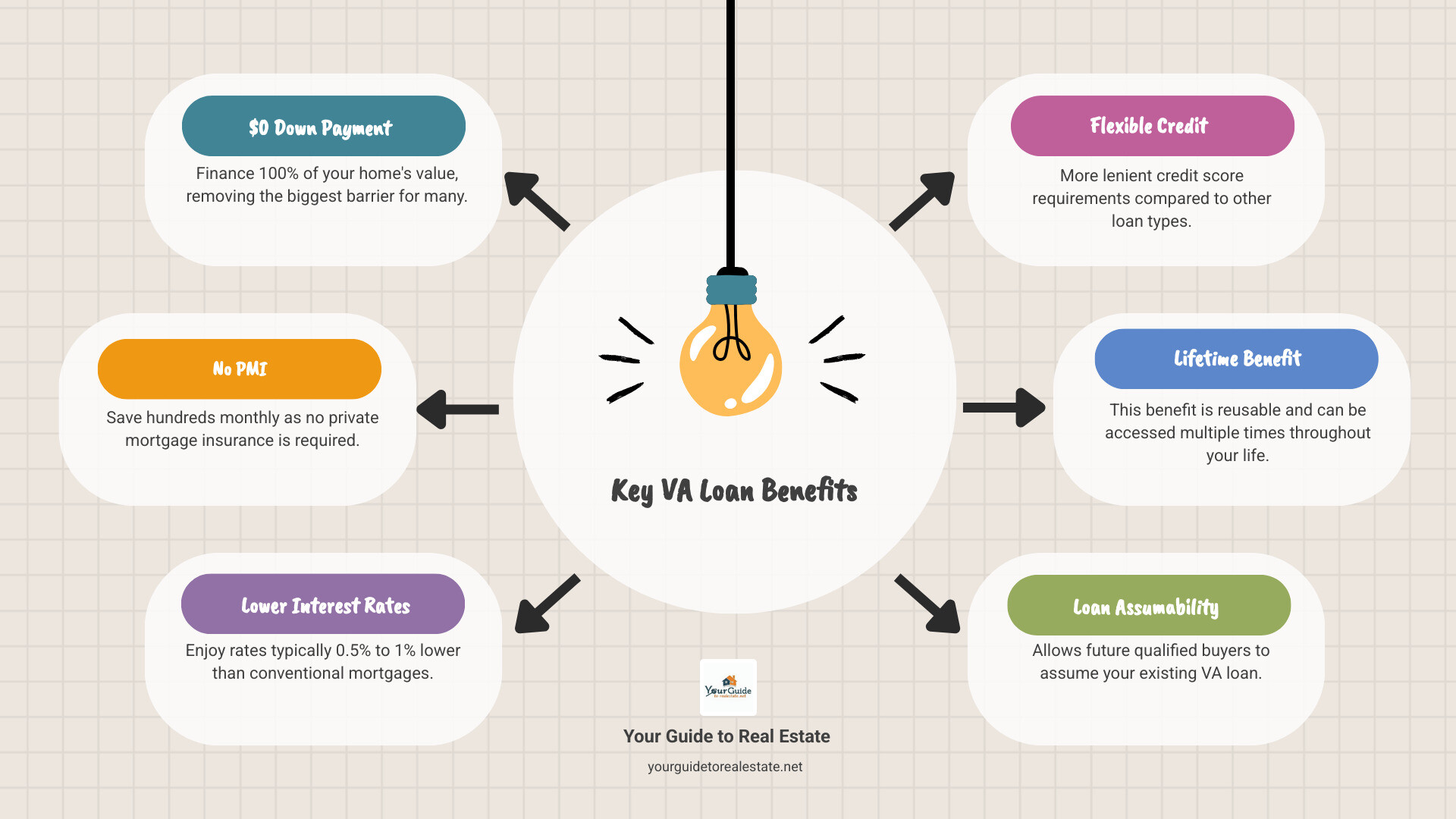
- $0 Down Payment Required: Finance 100% of your home’s value.
- No Private Mortgage Insurance (PMI): Save hundreds monthly compared to other loans.
- Lower Interest Rates: VA loans consistently offer the lowest average rates.
- Flexible Credit Requirements: More forgiving standards than conventional mortgages.
- Lifetime Benefit: Use the benefit multiple times.
- No Prepayment Penalties: Pay off your loan early without fees.
- Assumable by Future Buyers: Transfer your loan to a qualified buyer.
Statistics show that saving for a down payment is a major hurdle for aspiring homeowners. For eligible military members, veterans, and surviving spouses, VA loans eliminate this obstacle entirely.
These benefits translate to real savings. VA loans often have interest rates 0.5% to 1% lower than conventional mortgages, saving tens of thousands over the loan’s life. The absence of PMI can also reduce monthly payments by hundreds, significantly boosting your buying power.
The Core Financial Advantages of a VA Loan

When comparing VA loan benefits to conventional loans, the savings can be staggering—often tens of thousands of dollars over the life of the loan. While others save for years for a 20% down payment, a VA loan allows you to buy a home and start building equity immediately.
Primary Financial VA Loan Benefits
The no down payment feature is the most famous VA loan benefit. It allows you to finance 100% of the home’s purchase price, a life-changing advantage for military families who move often or young veterans starting their careers.
Another major benefit is no Private Mortgage Insurance (PMI). Conventional borrowers putting down less than 20% typically pay hundreds per month for PMI. Over a 30-year loan, this can add up to over $100,000 in payments that only protect the lender. With a VA loan, this cost is eliminated. To see how much PMI can cost, review our guide on Understanding Private Mortgage Insurance.
The competitively low interest rates on VA loans have been the lowest on the market for over a decade. A rate just 0.5% lower can save you $50,000 or more over 30 years. VA loans also feature limits on closing costs, as the VA prohibits lenders from charging certain fees, and sellers can often contribute to your costs.
| Loan Type | Down Payment | Mortgage Insurance | Typical Interest Rates |
|---|---|---|---|
| VA Loan | 0% | None | Lowest market rates (often 0.5-1% below conventional) |
| Conventional | 3-20%+ | PMI required if < 20% down | Market rates |
| FHA Loan | 3.5% minimum | Upfront + annual premiums | Generally higher than VA |
Flexible Financial Requirements
The financial flexibility of VA loan benefits extends beyond upfront costs, reflecting the VA’s understanding of unique military financial situations.
Lenient credit score requirements mean you don’t need perfect credit. While conventional loans often require scores of 680+, VA lenders frequently approve borrowers with scores in the 620s and sometimes lower if other financial factors are strong.
The VA also permits higher Debt-to-Income (DTI) ratios than most loans. Instead of a strict 43% DTI limit, VA guidelines are more flexible. The VA also considers residual income—the money left after monthly expenses—which provides a more realistic view of your ability to pay.
Finally, no prepayment penalties offer complete freedom. You can pay off your mortgage early, make extra payments, or refinance without incurring a fee. This flexibility is a rare and valuable feature.
For more insights on comparing different mortgage options, our guide on How to Compare Mortgages can help you understand all your choices.
Who Qualifies? Understanding Eligibility and How to Apply
Many people wonder if they qualify for VA loan benefits. The truth is that the program is more inclusive than most realize, designed to serve the entire military community as a lifetime benefit honoring their service.
Understanding Eligibility for VA Loan Benefits
Eligibility for VA loan benefits is based on your service record. The program is open to service members, veterans, and certain surviving spouses.
- Active-duty service members are typically eligible after 90 continuous days of service, allowing them to buy a home while still serving.
- Veterans generally need at least 90 days of active service during wartime or 181 days during peacetime.
- National Guard and Reserve members can also qualify, often after 90 continuous days of service following Initial Active Duty Training. Recent changes have expanded eligibility for those serving under specific Title 32 sections.
- Surviving spouses may be eligible if their spouse died in service or from a service-connected disability, though some rules regarding remarriage may apply.
Since eligibility rules can be detailed, it’s best to check the official source: Learn more about eligibility requirements.
The First Step: Your Certificate of Eligibility (COE)
Once you confirm your eligibility, the next step is obtaining your Certificate of Eligibility (COE). This official document proves to lenders that you have earned access to VA loan benefits by confirming your available entitlement.
Getting a COE is a streamlined process. Many VA-savvy lenders can pull your COE instantly through the VA’s automated system. You can also request it yourself through the VA’s eBenefits portal or by mail. The main required documentation for veterans is the DD214 (Certificate of Release or Discharge from Active Duty). Current service members will provide other documents verifying their service record.
Lender assistance is invaluable here. A lender specializing in VA loans can often handle the COE process for you, troubleshooting any issues that arise. To begin the process yourself, visit Get a Certificate of Eligibility (COE). With your COE, you can start house hunting with the confidence of having one of the nation’s best loan programs behind you.
A Deeper Dive into Key VA Loan Benefits and Features
Beyond the well-known VA loan benefits like zero down payment and no PMI, several other features provide significant long-term value and flexibility that conventional loans can’t match.
The VA Funding Fee: What It Is and Who Is Exempt
Most VA loans include a one-time VA funding fee. The purpose of the funding fee is to keep the program running for future service members without relying on taxpayer funding. This fee is typically rolled into the loan amount, so it’s not an out-of-pocket closing cost.
Fee percentages vary. For a first-time user with zero down, the fee is 2.15% of the loan amount, rising to 3.3% for subsequent use. However, making a down payment reduces this fee. A 5% down payment lowers the fee to 1.5%, and a 10% down payment drops it to 1.25%.
Crucially, many veterans qualify for funding fee exemptions. You are exempt if you receive VA compensation for a service-connected disability. This exemption also applies to Purple Heart recipients and eligible surviving spouses. This waiver can save you thousands of dollars. For complete details, see the VA’s page on the More on the VA funding fee.
Reusability and Assumability
A common myth is that VA loan benefits are a one-time deal. In reality, it is a lifetime benefit that you can use multiple times.
Using the benefit more than once is common for military families who move frequently. Your entitlement is restored automatically when you sell your home and pay off the VA loan. You can even have more than one VA loan at a time using second-tier entitlement, which may allow you to buy a new home while keeping a previous one as a rental.
Perhaps the most underrated feature is that VA loans are assumable. A qualified buyer—veteran or not—can take over your existing loan and its interest rate. In a high-rate environment, this is a powerful market advantage when selling. If you secured a low rate, a buyer assuming your loan inherits that great rate, making your home far more attractive.
Understanding these features is a key part of the Loan Process for Buying a House and shows how VA loan benefits provide value long after closing.
Navigating Different VA Loan Types and Support Programs
The VA loan benefits program is a long-term partner in your homeownership journey, offering specialized loans for various needs and a safety net for difficult times.
Types of VA Loans Available
The VA loan program offers several flexible options to fit your situation.
- VA Purchase Loan: This is the standard loan for buying a home, featuring zero down payment, no PMI, and competitive rates.
- Interest Rate Reduction Refinance Loan (IRRRL): Also known as a “VA Streamline,” this loan helps you refinance an existing VA loan to a lower interest rate. The process is faster and requires less paperwork than a typical refinance.
- Cash-Out Refinance: This option lets you tap into your home’s equity for cash to consolidate debt, pay for education, or fund home improvements. You can also use it to refinance a conventional loan into a VA loan.
- Native American Direct Loan (NADL): This program helps eligible Native American veterans buy, build, or improve homes on Federal Trust Land, with the VA acting as the direct lender.
- Adapted Housing Grants: These grants provide funding for veterans with certain permanent and total service-connected disabilities to buy, build, or modify a home to meet their accessibility needs.
For a deeper look at refinancing, our guide on Mortgage Refinancing Explained has more information.
Support When You Need It Most
A key feature of VA loan benefits is the VA’s commitment to helping you stay in your home. If you struggle with mortgage payments, the VA provides robust foreclosure avoidance assistance.
It is crucial to contact the VA early. Dedicated loan technicians can help you explore options like:
- Repayment plans to catch up on missed payments over time.
- Loan modifications to adjust your loan term or interest rate, making payments more manageable.
If keeping the home is not feasible, the VA can assist with a compromise sale to help you avoid foreclosure. The VA is also more forgiving after a foreclosure, with a typical waiting period of just two years to use your VA loan benefits again—much shorter than for conventional loans.
If you’re having trouble making payments, visit VA help to avoid foreclosures for immediate resources.
Potential Drawbacks and Special Considerations
While VA loan benefits are generous, they aren’t a perfect fit for every scenario. Understanding the program’s specific rules helps you make the best decision for your family.
What to Watch Out For
-
Primary Residence Requirement: The VA loan program is designed for homes you will live in, not for pure investment properties or vacation homes. You must intend to occupy the property as your primary residence. However, you can use a VA loan to buy a multi-unit property (up to four units) as long as you live in one of the units.
-
Seller Perceptions: Some sellers and agents hold outdated beliefs that VA loans are slow or complicated. In reality, VA loans close at similar rates to other loan types, especially with experienced professionals. A knowledgeable real estate agent can educate sellers on the strength of a VA-backed offer.
-
VA Appraisal and MPRs: The VA appraisal process includes a check for Minimum Property Requirements (MPRs). This is a key protection for the buyer. The appraiser ensures the home is safe, sound, and sanitary, checking for issues with the roof, electrical systems, and more. If a home fails to meet these standards, the seller must usually make repairs before closing. This prevents you from buying a property with significant safety or structural problems. For a full list, see the VA’s Learn about VA’s Minimum Property Requirements.
These points are not so much drawbacks as they are important considerations. Understanding the limitations of VA loan benefits makes you a smarter, more prepared homebuyer.
Frequently Asked Questions about VA Loans
Here are answers to some of the most common questions about VA loan benefits.
What are the VA loan benefits for sellers?
VA loan benefits also offer advantages to sellers. VA buyers are highly qualified, having already been vetted by the government for their Certificate of Eligibility. They often have steady, reliable income, leading to smoother transactions. The VA guarantee reduces risk for lenders, which can speed up processing. Furthermore, closing costs are negotiable, as sellers can contribute up to 4% of the loan amount to the buyer’s costs, providing valuable flexibility in negotiations. While some worry about VA appraisals, the process simply ensures the home is safe and sound, which is a benefit for all parties.
Can a Veteran use their VA loan benefit more than once?
Yes. A common misconception is that the VA loan is a one-time benefit, but it’s a lifetime benefit that can be used multiple times. Your entitlement can be restored after selling or paying off the loan. Typically, when you sell a home and pay off the VA loan, your full entitlement is restored for future use. It’s even possible to have more than one VA loan at a time by using your “second-tier entitlement,” which can allow you to buy a new home while retaining your previous one.
Are VA loans assumable by non-veterans?
Yes, VA loans can be assumed by anyone who qualifies financially, including non-veterans. The buyer simply needs to meet the lender’s credit and income standards. This is a major perk in a high-interest-rate environment, as the buyer inherits your loan’s original interest rate. This can make your home significantly more attractive than others on the market. It is crucial that the veteran must get a release of liability from the VA to ensure they are no longer legally responsible for the loan. This assumability feature can help you sell your home faster and for a better price.
Conclusion
The VA loan benefits program is our nation’s way of thanking those who have served. It offers a remarkable path to homeownership with no down payment, no PMI, and some of the market’s lowest interest rates. The benefits extend beyond initial savings, with flexible credit requirements, loan assumability, and lifetime reusability providing long-term financial security.
VA loan benefits make the dream of owning a home accessible. The program also provides support during difficult times, offering foreclosure prevention assistance to help veterans stay in their homes.
At Your Guide to Real Estate, we know buying a home can be overwhelming. Our proven framework is designed to remove stress from the process and guide you to success. We believe every veteran deserves to use these incredible benefits wisely.
Ready to learn more about your mortgage options? Our guide can help: Understanding Mortgages: A Beginner’s Guide to Home Loans.
Your service earned you these benefits. Let us help you use them.