

Understanding Stocks and Bonds: The Foundation of Your Portfolio
Navigating investments can feel complicated, but understanding the core difference between stocks and bonds is a crucial first step for any investor, whether you’re focused on real estate or diversifying your wealth. Simply put, here’s the main distinction:
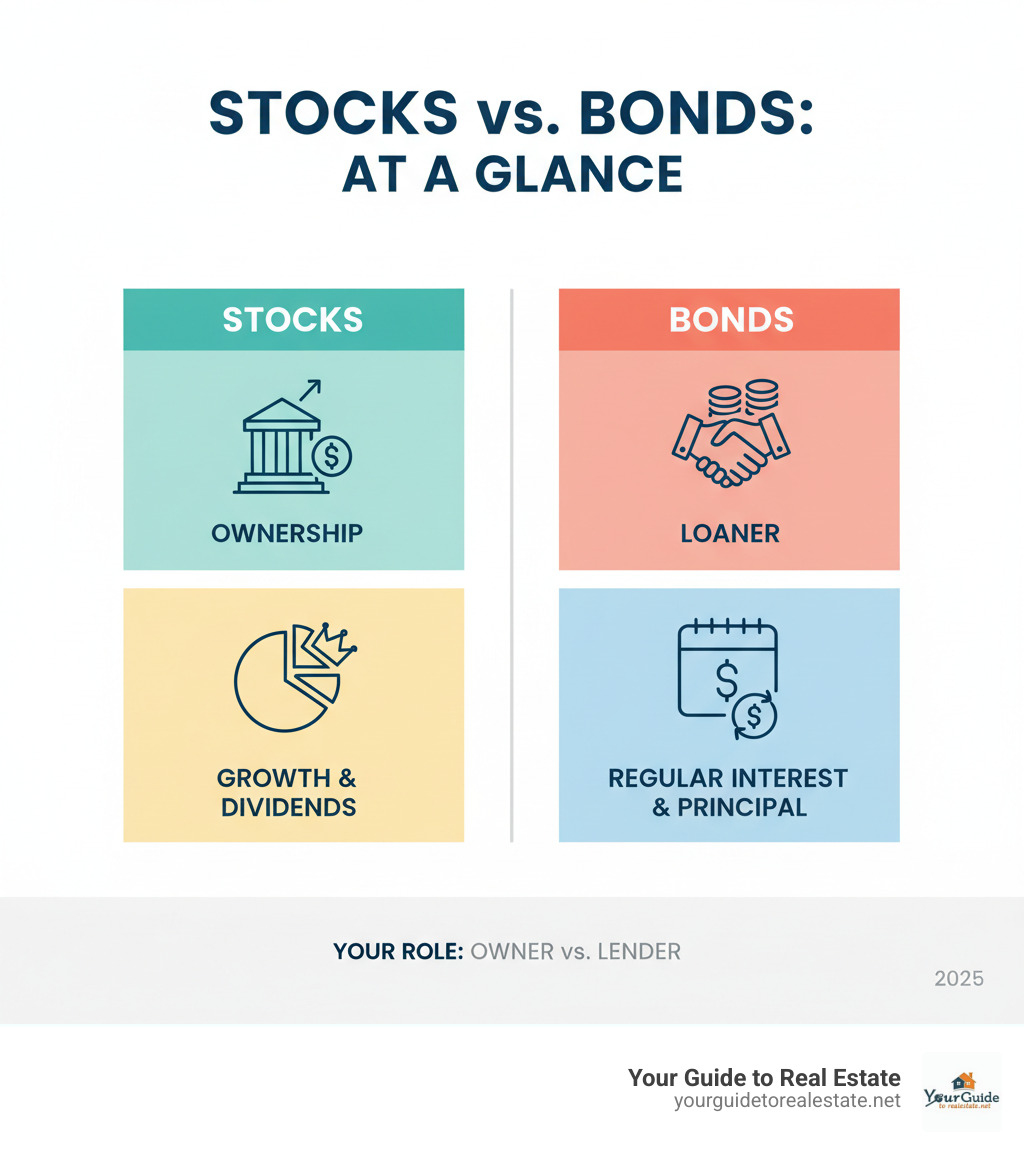
- Stocks: Represent ownership in a company. You buy a small “share” of that business. Your hope is that the company grows, increasing the value of your share, and sometimes you might receive a portion of their profits as dividends.
- Bonds: Represent a loan you make to a company or government. You become a creditor. In return for your loan, they promise to pay you back with regular interest payments and return your original investment (principal) by a specific date.
These two investment types are the building blocks of nearly every successful portfolio. Think of them as two key ways organizations raise money, but they offer you, the investor, very different roles and rewards. One makes you an owner, the other makes you a lender. Both have unique benefits and risks that impact your potential returns and overall financial stability.
Related content about difference between stocks and bonds:
The Core Difference Between Stocks and Bonds
Picture this: you walk into a coffee shop and see two investment opportunities. The owner offers to sell you part of the business, or you can lend them money to expand. That’s essentially the difference between stocks and bonds in a nutshell – one makes you an owner, the other makes you a lender.
At Your Guide to Real Estate, we’ve seen how this fundamental distinction shapes every aspect of your investment experience. Just like choosing between buying rental property or lending money for a mortgage, understanding whether you’re taking an ownership or creditor position changes everything about your risk, returns, and rights.
| Feature | Stocks | Bonds |
|---|---|---|
| Relationship | Ownership (Equity) | Lending (Debt) |
| Return Potential | High (Capital Gains, Dividends) | Moderate/Low (Fixed Interest Payments) |
| Risk Level | High (Volatility, Market & Company Risk) | Lower (Interest Rate, Credit, Inflation Risk) |
| Investor Rights | Voting rights, Claim on residual assets | No voting rights, Fixed payments, Priority claim |
| Liquidation | Last claim on assets | Higher claim on assets |
| Maturity | None (indefinite ownership) | Fixed maturity date (principal repaid) |
Ownership vs. Lending
When you buy stock, you’re literally buying a piece of a company. Think of it like purchasing a slice of your favorite pizza – you now own that slice, and if the pizza becomes more valuable (maybe it’s made with truffle oil!), your slice becomes worth more too.
Companies sell these shares to raise money for growth, new products, or expansion. As a shareholder, you’re betting on the company’s future success. If they do well, your shares might increase in value, giving you a capital gain when you sell. Some companies even share their profits with you through dividends – it’s like getting a bonus for being a good business partner.
Bonds work completely differently. When you buy a bond, you’re essentially handing someone an IOU – except you’re the one doing the lending. You give money to a company or government, and they promise to pay you back with interest over time. It’s like being the bank instead of the borrower.
The bond issuer pays you regular interest payments (called coupon payments) throughout the life of the bond. When the bond reaches its maturity date, they return your original investment – the principal. You’re not hoping for explosive growth here; you’re looking for steady, predictable income. The Official definition of bonds provides more technical details if you’re curious.
Investor Rights and Priority
Here’s where the difference between stocks and bonds gets really interesting – your rights as an investor change dramatically based on which side of the fence you’re on.
As a stockholder, you get a voice in how the company runs. You can vote on important decisions, elect board members, and even attend those annual shareholder meetings (though let’s be honest, they’re usually about as exciting as watching paint dry). You also have access to company records and financial information.
But here’s the catch – if the company goes belly-up, stockholders are last in line for any remaining assets. It’s like being the last person at a buffet; you might get something, but don’t count on the good stuff still being there.
Bondholders have a completely different experience. You don’t get voting rights or a say in company operations – after all, you’re just the lender, not the owner. Your main rights revolve around getting those promised interest payments and your principal back at maturity.
The silver lining? If the company faces bankruptcy, bondholders get paid before stockholders. You’re essentially first in line at that metaphorical buffet. This priority makes bonds generally safer for investors who value capital preservation over growth potential.
Main Types of Stocks and Bonds
The investment world offers various flavors of both stocks and bonds, each with its own risk-return profile.
Common stock is what most people think of when they hear “stock.” It comes with voting rights and the potential for significant gains (or losses). Preferred stock is like the middle child – it typically doesn’t have voting rights, but preferred shareholders receive fixed dividends before common stockholders and have a higher claim on assets during liquidation.
You’ll also encounter stocks categorized by company size: small-cap companies (under $2 billion market value) offer growth potential but higher risk, mid-cap companies ($2-10 billion) provide a balance of growth and stability, and large-cap companies (over $10 billion) are typically established giants that often pay steady dividends.
Government bonds are considered the safest option – after all, countries rarely go out of business. Treasury bills, notes, and bonds differ mainly in their time to maturity, from a few months to 30 years. Municipal bonds are issued by state and local governments, often offering tax advantages that make them attractive to higher-income investors.
Corporate bonds carry more risk than government bonds but typically offer higher returns. They range from investment-grade bonds issued by stable companies to high-yield bonds (sometimes called junk bonds) from riskier companies that compensate investors with higher interest rates.
Understanding these options helps you build a portfolio that matches your goals and risk tolerance. For more detailed explanations of investment terminology, check out our guide on stock market terminology.
How Stocks and Bonds Generate Returns and Involve Risk
When we talk about investing, it’s all about finding that sweet spot between making money and managing risk. The difference between stocks and bonds becomes crystal clear when you look at how each one puts your money to work—and what could go wrong along the way.

Generating Returns: Growth vs. Income
Think of stocks and bonds as two completely different approaches to growing your wealth. It’s like comparing a fruit tree that might give you amazing harvests some years (but terrible ones in others) versus a savings account that pays you the same amount every month.
Stocks are all about potential and possibility. Your money grows in two main ways: capital appreciation happens when your stock’s price goes up, letting you sell for more than you paid. We’ve all heard those amazing stories about early Amazon or Apple investors who saw their investments multiply many times over. Then there are dividends—think of these as your share of the company’s profits. Not all companies pay them, but when they do, it’s like getting a regular paycheck just for being an owner.
Bonds work more like being the neighborhood banker. You get coupon payments, which are just fancy words for the regular interest payments the borrower sends you. Let’s say you buy a $2,500 bond paying 2% annually for 10 years. You’d receive $50 every year in interest payments, totaling $500 over the bond’s life. At the end of those 10 years, you get your original $2,500 back through principal repayment. It’s predictable, which can be pretty comforting.
Sometimes bonds can surprise you with extra profits if interest rates drop after you buy them—your bond becomes more valuable because it pays better than newer bonds. This concept ties into Yield to maturity, which looks at your total return over the bond’s entire life.
The Risk-Return Spectrum
Here’s where the difference between stocks and bonds gets really interesting. It’s like choosing between a roller coaster and a gentle train ride—both will get you somewhere, but the experience is completely different.
Stock investments are the roller coaster of the investment world. They can swing wildly based on company news, industry changes, economic shifts, or even global events that seem totally unrelated to your investment. This volatility means you could lose money, sometimes a lot of it, in a short time. But here’s the flip side—stocks have historically delivered about 10% average annual returns over the long term. That higher potential reward comes with accepting that your portfolio might feel like it’s on a wild ride.
Bond investments are more like that steady train ride. They’re generally calmer and more predictable, but they face their own unique challenges. Interest rate risk is the big one—when interest rates go up, your existing bonds become less attractive because new bonds pay more. It’s like trying to sell your car right after the newer model comes out. Credit risk means the borrower might not pay you back (think of it as lending money to a friend who’s bad with finances). Inflation risk is sneaky—even if you get your money back, it might not buy as much as it used to.
Bonds have historically returned around 6% annually on average. Lower than stocks, but with much less drama along the way.
Key Tax Difference Between Stocks and Bonds
Nobody likes talking about taxes, but they can seriously impact how much money you actually keep from your investments. The tax treatment shows another important difference between stocks and bonds.
With stocks, timing matters a lot. If you sell a stock within a year of buying it, those profits get taxed as short-term capital gains at your regular income tax rate. Hold it longer than a year, and you qualify for long-term capital gains rates, which are usually much lower. If your income puts you in the 10-15% tax bracket, you might even pay zero percent on long-term gains. Dividend payments from stocks also get taxed, though qualified dividends often get that same favorable long-term capital gains treatment.
Bonds are typically less tax-friendly. Most bond interest gets taxed as ordinary income, meaning it’s added to your regular income and taxed at whatever rate applies to your total income. But here’s where bonds get interesting: municipal bonds often provide tax-free interest at the federal level, and sometimes at state and local levels too if you live in the issuing state. U.S. Treasury bonds give you a break on state and local taxes, though you’ll still owe federal taxes on the interest.
One quirky thing about bonds: if you own zero-coupon bonds, you might owe taxes each year on interest you haven’t even received yet. It’s called “phantom income,” and it can be an unpleasant surprise if you’re not prepared for it.
Understanding these tax implications helps you make smarter decisions about which investments belong in regular accounts versus tax-advantaged retirement accounts. As always, we recommend chatting with a tax professional to see how these rules apply to your specific situation.
Building a Balanced Portfolio with Stocks and Bonds
At Your Guide to Real Estate, we often talk about how real estate can be a truly powerful investment. But even for those of us who love properties, a smart financial plan usually includes a mix of other assets too. This is where truly grasping the difference between stocks and bonds becomes super important. It helps you build a well-rounded portfolio that can stand strong no matter what the market does.
The Power of Diversification
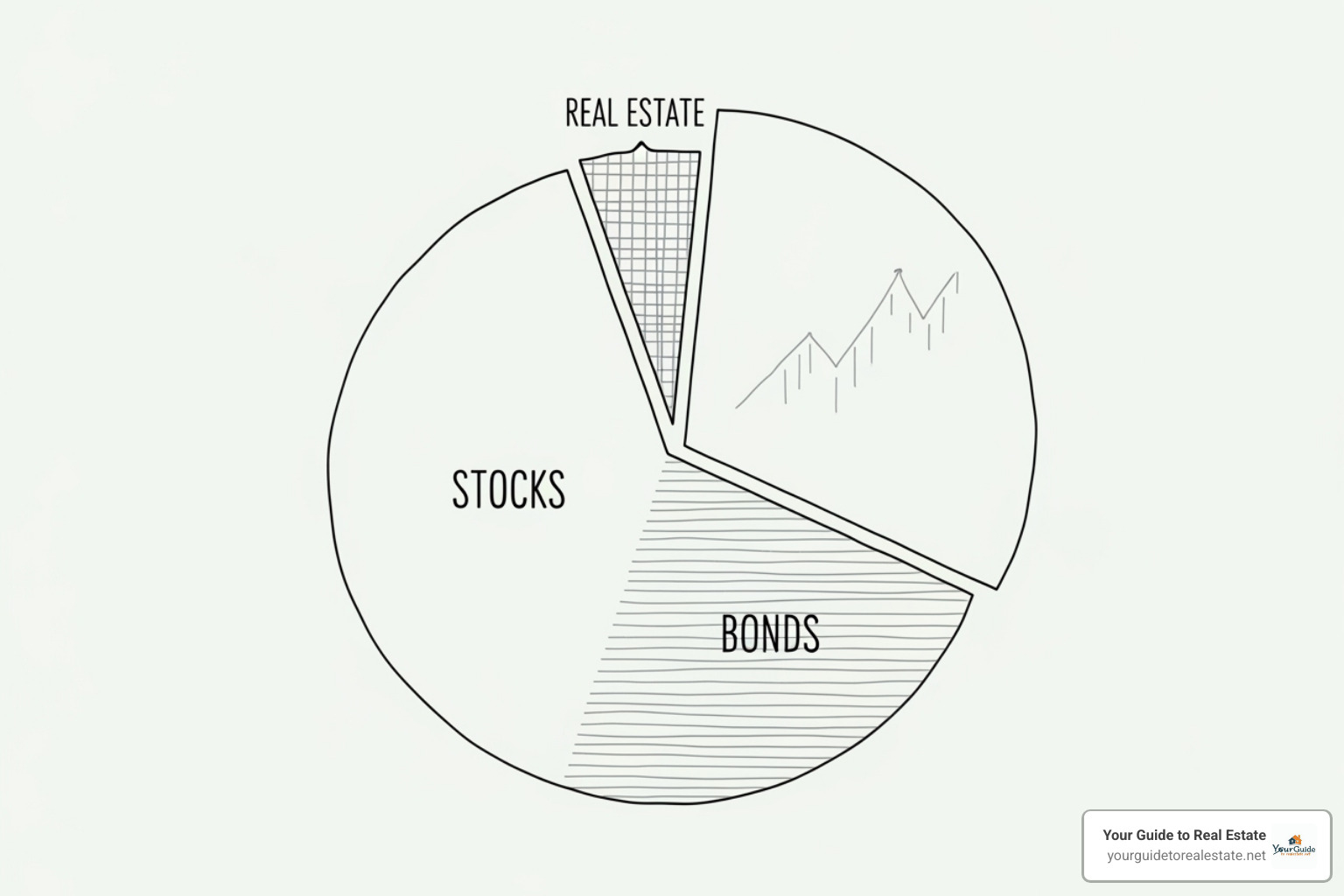
Think of diversification as your investment superpower! It’s simply about spreading your money around different types of investments. You put money into various assets, different industries, and even different parts of the world. Why do this? To lower your overall risk, of course!
The real magic happens when you combine stocks and bonds. They often act like a seesaw. Historically, when stocks are doing great and their prices go up, bonds might become less popular, so their prices tend to dip. But when stocks take a hit and prices fall, people often rush to bonds looking for a safer place for their money. This can make bond prices go up. This “negative correlation” helps your portfolio stay steadier. It’s like having a cushion during those bumpy market times.
For example, a portfolio made only of stocks is almost twice as likely to end the year with a loss compared to one made only of bonds. By mixing them, you can smooth out those ups and downs. You still aim for good growth, but you also guard against big drops. As the old saying goes, Diversification reduces risk. It’s a simple idea that can make a huge difference.
Understanding the difference between stocks and bonds for your portfolio
Deciding on the “perfect mix” of stocks and bonds in your own portfolio is a very personal choice. There’s no one-size-fits-all answer. Instead, it really depends on a few key things about you and your money journey.
First, consider your investment goals. Are you saving up for a big short-term purchase, like a down payment on a property in Dallas? Or is your eye on a long-term goal, like retirement many years away? Your goals will shape how much risk you’re willing to take.
Next, think about your time horizon. If you’re a younger investor, perhaps just starting your career in Oklahoma City, you likely have decades until retirement. This means you have more time to recover from any market dips. Because of this longer runway, you can usually afford to put more of your money into stocks, which offer higher growth potential.
Finally, how comfortable are you with ups and downs? This is your risk tolerance. If watching your investments swing wildly keeps you awake at night, then adding more bonds to your portfolio might be a better fit. Bonds generally offer more stability and can help you sleep soundly.
A classic guideline for mixing stocks and bonds is the “100 minus your age” rule for your stock allocation. So, a 30-year-old might aim for 70% stocks and 30% bonds. Today, with people living longer, some experts suggest “110 or even 120 minus your age” for stocks. This takes into account longer retirement periods and the ease of investing in low-cost index funds.
In short, stocks are generally your go-to for long-term growth and building wealth over time. Bonds, on the other hand, are valued for keeping your money safe and giving you a steady stream of income. And for those looking to spread their investments even further, learning How to Invest in Real Estate can be another fantastic way to diversify and grow your wealth.
Frequently Asked Questions about Stocks and Bonds
It’s completely normal to have questions when you’re navigating investing. We hear these questions often, and we’re always happy to offer clear, straightforward answers to help you feel more confident about your financial journey.
Which is a better investment, a stock or a bond?
This is a fantastic question, and one we get all the time! The truth is, neither stock nor bond is inherently “better” than the other. Instead, think of them as two different tools in your financial toolkit, each designed for a specific job. The “best” choice for you truly depends on your personal financial goals, how comfortable you are with risk, and how long you plan to invest your money.
For instance, if you have a long-term goal, like saving for retirement many years down the road, and you’re okay with some ups and downs along the way, stocks might be a great fit. They offer the potential for higher growth over time. On the other hand, if your priority is to protect your money, generate a steady income, or save for a shorter-term goal like a down payment on a property, then bonds might be more suitable. They tend to offer more stability and predictability.
Many smart investors actually combine both stocks and bonds in their portfolio. This balanced approach often helps to blend the growth potential of stocks with the steady, risk-reducing nature of bonds. It’s all about finding the right mix for you!
Can you lose money on bonds?
That’s a really important question, and the simple answer is: yes, you absolutely can lose money on bonds. While bonds are often seen as a safer bet than stocks, they aren’t completely without risk. It’s crucial to understand these potential pitfalls:
- Interest Rate Risk: Imagine you buy a bond that pays 3% interest. If new bonds come out later paying 5% because overall interest rates have gone up, your 3% bond suddenly looks less appealing. If you needed to sell your bond before it matures, you might have to sell it for less than you paid to attract a buyer.
- Credit Risk (or Default Risk): This is the risk that the organization you lent money to – whether it’s a company or a government – might not be able to pay you back. This could mean they miss interest payments or even fail to return your original investment. This risk is higher with corporate bonds, especially those from less financially stable companies.
- Inflation Risk: Over time, inflation (when prices go up) can quietly chip away at the purchasing power of your bond’s fixed interest payments and the principal you get back. Even if you get all your money back, it might not buy as much as it used to.
- Liquidity Risk: Some bonds, especially those from smaller issuers or with unique terms, aren’t traded as often. This means it might be hard to sell them quickly without having to accept a lower price.
So, while bonds generally offer more stability, it’s wise to be aware of these risks and how they might affect your investment.
How can a beginner start investing in stocks and bonds?
Starting your investment journey can feel exciting, and thankfully, it doesn’t have to be complicated! We recommend a few straightforward paths for beginners to get started with both stocks and bonds:
- Open a Brokerage Account: This is your first step, like opening a bank account for investments. You can easily set one up with an online brokerage firm. This account will be your hub for buying and selling investments.
- Invest in Mutual Funds: Instead of trying to pick individual stocks or bonds, which can be tricky, you can invest in mutual funds. These funds pool money from many investors to buy a professionally managed, diversified collection of stocks, bonds, or a mix of both. It’s like having a pro pick and manage a basket of investments for you.
- Consider Exchange-Traded Funds (ETFs): Similar to mutual funds, ETFs also gather money to invest in a diverse group of assets. The key difference between stocks and bonds in this context is that ETFs trade throughout the day on stock exchanges, just like individual stocks. They often come with lower fees than actively managed mutual funds and can give you broad exposure to many different stocks and bonds at once. You can find more information on ETFs explained.
- Explore Target-Date Funds: These are especially great for long-term goals like retirement. A target-date fund automatically adjusts its mix of stocks and bonds over time, becoming more conservative (meaning more bonds and fewer stocks) as you get closer to your chosen retirement date. It’s a hands-off way to manage your portfolio’s risk level.
No matter which path you choose, remember to start small, truly understand what you’re putting your money into, and try to contribute consistently. Every little bit adds up!
Conclusion
Phew! We’ve covered a lot of ground, haven’t we? Understanding the fundamental difference between stocks and bonds isn’t just financial jargon; it’s truly the bedrock for making smart investment decisions. We’ve seen that these two main investment types, while often talked about together, offer very distinct paths for your money.
To sum it up, think of it this way: stocks make you an owner. They offer the exciting potential for significant growth and wealth accumulation, letting you share in a company’s success (and sometimes even vote on its direction!). But with that thrilling ride comes higher risk and, should things go south, a lower priority when assets are distributed. On the other hand, bonds make you a lender. They’re often about providing stable income through regular interest payments and the predictable return of your principal. While generally offering lower returns, they bring a sense of stability, peace of mind, and a higher claim to assets if a company faces trouble.
The real magic happens when you realize these aren’t opposing forces but rather complementary partners in your financial journey. A balanced approach to your portfolio, combining stocks and bonds, allows you to harness the growth potential of stocks while enjoying the stability and income that bonds provide. It’s like having both the accelerator and the brake in your investment vehicle! The right mix for you will always depend on your unique risk tolerance, your investment goals, and how long you plan to invest.
At Your Guide to Real Estate, our mission is to provide stress-free guidance, and that extends beyond just property. We believe that a solid foundation in financial planning – including understanding how different assets like stocks and bonds work – empowers you to make confident decisions for your future, whether you’re dreaming of a new home or building your retirement nest egg.
As you continue on your financial journey, knowledge truly is power. And whether you’re navigating the stock market or exploring real estate opportunities, we’re here to help light the way. For more insights into managing your finances and achieving your goals, consider reading our guide on Understanding Mortgages: A Beginner’s Guide to Home Loans.