

Major Victory for Public Service Retirees: What You Need to Know
The social security fairness act update brings life-changing news for millions of public service workers. President Biden signed the Social Security Fairness Act into law on January 5, 2025, officially ending two provisions that unfairly reduced benefits for teachers, firefighters, police officers, and other government employees.
Key Updates at a Glance:
- What Changed: The Windfall Elimination Provision (WEP) and Government Pension Offset (GPO) are now eliminated
- Who Benefits: Nearly 3 million public service retirees and their surviving spouses
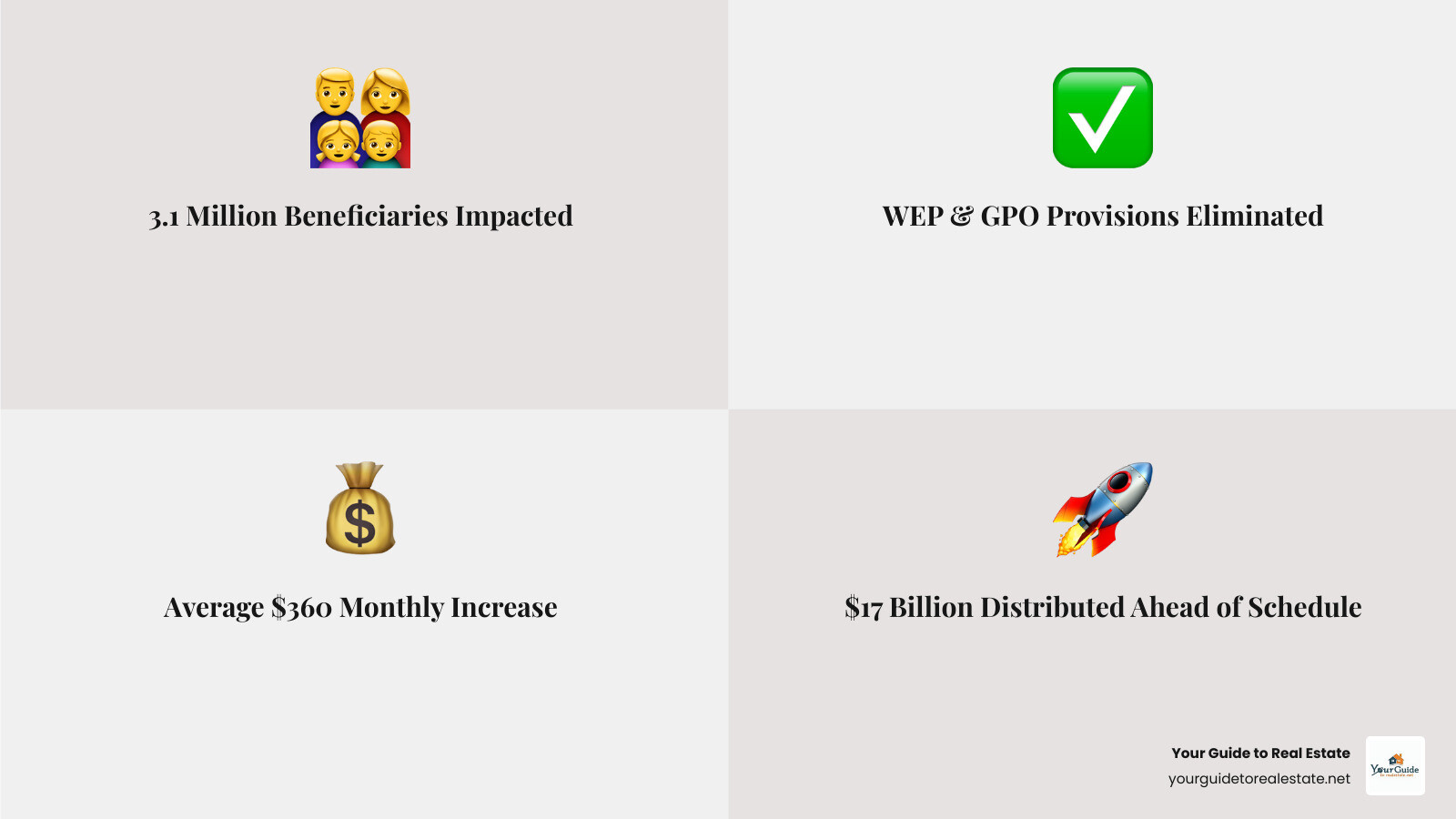
- Financial Impact: Average monthly increase of $360, with some receiving over $1,000 more
- Timeline: Retroactive to January 2024, with $17 billion already distributed
- Action Required: Most current beneficiaries need to do nothing; new applicants should apply online
The implementation has been remarkably swift. As SSA announced in July 2025, they completed sending over 3.1 million payments totaling $17 billion to eligible beneficiaries – five months ahead of schedule.
For decades, public servants faced an impossible choice: serve their communities through teaching, firefighting, or law enforcement, but sacrifice their full Social Security benefits. That era is now over.
This financial relief comes at a crucial time when many retirees are reconsidering their housing and investment strategies. With hundreds of additional dollars flowing into monthly budgets, the landscape of retirement planning – including real estate decisions – is shifting dramatically.
Social security fairness act update terms to know:
- what changes are coming to social security in 2025
- monthly dividend stocks
- i make $70,000 a year how much house can i afford
What is the Social Security Fairness Act (SSFA)?

After decades of advocacy, the Social Security Fairness Act update finally became reality when President Biden signed H.R. 82 into law on January 5, 2025. This groundbreaking legislation tackles a problem that had frustrated public servants for over forty years.
The heart of the SSFA is simple: it eliminates two unfair penalties that slashed Social Security benefits for millions of dedicated public servants. Teachers who shaped young minds, firefighters who ran toward danger, and police officers who protected our communities had been penalized simply for choosing careers in public service.
These workers often had no choice in their pension systems. They served their communities faithfully, yet faced reduced Social Security benefits even when they paid into the system through other jobs. The legislative journey to fix this injustice was long, but persistence finally paid off.
If you want to dive deeper into the legal details, you can read the full text of the Act directly from Congress. But the bottom line is clear: this law restores fairness to a system that had left public servants behind.
The Unfair Penalties: WEP and GPO Explained
To understand why this social security fairness act update matters so much, you need to know about the two provisions it eliminated. The Windfall Elimination Provision (WEP) and Government Pension Offset (GPO) were created in the 1970s and 1980s with good intentions, but they caused decades of financial hardship for public servants.
WEP hit retirement benefits hard. If you worked as a teacher, firefighter, or other government employee in non-covered employment (jobs where you didn’t pay Social Security taxes), WEP could slash your Social Security retirement benefits by up to $613 per month in 2025. This happened even if you paid into Social Security through other jobs during your career.
The math was brutal: WEP reduced your benefit by the lesser of 50% of your government pension or that maximum dollar amount. Many retirees finded this nasty surprise only when they applied for benefits, learning that decades of Social Security contributions wouldn’t provide the security they’d counted on.
GPO was even more devastating for surviving spouses. This provision reduced spousal and survivor benefits by two-thirds of your government pension amount. For many widows and widowers, this meant losing their entire survivor benefit – often their main source of income after losing their partner.
Picture this: you’re a retired teacher whose spouse passes away. You’re grieving and worried about finances, only to find that your teacher’s pension eliminates the Social Security survivor benefits you thought would help you through this difficult time. That’s the reality GPO created for countless families.
These weren’t minor adjustments – they were life-changing reductions that forced many public servants into financial hardship during retirement. The decades-long fight to eliminate these unfair penalties finally succeeded, bringing relief to nearly 3 million beneficiaries who had been caught in this bureaucratic trap.
Who Benefits and What is the Financial Impact?
The social security fairness act update brings relief to a very specific group of hardworking Americans who’ve been waiting decades for this moment. If you’re wondering whether you might be among those benefiting, the answer lies in whether your Social Security benefits were previously reduced or eliminated by those troublesome WEP and GPO provisions we discussed earlier.
Teachers who dedicated their careers to educating our children are finally getting their due. Firefighters who risked their lives protecting our communities can breathe a sigh of relief. Police officers who kept our streets safe are seeing their financial security restored. These public servants, along with other state and local government employees who receive pensions from work not covered by Social Security, make up the largest group of beneficiaries.
CSRS employees – those federal workers covered by the Civil Service Retirement System, including some postal workers – are also seeing their benefits restored. Additionally, individuals whose work was covered by foreign social security systems and had their U.S. benefits affected are now getting fair treatment.
Perhaps most importantly, surviving spouses who were hit hardest by these provisions are finally getting the support they deserve. Imagine losing your partner and then finding that your government pension wiped out your Social Security survivor benefits entirely. That heartbreaking scenario is now a thing of the past.

Now, here’s an important distinction: not every public worker will see an increase. If you receive a pension from work that was covered by Social Security – meaning you paid Social Security taxes on those earnings – you weren’t affected by WEP or GPO in the first place. About 72% of state and local public employees already work in Social Security-covered employment, so they won’t see changes from this law.
The financial impact is truly life-changing. We’re talking about an average increase of $360 per month in Social Security benefits. That’s real money that can cover groceries, utilities, or medical expenses that many retirees struggle to afford.
For some beneficiaries, especially surviving spouses who were severely impacted by the GPO, the increase can be even more dramatic – over $1,000 more each month! This isn’t just pocket change; it’s the difference between scraping by and having genuine financial security in retirement.
What makes this even better is that the repeal is retroactive to January 2024. This means eligible individuals are receiving substantial lump-sum payments covering more than a year of “back pay.” For many, this unexpected windfall has provided immediate relief and financial breathing room.
If you’re wondering whether you qualify, don’t guess – get the facts. Learn more about who will benefit directly from the Social Security Administration’s official resources.
By the Numbers: A Look at the Financial Boost
The numbers behind this social security fairness act update tell an incredible story of government efficiency and massive financial relief. When the SSFA became law, approximately 2.8 million current Social Security beneficiaries were getting reduced benefits because of WEP or GPO. That’s nearly 3 million retired public service workers and their surviving spouses who suddenly had reason to celebrate.
Here’s where it gets impressive: the Social Security Administration didn’t just promise action – they delivered. By July 7, 2025, the SSA had completed sending over 3.1 million payments totaling an astounding $17 billion to eligible beneficiaries. Even more remarkable? They finished this massive undertaking five months ahead of schedule. When was the last time you heard about a government program finishing early?
The $360 average monthly increase might not sound earth-shattering until you think about what it means over time. That’s $4,320 more per year, every year, for the rest of your retirement. For some beneficiaries receiving over $1,000 more monthly, we’re talking about an additional $12,000+ annually.
The retroactive payments have been particularly meaningful. Since the repeal covers benefits from January 2024 forward, many people received lump sums of several thousand dollars – money they never expected to see but rightfully earned through their years of public service.
There’s another encouraging trend worth mentioning: the SSA has received over 278,000 new claims from people with pensions from non-covered work since the law passed. This suggests many individuals who previously didn’t bother applying – knowing their benefits would be reduced or eliminated – are now claiming what they’ve earned.
This financial boost is changing retirement planning for millions of Americans. With hundreds of extra dollars flowing into monthly budgets, many retirees are reconsidering their housing situations and investment strategies. If you’re among those benefiting and thinking about how this affects your real estate options, our Understanding Mortgages: A Beginner’s Guide to Home Loans can help you explore your new possibilities.
The Social Security Fairness Act isn’t just about numbers on a statement – it’s about restoring dignity and financial security to those who spent their careers serving others.
The Official Social Security Fairness Act Update: Implementation and Timeline
The rollout of the social security fairness act update has been nothing short of impressive. When President Biden signed the Act into law on January 5, 2025, the Social Security Administration faced a massive challenge: how do you process benefit adjustments for nearly 3 million people while handling thousands of new applications?
The answer turned out to be “faster than anyone expected.”
The repeal of WEP and GPO became effective for benefits payable starting January 2024, which means December 2023 was the last month these unfair provisions applied. The SSA kicked into high gear on February 25, 2025, when they began adjusting benefits and issuing payments. By April 2025, most affected beneficiaries were already seeing their higher monthly benefit amounts appear in their accounts (covering their March 2025 benefit), along with substantial lump-sum payments covering the increases back to January 2024.
Here’s where it gets really exciting: SSA recently announced a key milestone on July 7, 2025, revealing they had completed sending over 3.1 million payments totaling $17 billion to eligible beneficiaries. The kicker? They finished this monumental task five months ahead of their original schedule. That’s government efficiency at its finest!
For new applications filed since the SSFA became law, the progress has been equally remarkable. By mid-July 2025, the SSA had received nearly 290,000 new applications and completed 92% of them. While some complex cases involving intricate work histories might take up to a year to fully process due to limited resources, the vast majority of beneficiaries have already received their financial relief.
What Beneficiaries Need to Do: A social security fairness act update on actions
The beauty of this social security fairness act update is that for most people, the hardest part is… doing nothing at all.
If you’re already receiving Social Security benefits that were reduced by WEP or GPO, congratulations – you’re in the easy category. The SSA automatically recalculated your benefits and issued your retroactive payments. Your monthly benefit amount has already been adjusted upward. The only thing we recommend is double-checking that the SSA has your correct mailing address and direct deposit information. You can verify this through your ‘my Social Security’ account online or by calling 1-800-772-1213.
If you never applied for Social Security benefits because of WEP or GPO, this is your moment to act. Many people avoided applying for retirement, spouse’s, or survivor benefits knowing they’d be reduced or eliminated. Now that these penalties are gone, you need to file your claim to start receiving your full benefits.
For retirement or spouse’s benefits, the process is straightforward. You can apply online for retirement or spouse’s benefits at www.ssa.gov/apply. When applying for spouse’s benefits, make sure to select ‘Family Benefits’ so you’re considered for all eligible benefits. Don’t worry if the online application still asks about your pension – the SSA won’t offset your benefit anymore.
Survivor benefits require a phone call or office visit since you can’t file online. Call the SSA at 1-800-772-1213 (Monday–Friday, 9 a.m.–6 p.m. ET) or visit your local Social Security office.
Here’s the important part about timing: retroactive payments for new applications are generally limited to six months before the month you file your application. Every month you delay could mean missing out on rightful back pay. If you encounter any confusion at your local SSA office, ask for a note to be added to your record documenting your attempt to apply, and request written confirmation. Don’t hesitate to ask for a supervisor if needed.
How the SSFA Affects Future Applicants
The social security fairness act update has completely rewritten the retirement playbook for future applicants. If you’re a public sector worker, federal employee covered by CSRS, or anyone who would have been affected by WEP or GPO, your entire Social Security strategy just got a major upgrade.
Your benefits will now be calculated fairly. Without WEP, your Social Security benefit reflects your actual covered earnings, just like everyone else. No more arbitrary reductions. If you’re eligible for spousal or survivor benefits, those will be paid in full without the GPO penalty that previously devastated so many families.
This change opens up entirely new possibilities for claiming strategies. Previously, some people claimed benefits at suboptimal times or skipped applying altogether because they knew their benefits would be slashed. Now you can make decisions based purely on maximizing your benefit and fitting your financial goals.
Want to delay benefits until age 70 for those delayed retirement credits? Go for it – you’ll actually get the full increased amount. Thinking about claiming spousal benefits while letting your own benefit grow? That strategy might actually work now. The decision of when to claim Social Security can be made without the distortion of these unfair penalties.
For many future retirees, this increased financial certainty will influence major life decisions. Maybe you’ll retire a bit earlier knowing your full Social Security benefit is secure. Perhaps you’ll consider that dream home purchase with confidence in your retirement income. These individual financial improvements can have broader economic effects, which is why we keep a close eye on trends like those outlined in our Real Estate Market Projections for 2025: Key Numbers to Watch. After all, when millions of retirees suddenly have hundreds more dollars each month, that money flows through the entire economy.
Broader Implications and Potential Pitfalls
While the social security fairness act update brings wonderful news for millions of public servants, it’s important to understand the full picture. Like most good things in life, increased benefits can sometimes create unexpected ripple effects on your overall financial situation.
Think of it this way: when you suddenly have more income, other parts of your financial life might shift too. It’s not necessarily bad news, but being prepared helps you make the best decisions for your situation.
Impact on Taxes and Medicare Premiums
The extra money flowing into your bank account each month is real and meaningful. However, Uncle Sam and Medicare might want their share of attention too.
Your tax situation could change with higher Social Security benefits. If your total income crosses certain thresholds, you might find that more of your Social Security becomes subject to federal income tax. Depending on your overall income, up to 85% of your benefits could become taxable. It’s one of those “good problems to have,” but still worth planning for. A qualified tax professional can help you understand exactly how this affects your specific situation.
Medicare premiums might increase for some higher-income beneficiaries through something called IRMAA (Income-Related Monthly Adjustment Amount). If your modified adjusted gross income exceeds certain levels, you’ll pay higher premiums for Medicare Part B and Part D. This doesn’t affect most people, but it’s worth keeping on your radar. A financial advisor can help you steer these waters.
Medicare payment logistics need some attention too. If you were previously paying Medicare premiums directly to the Centers for Medicare & Medicaid Services because your Social Security benefits were too small due to WEP or GPO, you’ll need to make some adjustments. Keep paying directly until you receive an official notice from the SSA. Once your benefits are adjusted, premiums will typically be deducted automatically from your Social Security payment. If you use Medicare Easy Pay or your bank’s bill payment service, remember to stop those direct payments to avoid paying twice. Any overpaid premiums will be refunded through your back payments or at the end of the calendar quarter.
Avoiding Scams Related to the SSFA
Unfortunately, whenever there’s big news about Social Security, scammers come crawling out of the woodwork. They see an opportunity to prey on people’s excitement and confusion about changes to their benefits.
Here’s the golden rule: the Social Security Administration will never ask you for money to increase or start your benefits. Not ever. If someone contacts you asking for payment, gift cards, or personal financial information like bank account numbers or Social Security numbers in exchange for securing your SSFA benefits, hang up immediately. It’s a scam, plain and simple.
Legitimate communication from the SSA comes through official mail, your ‘my Social Security’ online account, or their official phone number. Be suspicious of unsolicited calls, emails, or text messages claiming to be from the SSA, especially if they create a sense of urgency or threaten consequences if you don’t act immediately.
If you encounter anything suspicious, don’t engage. Report it to the SSA’s Office of the Inspector General right away. You’re not just protecting yourself – you’re helping protect others in your community too.
For the most reliable and current information, including important scam warnings, always go directly to the SSA’s official page. When in doubt, call the official SSA number at 1-800-772-1213 during business hours to verify any communication you’ve received.
The social security fairness act update represents decades of advocacy finally paying off for public servants. While there are some financial considerations to keep in mind, the overwhelming impact is positive. Stay informed, stay vigilant, and enjoy the financial security you’ve rightfully earned through your years of public service.
Frequently Asked Questions about the Social Security Fairness Act Update
We understand that navigating this social security fairness act update can feel overwhelming, even when it brings such positive changes. Let’s walk through the most common questions we’re hearing from folks just like you who want to understand exactly what this means for their financial future.
How much will my Social Security benefit increase?
Here’s the exciting part – while every person’s situation is unique, the average increase we’re seeing is $360 per month. That’s real money that can make a meaningful difference in your daily life, whether it’s covering rising grocery costs or finally taking that trip you’ve been putting off.
Your specific increase depends on several factors: your individual work history, the amount of your government pension, and whether WEP or GPO was affecting your benefits. Some people, especially surviving spouses who had their benefits completely wiped out by the Government Pension Offset, are seeing increases of over $1,000 per month. Imagine what that kind of financial breathing room could mean for your retirement plans.
But here’s the cherry on top – you’re not just getting the monthly increase going forward. You’ll also receive a one-time lump-sum payment covering all the benefits you should have received dating back to January 2024. For many people, this retroactive payment has been substantial and life-changing.
Do I need to apply to get my adjusted benefits?
This is probably the question we hear most often, and the answer depends entirely on your current situation with Social Security.
If you’re already receiving Social Security benefits that were reduced by WEP or GPO, you can breathe easy. You don’t need to do anything at all. The Social Security Administration is automatically handling everything – recalculating your benefits, processing your retroactive payments, and adjusting your ongoing monthly amounts. It’s like having someone fix a mistake in your favor without you having to lift a finger.
That said, we do recommend double-checking that the SSA has your current contact information and direct deposit details on file. You can easily verify this through your ‘my Social Security’ account online or by calling them at 1-800-772-1213.
Now, if you never applied for Social Security benefits because you knew they’d be slashed or eliminated by these unfair provisions, this is your moment to act. You absolutely must file a claim now to start receiving the payments you’ve earned. The SSA can’t process benefits for you if they don’t have an application on file – it’s that simple.
Here’s something crucial to understand: retroactive payments for new applications are typically limited to six months before your application date. This means every month you wait could be money left on the table. Don’t let bureaucratic hesitation cost you thousands of dollars in benefits you’ve rightfully earned through decades of public service.
When will I receive my back pay and increased monthly payments?
The Social Security Administration has honestly impressed us all with how quickly they’ve rolled out these changes. They started the ball rolling on February 25, 2025, and by July 2025, they had already completed sending over 3.1 million payments totaling $17 billion to eligible beneficiaries. That’s five months ahead of their original timeline – practically unheard of in government efficiency!
Most people who were already receiving benefits saw their first increased monthly payment in April 2025 (which covered their March 2025 benefit). Along with that, they received their lump-sum retroactive payment covering January 2024 through the adjustment date.
If you believe you should be eligible but haven’t seen these changes reflected in your account yet, don’t panic. Check your ‘my Social Security’ account first – sometimes the adjustment appears there before you receive official notification. If you still don’t see the changes, give the SSA a call directly. They’ve been incredibly responsive during this implementation period.
The bottom line is this: if you were affected by WEP or GPO, there’s a very good chance your financial situation has already improved significantly, or it will very soon. This social security fairness act update represents one of the most positive changes to Social Security in decades, and it’s happening faster than anyone expected.
Conclusion
The social security fairness act update marks the end of a long and frustrating chapter for millions of dedicated public servants. After decades of watching teachers, firefighters, police officers, and other government workers face unfair benefit reductions, justice has finally been served. The repeal of WEP and GPO on January 5, 2025, didn’t just change numbers on paper – it changed lives.
Think about what this really means. Nearly 3 million people who spent their careers protecting our communities, educating our children, and serving the public good are now receiving the full Social Security benefits they always deserved. That’s $17 billion flowing back into the pockets of hardworking retirees, with an average monthly boost of $360. For some surviving spouses who lost everything to GPO, we’re talking about over $1,000 more each month.
The Social Security Administration deserves real credit here too. They could have dragged their feet or gotten bogged down in bureaucracy. Instead, they rolled up their sleeves and got it done five months ahead of schedule. That’s government efficiency we don’t see every day, and it speaks to how important this issue really was.
But here’s where it gets interesting for your future planning. When you suddenly have hundreds of extra dollars coming in each month, your whole financial picture changes. Maybe that dream of downsizing to a cozy condo near the grandkids isn’t so far-fetched anymore. Or perhaps you’re finally ready to pay off that mortgage early and truly own your home free and clear.
This windfall creates opportunities many retirees never thought possible. With stronger monthly cash flow, you might qualify for financing options that seemed out of reach before. The housing market looks different when your income just got a significant boost. If you’re thinking about making any real estate moves – whether buying, selling, or investing – our Beginner’s Guide to Home Loans can help you understand how your improved financial position opens new doors.
Remember to stay sharp about scams targeting this good news, and definitely talk to a tax professional about how your increased benefits might affect your overall tax situation. But most importantly, take a moment to appreciate this victory. After years of fighting an unfair system, public servants can finally retire with the dignity and financial security they earned through decades of service.
At Your Guide to Real Estate, we’re here to help you make the most of these new opportunities, providing the expert insights and stress-free guidance you need to succeed in whatever comes next.