

Why Social Security Fairness Act Retroactive Payments Matter
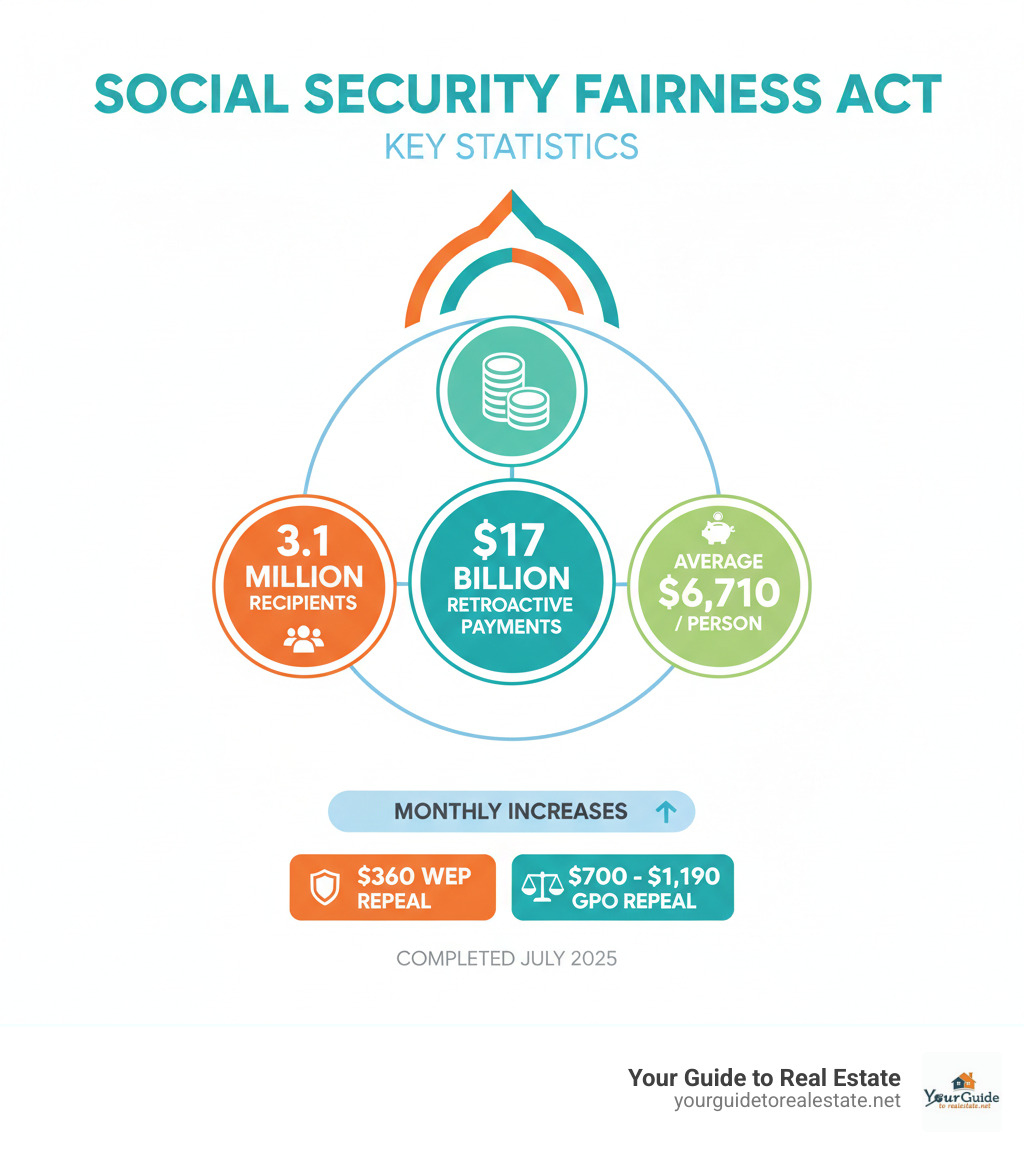
Social Security Fairness Act retroactive payments have delivered over $17 billion to more than 3.1 million Americans who were previously penalized by outdated pension offset rules. If you’re a retired teacher, firefighter, police officer, or other public service worker, you may be entitled to both a lump-sum retroactive payment and increased monthly benefits.
Quick Facts About SSFA Retroactive Payments:
- Total Paid Out: $17 billion to 3.1 million people (completed July 7, 2025)
- Average Retroactive Payment: $6,710 per person
- Monthly Benefit Increases: $360 average for WEP repeal, $700-$1,190 for GPO repeal
- Retroactive Period: January 2024 through present
- Payment Status: Completed 5 months ahead of schedule
- Action Required: None for current recipients with updated contact info
The Social Security Administration has successfully completed the largest benefit restoration in decades. This historic change eliminated the Windfall Elimination Provision (WEP) and Government Pension Offset (GPO) that unfairly reduced benefits for public sector workers who also earned Social Security credits.
Who received payments? Public employees with pensions from jobs that didn’t pay into Social Security, plus their spouses and survivors. About 28% of government workers were affected by these penalties.
The payments began February 24, 2025, and wrapped up in July – months faster than originally projected. Most people saw their increased monthly benefits start in April 2025.
Understanding the Social Security Fairness Act
For decades, dedicated public servants faced a frustrating reality: their Social Security benefits were slashed because they also earned a government pension. Teachers who worked summers at private companies, firefighters who had second jobs, and countless other public employees found themselves caught in a web of confusing rules that penalized them for their service.
The culprits? Two provisions with intimidating names: the Windfall Elimination Provision (WEP) and the Government Pension Offset (GPO). These rules created a financial double-bind that affected millions of hardworking Americans and their families.

But here’s the good news: on January 5, 2025, everything changed. H.R. 82, known as the Social Security Fairness Act, became law. This landmark legislation amended Title II of the Social Security Act, wiping out both WEP and GPO once and for all.
For anyone who believes people should get the benefits they’ve earned through honest work, this was a victory worth celebrating. The pension offsets that once reduced benefits for public sector workers are now history.
What the Act Repealed: WEP and GPO
Let’s break down what these confusing provisions actually did – and why their elimination matters so much for your wallet.
The Windfall Elimination Provision (WEP) started in 1983 with what seemed like good intentions. It targeted people who got pensions from jobs that didn’t pay Social Security taxes – think teachers, police officers, and firefighters in certain states. If these workers also earned Social Security credits from other jobs, WEP reduced their benefits using a different, less favorable formula.
The government’s reasoning? They wanted to prevent a “windfall” where people got higher Social Security payments than intended. But in practice, it felt like punishment for choosing public service. Many dedicated workers saw their expected Social Security benefits cut by hundreds of dollars each month.
You can dive deeper into the technical details with More info about the Windfall Elimination Provision.
The Government Pension Offset (GPO) was even older, dating back to 1977, and it hit spouses and survivors particularly hard. If you received a government pension from non-covered employment, your Social Security spousal or survivor benefits got slashed – sometimes eliminated entirely.
Picture this: a teacher’s widow who expected to receive Social Security survivor benefits based on her late husband’s work record, only to find that her teacher’s pension wiped out most or all of those benefits. For many families, this meant losing thousands of dollars in expected income during their most vulnerable times.
The GPO’s goal was to treat everyone fairly, but it often created severe financial hardship instead. Details on the Government Pension Offset explain how these reductions were calculated.
Now that both WEP and GPO are gone, the benefit reduction formulas no longer apply to payments from January 2024 forward. This represents a massive shift toward fairness, ensuring that Social Security benefits reflect what people actually earned and deserve.
Who Is Eligible for Social Security Fairness Act Retroactive Payments?
The big question everyone’s asking: “Will I get money back?” The answer depends on whether WEP or GPO previously reduced your benefits or prevented you from receiving them.
Public employees make up the largest group of beneficiaries. If you’re a teacher, firefighter, police officer, or other state and local government worker who received a pension from non-covered employment, you likely faced WEP reductions on your own Social Security benefits. Now you’ll receive both the Social Security Fairness Act retroactive payments and higher monthly benefits going forward.
Federal workers under the Civil Service Retirement System (CSRS) were also heavily impacted. Unlike newer federal employees, CSRS workers didn’t pay into Social Security for their government service. If you earned Social Security credits from other jobs or were eligible for spousal benefits, you probably encountered these unfair reductions.
Spouses and surviving spouses represent another major group. If you received spousal or survivor Social Security benefits that were reduced because of your own government pension, you’re now entitled to the full amount you should have been getting all along.
The key factor isn’t just having a government job – it’s having a pension from work where you didn’t pay Social Security taxes. About 72% of government employees today do pay into Social Security and weren’t affected by these provisions. But for the roughly 28% of government employees who were caught by WEP and GPO, this change means real financial relief.
Whether you’re currently receiving reduced benefits or were prevented from applying because of these provisions, the Social Security Fairness Act likely has good news for your bank account.
Your Guide to Social Security Fairness Act Retroactive Payments
When the Social Security Administration took on the massive task of recalculating benefits for millions of Americans, many wondered if it would really happen as promised. The good news? They delivered – and then some! What was initially expected to take over a year was completed in just five months.

The SSA’s implementation of these Social Security Fairness Act retroactive payments has been nothing short of impressive. They managed to process lump-sum payments for over 3.1 million people while simultaneously adjusting ongoing monthly benefits – all while maintaining their regular operations.
Let’s walk through exactly what you can expect from these payments and when everything happened.
How Much to Expect: Payouts and Monthly Increases
Here’s what everyone’s been waiting to hear about – the actual dollar amounts! The Social Security Fairness Act retroactive payments have already delivered life-changing money to millions of Americans.
The total payout reached a staggering $17 billion distributed to over 3.1 million people. That’s not just a number on a government spreadsheet – that’s real money going into real bank accounts of people who’ve been waiting years for this fairness.
The average retroactive payment came to $6,710 per person. For some retirees, that’s like getting an extra year’s worth of grocery money. For others, it might finally allow them to take that trip they’ve been putting off or help a grandchild with college expenses.
But the story doesn’t end with the lump-sum payments. The ongoing monthly benefit increases are where the real long-term impact shows up. The Congressional Budget Office broke down what people can expect:
WEP elimination brings an average monthly increase of $360 for about 2.1 million Social Security recipients. That’s an extra $4,320 every year going forward – money that adds up to real financial security over time.
GPO repeal for spouses delivers an average boost of $700 per month. After years of seeing their spousal benefits slashed, this restoration means spouses can finally receive what they were always entitled to based on their partner’s work record.
GPO repeal for surviving spouses provides the largest average increase at $1,190 monthly. For widows and widowers who were struggling financially after losing a spouse, this change can mean the difference between just getting by and actually living comfortably.
These aren’t just estimates anymore – they’re reality for millions of Americans. The CBO estimates on benefit increases provide the detailed breakdown if you want to dive deeper into the numbers.
Your individual increase depends on your specific work history, pension amount, and previous Social Security calculation. Some people might see smaller changes, while others could receive over $1,000 more each month.
Timeline for Social Security Fairness Act Retroactive Payments
The timeline for these payments moved faster than anyone expected, which was wonderful news for people who had been waiting decades for this fairness.
Everything started on January 5, 2025, when President Biden signed H.R. 82 into law. While this made the changes official, the benefits were applied retroactively to cover the entire year of 2024.
The first Social Security Fairness Act retroactive payments hit bank accounts on February 24, 2025. Imagine the surprise and relief of people who had been told to expect a much longer wait! The SSA worked overtime to get these payments out as quickly as possible.
By April 2025, most people began seeing their increased monthly benefits. Since Social Security pays one month behind, the April payment reflected the new, higher amount for March. This meant people could start budgeting with their new, permanent income level.
The really impressive milestone came on July 7, 2025, when the SSA announced they had completed sending all $17 billion in payments to the 3.1 million eligible recipients. This was a full five months ahead of their original schedule – a rare example of a government program finishing early!
The retroactive period covers benefits from January 2024 forward, which means December 2023 was the last month that WEP and GPO reductions were applied. Your lump-sum payment covers the difference for all those months when you should have been receiving the higher amount.
If you’ve received a substantial payment or your monthly income has increased significantly, this might be a good time to review your overall financial picture. Whether you’re thinking about paying off debts or making major purchases, having a clear plan can help you make the most of this financial boost. You might find it helpful to explore options like Managing a large payment with a Debt Consolidation Loan to optimize your financial strategy.
Next Steps and Troubleshooting
The Social Security Administration has worked incredibly hard to implement the Social Security Fairness Act, but with millions of beneficiaries and countless unique situations, questions and occasional hiccups are completely normal. The good news? Most issues have straightforward solutions, and we’re here to walk you through everything you need to know.

What Actions Do You Need to Take?
Here’s some wonderful news: if you’re already receiving Social Security benefits that were reduced by WEP or GPO, you probably don’t need to do anything at all! The SSA has been proactively handling most cases behind the scenes.
For current recipients, the process has been largely automatic. If the SSA has your current contact information and direct deposit details on file, your Social Security Fairness Act retroactive payments and monthly benefit increases should have arrived without any action on your part. It’s like getting a pleasant surprise in the mail – except you actually earned every penny of it.
Updating your contact information is absolutely crucial, though. Think of it as keeping your financial address book current. If the SSA can’t reach you, they can’t pay you. You can easily update your information on the SSA website through your ‘my Social Security’ account. It takes just a few minutes and could save you months of headaches.
Filing a new application becomes necessary if WEP or GPO previously made you ineligible for benefits altogether. Maybe you looked into Social Security benefits years ago, only to find that the penalties would reduce them to almost nothing. Now’s your chance for a fresh start! You can apply online or call the SSA at 1-800-772-1213. They’ve even set up a special team just to handle these situations, so you’ll be speaking with experts who understand exactly what you’re going through.
What to Do If You Haven’t Been Paid
If you believe you should have received Social Security Fairness Act retroactive payments but your mailbox (and bank account) remain disappointingly empty, don’t worry. While the SSA completed most payments by July 2025, some cases are still working their way through the system.
Contacting the SSA is your best first move. Call them at 1-800-772-1213 (or 1-800-325-0778 if you use TTY services). Have your Social Security number ready, along with any paperwork about your pension or previous Social Security benefits. The representatives have been handling these calls for months now, so they know exactly what questions to ask.
If phone calls aren’t your thing or if you need more personalized help, you can make an appointment with the SSA at your local office. Sometimes having a face-to-face conversation can clear up confusion faster than multiple phone calls.
Verifying eligibility is also worth double-checking. The key question is whether you actually received a pension from work where you didn’t pay Social Security taxes. Not all government jobs fall into this category, and sometimes people assume they were affected by WEP or GPO when they actually weren’t.
Your ‘my Social Security’ account is like a financial dashboard for your benefits. Log in to check your payment history, verify your contact information, and see if there are any notices about your case. It’s available 24/7 and often has information before you receive anything in the mail.
Why Some Payments Are Delayed: Handling Complex Cases
While the SSA managed to complete most Social Security Fairness Act retroactive payments months ahead of schedule, some cases are naturally more complicated. Think of it like untangling a particularly stubborn knot – it takes patience and careful attention.
Manual processing is often the culprit behind delays. While computers can handle straightforward cases quickly, complex situations require human expertise. Someone needs to carefully review your work history, calculate exactly how WEP or GPO affected your benefits, and ensure the new calculations are accurate. This personal attention takes time, but it helps ensure you get exactly what you’re owed.
Staffing challenges have also played a role. The SSA has been operating with fewer employees than in previous years due to hiring freezes, yet they’re handling this massive undertaking alongside their regular workload. It’s a bit like asking a restaurant to serve twice as many customers with the same number of waiters – everyone’s working hard, but service might be a little slower.
Pending cases add another layer of complexity. Around 500,000 Americans had existing cases with the SSA that were also affected by WEP or GPO. These situations often require extra review to ensure all the moving pieces fit together correctly.
The SSA is also being extra careful to avoid unintended consequences. They’re taking time to set up automated processes that won’t create new problems down the road. Sometimes they need to verify pension information to make sure they were calculating your benefits correctly even before the Act took effect.
If your case is taking longer, it usually means the SSA is being thorough to get everything right the first time. A little patience now can save everyone headaches later.
Staying Informed and Avoiding Scams
Unfortunately, whenever there’s big news about Social Security benefits, scammers come out of the woodwork like ants at a picnic. They’re hoping to trick people into giving up personal information or paying fake fees. Here’s how to protect yourself and your loved ones.
Official SSA communication comes through the mail or your ‘my Social Security’ account. The SSA won’t call you out of the blue asking for your Social Security number or bank account information. If someone calls claiming to be from Social Security and asking for personal details, hang up and call the official number yourself.
The SSA maintains a dedicated page specifically for updates about the Social Security Fairness Act. Bookmark SSA’s dedicated SSFA update page and check it regularly for the most current, accurate information. It’s like having a direct line to official updates without the noise of rumors or misinformation.
The SSA will never charge you fees for receiving your benefits or processing adjustments. Your Social Security Fairness Act retroactive payments are yours by right – you don’t need to pay anyone to get them. If someone asks for money upfront, it’s definitely a scam.
Red flags include unsolicited calls threatening arrest or legal action, demands for immediate payment, and requests for gift cards or wire transfers. The real SSA doesn’t operate like a debt collector or use scare tactics.
If you encounter suspicious activity, report fraud to the SSA Office of the Inspector General at oig.ssa.gov/report. You’ll be helping protect not just yourself, but other vulnerable people who might fall for these schemes.
Impact on Medicare Premiums
The changes from the Social Security Fairness Act don’t just affect your Social Security benefits – they can also impact how you pay for Medicare. Don’t worry, though. The system is designed to work smoothly once everything gets sorted out.
If your Medicare premiums were automatically deducted from your Social Security benefits before, they’ll continue being deducted from your new, higher benefit amount. The process stays the same, but now you’ll have more money left over after the deduction.
Direct payment refunds are coming for people who were paying Medicare premiums directly because their Social Security benefits were too low due to WEP or GPO reductions. Once your benefits are properly adjusted, the Centers for Medicare & Medicaid Services will refund you for payments you made that covered periods when your benefits should have been higher. Keep paying as directed until you get official notice that the change has been made.
If you use Medicare Easy Pay (automatic bank withdrawals), you’ll need to cancel this once the SSA starts deducting premiums from your Social Security check instead. You can do this by completing the Authorization Agreement for Preauthorized Payments form and sending it to Medicare, or handling it online at Medicare.gov.
For Civil Service Retirement System annuity deductions, the SSA will let you know when Medicare premiums will start being deducted from your Social Security benefits instead of your CSRS annuity. Any overpayments will be included in your retroactive payment or refunded separately.
In rare cases, some people had Medicare premiums deducted from both their Social Security benefits and their Office of Personnel Management annuity. If this happened to you, don’t panic – it’s being sorted out, and you’ll get refunds for the duplicate payments.
The bottom line is that your Medicare coverage continues uninterrupted, and the payment process should actually become simpler once everything is adjusted.
Frequently Asked Questions about SSFA Payments
You’ve probably got a lot of questions swirling around in your mind about these changes – and that’s completely normal! The Social Security Fairness Act retroactive payments represent a huge shift after decades of reduced benefits. Let’s walk through the most common questions we hear from folks just like you.
How far back are retroactive benefits paid?
Here’s the timeline that matters most to your wallet: Social Security Fairness Act retroactive payments go back to January 2024. December 2023 was officially the last month that those pesky WEP and GPO rules applied to anyone’s benefits.
If you were already getting Social Security benefits that were being reduced, your lump-sum payment covers the difference from January 2024 right up until your new, higher monthly payments kicked in. So if your adjusted monthly benefits started in April 2025, that retroactive check covered January 2024 through March 2025 – that’s why many people received such substantial amounts.
Now, here’s where it gets a bit trickier. If you never applied for Social Security benefits before because you knew WEP or GPO would slash them, you’ll want to apply now – but there’s a catch. New applications for retirement and survivor benefits can typically only go back six months from when you apply. So while the law itself is retroactive to January 2024, when you actually file your application really matters for how much back pay you’ll receive.
Will every public employee get an increase?
This is probably the biggest misconception we encounter, so let’s clear it up right away. No, not every public employee will see their Social Security benefits increase because of the Social Security Fairness Act.
Think of it this way: about 72% of government employees were already paying into Social Security through their regular paychecks. If you were one of these folks, WEP and GPO never touched your benefits in the first place. You were already getting your full Social Security benefits, so there’s nothing to restore.
The Social Security Fairness Act retroactive payments and monthly increases are specifically for that 28% of government workers who had pensions from jobs that didn’t pay into Social Security. These are often teachers in certain states, some police officers and firefighters, federal employees under the old Civil Service Retirement System, and similar roles.
If you’re not sure which category you fall into, check your old pay stubs or W-2 forms. If you see Social Security taxes being taken out, you were probably already getting your full benefits. If you didn’t pay Social Security taxes but earned Social Security credits from other work, then you might have been affected by WEP or GPO.
Do I need to reapply for benefits?
The answer depends entirely on whether you were already in the Social Security system or stayed away because of those benefit reductions.
If you’re currently receiving Social Security benefits – even reduced ones – you typically don’t need to lift a finger. The Social Security Administration has been working overtime to identify everyone who was getting shortchanged by WEP and GPO. As long as they have your current address and direct deposit information, they’ve handled the heavy lifting for you. Your Social Security Fairness Act retroactive payments and new monthly amounts should have arrived automatically.
But if you never applied for Social Security benefits because you knew WEP or GPO would reduce or eliminate them, now’s the time to act! This is especially important for spouse and survivor benefits, which GPO often wiped out entirely. Many people just gave up and never applied, thinking “what’s the point?”
Well, now there’s definitely a point. You can apply online through the Social Security website or call their national number at 1-800-772-1213. The SSA even set up a special team just to handle these new applications from people who were previously shut out by WEP and GPO.
When you’re not sure about your situation, your ‘my Social Security’ account is your best friend. Log in and take a look at your benefit history. If you see reductions labeled as WEP or GPO, you’re likely already in the system and should have received your payments. If you don’t see any Social Security benefits at all, it might be time to apply.
The bottom line? When in doubt, reach out to the Social Security Administration. They’d rather answer your questions than have you miss out on benefits you’ve rightfully earned.
Conclusion
After decades of unfair reductions, the Social Security Fairness Act retroactive payments have finally delivered the justice that millions of public servants deserved. This isn’t just about numbers on a check – though those numbers are certainly impressive, with over $17 billion reaching more than 3.1 million Americans who dedicated their careers to serving our communities.
Think about it: teachers who shaped young minds, firefighters who ran toward danger, police officers who kept our streets safe, and countless other public servants can now breathe a little easier. The average retroactive payment of $6,710 represents more than money – it’s recognition of their service and the correction of a long-standing inequity.
The monthly benefit increases are equally meaningful. Whether you’re seeing an extra $360 from WEP repeal or up to $1,190 from GPO repeal, these aren’t just temporary windfalls. These are permanent increases that will help stretch retirement dollars and provide the financial security you’ve earned through years of service.
This financial empowerment opens up new possibilities. Maybe you can finally tackle that home improvement project you’ve been putting off. Perhaps you’re ready to help a grandchild with college expenses. Or maybe – and this is where we get excited – you’re now in a position to make that real estate move you’ve been considering.
Your improved financial situation might be the key to open uping opportunities that seemed out of reach before. Whether it’s upgrading to a home that better fits your retirement lifestyle, investing in rental property, or simply having the confidence to make a move you’ve been contemplating, we’re here to help guide you through the process.
If you’re ready to explore how your improved financial position can work for you in the real estate market, consider Understanding Mortgages: A Beginner’s Guide to Home Loans. At Your Guide to Real Estate, we believe that financial security should translate into real opportunities, and we’re committed to helping you steer those possibilities with our proven framework and stress-free guidance.
The Social Security Fairness Act retroactive payments represent more than just correcting past wrongs – they’re about building a more secure future. Whatever that future holds for you, we’re here to help make it a reality.