

Why the Social Security Fairness Act Repeal Matters for Millions
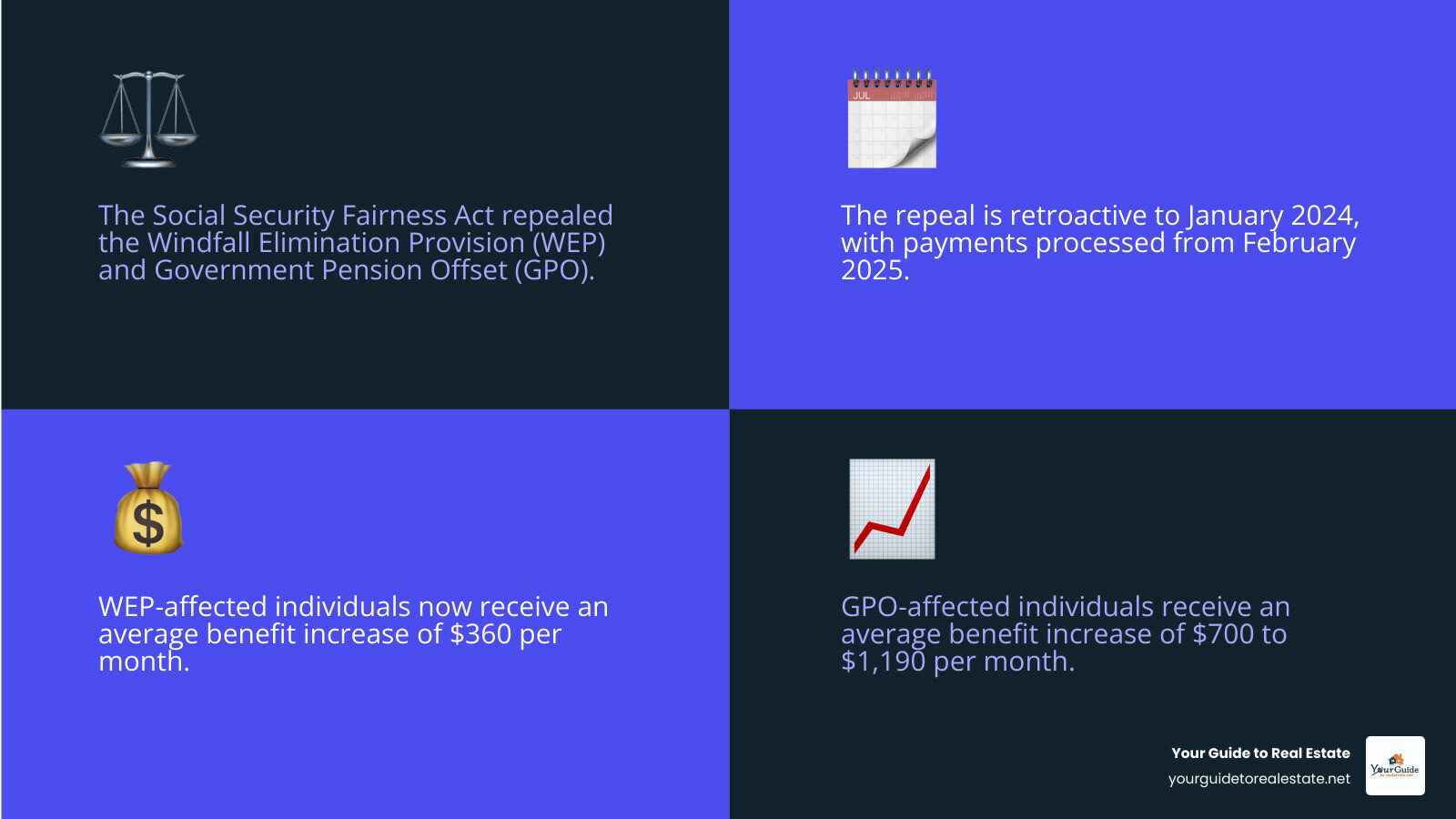
The social security fairness act repeal became law on January 5, 2025, when President Biden signed H.R. 82, eliminating two provisions that reduced Social Security benefits for nearly 3 million Americans. Here’s what you need to know:
Key Changes:
- Windfall Elimination Provision (WEP) – Repealed (was reducing benefits for workers with non-Social Security pensions)
- Government Pension Offset (GPO) – Repealed (was reducing spousal/survivor benefits)
- Effective Date – January 2024 (retroactive)
- Average Benefit Increases – $360/month for WEP, $700-$1,190/month for GPO
Who Benefits:
- Teachers, firefighters, police officers
- State and local government employees
- Federal employees under CSRS
- Spouses and survivors of public sector workers
The Social Security Administration began processing payments in February 22025, with over $17 billion distributed to eligible beneficiaries by July 2025. Most affected individuals don’t need to take action – the SSA is automatically adjusting benefits.
This legislative change corrects what many considered a longstanding inequity. Public servants who contributed to Social Security through other jobs previously saw their benefits reduced simply because they also earned pensions from government work that didn’t participate in Social Security.
For those affected, this repeal represents more than just increased monthly income. It opens new possibilities for retirement planning, housing decisions, and financial security that may have seemed out of reach before.
Learn more about social security fairness act repeal:
- social security fairness act update
- social security fairness act payments update
- what changes are coming to social security in 2025
What the Social Security Fairness Act Changes: A Look at WEP and GPO
When you hear about the social security fairness act repeal, you’re witnessing the end of a decades-long story that affected millions of hardworking Americans. To understand why this change matters so much, we need to look at what these two provisions actually did to people’s benefits.

Think of it this way: imagine working your entire career in public service, paying into Social Security through a second job or earlier career, only to find out your benefits would be slashed simply because you also earned a government pension. That’s exactly what happened to nearly 3 million Americans before this repeal.
The Windfall Elimination Provision and Government Pension Offset weren’t created out of malice. They were designed to fix what lawmakers saw as unfair advantages. But over time, it became clear these “fixes” created bigger problems than they solved.
The Windfall Elimination Provision (WEP)
Back in 1983, Congress was worried about something they called a “windfall.” Here’s what concerned them: Social Security gives higher replacement rates to lower-income workers. So if someone worked part of their career in a job that didn’t pay into Social Security, their Social Security record might make them look like a low-wage worker when they actually weren’t.
WEP was designed to prevent this perceived advantage. But in practice, it penalized about 2 million public servants who had legitimately earned both a government pension and Social Security benefits through different jobs.
The math was pretty harsh. If you had fewer than 30 years of Social Security-covered work, WEP could reduce the first calculation factor in your benefit formula from 90% down to just 40%. That’s a massive hit to your monthly income.
Teachers, firefighters, police officers, and other public employees felt this reduction most acutely. Many finded their Social Security benefits were cut by hundreds of dollars per month, money they had rightfully earned through covered employment.
Before the social security fairness act repeal, WEP affected workers who received pensions from government jobs that didn’t participate in Social Security. The reduction was limited to half of your government pension amount, but even with this “guarantee,” the financial impact was significant for most families.
For those who want to dive deeper into the technical details, you can review A detailed explanation of the WEP.
The Government Pension Offset (GPO)
The Government Pension Offset came even earlier, in 1977, and it targeted a different group: spouses and survivors of workers who had government pensions from non-covered employment.
GPO’s logic seemed reasonable on paper. If a private-sector spouse received their own Social Security benefit, their spousal benefit would be reduced. GPO tried to create similar treatment for those with government pensions.
But the reality was much harsher. GPO reduced spousal and survivor benefits by two-thirds of the government pension amount. For many people, this completely wiped out their spousal or survivor benefits.
Picture this: you’re a teacher’s widow, and your late husband paid into Social Security for decades. You’d expect to receive survivor benefits, right? But if you also had a small teacher’s pension from a job that didn’t pay Social Security taxes, GPO could eliminate your entire survivor benefit.
This created real financial hardship for families who had planned their retirement around receiving both benefits. Many finded too late that their expected Social Security income would be dramatically reduced or eliminated entirely.
The social security fairness act repeal addresses this inequity directly. Starting with payments in early 2025, affected spouses and survivors are seeing their full Social Security benefits restored, often adding $700 to $1,190 per month to their income.
You can learn more about how the GPO provision operated by visiting More on the GPO provision.
The end of WEP and GPO represents more than just a policy change – it’s recognition that public servants deserve the same Social Security treatment as everyone else. After decades of advocacy and countless personal stories of financial hardship, Congress finally acted to correct what many saw as a fundamental unfairness in the system.
Who Is Affected and What Are the Financial Impacts?
When President Biden signed the social security fairness act repeal into law, it wasn’t just a policy change—it was a lifeline for nearly 3 million Americans who had been waiting decades for this moment. These aren’t just numbers on a government spreadsheet; they’re real people who dedicated their careers to serving others, only to see their Social Security benefits unfairly reduced.

The heart of this change lies with our public sector heroes. We’re talking about the teacher who spent 30 years shaping young minds, the firefighter who risked their life to save others, and the police officer who kept our communities safe. These dedicated individuals, along with countless other state and local government employees, found themselves caught in an unfair system simply because their government jobs didn’t pay into Social Security.
Federal employees under the Civil Service Retirement System (CSRS) were also hit hard. If you were hired before 1984 and worked for the federal government, you likely didn’t pay Social Security taxes on that income, making you subject to these benefit reductions later in life.
But the impact went beyond the workers themselves. Spouses and survivors of public servants faced their own challenges through the Government Pension Offset, often seeing their Social Security spousal or survivor benefits drastically cut or eliminated entirely. Imagine losing your spouse and then finding that the Social Security benefits you were counting on had been reduced to almost nothing.
States like Alaska felt this impact particularly deeply, with some of the highest rates of affected residents per capita in the nation. For ongoing updates about how these changes continue to unfold, you can stay informed through our Social Security News page.
Estimated Benefit Increases for Retirees
Now for the good news—and it’s really good news! The financial relief from the social security fairness act repeal is both immediate and substantial. We’re not talking about pocket change here; these are life-changing amounts for many families.
Workers who were affected by WEP can expect to see their monthly Social Security benefits increase by an average of $360 per month. That might not sound like a fortune, but think about what an extra $360 monthly means over the course of a year—that’s more than $4,300 in additional income annually.
For spouses and survivors who were hit by GPO, the relief is even more dramatic. These individuals are seeing average monthly increases ranging from $700 to $1,190. For someone who was receiving little to no spousal or survivor benefits due to GPO, this restoration can mean the difference between struggling financially and living comfortably in retirement.
What makes this even better is that the increases are retroactive to January 2024. This means if you’re eligible, you’re not just getting higher monthly payments going forward—you’re also receiving a lump sum payment to cover the months since the beginning of 2024. The Social Security Administration has been working hard to process these payments, and by July 2025, they had distributed over $17 billion to eligible beneficiaries.
These restored benefits will also continue to grow with annual cost-of-living adjustments (COLA), ensuring your purchasing power keeps up with inflation. To understand how these changes fit into the broader picture of Social Security adjustments, check out our detailed guide on What Changes Are Coming to Social Security in 2025?.
Understanding the Impact on Your Retirement Planning
Here’s where things get exciting from a financial planning perspective. When you suddenly have hundreds or even over a thousand extra dollars coming in each month, it opens up a world of possibilities that may have seemed out of reach before.
Your daily life gets easier first and foremost. Basic expenses that might have caused stress—groceries, utilities, medical bills—become more manageable. You might finally be able to visit the grandkids more often or take that trip you’ve been putting off.
But the real game-changer comes with your housing and real estate decisions. This is where we see the most exciting changes at Your Guide to Real Estate. With a stronger, more predictable income stream, you might find yourself reconsidering your entire living situation.
Maybe you’ve been thinking about downsizing but weren’t sure if you could afford the transition costs. Or perhaps you’ve dreamed of that second home or vacation property but never had the financial confidence to take the leap. Some of our clients have even finded that their improved financial position makes them eligible for better refinancing terms on their current mortgage, potentially saving them even more money each month.
For the more adventurous, this increased income might provide the foundation for exploring real estate investment opportunities. When you have that extra monthly cushion, it becomes easier to consider properties that could generate additional passive income.
The key is understanding that this isn’t just about having more spending money—it’s about having more financial security and options. Whether you’re looking to make your current home more comfortable, move closer to family, or explore new investment opportunities, your newly restored Social Security benefits can be a powerful tool in your financial toolkit.
We’re here to help you steer these exciting new possibilities, whether you’re ready to make a move today or just starting to dream about what’s possible tomorrow.
The Social Security Fairness Act Repeal: Implementation and Next Steps
The wheels of change started turning quickly after the social security fairness act repeal became law. The Social Security Administration faced a monumental task: adjusting benefits for nearly 3 million Americans who had been affected by WEP and GPO. It’s one thing to pass a law, but implementing it for millions of people? That’s where the real work begins.

The SSA deserves real credit here. They understood that people had been waiting decades for this moment, and they moved with impressive speed and efficiency. For us at Your Guide to Real Estate, we’ve been watching this process closely because we know how much these benefit increases can change someone’s housing and retirement plans.
Key Dates and Retroactive Payments
Let’s walk through how this historic change unfolded. President Biden signed H.R. 82 into law on January 5, 2025, after it sailed through Congress with overwhelming bipartisan support. The House passed it 327-25, and the Senate followed with a 76-20 vote. Years of advocacy from public servants and organizations finally paid off.
But here’s what made this law especially meaningful: the benefits became retroactive to January 2024. That meant people wouldn’t lose out on a full year of increased payments while waiting for the law to pass. It was the right thing to do, and it showed real respect for the people who had been shortchanged for so long.
The SSA began processing payments during the week of February 24, 2025. Think about that timeline – from signing to payments in less than two months. That’s government efficiency at its best.
The real milestone came in July 2025. The SSA announced they had sent over 3.1 million payments totaling $17 billion to eligible beneficiaries. Even more impressive? They finished this massive undertaking five months ahead of their original schedule. That’s $17 billion flowing back to public servants and their families who had earned every penny of it.
Most people started seeing their new monthly benefit amounts in April 2025 (covering their March benefits). The retroactive payments, covering that crucial period from January 2024, were generally deposited by the end of March 2025. For many families, that retroactive payment represented a substantial lump sum that could make an immediate difference in their lives.
You can dive deeper into how these retroactive payments were calculated in our detailed guide: Social Security Fairness Act Retroactive Payments.
What Action Do You Need to Take?
Here’s the question everyone’s asking: “Do I need to fill out forms or call someone to get my money?” For most people affected by WEP or GPO, the answer is wonderfully simple: you don’t need to do anything. The SSA has been automatically recalculating benefits and sending out payments.
But there are a few smart steps you should take to make sure everything goes smoothly. First, verify your contact information with the SSA. If they can’t reach you or don’t have your current bank details, you might miss out on important notices or face delays in getting your money. The easiest way to check this is through your ‘my Social Security’ account online. If you don’t have one yet, it’s worth setting up at the SSA’s website.
Keep an eye on your bank account and mailbox over the next few months. You should see both the retroactive lump sum payment and your increased monthly benefits. The SSA will also send you official notices explaining exactly what changed and why.
If you’re someone who never applied for Social Security benefits because WEP or GPO made them too small to bother with, now’s the time to reconsider. You can apply for benefits online through the SSA’s website. The application might still ask about your pension, but don’t worry – they won’t reduce your benefits anymore.
The same goes for spousal or survivor benefits. If GPO previously wiped out these benefits entirely, you might now be eligible for substantial monthly payments. While you can apply for retirement and spousal benefits online, survivor benefits require a phone call to the SSA at (800) 772-1213. When you call, mention “Fairness Act” to make sure you get connected with someone who understands the recent changes.
Some complex cases might take a bit longer to process. The SSA handled the straightforward situations first, but if your case involves unusual circumstances, it might require manual review. They’ve asked people to wait until after April 2025 to inquire about monthly benefits if you haven’t seen changes yet.
For the most up-to-date information and official guidance, check the SSA’s dedicated page: Official SSA updates on the Fairness Act. They’ve been keeping it current as the implementation moves forward.
Broader Implications and Potential Challenges
While the social security fairness act repeal represents a tremendous victory for millions of public servants and their families, it’s important to understand that this significant legislative change comes with broader implications that extend beyond individual benefits. As we’ve watched this law unfold, we’ve seen both the positive impacts and the challenges that naturally arise when making such sweeping changes to a system as complex as Social Security.
At Your Guide to Real Estate, we believe in giving you the complete picture. Just as we’d never hide potential challenges when you’re buying a home, we want you to understand both the benefits and the broader context of this important change.
The Impact on the Social Security Trust Fund
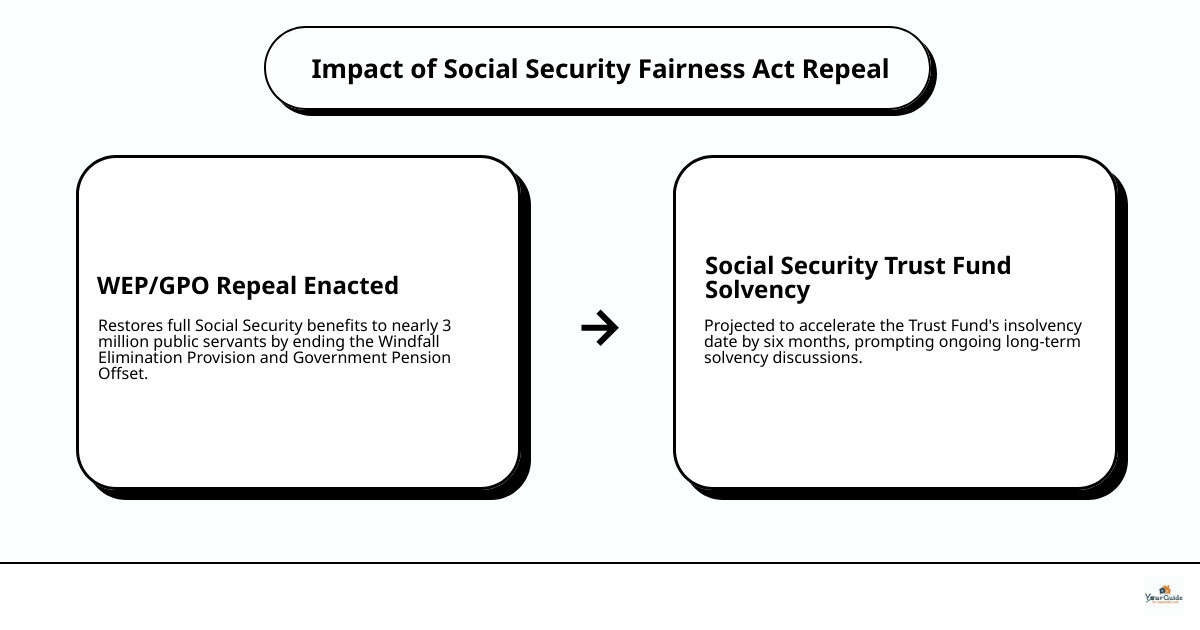
Let’s talk about the elephant in the room – the impact on Social Security’s long-term financial health. The social security fairness act repeal will accelerate the projected insolvency of the Social Security Trust Fund by approximately six months. While this might sound concerning at first, it’s important to put this in perspective.
This relatively small acceleration represents the cost of correcting what many considered a decades-long injustice. Advocates for the repeal argued passionately that restoring fairness to public servants was worth this modest impact on the trust fund’s timeline. After all, these are people who dedicated their careers to serving our communities as teachers, firefighters, police officers, and other essential public workers.
The ongoing discussions about Social Security’s long-term solvency involve much larger considerations than this repeal. Policymakers continue to explore various solutions, from adjusting retirement ages to modifying benefit formulas or increasing payroll taxes. The cost versus equity argument that surrounded this legislation ultimately came down to a simple principle: public servants shouldn’t be penalized for their choice to serve.
Looking ahead, these long-term solvency discussions will continue to evolve. The repeal adds one more piece to a complex puzzle that lawmakers will need to address comprehensively in the coming years. For context on other financial changes affecting Social Security, including annual adjustments, check out our article on Social Security 2025 COLA Increase.
Implementation Challenges for the Social Security Administration
Implementing a change that affects nearly 3 million Americans and requires recalculating years of benefit history is no small feat. The Social Security Administration has done an impressive job – distributing over $17 billion by July 2025, five months ahead of schedule – but the process hasn’t been without its challenges.
Complex cases have required the most attention. Think about someone who worked as a teacher for 20 years, then in the private sector for 15 years, with periods of disability benefits mixed in. These situations need manual updates and careful review, which can cause potential delays for some beneficiaries. The SSA has been working through these cases methodically, but patience has been necessary for those with more complicated work histories.
The agency has also had to balance this massive undertaking with their regular SSA workload – processing new applications, handling appeals, and managing existing benefits for millions of Americans. It’s like renovating your house while still living in it – doable, but requiring careful coordination.
One area we want to highlight is scam awareness. Whenever there’s a major benefit change, unfortunately, scammers come out of the woodwork. Here’s what you need to remember: the SSA will not charge for help with your benefits. Period. If someone calls asking for payment to “expedite” your Social Security Fairness Act benefits, hang up and report the fraud to the SSA’s Office of the Inspector General.
The good news is that the SSA has been proactive about communication, creating dedicated web pages and sending clear notices to beneficiaries. For more insights into how Social Security maintains transparency in its operations, visit our page on Social Security Transparency Initiatives.
Despite these challenges, the implementation has been largely successful. Most beneficiaries have received their increased benefits without any action required on their part – exactly as it should be when correcting a longstanding inequity.
Frequently Asked Questions about the Social Security Fairness Act Repeal
We understand that major changes like the social security fairness act repeal can bring up lots of questions. After helping countless clients steer financial changes that affect their real estate decisions, we’ve seen how important it is to have clear, reliable answers. Let’s tackle the most common questions we’re hearing about this life-changing legislation.
How do I know if I am affected by the WEP/GPO repeal?
The easiest way to tell if the social security fairness act repeal affects you is to look at your work history and current benefits. You’re likely impacted if you receive a pension from a job where you didn’t pay Social Security taxes – think teaching, firefighting, police work, or other state and local government positions.
Here’s how to know for sure: Check your Social Security benefit statements for any mentions of WEP or GPO reductions. These abbreviations would appear if your benefits were being reduced. Your monthly statements or annual Social Security Statement would show this information clearly.
Review your employment history too. Did you work for an employer that had its own pension system instead of Social Security? Many teachers, for example, paid into state teacher retirement systems rather than Social Security for their educator roles.
If you’re still not sure, contact the Social Security Administration directly at (800) 772-1213. When you call, mention “Fairness Act” right away – this helps connect you with representatives who are up to speed on these changes. They can look at your specific situation and give you a definitive answer.
The SSA can also tell you exactly how much your benefits will increase, which is incredibly helpful for planning your financial future.
Will my Medicare premiums be affected?
Yes, and this is actually good news for most people! If your Social Security benefit was so low due to WEP or GPO that you had to pay Medicare premiums directly, that’s about to change.
Your Medicare premiums will now likely be deducted from your increased Social Security benefit, just like it works for most retirees. This is actually more convenient – one less bill to worry about each month.
But here’s the important part: you need to stop any automatic payments you set up to pay Medicare directly. If you don’t, you’ll end up paying twice, which nobody wants.
If you were using Medicare Easy Pay (where Medicare automatically took money from your bank account), you’ll need to fill out form SF-5510 to stop those payments. If you were paying through your bank’s online bill pay system, call your bank to cancel those automatic payments.
Medicare will process refunds if you accidentally pay twice, but it’s much easier to prevent this from happening in the first place. For specific questions about Medicare premium changes, call 1-800-MEDICARE – they’re the experts on this part.
Where can I get official updates on the social security fairness act repeal?
With so much information floating around, it’s crucial to stick with official, reliable sources. The Social Security Administration’s official website should be your go-to resource. They have a dedicated page specifically for the Social Security Fairness Act at https://www.ssa.gov/benefits/retirement/social-security-fairness-act.html.
This page includes detailed FAQs, implementation updates, and guidance custom to different situations. You can even subscribe to email or text alerts directly from the SSA to get updates sent straight to you – no need to keep checking back.
Your personal ‘my Social Security’ account is another goldmine of information. Log in at www.ssa.gov/myaccount to check your benefit status, review payment history, and make sure your contact information is current. This is especially important now that payment amounts are changing.
For personalized help, call the SSA at (800) 772-1213 between 8 a.m. and 7 p.m., Monday through Friday. The representatives can answer questions specific to your situation.
A word of caution: Be very wary of anyone claiming they can expedite your benefits for a fee. The SSA never charges for help with your benefits. If someone asks for payment to “speed up” your Social Security Fairness Act benefits, it’s a scam. Report these to the SSA’s Office of the Inspector General.
These official sources will keep you informed and protected as this historic change continues to roll out.
Conclusion: A New Financial Future for Public Servants
The social security fairness act repeal marks the end of a decades-long fight for fairness. After years of advocacy and bipartisan support, millions of public servants can finally breathe a sigh of relief. Teachers who spent their careers shaping young minds, firefighters who risked their lives for their communities, and police officers who kept our streets safe are no longer penalized for their service.
This isn’t just about policy changes or legislative victories. It’s about real people getting the benefits they earned through years of hard work. When you see an extra $360 per month in your account if you were affected by WEP, or $700 to $1,190 more if GPO was reducing your spousal or survivor benefits, that’s money that can change your daily life.
The numbers tell an incredible story of swift action. The Social Security Administration distributed over $17 billion to more than 3 million beneficiaries by July 2025 – five months ahead of schedule. Most people didn’t have to lift a finger; the payments just started showing up in their accounts.
But here’s what excites us most at Your Guide to Real Estate: this financial boost opens up possibilities that may have seemed out of reach before. Maybe you’ve been putting off that dream of downsizing to a cozy home near your grandchildren. Perhaps you’ve always wanted a little vacation cottage by the lake. Or maybe you’re thinking about refinancing your current home to take advantage of better terms now that your monthly income is more stable.
These aren’t just daydreams anymore. With hundreds or even over a thousand extra dollars each month, your housing options have genuinely expanded. We’ve seen clients use similar windfalls to finally make moves they’d been considering for years – whether that’s upgrading to a more comfortable retirement home or investing in real estate to create additional income streams.
The social security fairness act repeal corrected a longstanding injustice, but more importantly, it restored dignity and financial security to those who dedicated their careers to serving others. Your years of public service are finally being recognized with the full benefits you always deserved.
With restored benefits, you may be reconsidering your housing and investment goals. To see how this could impact your ability to secure a home loan, explore our beginner’s guide to understanding mortgages. We’re here to help you steer whatever exciting possibilities this new chapter might bring.