

Why the Social Security 2025 COLA Increase Matters for Your Financial Future
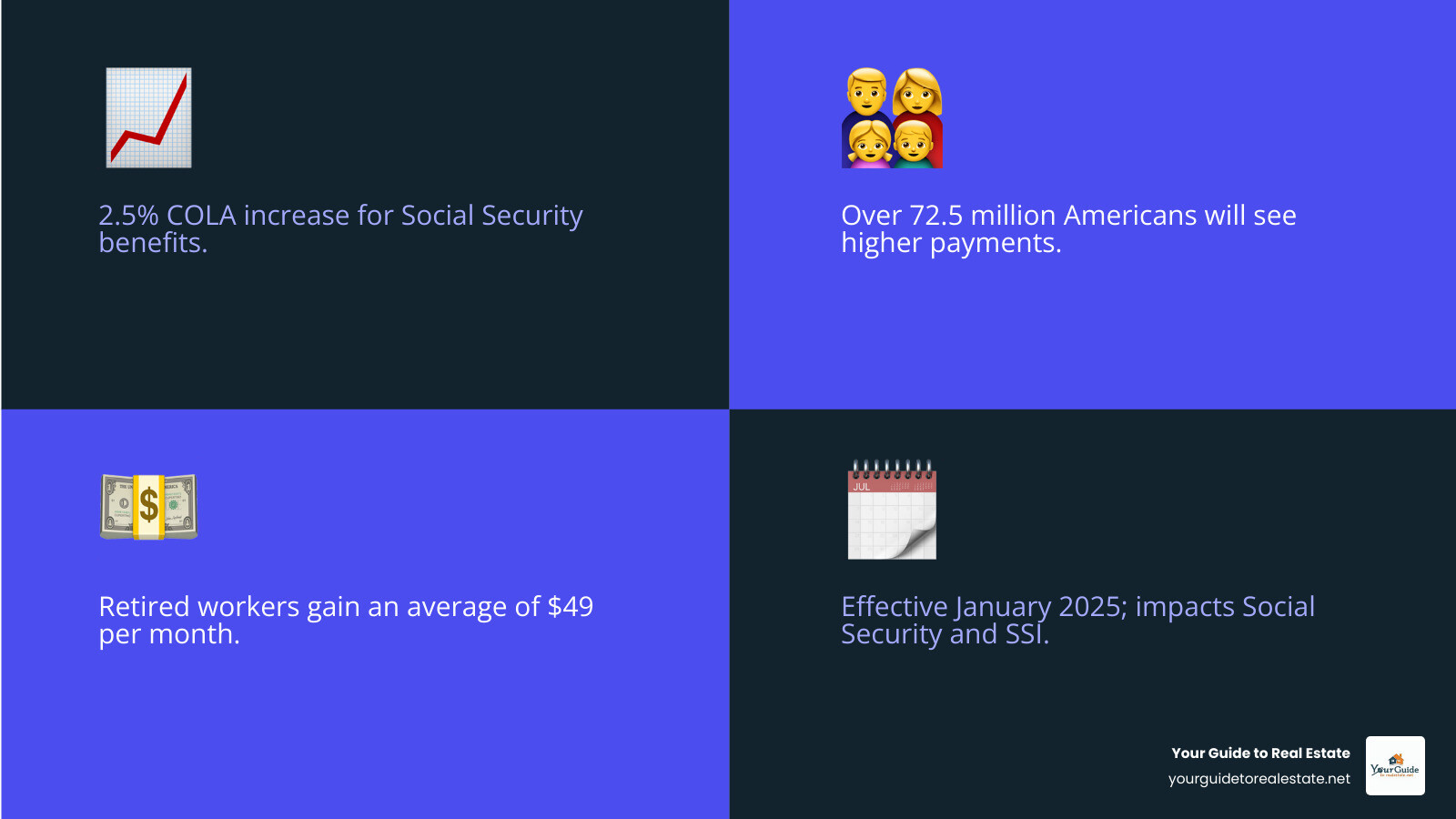
The social security 2025 cola increase brings a 2.5% boost to benefits for over 72.5 million Americans starting in January 2025. Here’s what you need to know:
Key Details:
- Increase Amount: 2.5% cost-of-living adjustment (COLA)
- Average Benefit Boost: $49 per month for retired workers
- Married Couples: Average increase of $75 per month
- Effective Date: January 2025 for Social Security, December 31, 2024 for SSI
- Total Impact: Affects Social Security and Supplemental Security Income recipients
This annual adjustment helps protect your purchasing power against inflation. The Social Security Administration calculates the COLA using the Consumer Price Index for Urban Wage Earners and Clerical Workers (CPI-W), comparing third-quarter data from year to year.
While the 2.5% increase is lower than recent years – down from 3.2% in 2024 and the record 8.7% in 2023 – it aligns with the historical average of about 2.6% over the past 20 years.
Important note: Your actual benefit increase may be smaller than expected due to Medicare Part B premium deductions, which are automatically taken from Social Security payments.
Learn more about social security 2025 cola increase:
- how to close chase checking account
- freelancing tips
- how long does it take to become a real estate agent
Understanding the Official Social Security 2025 COLA Increase
When you’re planning your retirement budget, every dollar counts. That’s why understanding exactly how the social security 2025 cola increase will affect your monthly income is so important. The 2.5% adjustment might sound modest, but for the 72.5 million Americans who depend on Social Security, it represents real money that can help cover rising costs.
Let’s break down what this increase means for your wallet and explore some important details that might affect your actual take-home amount.
How Much Will Your Benefits Actually Increase?
The good news? Most beneficiaries will see a meaningful boost in their monthly checks. If you’re an average retired worker, you can expect an additional $49 per month starting in January 2025. This brings the typical monthly benefit from $1,927 to $1,976.
Married couples will see their combined benefits increase by about $75 monthly, raising their average from $3,014 to $3,089. That extra money can make a real difference when you’re dealing with rising grocery bills or utility costs.
The timing varies slightly depending on your benefit type. Supplemental Security Income (SSI) recipients will see their increased payments begin on December 31, 2024 – a nice way to ring in the new year.
Disabled workers will see their average monthly benefit rise to $1,580. For families with a disabled worker, spouse, and children, the estimated average monthly benefit becomes $2,826.
Survivor benefits also get the 2.5% boost. An aged widow or widower living alone can expect about $1,832 monthly, while a widowed parent with two children will receive an average of $3,761.

These are averages. Your personal increase depends on your current benefit amount. You can find all the official details in the 2025 Social Security Changes Fact Sheet.
The Hidden Factor: How Medicare Premiums Affect Your Raise
Here’s where things get a bit tricky, and it’s something many retirees find the hard way. While you’re celebrating that extra $49 in Social Security benefits, Medicare Part B premiums might be quietly eating into your raise.
These premiums come directly out of your Social Security check each month. For 2025, Medicare Part B premiums are expected to rise, potentially reaching around $184 monthly. So if your Social Security goes up by $49 but your Medicare premium increases by $15, your actual gain is only $34.
It’s like getting a raise at work, only to find out your health insurance costs went up too. Frustrating, but unfortunately common.
There’s something called the “hold harmless” provision that offers some protection. It prevents your Medicare premium from increasing by more than your COLA increase. However, this safety net doesn’t cover everyone – particularly those new to Medicare or people with higher incomes.
Understanding this relationship between your social security 2025 cola increase and Medicare costs is crucial for realistic budgeting. Check Medicare’s official site for the latest premium information to plan accordingly.
Other Key 2025 Social Security Adjustments
The Social Security Administration doesn’t just adjust benefit amounts – they update several other important numbers that affect both current workers and retirees.
The maximum taxable earnings limit jumps to $176,100 in 2025. This means you only pay Social Security taxes on income up to this amount. Anything above this threshold is tax-free from Social Security’s perspective.
If you’re still working while collecting benefits, pay attention to the retirement earnings test changes. Before reaching full retirement age, you can earn up to $23,400 without affecting your benefits. Earn more than that, and Social Security reduces your benefits by $1 for every $2 over the limit.
The rules are more generous if you’re reaching full retirement age in 2025. You can earn up to $62,160 with only $1 in benefits withheld for every $3 over the limit. Once you hit full retirement age, these earnings limits disappear completely.
For current workers, earning Social Security credits now requires $1,810 per credit in 2025. You need four credits (or $7,240 in earnings) to get a full year’s credit toward your future benefits.
These adjustments help keep the Social Security system current with economic changes, ensuring it continues working for both today’s beneficiaries and future retirees.
How the Social Security COLA is Calculated
You might be curious about how the government decides on that annual COLA percentage. The good news? It’s not someone making wild guesses or pulling numbers from thin air. There’s actually a specific formula that’s been used for decades, though whether it truly captures what retirees experience is another story entirely.
This section explains the methodology behind the annual adjustment and the ongoing debate surrounding its accuracy for retirees.
The Role of the CPI-W in the COLA Calculation
The social security 2025 cola increase of 2.5% didn’t just appear overnight. It came from a very specific calculation based on the Consumer Price Index for Urban Wage Earners and Clerical Workers, or CPI-W for short. The Bureau of Labor Statistics (BLS) creates this index by tracking how much prices change for everyday items that working people buy.
Think of it like taking a giant shopping cart filled with everything from groceries and gas to rent and medical bills. The BLS watches how the total cost of that cart changes over time. When prices go up, the CPI-W goes up too.
Here’s the process that led to your 2025 adjustment: The Social Security Administration compared the average CPI-W from July, August, and September of 2024 with the same three months in 2023. The difference between those two periods became your COLA percentage, rounded to the nearest tenth.
It’s worth noting that if prices had actually gone down or stayed flat, there wouldn’t be any COLA at all. This happened in 2010 and 2011 when beneficiaries received zero increases. Fortunately, that’s not the case for 2025.
You can dive deeper into how these calculations work by checking out the Official BLS inflation reports, which show exactly how they track price changes across the economy.
The Debate: Does the COLA Accurately Reflect Retiree Costs?
Now here’s where things get interesting – and a bit controversial. While the CPI-W is the official measuring stick, many retirees feel like it doesn’t match their real-world experience. It’s kind of like using a teenager’s spending habits to figure out what a grandparent needs for their budget.
The heart of the problem is simple: retirees spend money differently than working-age people. If you’re retired, you’re probably spending more on healthcare and less on work clothes. You might be dealing with higher housing costs as you age in place or move to senior-friendly communities. Meanwhile, the CPI-W is based on what urban workers and clerical employees buy.
Healthcare costs are the biggest sticking point. While the overall inflation rate might be manageable, medical expenses often climb much faster. When you factor in Medicare premiums, prescription drugs, and out-of-pocket medical costs, many seniors find their expenses rising faster than their COLA can cover.
Housing expenses present another challenge. Whether it’s property taxes, maintenance costs, or utility bills, these essential costs often outpace general inflation. For many retirees, housing represents their largest monthly expense, so even small increases can have a big impact.
There’s actually an alternative called the Consumer Price Index for the Elderly (CPI-E) that would track spending patterns specifically for people 62 and older. Advocacy groups like The Senior Citizens League have been pushing for this change for years, arguing it would give a more accurate picture of what retirees actually face.
Recent surveys show just how real this disconnect feels. Many retirees worry that economic changes like tariffs and trade policies could drive up their costs faster than any COLA could keep up with. When you’re living on a fixed income, even small gaps between your benefit increases and actual cost increases can add up quickly.
The reality is that while the social security 2025 cola increase provides welcome relief, it may not cover everything you’re experiencing in your own budget. That’s why staying on top of your expenses and planning accordingly becomes so important. You can learn more about these ongoing concerns from The Senior Citizens League’s perspective.
A Look at Historical COLAs and Future Projections
Understanding where the social security 2025 cola increase fits in the bigger picture can help you better plan for your financial future. The 2.5% adjustment doesn’t exist in a vacuum – it’s part of a decades-long story of how Social Security benefits have adapted to changing economic conditions.
Putting the 2025 adjustment into perspective by examining past trends and looking ahead to preliminary forecasts for next year.
Social Security COLA Increases Through the Years
Social Security’s automatic cost-of-living adjustments have been protecting retirees from inflation since 1975. Before that, benefit increases required special acts of Congress – imagine waiting for politicians to agree on your grocery money! Since the automatic system began, we’ve seen quite a roller coaster of adjustments that mirror the economic ups and downs of American life.
The historical average COLA over the past 20 years sits at about 2.6%, making the 2025 increase of 2.5% pretty typical. But “typical” doesn’t mean predictable – these adjustments have swung from generous to non-existent based on what’s happening in the broader economy.
Recent years have been particularly dramatic. We saw the highest COLA in decades at 8.7% in 2023, a direct response to the inflation surge that had everyone feeling the pinch at the grocery store and gas pump. That was followed by a more moderate 3.2% in 2024 as inflation began to cool.
On the flip side, there have been years when retirees received no increase at all – like in 2010 and 2011 during the aftermath of the financial crisis. Those zero-percent years serve as a reminder of how closely tied these adjustments are to the broader economic climate.
Here’s how the COLA has evolved over the past decade:
| Year | COLA Percentage |
|---|---|
| 2015 | 1.7% |
| 2016 | 0.0% |
| 2017 | 0.3% |
| 2018 | 2.0% |
| 2019 | 2.8% |
| 2020 | 1.6% |
| 2021 | 1.3% |
| 2022 | 5.9% |
| 2023 | 8.7% |
| 2024 | 3.2% |
| 2025 | 2.5% |
This data tells a story of economic resilience and adaptation. The dramatic spike in 2022 and 2023 shows how the system responded to unprecedented inflation, while the gradual decline toward more normal levels in 2024 and 2025 suggests the economy is finding its footing again.
Looking Beyond the Social Security 2025 COLA Increase to 2026
Even as we’re still digesting what the 2025 adjustment means for our budgets, analysts are already crunching numbers for next year. Early projections suggest the 2026 COLA could land between 2.7% and 2.8% – slightly higher than this year’s increase.
The Senior Citizens League estimates a 2.7% COLA for 2026, which would translate to about $54 more per month for the average retired worker. That would bump the average benefit from an estimated $2,008 to $2,062. Meanwhile, independent analyst Mary Johnson suggests we might see a 2.8% increase, depending on how inflation data unfolds through 2025.
Of course, these are just preliminary projections based on early inflation data. The official announcement won’t come until mid-October 2025, following the same timeline we’ve come to expect. The Social Security Administration will compare third-quarter inflation data from 2025 with 2024’s numbers to determine the exact percentage.
What’s interesting is that a 2.7% to 2.8% increase would be roughly average as that of the last 20 years, suggesting we’re moving back toward more stable, predictable adjustments after the wild swings of recent years.
But here’s the catch – and it’s a big one. Medicare Part B premiums are projected to rise by 11.6% in 2026, which could eat up a significant chunk of any COLA increase. This pattern of Medicare premium increases offsetting Social Security gains has become an unfortunately familiar story for many retirees.
The key takeaway? While it’s encouraging to see projections for a decent COLA in 2026, the real test will be how much of that increase you actually get to keep after Medicare and other deductions. Planning ahead and staying informed about both Social Security and Medicare changes will help you make the most of whatever increase comes your way.
How to Prepare and Find Official Information
Getting ready for the social security 2025 cola increase means more than just knowing the percentage. You’ll want to see exactly how it affects your personal benefits and make sure your finances are set up for success. The good news? The Social Security Administration makes it pretty straightforward to get all the details you need.
Actionable steps for beneficiaries to access their official notice and manage their finances in light of the annual change.
Accessing Your Official 2025 COLA Notice
Your official COLA notice is like getting your personalized report card for the year ahead. It shows your exact new benefit amount, any deductions, and when everything takes effect. Here’s how to get yours without any hassle.
Online is usually fastest. Most people will find their 2025 COLA notice waiting in the Message Center of their “my Social Security” account starting in December 2024. The SSA has made these notices much more user-friendly – they’re just one page, written in plain language, and get straight to the point about your new benefit amount.
If you haven’t created your online account yet, doing it by November 20, 2024 ensures you’ll be able to view your notice digitally right away. It’s definitely worth setting up if you haven’t already.
Paper notices are still coming. Don’t worry if you’re more of a paper person or just haven’t gotten around to the online thing yet. COLA notices will be mailed throughout December. Just remember that mail delivery can be unpredictable – your neighbor might get theirs before you do, and that’s totally normal. The SSA suggests waiting until January before calling if you haven’t received your mailed notice.

To access your personalized information, sign in or create your account at the my Social Security account portal.
Actionable Steps for Beneficiaries
Now that the social security 2025 cola increase is official, there are some smart moves you can make to stay on top of your finances. Think of this as your preparation checklist for making the most of your benefit boost.
Get your online account sorted out. Creating or checking your “my Social Security” account should be your first priority. This isn’t just about viewing your COLA notice – it’s your command center for everything Social Security related. You can check your earnings history, get benefit estimates for the future, update your direct deposit information, and handle other important tasks without waiting on hold or making trips to the office.
Crunch the numbers for your household budget. Here’s where the rubber meets the road. Take your new benefit amount and subtract any projected increases in Medicare premiums to figure out your actual net gain. This might be a bit disappointing if Medicare costs eat up a big chunk of your COLA, but it’s better to know now so you can plan accordingly. If your net increase is smaller than you hoped, this is a good time to review other expenses and see where you might need to adjust.
Watch out for scammers trying to cash in. Unfortunately, whenever there’s Social Security news, the scammers come crawling out of the woodwork. Be extra careful about unsolicited calls, emails, or text messages asking for your Social Security number, bank details, or other personal information. The real SSA will never call you out of the blue demanding information or threatening to cut off your benefits. When in doubt, hang up and call the official SSA number directly.
Know the rules if you’re still working. If you’re receiving benefits but still earning income before reaching full retirement age, make sure you understand the earnings limits for 2025. Going over these limits could temporarily reduce your benefits, so it’s worth keeping track of your earnings throughout the year.
Report anything suspicious. If you encounter what seems like a Social Security scam, don’t just ignore it – report it. You can Report suspected Social Security fraud online or call the Inspector General’s Fraud Hotline at 1-800-269-0271. Reporting these incidents helps protect other people from falling victim to the same schemes.
Taking these steps now puts you in control of your financial situation and helps you make the most of your benefit increase. Just like buying or selling a home requires careful planning and attention to details, managing your Social Security benefits works best when you stay informed and proactive.
Conclusion: Maximizing Your Financial Security in Retirement
The social security 2025 cola increase of 2.5% brings welcome news for millions of Americans, but it’s just one piece of your retirement financial puzzle. While that extra $49 per month for the average retiree helps, the reality is that rising Medicare premiums and other costs can quickly eat into your gain.
Think of this COLA increase like getting a small raise at work – it’s nice, but you still need to be smart about how you spend it. The key is staying proactive rather than just hoping everything works out on its own.
Knowledge is your best defense against financial surprises. Keep tabs on your benefits through your “my Social Security” account, and don’t wait until December to figure out what your new monthly amount will be. Budget for the net increase, not the gross one, because those Medicare premiums aren’t going anywhere.
Managing your retirement finances successfully requires the same careful attention you’d give to any major life decision. Just as buying or selling a home benefits from expert guidance, so does navigating the complexities of Social Security, Medicare, and retirement planning.
The social security 2025 cola increase is a helpful boost, but your long-term financial security depends on staying informed, planning ahead, and making smart choices with all your resources. Whether you’re dealing with benefit calculations or major financial decisions like real estate transactions, having the right guidance makes all the difference.
For tips on finding the right professionals to guide you through major life decisions, explore our resources on selecting the best agents.