
Why Understanding the REALTOR® Trademark Matters
The realtor trademark is one of the most misunderstood terms in real estate, yet it carries significant legal and professional weight that affects both agents and consumers.
Key Facts About the REALTOR® Trademark:
- REALTOR® is a federally registered trademark owned by the National Association of REALTORS® (NAR)
- Only NAR members who follow a strict Code of Ethics can use this term
- Must always be capitalized with the ® symbol: REALTOR®
- Protected by federal law since 1916
- Not all real estate agents are REALTORS® – only those who are NAR members
The distinction matters more than you might think. When you see REALTOR® after someone’s name, it signals membership in NAR and adherence to their Code of Ethics – a higher standard than basic licensing requires.
For consumers, this trademark serves as a quality indicator. REALTORS® commit to professional standards beyond what state licensing demands.
For real estate professionals, proper trademark usage isn’t optional. Misusing the term can lead to legal consequences and undermines the value of this professional designation.
NAR celebrated the 100th anniversary of the REALTOR® marks in 2016, highlighting a century of brand protection. Today, with strict usage rules and active enforcement, the trademark remains one of real estate’s most valuable professional identifiers.
Understanding these rules protects both the integrity of the profession and helps consumers make informed decisions about their real estate representation.
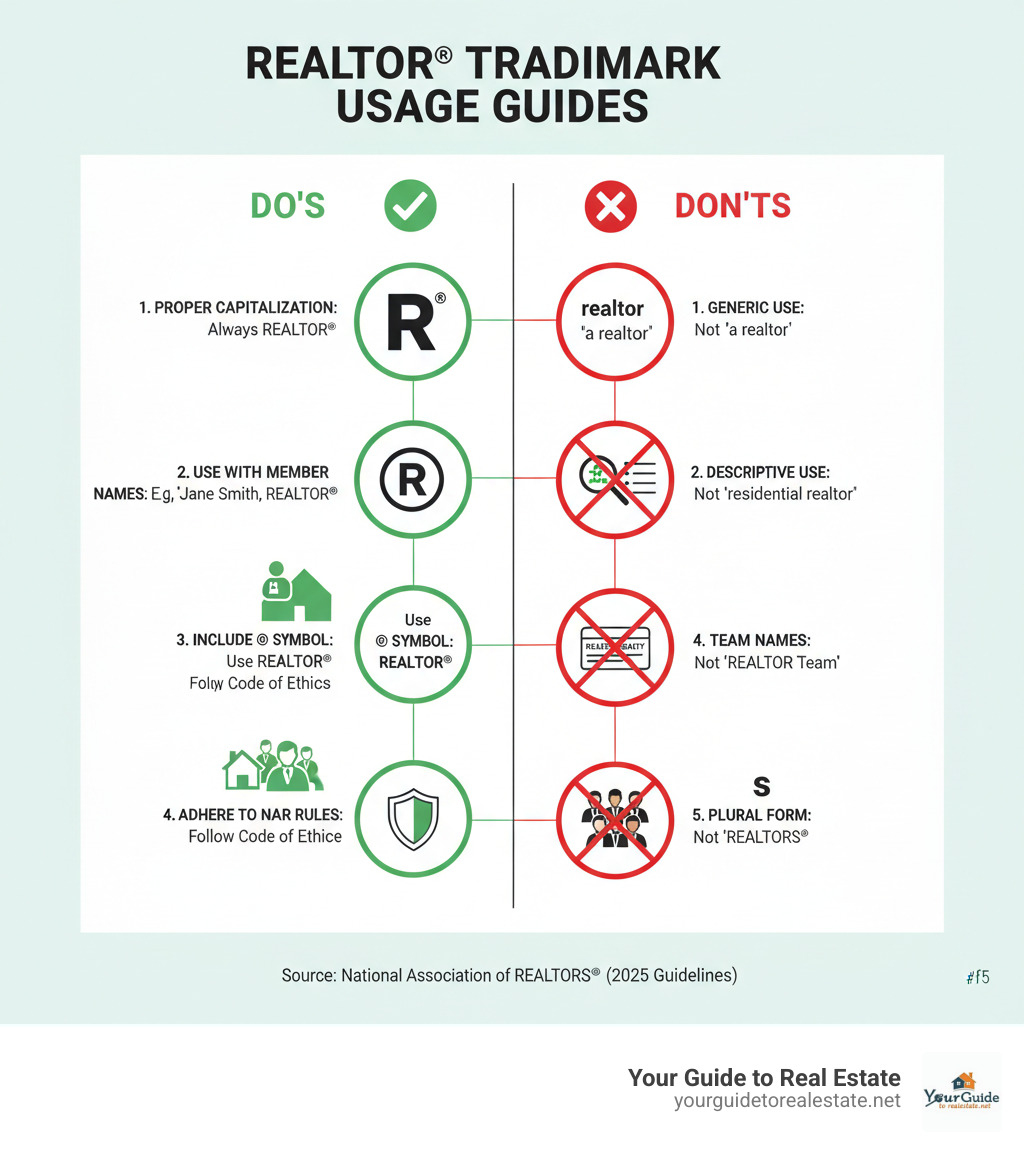
Basic realtor trademark glossary:
Understanding the REALTOR® Trademark: More Than Just a Title
Think of the REALTOR® trademark like a badge of honor in the real estate world. It’s not just another way to say “real estate agent” – it’s actually a federally protected symbol that carries real weight and meaning.
The National Association of REALTORS® (NAR) owns this prestigious mark in the United States, while The Canadian Real Estate Association (CREA) holds the rights in Canada. Both organizations guard this trademark fiercely under federal law, and for good reason.
Here’s what makes this so important: when you see REALTOR® after someone’s name, you’re looking at a professional who has committed to something beyond basic licensing requirements. They’ve pledged to follow a strict Code of Ethics that puts your interests first. It’s like the difference between a regular driver and one who’s taken advanced safety courses – both can get you where you need to go, but one has made an extra commitment to excellence.
The trademark celebrated its 100th anniversary in 2016, which is pretty remarkable when you think about it. For a century, NAR and CREA have worked tirelessly to prevent this term from becoming just another generic word for real estate agent. Without this protection, “realtor” could have ended up like “kleenex” or “band-aid” – useful products that lost their trademark meaning.
This careful protection builds consumer trust. When you’re making one of the biggest financial decisions of your life, knowing your agent has committed to higher ethical standards provides real peace of mind. If you’re wondering about other factors to consider, our guide on how to choose the right real estate agent covers everything you need to know.
What Distinguishes a REALTOR®?
Here’s where things get interesting. Every REALTOR® is a real estate agent, but not every real estate agent is a REALTOR®. It’s a classic “all squares are rectangles” situation.
The key difference lies in NAR membership and the commitment to higher standards. While a regular real estate licensee meets their state’s minimum requirements, a REALTOR® voluntarily joins NAR and agrees to follow additional ethical guidelines.
| Feature | Real Estate Licensee | REALTOR® |
|---|---|---|
| Licensing | State-licensed to facilitate transactions | State-licensed plus NAR membership |
| Ethics | Follows state laws and regulations | Follows state laws and NAR’s Code of Ethics |
| Professional Body | No required association membership | Member of local, state, and national REALTOR® associations |
| Resources | Standard industry tools | Exclusive NAR resources, data, and education |
| Standards | Meets legal minimums | Commits to higher professional standards |
REALTORS® get access to specialized resources that help them serve clients better – things like exclusive market data, legal updates, and continuing education opportunities. These aren’t just nice-to-have perks; they’re tools that help REALTORS® develop the essential real estate agent skills that benefit you as a consumer.
The continuing education aspect is particularly valuable. Real estate laws and market conditions change constantly, and REALTORS® commit to staying current with these developments. This means when you work with a REALTOR®, you’re getting someone who’s actively invested in maintaining their expertise.
The Core Principles of the realtor trademark
The strict protection of the REALTOR® trademark isn’t just legal nitpicking – it serves important purposes that benefit everyone involved in real estate transactions.
Protecting the brand ensures that when you see REALTOR®, it means something specific. Without this protection, anyone could slap the term on their business card, which would make it meaningless for consumers trying to identify qualified professionals.
Preventing genericization is a constant battle. You’ve probably used “kleenex” to mean any tissue or “xerox” to mean photocopy – that’s genericization in action. NAR works hard to prevent “realtor” from becoming a generic term for any real estate agent, because once that happens, the trademark loses its legal protection and its value as a quality indicator.
Consumer trust is perhaps the most important principle. The trademark serves as a shortcut for consumers to identify professionals who’ve committed to higher standards. In a transaction as significant as buying or selling a home, this trust marker provides valuable peace of mind.
Professional identity gives NAR members a recognized credential that sets them apart in the marketplace. It’s a competitive advantage that reflects their commitment to professionalism and ethical conduct.
These principles are spelled out in detail in NAR’s Logos and Trademark Rules, which provide comprehensive guidance on proper usage. These aren’t bureaucratic problems – they’re the foundation that maintains the value and meaning of the REALTOR® designation for both professionals and the consumers they serve.
The Official Rulebook: How to Use the realtor trademark Correctly
Getting the realtor trademark right isn’t just about following rules – it’s about protecting a century-old symbol of trust that consumers recognize and value. Think of it like wearing a uniform properly; every detail matters because it represents something bigger than yourself.
The good news? The rules are straightforward once you understand the why behind them. NAR and CREA created these guidelines to keep the REALTOR® designation meaningful and legally protected. When you follow them correctly, you’re joining thousands of professionals who’ve built this brand’s reputation over the decades.
Capitalization matters more than you might think. The term must always appear as REALTOR® – never “realtor” or “Realtor.” This isn’t about being picky; it’s about maintaining the legal distinction between a trademarked professional designation and a generic term. When you write it in lowercase, you’re essentially treating it like any common word, which weakens its protected status.
The registered trademark symbol (®) isn’t optional. Every time you use REALTOR® in prominent places like business cards, websites, or advertisements, that little ® needs to be there. It’s your legal shield, showing the world that this isn’t just a job title – it’s a protected mark that means something specific.
Here’s where many people get confused: REALTOR® should always accompany a name, never stand alone. Instead of saying “I am a REALTOR®,” try “I am John Smith, REALTOR®” or “I’m a real estate agent and a REALTOR®.” This distinction keeps the mark tied to membership rather than becoming a generic job description.
Punctuation creates clarity. When you write “Sarah Johnson, REALTOR®” or “ABC Realty, REALTORS®,” that comma isn’t just stylistic – it shows that REALTOR® is a separate designation, not part of the actual name. It’s a small detail that makes a big legal difference.
One crucial point that trips up many professionals: you can use REALTOR® with your firm’s marketing name, but it cannot be part of your company’s legal name. So “Smith & Associates, REALTORS®” works perfectly for marketing, but your incorporation papers need to show something like “Smith & Associates, LLC.”
Understanding these rules is essential whether you’re just starting to become a real estate agent or you’re a seasoned professional. They protect both your professional standing and the value of the designation itself.
Official Manuals and Logo Downloads
Nobody expects you to memorize every trademark rule from scratch. That’s why both NAR and CREA provide comprehensive guides that take the guesswork out of proper usage. These aren’t dry legal documents – they’re practical resources designed to help you succeed while staying compliant.
The Membership Marks Manual is your go-to resource for everything realtor trademark related. This detailed guide walks you through real-world scenarios, from writing social media bios to designing business cards. It’s updated regularly to address new questions and technology changes, so you’re always working with current information.
For quick reference, NAR also offers the “On Your Mark” brochure, which distills the most important rules into an easy-to-scan format. Think of it as your cheat sheet for common situations. Canadian members have access to the CREA Trademark Manual, which covers similar ground while addressing specific Canadian regulations and practices.
When it comes to visual materials, quality matters. NAR provides official REALTOR® logo downloads that include high-resolution versions in multiple formats. These aren’t just pretty graphics – they’re legally compliant versions that protect you from inadvertent trademark violations.
The download section includes everything from the standard REALTOR® logo to specialized versions for commercial members, plus the Equal Housing Logo and MLS® Logo. Having access to these official files means you’ll never have to worry about using an outdated or incorrect version.
The REALTOR® Logo and Visual Identity
The iconic Block ‘R’ logo is instantly recognizable to consumers across North America. But like the word REALTOR® itself, this visual symbol comes with specific usage requirements that protect its impact and legal status.
REALTOR® Blue (PMS 293) is the official color, though the logo works beautifully in other high-contrast combinations. The key is making sure it stands out clearly against whatever background you choose. For commercial members, red and gold create an equally striking combination that maintains professional appeal.
Size requirements exist for good reason – the logo needs to remain readable whether someone sees it on your real estate business cards or on a highway billboard. The Block ‘R’, the word REALTOR®, and that crucial ® symbol all need to stay legible. If you’re going big with signage, people should be able to read those registration marks from 20 feet away.
White space around the logo isn’t wasted space – it’s protection space. The official “area of isolation” (equal to half the width of the Block ‘R’) keeps other elements from crowding the logo and diluting its impact. Think of it as giving your professional designation room to breathe and command attention.
These visual standards might seem detailed, but they serve an important purpose. When every REALTOR® follows the same guidelines, consumers develop trust in the consistency and professionalism the mark represents. Your compliance contributes to a brand reputation that benefits everyone who holds the designation.
Putting it into Practice: Trademark Use on Marketing Materials
When you’re ready to put your realtor trademark knowledge to work, your marketing materials become the testing ground. Every business card you hand out, every promotional item you give away, and every sign you post is an opportunity to showcase your professionalism – or accidentally undermine it.
The good news? Once you understand the basics, applying them becomes second nature.

Your business cards are often your first impression with potential clients. They should clearly show your name followed by “REALTOR®” – for example, “Sarah Johnson, REALTOR®.” If you work with a firm that’s comprised of REALTORS®, you might also include “Hometown Realty, REALTORS®.” Capitalization and the ® symbol aren’t optional extras – they’re essential elements that protect the mark’s value.
Promotional items like pens, keychains, and coffee mugs follow the same rules. The realtor trademark should always connect to your name or firm name, never stand alone as a generic term. Yes, fitting everything on a small pen can be challenging, but maintaining the connection between the mark and your identity is what keeps it meaningful.
Signage gives you more space to work with, so use it wisely. Whether it’s a “For Sale” sign, office signage, or a highway billboard, make sure the REALTOR® trademark appears correctly with your name and brokerage. This is also where the Block ‘R’ logo can really shine, following those area of isolation and color guidelines we discussed earlier.
When writing advertising copy for print ads, flyers, or even radio scripts, always capitalize REALTOR® and use it as a membership designation, not a job description. Instead of saying “Your trusted realtor in the area,” try “Your trusted real estate agent and REALTOR® in the area.” It’s a small change that makes a big difference in compliance.
Navigating the realtor trademark on the Internet
The digital world has its own set of challenges when it comes to the realtor trademark. From domain names to social media handles, every online touchpoint needs careful consideration.
Domain names are probably the most misunderstood area. You can absolutely use REALTOR® in your domain, but it must pair with your name or firm name. Think johndoerealtor.com or citywiderealtors.net. What you can’t do is combine it with descriptive words like bestrealtorincity.com or affordablerealtor.org. The lowercase letters in domain names are fine – that’s just how the internet works – but the intent remains to identify you as a member, not describe your services.
Your email addresses follow similar logic. Something like [email protected] works perfectly, while [email protected] doesn’t meet the guidelines.
Social media profiles require extra attention because they’re so visible. Your username might be @JohnDoeREALTOR or @SunshineRealtyREALTORS, but avoid generic handles like @BestRealtorEver. In your bio, write something like “Licensed Real Estate Agent & REALTOR® at Sunshine Realty” rather than “I’m a realtor who loves helping families.”
Throughout your website content, maintain that capitalization and include the ® symbol where appropriate. NAR’s Trademark & Logo Use on the Internet guidelines provide detailed help for digital applications.
The key principle across all digital platforms is using REALTOR® as a membership identifier, not a generic job title. Even if you’re working with a virtual real estate assistant to manage your online presence, make sure they understand these guidelines completely.
Canadian and Provincial Advertising Rules
Our Canadian friends have an additional layer to steer, especially in provinces like Ontario where recent regulatory changes have created new opportunities for using the realtor trademark.
CREA’s Policies and Rules provide the national framework, but here’s what makes it interesting: while adding a job title with REALTOR® is ideal (like “My job is a salesperson. I am also a REALTOR®.”), it’s not always strictly required. You can use the mark alone with your name to show membership. However, if there’s any chance someone might think REALTOR® is your job description rather than your membership designation, then adding a clarifying job title becomes important.
Ontario’s Trust in Real Estate Services Act, 2020, which took effect on October 1, 2020, actually made things clearer for CREA members. You can now use “REALTOR®,” “REALTOR® salesperson,” or “REALTOR® broker” in your advertisements. This aligns beautifully with CREA’s existing policies and gives you clear options for presenting your professional designation while meeting provincial law.
The smart approach is checking both CREA’s Trademark Manual and your provincial regulator’s guidelines. This double-check ensures you’re meeting both your association’s standards and legal requirements, whether you’re working in Vancouver, Toronto, or anywhere else across Canada.
These rules aren’t bureaucratic obstacles – they’re the foundation that keeps the REALTOR® designation meaningful and valuable for everyone who’s earned the right to use it.
Avoiding Pitfalls: Common Misuses and Consequences
Let’s be honest – even with the best intentions, it’s easy to slip up when using the realtor trademark. We’ve seen seasoned agents make these mistakes, and the consequences can be more serious than you might expect.
The most common mistake we encounter? Using “realtor” as a generic term for any real estate agent. It happens all the time in casual conversation. Someone says “I need to find a good realtor in my area,” when they really mean “I need to find a good real estate agent.” REALTOR® specifically identifies someone who’s committed to NAR’s Code of Ethics – it’s not just another word for real estate professional.
Capitalization errors are another frequent stumble. Writing “realtor” in lowercase or “Realtor” without the ® symbol might seem like a small detail, but it actually weakens the trademark’s legal protection. Always use REALTOR® in all caps with the registered symbol, especially in prominent places like business cards and websites.
Here’s where things get tricky: combining REALTOR® with descriptive phrases. NAR’s bylaws are crystal clear – you can’t use phrases like “The #1 REALTOR®” or “Your Premier REALTOR®.” Instead, try “Your #1 real estate agent, who is a REALTOR®” or “Premier real estate service from a REALTOR®.”
Many agents also mistakenly try to incorporate REALTOR® into their firm’s legal business name. This is a no-go. You can use it with your firm’s name (like “Sunshine Realty, REALTORS®“), but it can’t be part of the actual legal entity name.
Perhaps the most serious violation is when non-members use the term. If you’re not a current NAR or CREA member, using REALTOR® is trademark infringement – period. Length of experience in real estate doesn’t matter.
What happens when you mess up? The consequences aren’t just a slap on the wrist. NAR actively monitors trademark usage and can issue cease and desist letters, require corrective actions, impose fines, or even pursue legal action. In severe cases, membership suspension is possible.
We’ve seen agents have to reprint thousands of business cards, redesign websites, and even change domain names. It’s expensive and embarrassing – much easier to get it right from the start.
Spotted a violation? You can report suspected misuse to your local association or NAR directly. This isn’t about being the trademark police – it’s about protecting the value of the designation for everyone who’s earned it.
The bottom line: these rules exist to maintain the realtor trademark’s value and meaning. Following them protects both your professional standing and the integrity of the entire industry.
Frequently Asked Questions about the REALTOR® Trademark
At Your Guide to Real Estate, we hear these questions about the realtor trademark almost daily. Let’s tackle the most common ones together!
Can a real estate agent who is not a member of NAR use the term “realtor”?
This is a big no. The REALTOR® trademark belongs exclusively to members of the National Association of REALTORS® (NAR) in the United States and The Canadian Real Estate Association (CREA) in Canada. These members have committed to following a strict Code of Ethics that goes beyond basic licensing requirements.
Think of it like this: you wouldn’t call yourself a doctor without a medical degree, right? Using REALTOR® without membership is trademark infringement. It’s not just breaking the rules – it’s actually illegal and can result in serious legal consequences.
Non-members should stick to terms like “real estate agent,” “real estate salesperson,” or “real estate broker.” These accurately describe their role without violating trademark law.
What is the difference between REALTOR® and REALTORS®?
This one trips up a lot of people, but it’s actually pretty straightforward! REALTOR® refers to one individual member. You’d say “Sarah Johnson, REALTOR®” when talking about a single person.
REALTORS® is the plural form. You use it for firms or groups of members. For example, “ABC Real Estate, REALTORS®” or “The team of REALTORS® worked together on the complex transaction.”
Both versions must always be capitalized and include the ® symbol in prominent uses. It’s like the difference between “student” and “students” – same concept, different numbers.
Do the rules apply to social media usernames?
Absolutely! The realtor trademark rules follow you everywhere – including Instagram, Facebook, Twitter, and LinkedIn. Your digital presence needs to comply just like your business cards and yard signs.
Your username should connect the mark with your actual name or firm name. Something like @JaneDoeREALTOR or @SunshineRealtyREALTORS works perfectly.
What doesn’t work? Generic usernames like @BestDallasRealtor or @YourNeighborhoodRealtor. These use the trademark as a description rather than identifying you as a specific member.
The same goes for your bio and posts. Always use REALTOR® as your professional designation, not as a generic job title. Your followers should understand that this mark represents your membership and commitment to higher ethical standards.
Social media might feel casual, but trademark law doesn’t take a break for Instagram stories!
Conclusion
The realtor trademark represents something far more meaningful than just professional terminology—it’s a century-old promise of integrity, ethical standards, and genuine commitment to serving clients with excellence. When you see those distinctive capital letters followed by the ® symbol, you’re looking at a mark that has weathered decades of careful protection and unwavering dedication to quality.
At Your Guide to Real Estate, we’ve seen how understanding the realtor trademark transforms both professional success and client relationships. It’s not about memorizing rules for the sake of compliance—it’s about embracing what makes this designation truly special. When REALTORS® follow proper usage guidelines, from correct capitalization to appropriate context in marketing materials, they’re participating in something bigger than themselves.
Think about it: every time a REALTOR® uses their mark correctly, they’re building consumer trust one interaction at a time. Clients learn to recognize that distinctive designation as a signal of reliability and ethical conduct. This collective effort strengthens the entire profession and helps maintain the competitive advantage that comes with NAR or CREA membership.
The beauty of these guidelines lies in their purpose. They’re not bureaucratic problems—they’re the foundation that keeps the realtor trademark valuable and meaningful. When members consistently follow the rules about proper punctuation, appropriate use with names and firm names, and correct application across all marketing channels, they preserve something precious for future generations of real estate professionals.
For those ready to take their real estate business to the next level, understanding trademark compliance is just the beginning. Learn more about building your business in our Virtual Real Estate Brokerage guide and find how proper professional practices create lasting success.
The realtor trademark isn’t just about following rules—it’s about being part of a tradition that puts clients first and maintains the highest standards in an industry built on trust.