Getting Your Real Estate License: The Gateway to Your Real Estate Career
A real estate license is your legal authorization to represent buyers and sellers in property transactions, and it’s the mandatory first step to starting your career in real estate. Whether you’re looking to help families find their dream homes or build a thriving real estate business, obtaining your license opens the door to this dynamic industry.
Quick Answer: What You Need to Know About Real Estate Licenses
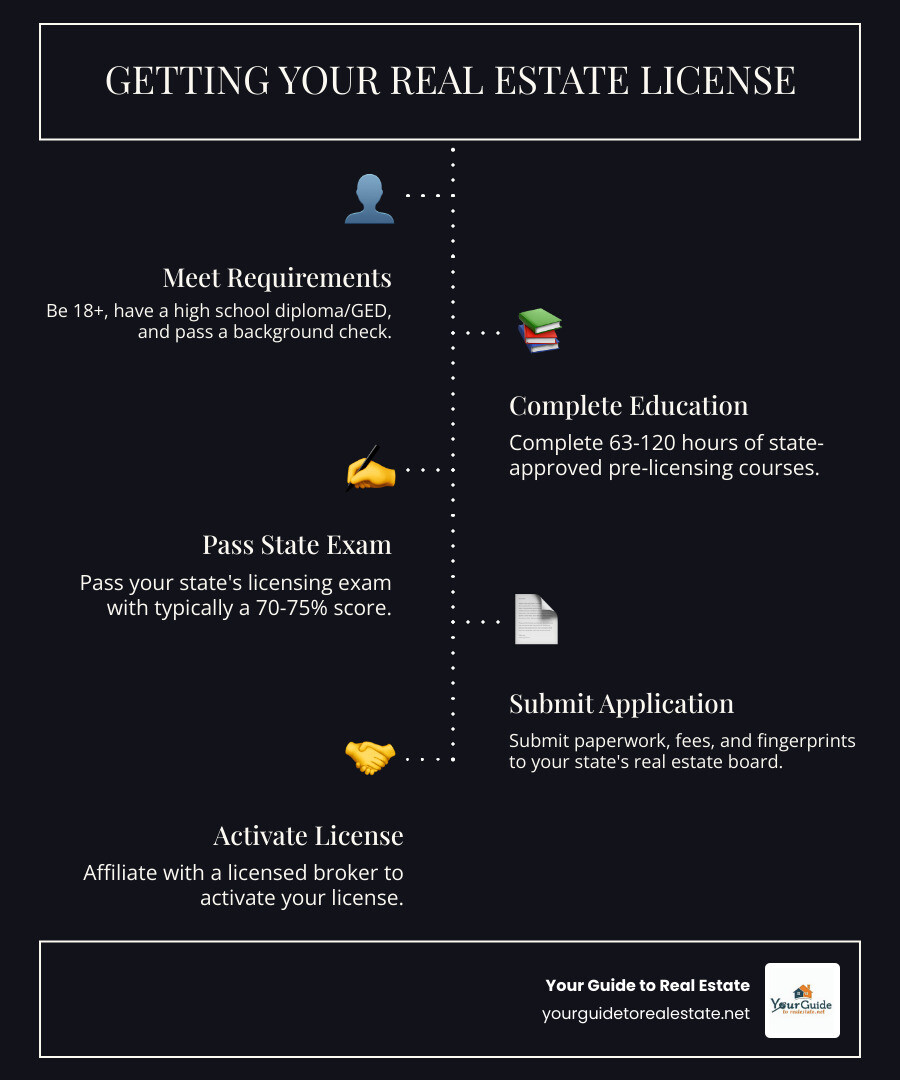
- Minimum Requirements: Be 18+, have a high school diploma/GED, and pass a background check
- Education: Complete 63-120 hours of state-approved pre-licensing courses (varies by state)
- Exam: Pass your state’s licensing exam with typically a 70-75% score
- Application: Submit paperwork, fees, and fingerprints to your state’s real estate board
- Activation: Affiliate with a licensed broker to activate your license
- Timeline: 2-5 months from start to finish
- Cost: $300-$600 total investment
Getting licensed isn’t just about passing a test – it’s about joining a profession that helps people make one of the biggest decisions of their lives. As one successful agent put it: “The real estate exam definitely needs to be taken seriously.” But with proper preparation and understanding of the process, thousands of people successfully earn their licenses each year.
This guide walks you through every step of the licensing process, from choosing your education provider to finding your first brokerage. We’ll break down the costs, timeline, and requirements so you know exactly what to expect on your journey to becoming a licensed real estate professional.
Simple guide to real estate license terms:
Understanding Real Estate License Types and Roles
Before you dive into getting your real estate license, it’s important to understand the different types of licenses available and what each one means for your career path. Think of it like choosing your character in a video game – each role has different powers, responsibilities, and requirements.
The real estate world has three main players: Sales Associates, Brokers, and Broker Associates. While they’re all licensed professionals, their day-to-day responsibilities and career paths look quite different.
A Sales Associate is essentially someone who can perform all the core real estate activities – like helping buyers find homes, listing properties for sellers, and negotiating deals – but they must work under the supervision of a licensed broker. It’s like being a skilled craftsperson who works for an established company.
A Broker, on the other hand, has reached the next level. They can do everything a sales associate does, plus they can operate independently, manage their own real estate office, and supervise other licensees. Think of them as the business owner who can hire and guide other real estate professionals.
Then there’s the Broker Associate – this is someone who has earned their broker’s license but chooses to work under another broker rather than starting their own brokerage. They have the advanced credentials but prefer the support structure of working with an established company.
Want to see what these professionals actually do all day? Check out our guide on The Day-to-Day Life of a Real Estate Agent: What You Didn’t Know for the real scoop.
| Feature | Real Estate Sales Associate | Real Estate Broker |
|---|---|---|
| Requirements | Pre-licensing education, state exam, background check | Sales Associate experience, advanced education, broker state exam |
| Responsibilities | Representing buyers/sellers, showing properties, writing offers (under broker supervision) | Managing a brokerage, supervising agents, handling trust accounts, complex transactions |
| Autonomy | Works under a licensed broker | Can operate independently, manage their own firm, employ agents |
| Entry Level | Yes | Advanced, requires prior experience |
Sales Associate: Your First Step
Getting licensed as a sales associate (often called a “real estate agent” in everyday conversation) is where almost everyone starts their real estate journey. It’s your entry ticket to the industry, and honestly, it’s an exciting place to begin.
As a sales associate, you’ll work under the guidance of a licensed broker who acts as your mentor and supervisor. This isn’t a limitation – it’s actually a huge advantage when you’re starting out. Your broker provides the experience and oversight that helps you steer those tricky first transactions without making costly mistakes.
Your daily life will be filled with variety: showing homes to excited buyers, helping sellers prepare their properties for market, writing offers, and celebrating with clients when deals close. It’s a people-focused career that requires a diverse skill set. If you’re wondering whether you have what it takes, our article on Real Estate Agent Skills breaks down exactly what you’ll need to succeed.
The best part? You’re not stuck in this role forever. Most sales associates use this time to learn the business, build their client base, and decide whether they want to eventually become brokers themselves.
Broker: The Next Level
After you’ve spent some time as a sales associate – typically 24 months of active experience – you can take the leap to become a broker. This is where things get really interesting from a career development standpoint.
As a broker, you gain the freedom to manage your own brokerage, hire and supervise other agents, and take on more complex transactions. You’re no longer just helping individual clients – you’re building a business and potentially leading a team.
The responsibilities expand significantly too. Brokers handle trust accounts (where client money is held), manage compliance issues, and often deal with the most challenging transactions that require advanced expertise. It’s definitely more responsibility, but it also comes with greater earning potential and professional autonomy.
Many agents dream of this role because it represents true entrepreneurial freedom in real estate. If you’re thinking this might be your eventual goal, our comprehensive guide on becoming a Real Estate Broker will give you all the details about making this career transition.
Your Step-by-Step Guide to Getting Licensed
Getting your real estate license might seem overwhelming at first, but it’s really just following a proven path that thousands of people take every year. Think of it like learning to drive – once you know the steps, it becomes much more manageable.
While each state has its own specific requirements, the basic process is surprisingly similar no matter where you live. We’ll use Florida as our main example throughout this guide since they have clear, well-documented procedures that represent what you’ll find in most states.
The journey to your real estate license follows four main steps: meeting basic requirements, completing your education, passing the state exam, and finding a broker to activate your license. Let’s walk through each one together.
Step 1: Meet the Basic Eligibility Requirements
Before you start studying or filling out applications, you need to make sure you qualify for a license in the first place. The good news? Most people meet these requirements without any issues.
You must be at least 18 years old – no exceptions here. You’ll also need a high school diploma or GED to prove you have basic educational qualifications. Every state requires a U.S. Social Security number for licensing purposes.
The one requirement that catches some people off guard is the background check. States want to ensure that licensed agents have good moral character, which makes perfect sense when you think about it. You’ll be handling other people’s biggest financial transactions, so they want to know you’re trustworthy.
This background check involves electronic fingerprinting, and yes, they do a thorough review. If you have any criminal history, don’t panic – full honesty on your application is always the best approach. Many states review applications on a case-by-case basis.
Step 2: Complete Pre-Licensing Education
This is where you’ll learn everything you need to know about real estate law, contracts, ethics, and market practices. In Florida, you need 63 hours of state-approved courses, though other states vary widely – some require as few as 40 hours while others mandate 120 or more.
Your coursework will cover essential topics like real estate principles, property law, contracts, financing, and ethics. These aren’t just random subjects – they’re the foundation of everything you’ll do as a licensed agent.
You have flexibility in how you complete these hours. Many people choose online courses because they can study around their current job schedule. Others prefer traditional classroom settings for the face-to-face interaction. Some schools offer live online classes that give you the best of both worlds.
Florida makes it easy to find approved programs through their Sales Associate Pre-Licensure Education database. Look for schools that offer mobile-friendly platforms and 24/7 access if you need maximum flexibility.
At the end of your coursework, you’ll take a course final exam. Most schools require a 70% or higher to pass, and they typically allow retakes if needed.
Step 3: Submit Your Application and Pass the State Exam
Now comes the official part – applying for your license and proving you know your stuff on the state exam.
Electronic fingerprinting usually comes first. In Florida, you’ll submit fingerprints to the Department of Business and Professional Regulation (DBPR) using the specific code FL920010Z. Pro tip: submit your fingerprints about 5 days before your license application to avoid delays. You can make an appointment online for fingerprinting at any IdentoGO location.
Your license application goes to your state’s real estate board next. This includes all your personal information, education details, and background disclosures. Application approval typically takes 2-4 weeks, so patience is important here.
Once approved, you’ll receive a candidate ID number that lets you schedule your state exam. Most states use testing companies like Pearson VUE to handle exam scheduling and administration.
The state exam itself covers both national real estate principles and your specific state’s laws. In Florida, you’ll face 100 multiple-choice questions and need 75% to pass. This isn’t a casual quiz – it’s a serious test that requires dedicated preparation with study guides and practice exams.
Step 4: Activate Your License with a Sponsoring Broker
Congratulations on passing your exam! But here’s something that surprises many new licensees – you can’t start working yet. Your license exists, but it’s inactive until you affiliate with a licensed real estate broker.
This isn’t just a formality. The broker you choose will provide training, support, and supervision as you start your career. They’ll also handle the legal and financial aspects of your transactions.
Finding the right brokerage is crucial for your success. You’ll want to consider their training programs, commission structure, office culture, and the technology they provide. Some brokers offer extensive mentorship programs that can be invaluable for new agents.
If you’re not sure what to look for in a brokerage, our guide What is a Real Estate Brokerage? A Beginner’s Complete Guide explains how these companies work. We also have specific advice in our Top 5 Things to Look For When Choosing a Real Estate Brokerage as a New Agent article.
Don’t be shy about interviewing multiple brokers. Ask about their commission splits, what fees you’ll pay, what training they offer, and how they support new agents. The right broker can make your first year much smoother and more profitable.
The Costs and Timeline for Your Real Estate License
Let’s talk money and time – the two things everyone wants to know about when considering a real estate license. The good news? Getting licensed is surprisingly affordable, and the timeline is shorter than you might think. Think of it as investing in your future rather than just another expense.

Most people can expect to invest between $300 to $600 total to get their real estate license, and the entire process typically takes 2 to 5 months from start to finish. Of course, these numbers can vary depending on which state you’re in and how quickly you move through each step.
Breaking Down the Costs of a real estate license
The biggest chunk of your investment will go toward your pre-licensing education, which makes sense since this is where you’ll gain all the knowledge you need to succeed. Pre-licensing course fees typically range from $150 to $500, depending on whether you choose online or in-person classes and what extras are included (like exam prep materials).
Your state’s application fee is usually pretty reasonable, running around $40 to $90. In Florida, for example, you’ll pay about $39 to $89 to have your application processed by the Department of Business and Professional Regulation.
The background check and fingerprinting will cost you roughly $50 to $60. This might seem like a small expense, but it’s a crucial step that ensures the industry maintains high standards. Florida residents can expect to pay around $50 to $58 for this requirement.
Finally, there’s the state exam fee, which typically falls between $35 to $60. In Florida, you’re looking at about $37 to $58 to take your licensing exam. Not too bad for the chance to launch your new career!
When you add everything up, Florida residents can expect to invest approximately $325 to $375 for their initial real estate license. This is just your starting investment – you’ll have ongoing costs for continuing education and license renewals down the road.
How Long Does It Take to Get Licensed?
Here’s where things get exciting – you could be holding your real estate license in as little as 2 months if you’re really focused! Most people take between 2 to 5 months to complete the entire process, but your timeline depends on how quickly you work through each step.
The course completion phase offers the most flexibility in your timeline. Florida’s 63-hour requirement can be knocked out in just 3 weeks if you’re highly motivated, especially with self-paced online options. Most students take around 45 days to finish their coursework, but there’s no shame in taking longer if you need it. Some prefer to spread it out over several months to really absorb the material.
Once you submit your application, approval typically takes 10 days to 2 weeks in most states. Florida’s Department of Business and Professional Regulation usually processes applications within about 10 days, though it can sometimes stretch to 2-4 weeks during busy periods.
Scheduling and taking your state exam is usually the quickest part – about 1 to 2 weeks from approval to exam day. In Florida, the average is around 8 days, which gives you just enough time to do some final cramming!
The bottom line? Most Florida residents can expect to have their real estate license in hand within about 10 weeks (70 days) if they stay on track. That’s less than three months from starting your education to holding your license – pretty amazing when you think about it!
Your personal timeline will depend on your schedule, how quickly you absorb the material, and how efficiently your state processes applications. But with some dedication and planning, you’ll be ready to start your real estate career sooner than you might expect.
Maintaining and Advancing Your Career
Earning your initial real estate license is just the beginning of what can be an incredibly rewarding career journey! Think of it as getting your driver’s license – you’ve proven you know the basics, but the real learning happens when you’re out on the road. The real estate industry never stands still, with new laws, technologies, and market trends constantly reshaping how we do business.

That’s why states require ongoing education and provide pathways for career advancement. Whether you’re looking to stay current with your real estate license, advance to become a broker, or expand into new markets, there’s always room to grow in this dynamic field.
Post-Licensing and Continuing Education (CE)
Your education doesn’t end when you pass that state exam – in fact, it’s just getting started! States want to make sure you stay sharp and up-to-date with the latest industry standards and legal requirements.
First renewal requirements are often the most intensive. If you’re a new licensee in Florida, you’ll need to complete 45 hours of post-licensing education before your first renewal, while brokers need 60 hours covering Broker Investment and Broker Management topics. Kentucky requires 48 hours within your first two years, and New Mexico mandates 30 hours of post-licensing education plus an additional 36 hours of continuing education. Ohio keeps it simpler with 20 hours for salespersons and 10 hours for brokers within the first 12 months.
Here’s something important to remember: missing these deadlines isn’t just an inconvenience – it can make your license null and void. So mark those calendar dates clearly!
Once you’ve completed your initial post-licensing requirements, you’ll settle into a regular continuing education cycle. Florida requires 14 hours of CE every two years for active licensees. New Mexico stretches it out to 36 hours every three years, while Ohio requires 30 hours every three years for both salespersons and brokers.
Most states emphasize core law and ethics within these requirements, ensuring you stay current with legal changes and maintain high ethical standards. Interestingly, Florida Bar members in good standing are actually exempt from the 14-hour CE requirement – a nice perk for those with legal backgrounds!
Renewing your license has become much easier with online portals. We recommend setting up your online account early and keeping your contact information current. You can Find Continuing Education Courses through your state’s official channels, making it convenient to stay compliant.
Upgrading Your real estate license to a Broker
After working as a sales associate and gaining valuable experience, many agents set their sights on becoming a broker. It’s a natural progression that opens doors to greater independence, business ownership, and the ability to mentor other agents.
The path to becoming a broker requires both experience and additional education. In Florida, you’ll need 24 months of active licensure within the past five years. Ohio requires two of the last five years as an active salesperson. This experience requirement makes sense – states want to ensure you’ve handled real transactions and understand the business from the ground up.
Advanced education requirements are more comprehensive than your initial licensing courses. Florida requires 72 hours of specialized broker coursework. Ohio gets specific about what you need to learn, requiring courses in Financial Management, Human Resources and Personnel Management, Applied Business Economics, and Business Law, alongside core real estate subjects.
Just like your original license, you’ll need to pass a broker exam that’s typically more challenging and comprehensive than the sales associate test. This exam tests not just your real estate knowledge, but your understanding of business management and supervision responsibilities.
The broker you choose to work under as a sales associate can significantly influence your preparation for this next step. Our guide on How to Choose a Broker as a Real Estate Agent provides valuable insights for making this important decision.
License Reciprocity and Mutual Recognition
What happens when you want to expand your real estate practice across state lines? This is where reciprocity and mutual recognition agreements become your best friend.
Working in multiple states typically requires separate licenses, since real estate law varies significantly from state to state. However, many states have created agreements to make this process easier for experienced agents.
Reciprocity agreements allow licensed professionals from one state to obtain a license in another state with reduced requirements. You might skip some pre-licensing education hours, but you’ll still need to pass the new state’s law exam and complete a background check.
Florida has mutual recognition with 10 states: Alabama, Arkansas, Connecticut, Georgia, Illinois, Kentucky, Maryland, Mississippi, Nebraska, and Oklahoma. If you hold an active license in any of these states, you can qualify for a Florida license by passing a 40-question Florida real estate law exam (you need 30 correct answers). New Mexico has formal agreements with Georgia, Louisiana, and Massachusetts.
These agreements can change over time, so always verify current requirements with your target state. For Florida’s program details, check the Sales Associate Mutual Recognition (RE 1) section on the DBPR website.
Expanding into new markets is an exciting opportunity, but each state has its own unique laws, customs, and market conditions. Take time to understand these differences – your clients will appreciate the extra knowledge and professionalism you bring to their transactions.
Frequently Asked Questions about the Licensing Process
Let’s be honest – getting your real estate license probably feels a bit overwhelming right now. You’re not alone in having questions! We’ve helped thousands of people through this process, and these are the three questions that come up again and again. Let’s tackle them head-on so you can move forward with confidence.
How hard is the real estate exam?
Here’s the truth: the real estate license exam isn’t something you can just show up and wing. It requires dedicated study and preparation, but it’s absolutely achievable with the right approach.
The difficulty varies by state, but most exams follow a similar format. Take Florida, for example – you’ll face 100 multiple-choice questions covering everything from national real estate principles to specific state laws, and you need to score 75% to pass. The good news? If you don’t pass on your first try, you can retake it the very next day for $57.75, with no limit on attempts.
Nationwide, pass rates for first-time takers hover around 50-60%. Before you panic, proper preparation makes all the difference. Students who invest in solid exam prep courses often see their passing chances increase by more than 40%. The key is treating this seriously from day one – our proven framework and stress-free guidance are designed to help you prepare effectively, not just memorize facts.
Can I get a license with a criminal record?
This is a tough but important question, and we appreciate your honesty in asking it. The answer depends on your state and the nature of your past conviction, but having a criminal record doesn’t automatically disqualify you from getting your real estate license.
Every state requires a criminal background check because they’re looking for “good moral character” in their licensees. Real estate involves handling large sums of money and earning people’s trust during major life decisions, so this scrutiny makes sense.
Here’s what matters most: complete honesty on your application. Trying to hide your past is almost always worse than the original offense and can lead to immediate denial. State boards like Florida’s DBPR review each case individually, typically focusing on crimes involving financial fraud, moral turpitude, or anything that questions your trustworthiness in real estate transactions.
If you have a criminal record, contact your state’s real estate commission directly before investing time and money in the process. They can give you specific guidance about how your situation might affect your application. Many people with past mistakes have successfully obtained their licenses – transparency and demonstrating personal growth go a long way.
How much do real estate agents make?
Ah, the question everyone wants answered! The reality is that real estate license holders work on commission, which means your income potential is directly tied to your effort, market knowledge, and dedication. There’s no guaranteed salary, which can be both exciting and nerve-wracking.
Your earnings depend on several key factors. Market activity plays a huge role – busy markets with lots of transactions mean more opportunities for you. Location matters too – agents in high-cost areas often see higher commission dollars per transaction. Experience is everything – new agents typically earn less while building their client base, while seasoned professionals with strong networks can command substantial incomes.
Don’t forget about specialization. Some agents focus on luxury homes, others on first-time buyers, and some dive into commercial properties or property management. Each niche has different income potential.
Your brokerage relationship also impacts your take-home pay significantly. The commission split you negotiate with your sponsoring broker directly affects what you keep from each transaction.
We believe in setting realistic expectations from the start. While the potential for high earnings absolutely exists in real estate, building a successful career takes time, hard work, and persistence. For detailed numbers and real-world examples of what agents actually earn, check out our comprehensive breakdown: How Much Do Real Estate Agents Really Make With Real Numbers?.
Conclusion
Congratulations! You’ve just walked through the complete roadmap to earning your real estate license – and what an exciting journey it is. From understanding the difference between sales associates and brokers to mastering the four essential steps of getting licensed, you now have everything you need to transform your career dreams into reality.
Getting your real estate license isn’t just about checking boxes or passing an exam (though that 75% passing score is definitely important!). It’s about joining a profession where you’ll help families find their perfect homes, assist investors in building wealth, and guide people through one of the biggest financial decisions of their lives. That’s pretty amazing when you think about it.
This journey requires commitment to education and ethics – two pillars that will serve you well throughout your entire career. Whether you’re spending those 63 hours in pre-licensing courses, studying for your state exam, or completing your continuing education years down the road, you’re building the foundation for a profession that rewards knowledge and integrity.
The path ahead might seem challenging at times. Yes, you’ll invest $300-$600 and dedicate 2-5 months to the process. You’ll need to find the right sponsoring broker and commit to lifelong learning. But here’s the beautiful part: thousands of people successfully earn their licenses every year, and many go on to build thriving, fulfilling careers in real estate.
At Your Guide to Real Estate, we believe in your success. We’ve been here with you through every step of this guide, and we’ll continue to be your trusted resource as you grow in the industry. Our proven framework and stress-free guidance don’t stop once you get licensed – they’re designed to support you throughout your entire real estate journey.
Ready to take that first step into your new career? The real estate world is waiting for you, and we think you’re going to do amazing things. Consider exploring a career with a virtual real estate brokerage to see how modern technology can give you the flexibility and support you need to thrive from day one.
Your real estate license is more than a piece of paper – it’s your key to a dynamic, rewarding future. Now go out there and open up it!