

Why Some Will See Two SSI Checks in November
November SSI payments will arrive twice this month for millions of Americans, but this isn’t a bonus – it’s simply a calendar quirk that affects the payment schedule.
Quick Answer for November 2024 SSI Recipients:
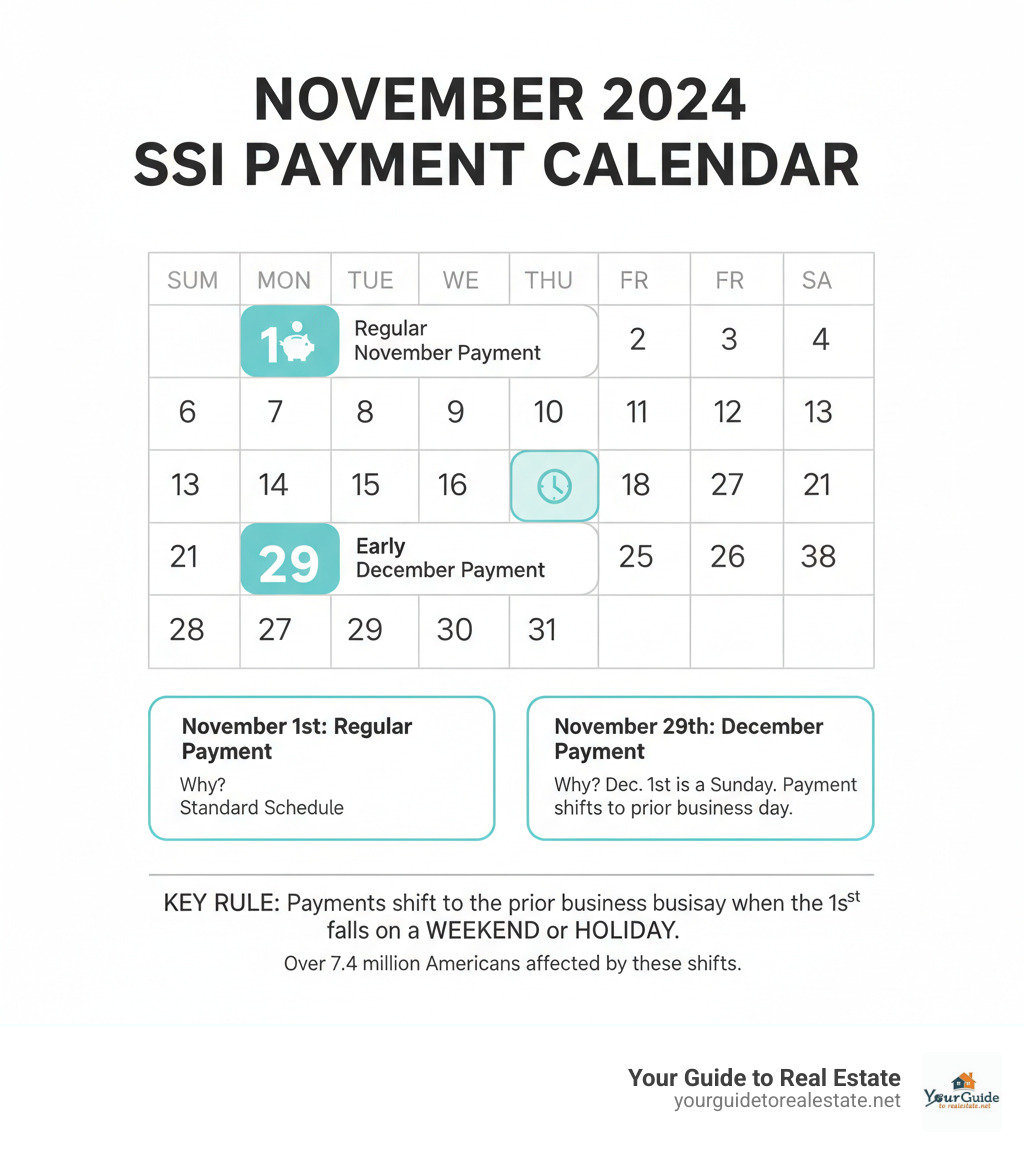
- November 1, 2024: Your regular November SSI payment
- November 29, 2024: Your December SSI payment (early because Dec. 1 falls on Sunday)
- Why two payments: SSA pays early when the 1st falls on weekend/holiday
- Total recipients affected: Over 7.4 million Americans receive SSI
Here’s what’s happening: The Social Security Administration (SSA) follows a strict rule about payment timing. Since December 1, 2024 falls on a Sunday, your December SSI check gets moved to the last business day before – which is Friday, November 29th.
This means you’ll receive your regular November payment on November 1st, then get your December payment three weeks later on November 29th. It’s not extra money – just your December check arriving early.
Supplemental Security Income (SSI) normally arrives on the first day of each month. But when that date lands on a weekend or federal holiday, the SSA shifts the payment to the previous business day. This scheduling adjustment helps ensure recipients don’t face delays in accessing their benefits.
For the more than 7.4 million Americans who depend on SSI, understanding these payment shifts is crucial for managing monthly expenses and budgeting effectively.
Know your november ssi payments terms:
Your Guide to the November 2024 SSI Payments
If you’re wondering about your november ssi payments, you’re not alone. This month brings something special – two payments landing in your account. Don’t worry, it’s not a mistake or a system glitch. It’s simply how the calendar works with Social Security’s payment rules.

Let’s walk through exactly what to expect and when your money will arrive. Understanding these dates helps you plan your monthly budget better, especially during this unusual payment month.
The First of Two November SSI Payments
Your first payment arrives exactly when you’d expect it. November 1st, 2024 brings your regular monthly SSI check, just like clockwork. This payment covers your November expenses and follows the normal schedule you’re used to.
Most people receive their SSI through direct deposit, which means the money hits your bank account on November 1st. If you’re one of the folks who still gets mailed checks, give yourself a few extra days for delivery. The post office is pretty reliable, but it’s always smart to plan for a slight delay.
This first payment is your standard monthly benefit – nothing fancy, just the dependable support that helps cover your essential needs throughout November.
The Second November SSI Payment: Your Early December Check
Here’s where things get interesting. On November 29th, 2024, you’ll see another SSI payment in your account. Before you start planning how to spend this “bonus,” let me explain what’s really happening.
This second payment isn’t extra money for November. It’s actually your December 2024 check arriving early. The reason is pretty straightforward – December 1st falls on a Sunday this year.
The Social Security Administration has a simple rule: when the 1st of the month lands on a weekend or holiday, they send your payment on the last business day before. Since December 1st is a Sunday, your December payment gets moved up to Friday, November 29th. It’s the SSA’s way of making sure you don’t have to wait extra days for your benefits.
This means you’ll have your December money before December even starts. That’s helpful for paying bills early, but remember – you won’t get another payment in December. Your next check after November 29th will arrive on January 1st, 2025.
You can double-check all these dates in the official 2024 payment schedule issued by the SSA if you want to see it in black and white.
Understanding the SSI Calendar: Why Payment Dates Shift
If you’ve ever wondered why your november ssi payments don’t always arrive exactly when you expect them, you’re not alone! The Social Security Administration operates on a schedule that’s designed to help you, but it can feel a bit like trying to solve a puzzle sometimes. The good news is that once you understand the pattern, you’ll be able to plan your finances with much more confidence.

The SSA follows one simple rule that drives everything: if the first day of the month falls on a weekend or federal holiday, your payment moves to the last business day before. It’s that straightforward! This policy exists because the government wants to make sure you get your money as quickly as possible, without having to wait for banks and government offices to reopen after weekends or holidays.
Think of it like this – the SSA would rather give you your money a day or two early than make you wait an extra day or two late. That’s actually pretty thoughtful when you think about it, especially since so many people depend on these payments for essential expenses like rent, groceries, and utilities.
How the SSI Schedule Differs from Regular Social Security
Here’s where things get interesting, and honestly, a bit confusing for many people. SSI payments work completely differently from regular Social Security retirement benefits, even though they’re both handled by the same government agency.
SSI payments are beautifully simple – they’re scheduled for the 1st of every month. No birth dates to remember, no complicated calculations. Just the first day of the month, with those weekend and holiday adjustments we talked about.
Regular Social Security payments follow a totally different playbook. Your payment date depends entirely on when you were born. If your birthday falls between the 1st and 10th, you’ll get paid on the Second Wednesday of each month. Born between the 11th and 20th? Your payment arrives on the Third Wednesday. And if your birthday is between the 21st and 31st, expect your check on the Fourth Wednesday.
Now, if you’re lucky enough to receive both SSI and Social Security benefits (these folks are called dual recipients), you’ll get two separate payments each month. Your Social Security typically arrives on the 3rd of the month, while your SSI comes on the 1st. It’s like getting a financial one-two punch that can really help with monthly budgeting.
For anyone wanting to stay on top of all the latest changes and updates, our Social Security news section is a great resource to bookmark.
A Look Ahead: Early Payments in 2025
The calendar quirks that brought you two november ssi payments this year aren’t going anywhere. In fact, 2025 has several months lined up where you’ll see this same pattern repeat itself.
January starts the year with an early arrival – your January 2025 payment will actually show up on December 31, 2024. Why? Because January 1st is New Year’s Day, and nobody’s working at the bank that day! Then February’s payment comes early too, arriving on January 31, 2025 since February 1st falls on a Saturday.
Here’s where it gets really important to pay attention: May, August, and November 2025 will all be double-payment months. In May, you’ll get your regular May payment on the 1st, then your June payment early on May 30th because June 1st is a Sunday. August brings your regular August payment plus your September payment early on August 29th (September 1st is Labor Day). And November delivers your regular November payment plus your December payment early on October 31st since November 1st is a Saturday.
The flip side means some months will have zero payments – specifically June, September, and November 2025. This isn’t the SSA forgetting about you or making a mistake. You’ll have already received those payments in the previous month.
This is why budgeting becomes so crucial. When you get two payments in one month, you need to make sure you set aside enough from that second payment to cover the following month when no payment will arrive. It’s like getting your allowance early – great in the moment, but you need to make it last!
The official 2025 SSA calendar has all these dates clearly marked if you want to plan ahead. Many recipients find it helpful to circle these dates on their personal calendars and set up reminders to help with budgeting throughout the year.
SSI Eligibility, COLA, and Benefit Amounts for 2025
Beyond knowing when your payments arrive, understanding who qualifies for SSI and how much they receive is equally important. This section dives into the financial heart of the SSI program, including the all-important Cost-of-Living Adjustment (COLA) and the maximum benefit amounts for the upcoming year.

Who is Eligible for SSI?
Supplemental Security Income isn’t available to everyone – it’s specifically designed for people who truly need financial help. Think of SSI as a safety net that catches those who fall through the cracks of other programs.
To qualify for SSI, you need to meet some pretty strict requirements. First, your income must be very limited. The Social Security Administration looks at how much money you bring in each month from work and other sources. Generally, if you’re earning more than $1,971 from work each month, you’ll likely exceed the income limits (though this can vary based on other factors and exclusions).
Your assets also matter. The SSA sets resource limits at $2,000 for individuals and $3,000 for couples. Before you panic about your car or home, know that certain things don’t count toward these limits – like your primary residence and one vehicle you use for transportation.
You also need to fit into one of three categories: be 65 or older, be legally blind, or have a qualifying disability. The disability requirement applies to both adults and children, and it’s pretty specific – the SSA defines it as a severe physical or mental condition that prevents substantial work and is expected to last at least 12 months or result in death.
Finally, you need to be a U.S. citizen or qualified non-citizen living in one of the 50 states, Washington D.C., or the Northern Mariana Islands. It’s a program designed to support the most vulnerable among us, and if you think you might qualify, it’s worth exploring your options. You can find detailed information about who is eligible for SSI directly from the SSA.
How the 2025 COLA and Maximum Payments Affect You
Every year, the Social Security Administration gives benefits a boost to help keep up with rising costs. This adjustment, called the Cost-of-Living Adjustment or COLA, ensures your november ssi payments and other benefits don’t lose their buying power as prices go up.
For 2025, there’s good news: benefits will increase by 2.5%. This might not sound like a huge jump, but every dollar counts when you’re managing a tight budget. The COLA affects all SSA-administered benefits, including both SSI and regular Social Security.
With this 2.5% increase, the maximum federal SSI payments for 2025 are $967 per month for individuals and $1,450 per month for couples. These are the highest amounts you can receive from the federal government through SSI.
That your actual payment might be lower than these maximums. The SSA reduces your benefit based on any other income you have and your living situation. If someone else pays for your food or shelter, for example, your payment will be reduced.
There’s also a special category for what the SSA calls an “essential person” – someone who lives with an SSI recipient and provides necessary care. In 2025, the payment for an essential person will be around $484 per month.
This COLA increase is a crucial part of financial planning for SSI recipients. It helps ensure that your benefits continue to provide meaningful support as the cost of everything from groceries to utilities goes up. For more insights into how these changes impact various Social Security programs, check out our detailed article on What Changes Are Coming to Social Security in 2025?
Comparing SSI vs. Social Security Retirement Benefits
Many people use “Social Security” as a catch-all term, but there’s actually a big difference between Supplemental Security Income (SSI) and regular Social Security retirement benefits. Understanding this distinction is crucial for managing your financial future.
The fundamental difference lies in how you qualify. SSI is a needs-based program – it doesn’t matter if you’ve never worked a day in your life. If you meet the income, resource, and disability or age requirements, you can receive SSI. Social Security retirement benefits, on the other hand, are earned benefits based on your work history and the taxes you’ve paid into the system over the years.
Funding sources also differ completely. SSI comes from general tax revenues – the same pot that funds other government programs. Social Security retirement benefits come from a dedicated trust fund that workers and employers pay into through payroll taxes.
The payment schedules work differently too. As we’ve seen with your november ssi payments, SSI typically arrives on the 1st of each month (or the previous business day if the 1st falls on a weekend or holiday). Regular Social Security payments follow a different rhythm based on your birth date – they arrive on the second, third, or fourth Wednesday of the month.
When it comes to payment amounts, the calculations are worlds apart. SSI has set maximum amounts that are reduced based on your other income and living situation. Social Security retirement benefits are calculated using a complex formula based on your highest 35 years of earnings, adjusted for inflation.
Some people receive both types of benefits, which is called being a “dual recipient.” If that’s your situation, you’ll get your Social Security payment (usually on the 3rd of the month) and your SSI payment separately, each following its own schedule and rules.
This distinction matters because the programs have different rules, different payment amounts, and different long-term financial outlooks. Understanding which benefits you’re receiving helps you plan better and know what to expect from each program.
Introduction: Why Some Will See Two SSI Checks in November
If you’re expecting november ssi payments this month, you might notice something unusual – two checks instead of one. Before you get too excited, let me explain what’s really happening.
This isn’t a bonus or extra money from the government. It’s simply how the calendar falls this year, and it affects the payment schedule for Supplemental Security Income recipients.
Here’s the quick breakdown for November 2024:
- November 1st: Your regular November SSI payment arrives as usual
- November 29th: Your December payment comes early (because December 1st is a Sunday)
- The reason: The Social Security Administration always pays early when the 1st falls on a weekend or holiday
- Who this affects: All 7.4 million Americans who receive SSI benefits
The Social Security Administration has a simple but firm rule about payment timing. When the first day of any month lands on a weekend or federal holiday, they move your payment to the last business day before that date. Since December 1, 2024 happens to be a Sunday, your December check gets bumped up to Friday, November 29th.
This means you’ll get your usual November payment on the first, then receive your December funds just three weeks later. It’s not extra money – you’re just getting your December check a couple days early.
For millions of Americans who depend on these payments, understanding when money will hit your account makes all the difference in managing your monthly budget. The SSA designed this system to prevent any delays that might leave you waiting over a weekend for essential funds.
These calendar quirks happen several times throughout the year, so it’s worth staying informed about when to expect your payments. The key is planning ahead so you can budget properly during months when you receive two payments – and remember that the following month won’t have a payment since it came early.
Understanding your november ssi payments schedule is just one part of managing your finances effectively. For more updates and information about Social Security changes, check out our social security 2025 cola increase guide and stay current with our social security news section.
Your Guide to the November 2024 SSI Payments
Planning your monthly budget becomes a bit more interesting when you’re expecting two november ssi payments instead of the usual one. Don’t worry though – this isn’t as complicated as it might seem at first glance. Let’s walk through exactly when your money will arrive and why the calendar is working in your favor this month.
The First of Two November SSI Payments
Your first payment arrives exactly when you’d expect it to. Friday, November 1, 2024 brings your regular monthly SSI check, right on schedule. This payment covers your November expenses – nothing unusual here.
If you receive your benefits through direct deposit, you’ll see the money in your account first thing in the morning. It’s the fastest and safest way to get your funds. Still getting mailed checks? Give yourself a few extra days for delivery, though the official payment date stays November 1st.
This is the payment you can count on month after month. It’s designed to help cover your essential needs throughout November.
The Second November SSI Payment: Your Early December Check
Here’s where things get interesting. That second payment showing up on Friday, November 29, 2024 isn’t a mistake or bonus money. It’s actually your December 2024 check arriving early.
The reason for early payment is straightforward: December 1st is a Sunday. The Social Security Administration follows a simple but important SSA rule – if the first of the month falls on a weekend or holiday, they move your payment to the last business day before.
This means instead of waiting until Monday, December 2nd, you get your December funds on the last Friday of November. It’s actually pretty thoughtful when you think about it – no one wants to wait extra days for money they’re counting on.
Just remember, this early December payment means you won’t receive another SSI check in December itself. The money you get on November 29th needs to last through the entire month of December. You can double-check these dates on the official 2024 payment schedule issued by the SSA if you want to see it in writing.
The expected arrival times are the same as always – direct deposit recipients will see their funds first, while mailed checks take a few additional days to reach your mailbox.
Understanding the SSI Calendar: Why Payment Dates Shift
The Social Security Administration has a fascinating way of scheduling payments, especially for SSI. While the goal is always to deliver benefits promptly, the reality of weekends and federal holidays means the calendar can sometimes look like a game of musical chairs! Knowing how these shifts work throughout the year, not just for your november ssi payments, can help us all plan better.
The core principle is simple: if the first day of the month is a Saturday, Sunday, or a federal holiday, the payment is moved to the preceding business day. This isn’t just a random occurrence; it’s a consistent policy designed to ensure that beneficiaries receive their funds without delay due to non-business days.
Think of it as the SSA’s way of making sure you never have to wait longer than necessary for your benefits. They know how important these payments are for covering rent, groceries, and other essential expenses.
How the SSI Schedule Differs from Regular Social Security
It’s common to confuse Supplemental Security Income (SSI) with regular Social Security retirement benefits, but their payment schedules are quite distinct. Understanding this difference can save you confusion and help you plan your monthly budget more effectively.
SSI payments follow a straightforward pattern – they’re generally paid on the 1st of each month. As we’ve seen with your november ssi payments, this date can shift if the 1st falls on a weekend or holiday, but the system is predictable once you understand it.
Regular Social Security payments operate on a completely different rhythm, tied to when you were born. If your birthday falls between the 1st and 10th of the month, your payment arrives on the Second Wednesday. Those with birthdays between the 11th and 20th get paid on the Third Wednesday, while anyone born between the 21st and 31st receives their payment on the Fourth Wednesday.
For people who receive both benefits – what we call dual recipients – there’s a special arrangement. Your SSI payment typically arrives on the 1st of the month (or the preceding business day), while your Social Security payment would usually arrive on the 3rd of the month. This separation helps streamline the process and makes it easier to track your different income sources.
Staying informed about these nuances is part of being financially savvy. For more detailed information and updates on all things related to benefits, check out our Social Security news section.
A Look Ahead: Early Payments in 2025
The phenomenon of early payments due to calendar quirks doesn’t stop with your november ssi payments for December 2024. This pattern continues into 2025, creating a domino effect that leads to several months where you’ll receive two payments, and consequently, some months where you won’t receive a payment at all because it was advanced.
Let’s walk through what the 2025 SSA calendar has in store for SSI recipients, so you can plan ahead and avoid any financial surprises.
Your January 2025 payment will actually arrive on Tuesday, December 31, 2024. Why? Because January 1st is New Year’s Day, a federal holiday. What a way to ring in the new year – with your January benefits already in hand!
The February 2025 payment follows a similar pattern, arriving on Friday, January 31, 2025. February 1st falls on a Saturday, so the payment gets moved up to the previous business day.
Here’s where it gets interesting: because your February payment arrived early, you will not receive a payment in the calendar month of March 2025. Your March payment will have already arrived on February 28, 2025.
This pattern continues throughout the year. In May 2025, you’ll get two payments – your regular May payment on May 1st, plus your June 2025 payment on Friday, May 30, 2025 (since June 1st is a Sunday). This means no payment in June 2025.
August 2025 brings another double payment month. You’ll receive your regular August payment on August 1st, then your September 2025 payment on Friday, August 29, 2025 (since September 1st is Labor Day, a federal holiday). Again, this means no payment in September 2025.
Finally, October 2025 rounds out the year with two payments. Your regular October payment arrives on October 1st, followed by your November 2025 payment on Thursday, October 31, 2025 (since November 1st is a Saturday). This means no payment in November 2025.
It’s crucial to remember that these are simply scheduling adjustments, not extra money. The SSA always makes exactly 12 annual payments. When you receive two payments in one month, one of them is always an advance for the following month. This means you need to budget carefully, stretching that early payment to cover the month it was intended for.
For a comprehensive view of all these dates, we recommend checking the official 2025 SSA calendar. This forward-thinking approach to managing your SSI payments can help you avoid any unexpected financial surprises throughout the year and keep your household budget on track.
SSI Eligibility, COLA, and Benefit Amounts for 2025
Beyond knowing when your payments arrive, understanding who qualifies for SSI and how much they receive is equally important. This section dives into the financial heart of the SSI program, including the all-important Cost-of-Living Adjustment (COLA) and the maximum benefit amounts for the upcoming year.
Who is Eligible for SSI?
Supplemental Security Income isn’t available to everyone – it’s specifically designed as a safety net for people who truly need financial assistance. Think of it as the government’s way of making sure our most vulnerable citizens have at least some basic income to survive.
The program has pretty strict rules about who can qualify. First, you need to have limited income and resources. The Social Security Administration sets the resource limit at $2,000 for an individual and $3,000 for a couple. Don’t worry though – your home and one vehicle usually don’t count toward these limits, so you won’t lose your place to live or your way to get around.
You also need to fit into one of three categories: be age 65 or older, be blind, or have a qualifying disability. The disability part is pretty comprehensive – it includes children with disabilities too. The SSA defines disability as a severe physical or mental condition that prevents you from doing substantial work and is expected to last at least 12 months or result in death.
There’s also a citizenship requirement. You must be a U.S. citizen or fall into certain categories of qualified non-citizens, and you need to live in one of the 50 states, Washington D.C., or the Northern Mariana Islands.
It’s worth noting that this program is designed to help the most vulnerable people in our society. If you think you might qualify, it’s definitely worth exploring your options. You can find detailed information about who is eligible for SSI directly from the SSA.
How the 2025 COLA and Maximum Payments Affect You
Every year, the Social Security Administration does something pretty thoughtful – they adjust benefits to keep up with rising costs. This is called the Cost-of-Living Adjustment, or COLA for short. Without it, your november ssi payments and other benefits would gradually lose their buying power as everything gets more expensive.
For 2025, recipients received a 2.5% Cost of Living Adjustment. This might not sound like a huge number, but it makes a real difference when you’re managing a tight budget. Every dollar counts when you’re living on a fixed income.
With this COLA boost, the maximum federal SSI payment amounts for 2025 are $967 per month for an individual and $1,450 per month for a couple. These are the highest amounts you can receive from the federal government, though your actual payment might be lower depending on your other income and living situation.
There’s also a special payment category for what’s called an “essential person” – someone who lives with an SSI recipient and provides necessary care. This payment will be around $484 per month in 2025.
These are federal maximums. Some states add their own money on top of these amounts, so you might receive more depending on where you live. The COLA adjustment helps ensure that your benefits maintain their value year after year, which is crucial for financial planning.
For a deeper dive into how these changes affect all Social Security programs, check out our article on What Changes Are Coming to Social Security in 2025?.
[TABLE] comparing SSI vs. Social Security Retirement Benefits
Many people get confused between Supplemental Security Income and regular Social Security retirement benefits. While both come from the Social Security Administration, they’re actually quite different programs. Here’s how they stack up:
| Feature | Supplemental Security Income (SSI) | Social Security Retirement Benefits |
|---|---|---|
| Basis | Need-based program for people with limited income and resources | Earned benefit based on your work history and taxes paid |
| Funding | General tax revenues (not Social Security taxes) | Social Security payroll taxes (FICA) |
| Eligibility | Age 65+, blind, or disabled with strict income/resource limits | Must have enough work credits (usually 40 credits over 10 years) |
| Payment Calculation | Federal maximum reduced by other income | Based on your lifetime earnings – higher earnings mean higher benefits |
The key difference is that SSI is based on need, while Social Security retirement benefits are based on what you’ve earned through working and paying into the system. SSI provides a basic income floor for people who need it most, while Social Security retirement replaces part of your working income when you retire.
Understanding this distinction is important for planning your financial future, especially if you might qualify for both programs.
Frequently Asked Questions about November SSI Payments
We know that understanding government benefits can sometimes feel overwhelming. That’s why we’ve gathered the most common questions about your november ssi payments and provided clear, straightforward answers to help you feel more confident about your benefits.
Why am I getting two SSI payments in November 2024?
The short answer? It’s all about the calendar, not extra money. You’re receiving two payments in November because December 1st falls on a Sunday this year.
Here’s how it breaks down: Your first payment on November 1st is your regular November benefit – nothing unusual there. Your second payment on November 29th is actually your December 2024 payment, arriving early. The Social Security Administration has a simple but important rule: if the 1st of any month falls on a weekend or federal holiday, they pay benefits on the last business day before that date.
Since December 1st is a Sunday, the SSA moves your December payment to Friday, November 29th. This means you won’t receive another SSI payment in December – you’ll already have it! It’s a thoughtful policy that prevents delays, but it does require some extra budgeting attention on your part.
What should I do if I don’t receive my payment on time?
Missing a payment can be stressful, especially when you’re counting on those funds. The good news is that most payment delays resolve themselves quickly with a few simple steps.
Start by waiting three additional mailing days before taking any action. The Social Security Administration recommends this because small processing delays happen more often than you might think. If you use direct deposit, check with your bank first – sometimes the issue is on their end rather than with the SSA.
Your My Social Security account online is your best friend for checking payment status. You can log in anytime to see if your payment has been processed and when it should arrive. This online tool often has the most up-to-date information about your benefits.
If you’ve waited the recommended time and still haven’t received your payment, then it’s time to contact the Social Security Administration directly. You can call them at 1-800-772-1213 or visit your local office. That recent changes to your address, banking information, or benefit status can sometimes cause temporary delays.
What is the maximum federal SSI payment for 2025?
Thanks to the 2.5% Cost-of-Living Adjustment (COLA) for 2025, SSI payments are getting a helpful boost. The maximum federal SSI payment amounts have increased from the 2024 levels to help recipients keep up with rising costs.
For 2025, you can receive up to $967 per month if you’re an individual or $1,450 per month if you’re a married couple both receiving SSI. These represent the highest federal amounts possible. Your actual payment might be lower depending on your other income and living arrangements.
These are federal maximums. Some states add their own supplements to these amounts, while your individual payment calculation takes into account any other income you might have. The COLA increase ensures that your benefits maintain their purchasing power as costs rise – it’s one of the most important protections built into the SSI program.
Conclusion: Plan Your Finances with Confidence
Understanding your november ssi payments might seem complicated at first, but once you grasp the simple scheduling rules, you’ll feel much more confident about managing your money. The key takeaway is straightforward: you’re getting two payments in November 2024, but it’s not extra money – it’s just the calendar playing tricks with the usual schedule.
Your November 1st payment covers November expenses, while your November 29th payment is actually your December money arriving early because December 1st falls on a Sunday. This means no December payment will arrive in December itself, so budgeting becomes extra important during this period.
The same scheduling quirks will pop up throughout 2025, creating months where you’ll see two payments followed by months with none. By marking these dates on your calendar now, you can plan ahead and avoid any financial surprises. Think of it like preparing for a long road trip – knowing where the rest stops are makes the journey much smoother.
At Your Guide to Real Estate, we believe that understanding your financial landscape is just as important as understanding the housing market. Whether you’re managing SSI benefits or planning a real estate investment, having clear, reliable information makes all the difference. We’re here to break down complex topics into simple, actionable guidance.
The beauty of knowing these payment patterns is that it puts you in control. Instead of wondering when your next check will arrive, you can plan your monthly expenses with confidence. You can set aside money from those double-payment months to cover the gaps, creating your own financial buffer.
This scheduling system exists to help you, not confuse you. The Social Security Administration moves payments early to ensure you never have to wait because of weekends or holidays. It’s actually a thoughtful policy designed with your needs in mind.
For more expert guidance on navigating your financial future and making informed decisions about your money and property investments, find expert guidance for your financial future. We’re here to help you succeed, one clear explanation at a time.