

Why Market Gap Analysis Is Your Key to Spotting Untapped Opportunities
Market gap analysis is the process of identifying the space between what customers need and what the market currently provides. It reveals where you can create value, reduce competition, and build a stronger business by finding:
- Unmet customer needs
- Underserved markets
- Weak competitor offerings
- Emerging trends and innovation opportunities
Companies like Airbnb and Uber didn’t just get lucky; they identified significant gaps and filled them with creative solutions, changing entire industries. This isn’t guesswork. It’s a systematic, data-driven approach that combines customer research, competitive analysis, and market trends to reveal opportunities others miss.
For real estate professionals, this is critical. The market constantly shifts, buyer preferences change, and technology creates new expectations. Without understanding where the gaps are, you’re missing chances to serve clients better, invest smarter, or develop properties people actually want.
This guide will walk you through conducting a market gap analysis to move from research to real results.

What is a Market Gap and Why Does It Matter?
A market gap is the space between what customers want and what the market currently offers. It could be a non-existent product, a poor-quality service, or an ignored customer segment. These gaps are invitations to create something better.
For businesses, especially in real estate, finding these gaps is like finding buried treasure. When you fill a genuine market gap, you create your own space where customers come to you for something they genuinely need, rather than competing on price. A solid market gap analysis turns hunches into concrete strategies, helping you understand where opportunities exist and how to move forward with confidence.
Successfully addressing a market gap builds customer loyalty and can create entirely new demand. You position yourself as an innovator, not just another option in a crowded field.
Understanding the Two Main Types of Gaps
Not all gaps are created equal. Knowing the difference helps you prioritize your focus.
Performance gaps occur when your business isn’t meeting its own goals or matching competitors. For example, aiming for 90% client satisfaction but only hitting 75%, or your property listings getting half the engagement of similar properties. These gaps point to operational inefficiencies or a disconnect between your delivery and customer expectations.
Opportunity gaps are forward-looking. They emerge when you spot an untapped market, a new technology, or an emerging customer need that nobody is addressing. In real estate, this might be a rising demand for flexible housing options in a city where only traditional apartments are being built. These gaps represent chances to grow into new spaces before your competition.
A key rule: fix performance gaps before chasing opportunity gaps. A struggling operation can’t support new ventures. A technology you ignore today can quickly turn from an opportunity gap into a performance gap when competitors adopt it and leave you behind.
Understanding how gap analysis drives strategic change can transform your business planning. This article offers deeper insights into how gap analysis can drive strategic change in your organization.
The Strategic Importance of Finding Gaps
Finding and filling market gaps is essential for long-term success.
- Increased profitability: You’re offering something people genuinely need, so they are willing to pay fair prices. Your marketing becomes easier because demand already exists.
- Greater market share: By being first or best in a space, you become the go-to solution.
- Natural innovation: Market gap analysis pushes you to think creatively about customer problems, leading to breakthrough products and a competitive advantage.
- Efficient resource allocation: You invest effort where it matters most, aligning your resources with real market needs.
- Reduced risk: Spotting issues before they become crises and identifying opportunities early makes your business more resilient.
In real estate, these benefits are concrete. You might identify that Oklahoma City needs more affordable housing for first-time buyers, or that property management companies are ignoring the needs of remote landlords. When a developer notices growing demand for co-living spaces among young professionals but sees only traditional apartments being built, that’s a massive opportunity. Acting on these gaps means you’re not just running a business—you’re creating solutions people are already searching for.
The 5-Step Guide to Conducting a Market Gap Analysis
Finding market gaps isn’t about a flash of inspiration; it’s about a systematic, data-driven process. Think of it as detective work: gathering clues, piecing together evidence, and solving the mystery of what customers need but aren’t getting. Let’s walk through the five steps.
Step 1: Define Your Target Market and Scope
Before finding a gap, you must know who you’re serving. Focus on a specific group whose needs you can genuinely understand. Start with market segmentation, dividing the market into smaller groups based on shared characteristics like:
- Demographics: Age, income, family size (e.g., first-time homebuyers vs. retirees).
- Psychographics: Lifestyle, values, and personality (e.g., eco-conscious vs. luxury seeker).
- Geographic location: Specific neighborhoods, cities, or regions like Dallas or Oklahoma City.
- Behavioral factors: How people make decisions (e.g., frequent investors vs. forever-home buyers).
Create detailed customer personas to bring these segments to life. Thinking about “Sarah, the 32-year-old teacher looking for a walkable neighborhood,” helps you understand needs better than a generic “millennial homebuyer.” Also, consider niche markets like accessible housing or multi-generational living, which often hold promising opportunities.
Step 2: Research Customer Needs and Pain Points
Now, listen to what customers are experiencing. Understanding the gap between their current state and desired state is key.
- Customer interviews and focus groups: One-on-one conversations and group discussions uncover deep insights and shared pain points. Ask open-ended questions about their frustrations and dreams.
- Surveys: Collect quantitative data on preferences and satisfaction levels. Keep them focused and brief.
- Social listening and online reviews: Monitor platforms like Reddit and local community groups for unfiltered conversations. Analyze reviews for your competitors to find patterns of dissatisfaction—that’s a gap waiting to be filled.
This needs analysis helps you understand exactly what problems your target market faces. For more on this, see this resource: How can you identify gaps in the market and capitalize on them with a needs analysis?.
Step 3: Analyze the Market Landscape
You know what customers want; now see what they’re getting. Start by tracking market trends using tools like Google Trends. In real estate, demographic shifts, regulatory changes, and new technology constantly create new demands.
Competitor analysis is about identifying where others are leaving opportunities on the table. Identify both direct competitors and indirect alternatives (e.g., renting is an alternative to homeownership). Conduct a SWOT analysis (Strengths, Weaknesses, Opportunities, Threats) for key competitors to highlight their vulnerabilities.
Examine their offerings: What features and services are missing? Where are the service level gaps? Maybe their online tools are clunky, or they lack 24/7 maintenance support. Review their pricing strategies and read their customer complaints. The gap between their marketing promises and reality is your opportunity.
Our Competitive Market Analysis Complete Guide offers more detail on this process.
Step 4: Synthesize Data to Identify a Market Gap
It’s time to connect the dots. Lay out your customer research and competitive analysis to find recurring themes. Are multiple customers mentioning the same frustration? Are several competitors weak in the same area? These patterns point toward gaps.
Look for overlooked customer segments and unmet needs. Is there a demand for specific amenities or property types that aren’t available? Map the customer journey and look for friction points—places where customers experience frustration or delays. Each friction point, like a confusing mortgage process, represents a potential gap. By combining all your insights, you’ll start to see specific, actionable opportunities.
Step 5: Validate Your Potential Opportunity
Before investing significant time and money, validate that the gap is real and your solution will work. This reality check saves you from expensive mistakes.
- Minimum Viable Product (MVP): Create a basic version of your solution to gather feedback from early customers. The goal is learning, not perfection.
- Landing page tests: Create a simple webpage describing your proposed solution. Drive traffic to it and measure interest through sign-ups or downloads.
- A/B testing: Test variations of your idea (messaging, pricing) with a small audience to see what resonates.
- Gather feedback: Use surveys and interviews to ask direct questions about your proposed solution: “Would you use this? How much would you pay?”
Avoid falling in love with your idea too early. Be open to negative feedback and willing to pivot. Validation confirms whether your solution addresses a real market need and if customers will pay for it.
Essential Tools and Frameworks for Your Analysis
Conducting a market gap analysis is like building a house—you need the right tools. Proven frameworks help organize research and turn raw data into actionable insights.
Classic Frameworks for a Comprehensive Market Gap Analysis
These classic frameworks provide structured ways to view your business and the market.
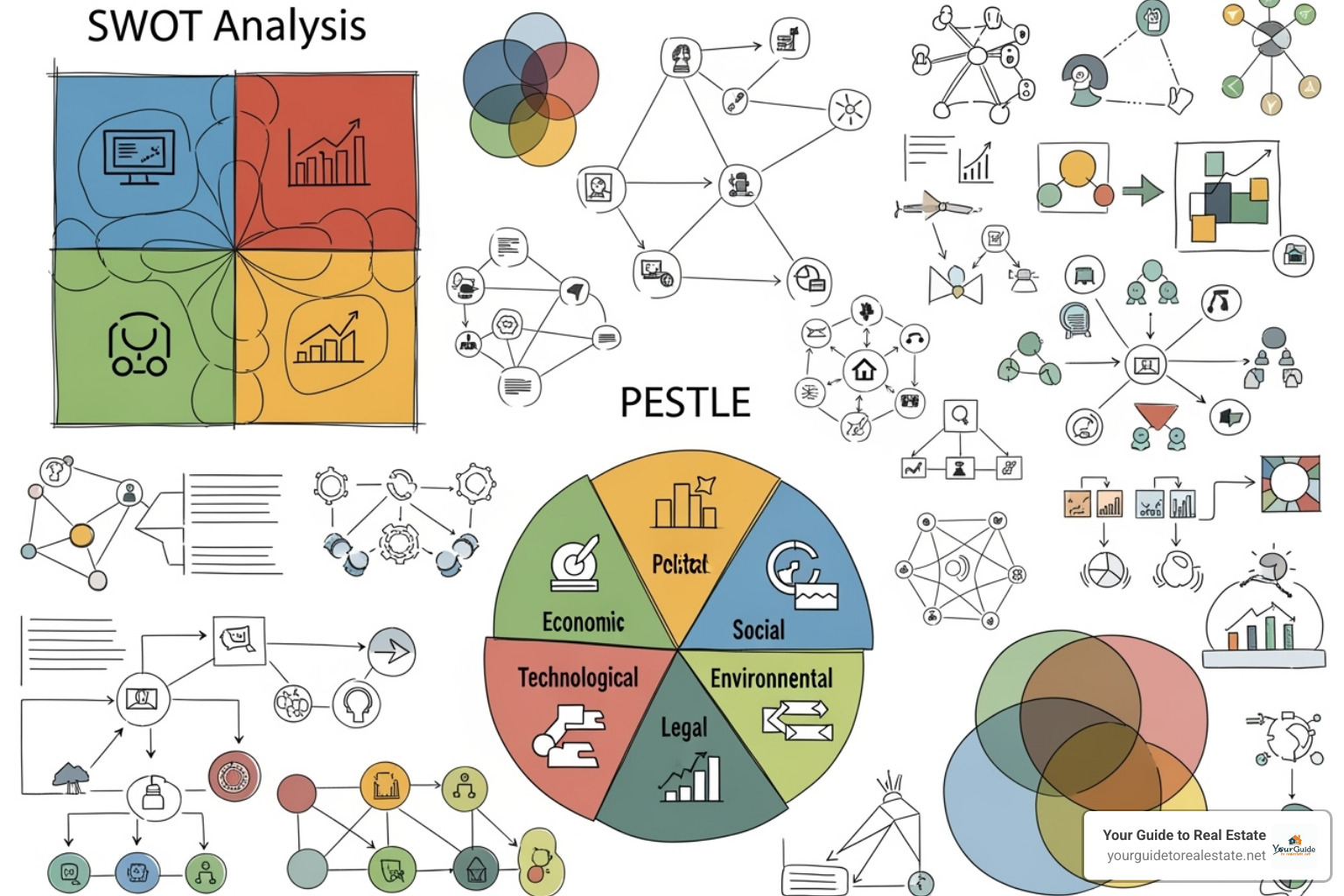
SWOT Analysis identifies your internal Strengths and Weaknesses, along with external Opportunities and Threats. The power of SWOT comes from connecting these dots. For instance, if an opportunity (growing demand for eco-friendly homes) aligns with a strength (expertise in sustainable building), you’ve found a gap you’re positioned to fill.
PESTLE Analysis examines macro-environmental factors: Political (zoning laws), Economic (interest rates), Social (lifestyle trends), Technological (smart homes), Legal (building codes), and Environmental (sustainability). This framework helps spot gaps before they become obvious. For example, a social trend toward multi-generational living combined with economic pressures could reveal a gap for properties designed for extended families. Learn more about this in How Gap Analysis Can Drive Strategic Change in Your Organization.
McKinsey’s 7-S Framework examines seven interconnected elements: Strategy, Structure, Systems, Shared Values, Skills, Style, and Staff. Analyzing competitors through this lens can reveal why market needs aren’t being met. A company might have the right strategy but lack the skills to execute it, creating an opportunity. You can explore this framework further here: Enduring Ideas: The 7-S Framework.
Modern Tools for Deeper Insights
Modern technology adds superpowers to your analysis.
Customer Journey Mapping visualizes every interaction a customer has with a product or service. At each touchpoint, you identify pain points (frustrations) and moments of delight. Every pain point is a potential market gap. If the home buying process is confusing, that’s a gap for clearer guidance or better tools.
AI-powered data analysis and predictive analytics can process enormous amounts of information—reviews, social media, market reports—to spot patterns humans would miss. AI can predict future market needs based on current trends, helping you anticipate gaps. In real estate, AI might analyze data to predict demand for specific property types or amenities in certain neighborhoods. Our Competitor Analysis AI Complete Guide explores how these technologies can boost your analysis.
From Gap to Goldmine: Strategies to Capitalize on Your Findings
You’ve identified and validated a market gap. Now it’s time to turn that insight into action. Finding a gap is only half the battle; successful execution depends on choosing the right strategy and building a solid plan.

Choosing the Right Strategy for the Gap
The strategy you choose must match the gap and your business capabilities.
- Market Penetration: This works when you can better serve your existing market with your current offerings. For example, if you manage rental properties and have found that tenants are frustrated with slow maintenance, you could launch a premium maintenance package to deepen your relationship with current customers.
- Market Development: This involves taking a successful product to a new market. If your real estate investment model thrives in Dallas, and your analysis reveals similar unmet needs in Oklahoma City, you can expand into that new geographic area.
- Product Development: This is for when your existing customers need something you don’t offer. If research shows homebuyers want smart home features, you could create renovation packages that integrate this technology, serving the same market with a new offering.
- Diversification: The boldest move—creating new products for new markets. A real estate brokerage might diversify by developing property technology for other brokers, entering a new market with a complementary product.
Choose the strategy that aligns with your strengths and resources.
Building Your Action Plan
A strategy needs a concrete action plan to become a reality.
- Set SMART goals: Be Specific, Measurable, Achievable, Relevant, and Time-bound. Instead of “grow our business,” a goal would be “launch a new line of eco-friendly homes in Dallas and capture 10% market share within 18 months.”
- Allocate resources: Honestly assess what you’ll need in terms of people, budget, and technology. Underestimating resources is a common reason for failure.
- Define timelines: Break your goal into phases with specific deadlines to maintain momentum and accountability.
- Establish KPIs: Choose Key Performance Indicators (e.g., market share, customer satisfaction scores, ROI) to track whether your strategy is working.
- Create a go-to-market plan: This is your roadmap for introducing your solution, covering marketing channels, pricing, and distribution.
With the right strategy and a solid plan, you can turn your market gap analysis into real business growth.
Frequently Asked Questions about Market Gap Analysis
Let’s clear up a few common questions about this strategic process.
How does a market gap analysis differ from a SWOT analysis?
While they work together, they serve different purposes. A SWOT analysis is a diagnostic tool, giving you a snapshot of your internal Strengths and Weaknesses and external Opportunities and Threats. It tells you where you stand right now.
Market gap analysis, on the other hand, takes those insights—especially the opportunities—and digs deeper. If SWOT reveals an opportunity like “growing demand for sustainable housing,” a market gap analysis answers the specifics: What kind of housing? For which customers? In what locations?
In short, SWOT identifies the signals, while market gap analysis translates them into concrete, actionable opportunities.
How often should a business conduct a market gap analysis?
Market gap analysis is not a one-time event. Markets are constantly evolving. We recommend conducting a thorough analysis at several key moments:
- Before launching any new product or service.
- When entering new markets (crucial for real estate expansion).
- Annually as part of your strategic review to stay agile.
You should also run an analysis whenever significant market shifts occur, such as an economic downturn, a technological breakthrough, or new regulations. Think of it like checking your GPS during a long road trip to adjust for changing conditions.
Can a market gap analysis be applied to real estate investing?
Absolutely. It’s one of its most powerful applications, helping investors make smarter decisions and avoid costly mistakes. In practice, you can use market gap analysis to:
- Identify underserved housing needs: Find specific requirements for groups like remote workers or single-parent families that aren’t being met.
- Find locations where supply falls short of demand: Pinpoint neighborhoods with strong demand for a certain property type (e.g., affordable starter homes) but few available options.
- Find gaps in property management services: Investors or tenants may need better tech-enabled communication or short-term rental management.
- Spot trends in amenities: Identify features buyers are looking for that the market isn’t providing, like EV charging stations or co-working spaces.
The systematic approach of market gap analysis helps investors move beyond gut feelings to make data-driven decisions. To learn more about analyzing real estate markets effectively, check out our guide on Valuation and Market Analysis in Real Estate.
Conclusion
In this guide, we’ve walked through how market gap analysis can transform your business opportunities. Identifying unmet needs isn’t just about a clever idea; it’s about building a sustainable business that genuinely helps people while giving you a competitive edge.
The framework is simple: define your market, listen to customers, analyze the competition, connect the dots, and validate your findings. This data-driven approach moves you from guesswork to strategy, setting you up for success.
This is the kind of proven framework we believe in at Your Guide to Real Estate—helping people steer complex markets with confidence. The investment of time and effort pays off when you spot opportunities that others miss.
Start practicing a “gap-spotting” mindset. Your next breakthrough opportunity might be hiding in plain sight. The real estate market is always shifting, creating new gaps. Stay curious, be systematic, and keep looking for those spaces where you can make a real difference.
Learn more about Valuation and Market Analysis in Real Estate to strengthen your analytical skills.