
Why Becoming a Realtor® Is an Attractive Career Path
Learning how to become a realtor is a common goal for people seeking career flexibility, financial independence, and the satisfaction of helping others achieve their homeownership dreams. The process involves meeting state requirements, completing education, passing exams, and joining professional associations.
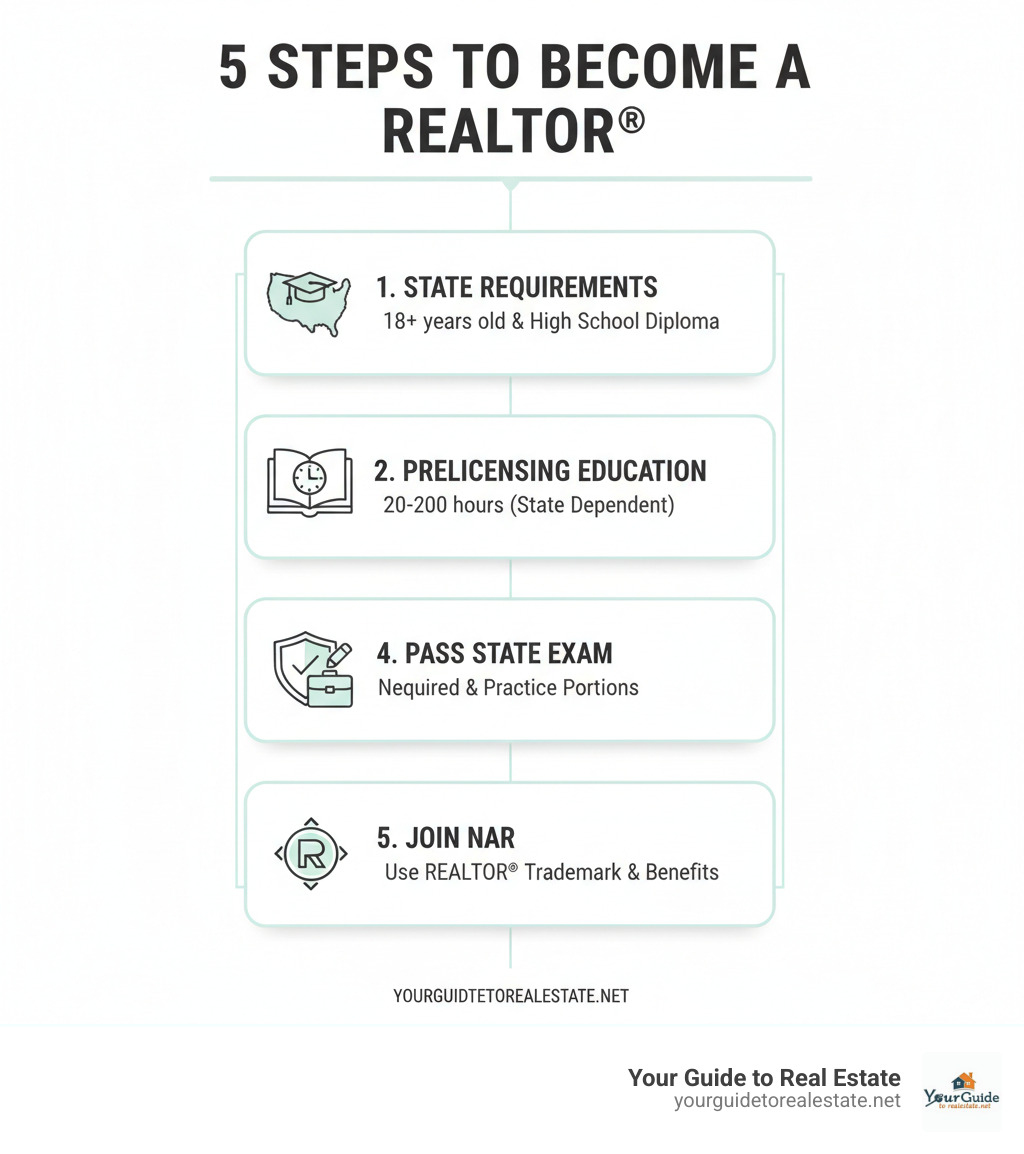
Quick Steps to Become a Realtor®:
- Meet state requirements – Be 18+ years old with high school diploma
- Complete pre-licensing education – 20-200 hours depending on your state
- Pass the state licensing exam – Both national and state portions
- Join a real estate brokerage – Required to practice legally
- Join the National Association of Realtors® – To use the Realtor® designation
The appeal is clear. Real estate offers the chance to control your own hours, build wealth through commissions, and make a meaningful impact during major life transitions. As one industry expert notes, “You can complete the required training, become a licensed real estate agent and start a new career in a matter of weeks or months” in states like Pennsylvania.
However, the reality includes significant challenges. About 85% of new agents don’t make it to their third year, according to industry estimates. The profession requires substantial upfront investment, with costs ranging from $500 to over $2,000 for education, exams, and licensing fees.
Success demands more than just getting licensed. You’ll need to master lead generation, build a client network, and steer a commission-only income structure. The median income for agents with less than two years of experience was just $10,800 in 2023, according to the National Association of Realtors®.
Despite these challenges, those who persist can build rewarding careers. The top 10% of agents earn significantly more than the $49,000 average, and the profession offers genuine opportunities for entrepreneurship and community impact.
Common how to become a realtor vocab:
Real Estate Agent vs. Realtor®: Understanding the Key Differences
Before diving into the steps on how to become a realtor, it’s crucial to understand a fundamental distinction that often confuses aspiring professionals: the difference between a real estate agent and a Realtor®. While these terms are sometimes used interchangeably in casual conversation, they represent different levels of professional commitment and ethical obligation.
Think of it this way: all Realtors® are real estate agents, but not all real estate agents are Realtors®.
A real estate agent is someone who has earned their state license to help clients buy, sell, or rent property. This license proves they’ve completed the required education and passed their state exam. They’re legally authorized to facilitate real estate transactions under the supervision of a licensed broker.
A Realtor®, however, takes things a step further. This is a real estate agent who has also joined the National Association of Realtors® (NAR), one of America’s oldest and most respected trade associations. Founded in 1908, NAR has been setting professional standards in real estate for over a century.
Here’s where it gets interesting: to earn the Realtor® designation, licensed agents must join their local and state associations affiliated with NAR. More importantly, they must agree to follow NAR’s strict Code of Ethics. This code goes beyond state laws, requiring Realtors® to put their client interests above their own financial gain.
The Realtor® designation isn’t just a fancy title – it’s a registered trademark that signals a higher ethical standard. Using the term “Realtor®” without NAR membership is actually a violation of trademark law. You can find more info about the Realtor Trademark on our site.
This ethical commitment creates an important distinction. While all licensed agents must follow state regulations, Realtors® voluntarily bind themselves to additional, more stringent guidelines. For clients, this often translates to an added layer of trust and credibility.
| Feature | Real Estate Agent | Realtor® |
|---|---|---|
| Membership | State-licensed professional | State-licensed professional + Member of the National Association of Realtors® (NAR) |
| Ethical Code | Must abide by state real estate laws | Must abide by state laws AND NAR’s strict Code of Ethics |
| Requirements | State-mandated education, exam, and license | State license + NAR membership (local, state, and national associations) |
| Public Perception | Licensed to practice real estate | Often perceived as having higher ethical standards and professionalism |
The bottom line? Both can help you buy or sell property, but Realtors® have made an extra commitment to professional ethics and ongoing education. When you’re learning how to become a realtor, you’ll likely want to pursue the full Realtor® designation to maximize your credibility with future clients.
The Step-by-Step Guide on How to Become a Realtor®
Ready to turn your real estate dreams into reality? The journey of how to become a realtor might seem overwhelming at first, but it’s actually quite straightforward when you break it down into manageable steps. Every state has its own specific requirements, but the overall path remains remarkably similar across the country.
Think of it like following a recipe – each ingredient matters, and the order counts. You’ll start with meeting basic state requirements, then move through education, testing, finding a brokerage, and finally joining the professional associations that make you a true Realtor®.
Understanding the State Requirements for How to Become a Realtor®
Before you can even think about studying real estate law or taking practice tests, you need to make sure you meet your state’s basic eligibility requirements. These aren’t complicated, but they’re absolutely essential.
Age requirements vary slightly by state – you’ll need to be at least 18 or 19 years old. Pennsylvania, for example, requires you to be 18, while some states set the bar at 19. You’ll also need a high school diploma or equivalent, like a GED. This makes sense when you think about it – you’ll be handling major financial transactions and need that foundational education.
Legal U.S. residency is another must-have requirement across all states. The background check is where things get a bit more serious. States want to ensure their licensed professionals have integrity, so they’ll dig into your criminal history.
In Pennsylvania, you’ll need to obtain your criminal history report through the Pennsylvania Access to Criminal History (PATCH) system. Here’s something important to remember – all background check documents must be less than 90 days old when you submit your license application. Don’t get your background check too early, or you’ll have to do it again! You can Request your criminal history background check directly through Pennsylvania’s official site.
If you have concerns about your background, don’t panic. While felony records can sometimes prevent licensing, each state handles these situations differently. It’s worth checking your specific state’s guidelines or consulting with the real estate commission directly.
For a deeper dive into these initial requirements, check out our complete guide to getting your license.
Complete Your State’s Pre-Licensing Education
Now comes the real work – your pre-licensing education. This is where you’ll learn everything from property law to fair housing regulations. The required hours vary dramatically depending on where you live, and honestly, it can be quite shocking how different states are.
Pennsylvania requires 75 hours of approved education, while Virginia asks for 60 hours. If you’re in California, prepare for 135 hours of coursework. Some states like Kansas only require 30 hours, but Texas demands a hefty 210 hours. It really depends on your state’s philosophy about preparation.
These courses aren’t just busy work – they cover critical topics like property ownership, contracts, agency law, financing, valuation, and fair housing laws. You’ll need this knowledge not just to pass your exam, but to actually help clients effectively.
You have several learning options, each with different cost ranges from $200 to $900+. Live online courses offer real-time interaction with instructors and fellow students, typically costing $300-$900+. On-demand courses let you study at your own pace for $200-$800+, which is perfect if you’re juggling a full-time job. Home study courses are usually the most budget-friendly at $180-$600, though they require more self-discipline.
The key is choosing a state-approved education provider – otherwise, your hours won’t count toward your license. This is not the time to cut corners or look for shortcuts.
For comprehensive information on selecting the right educational path, visit our educational resources guide. You typically have a specific timeframe to complete these requirements – in Pennsylvania, it’s within five years of taking your exams.
Pass the Real Estate Licensing Exam
Here’s where many aspiring agents feel their heart rate spike – the licensing exam. But here’s the thing: if you’ve studied properly, this is totally manageable. Most states use third-party testing services like PSI Services LLC or Pearson VUE to administer these exams.
Your exam will have two main parts. The national portion covers general real estate principles and federal laws that apply everywhere in the United States. The state-specific portion focuses on your particular state’s laws and regulations. Both sections are typically multiple-choice, though you might encounter some math problems along the way.
Passing scores generally hover around 70%, which means you don’t need to be perfect – just well-prepared. But don’t underestimate this test. In some states like Florida, about 50% of first-time test-takers fail. That’s not meant to scare you, just to emphasize the importance of thorough preparation.
Exam fees typically range from $100 to $300, and in Pennsylvania, you have three years from your license application date to pass both portions. If you don’t pass the first time, most states let you retake the exam after a waiting period, though you’ll pay the fee again.
The good news? Your pre-licensing courses usually include practice tests and study materials. Take advantage of every practice opportunity you can find. For Pennsylvania residents, you can view information about the real estate salesperson exam on Pearson VUE’s official site.
Find a Sponsoring Real Estate Brokerage
Congratulations on passing your exam! But hold on – you can’t start selling houses just yet. In every single state, you must work under a licensed real estate broker. This isn’t optional; it’s the law.
Your broker serves as your supervisor, mentor, and guide as you steer your first transactions. They’ll oversee your deals, ensure you follow legal and ethical standards, and hopefully provide the support you need to succeed. Think of them as your safety net while you learn the ropes.
Choosing the right brokerage is crucial for your success, especially as a new agent. Training programs can make or break your first year – some brokerages offer extensive mentorship and education, while others expect you to figure things out on your own.
Commission splits vary widely, and while a higher split might look attractive, sometimes a lower split with better support leads to more success for new agents. Company culture matters too – you want to feel comfortable asking questions and learning from experienced colleagues.
Look for brokerages that provide solid support and resources like technology tools, marketing assistance, and administrative help. Brokerages are usually eager to bring on new agents because it costs them little upfront, and they earn a percentage of your commissions.
For detailed guidance on this critical decision, explore our ultimate guide to picking your first brokerage and learn about the top 5 things to look for when choosing a brokerage.
The Final Step: How to Become a Realtor® After Getting Your License
You’ve made it through the education, passed your exam, and found a sponsoring broker – you’re officially a licensed real estate agent! But to complete your journey of how to become a realtor, you have two final steps: getting your official license and joining the National Association of Realtors®.
Applying for your real estate license involves submitting your official application to your state’s real estate commission. In Pennsylvania, you’ll use the Pennsylvania Licensing System (PALS) to create a profile, upload all your documentation, and submit everything for approval. This includes your education certificates, exam scores, and that background check we talked about earlier.
Activation fees typically run $200 to $400, depending on your state. It’s a small price to pay for the ability to legally practice real estate!
Becoming a member of NAR is what transforms you from a real estate agent into a Realtor®. This involves joining three levels simultaneously: your local Realtor® association, your state association, and the National Association of Realtors®. It’s like a membership package deal.
The benefits are substantial. You’ll gain increased industry recognition, access to exclusive market data, discounts on continuing education, and transaction management services. Most importantly, you can use the powerful Realtor® branding on your business cards and marketing materials, which adds serious credibility with clients.
NAR national membership dues are $156 annually in 2024, plus a $45 special assessment that funds consumer advertising campaigns. You’ll also pay separate dues to your local and state associations, plus MLS dues for access to property listings. Most brokerages require Errors & Omissions insurance to protect you from claims of negligence or mistakes.
The biggest commitment isn’t financial – it’s adhering to NAR’s strict Code of Ethics. This code sets standards that go beyond basic state laws, emphasizing honesty, integrity, and always putting client interests first. While all agents must follow the law, Realtors® commit to a higher ethical standard.
You can learn more about NAR membership benefits on their official website to see if this professional designation aligns with your career goals.
The Reality of a Real Estate Career: Costs, Timeline, and Income
The journey on how to become a realtor is just the beginning. Understanding the practical realities—the costs, timeline, and earning potential—is crucial for setting realistic expectations and preparing for a successful career.

How Long Does It Take to Become a Licensed Agent?
If you’re wondering about the timeline for how to become a realtor, the good news is that it’s faster than many other career changes. Most people complete the entire process in four to six months, though your dedication and schedule will ultimately determine the pace.
Your pre-licensing education will likely take the most time. If you’re studying part-time while working another job, expect this phase to last two to four months. Those who can dedicate more hours each week might finish in just a few weeks. The beauty of online courses is that you can study at your own pace, fitting education around your current commitments.
Once you’ve completed your coursework, you’ll need time to prepare for and schedule your exam. Most people spend a few weeks reviewing material and practicing test questions before feeling confident enough to sit for the real thing. Exam appointments are usually available within a week or two of when you’re ready.
After passing your exam and finding a sponsoring broker, the application processing phase begins. In Pennsylvania, for example, license approval notifications typically take about six weeks. This waiting period can feel long when you’re eager to start your new career, but it gives you time to prepare your marketing materials and business plan.
The reality is that you could complete the required training, become a licensed real estate agent, and start your new career in just a matter of weeks if you’re highly motivated. For a more detailed breakdown, refer to A detailed breakdown of the real estate license timeline.
What Are the Total Costs Involved?
Let’s talk numbers. While becoming a real estate agent doesn’t require the massive investment of medical school or law school, you’ll still need to budget carefully for your transition into this new career.
Your education costs will likely be your biggest upfront expense. Depending on whether you choose home study materials ($180-$600), on-demand online courses ($200-$800), or live interactive classes ($300-$900), you’ll need to plan accordingly. This isn’t just a cost—it’s an investment in your future earning potential.
The exam fees typically run between $100 and $300, depending on your state. In some places like New York, you’ll pay $65 for the initial application fee plus a $15 exam fee. Don’t forget to budget for a retake if needed—about half of first-time test takers don’t pass on their initial attempt.
Your licensing and activation fees will add another $200 to $400 to your total. You’ll also need to pay for your background check, which varies by state but is usually under $50.
Once you’re licensed, the ongoing costs begin. MLS dues can run several hundred dollars annually, giving you access to the property listings you’ll need to serve clients effectively. If you choose to become a Realtor® (which we highly recommend), you’ll pay NAR dues of $156 in 2024, plus a $45 special assessment, along with local and state association fees.
Errors & Omissions insurance is typically required by brokerages and protects you from professional liability claims. This usually costs a few hundred dollars per year. Don’t forget about startup expenses like business cards, marketing materials, and professional clothing.
When you add everything up, expect a total initial investment ranging from $500 to $2,000+. The wide range depends on your state’s requirements, the education format you choose, and how elaborate your initial marketing efforts are. For a comprehensive look at these expenses, check out Understanding the full cost of a real estate license.
Earning Potential and First-Year Challenges
Here’s where we need to have an honest conversation about what to expect financially when pursuing how to become a realtor. The earning potential is genuinely exciting, but the path to success requires patience, persistence, and realistic expectations.
According to the Bureau of Labor Statistics, real estate agents make an average of $49,000 per year, with the U.S. Department of Labor reporting a mean salary around $65,850 for 2022. The top 10% of agents earn more than three times that amount, showing the incredible potential for those who master the business.
Most agents work with properties valued between $200,000 and $450,000, earning $2,500 to $8,500 per sale. Since real estate is a performance-based commission industry, your income directly correlates with the number of transactions you close and your commission percentage.
But here’s the reality check: your first year will likely be challenging financially. The median gross income for agents with less than two years’ experience was about $10,800 in 2023, according to NAR. This isn’t meant to discourage you—it’s meant to help you prepare properly.
The statistics are sobering: many real estate experts estimate that about 85% of new agents don’t make it to their third year. The primary reason? They run out of money before their business gains momentum.
Commission-based income means you’re only paid when transactions close. There’s no guaranteed salary or benefits, which means you need to be prepared for periods with little to no income. We strongly advise having at least six months to a year’s worth of living expenses saved before fully transitioning into real estate.
Your primary challenge as a new agent won’t be learning about contracts or property values—it will be finding clients. No one will call you just because you have a license. You’ll need to master prospecting, networking, cold calling, social media engagement, and building a sphere of influence. It’s a numbers game that requires consistent daily effort.
Building a client base takes time. You’ll need to develop exceptional communication skills, be proactive in your service, and deliver results that turn clients into raving fans who refer their friends and family. The emotional toll of dealing with clients’ high emotions, unexpected problems, and transaction stress can be draining, especially when you’re not yet earning substantial income.
Despite these challenges, the rewards for dedicated and persistent agents are significant. Those who weather the initial storm often build thriving businesses with the flexibility and income they dreamed of when they first wondered how to become a realtor. For a deeper dive into what agents truly earn, read How much do real estate agents really make?.
Frequently Asked Questions about Becoming a Realtor®
We know that figuring out how to become a realtor can feel overwhelming with so many details to consider. That’s completely normal! After helping countless people steer this career transition, we’ve noticed the same questions come up time and again. Let’s tackle the big ones that are probably on your mind right now.
What is the difference between a real estate agent and a broker?
This is one of the most common sources of confusion, and honestly, it’s pretty understandable. Think of it this way: a real estate agent must always work under a licensed broker – they can’t fly solo. When you first get licensed, you’ll be an agent working under someone else’s supervision.
A broker has taken things to the next level. They’ve completed additional education and exams (usually requiring several years of experience as an agent first), which gives them the authority to operate their own brokerage and supervise other agents. Essentially, a broker has a more advanced license with greater responsibility and independence.
It’s like the difference between being a teacher and being a principal – both are important roles in education, but one has more oversight responsibilities than the other.
Can I become a Realtor® while working a full-time job?
Absolutely! In fact, many people transition into real estate part-time while keeping their day job for financial security. The beauty of online pre-licensing courses is that they offer incredible flexibility – you can study early mornings, evenings, or weekends around your current schedule.
Here’s the reality though: once you’re licensed and working with clients, real estate doesn’t follow a 9-to-5 schedule. You must be available when clients need you, which often means evenings and weekends. It requires excellent time management and a very understanding family or support system.
Our advice? Start with a clear transition plan. Begin part-time to test the waters and build your client base, but plan to transition to full-time as your real estate business grows. This career demands significant time and attention to truly succeed, and trying to juggle both long-term can leave you stretched too thin to excel at either.
Most importantly, save up a solid financial cushion before making the full transition. Real estate is commission-based, so having six months to a year of expenses saved will give you the breathing room to focus on building your business without the stress of immediate income pressure.
What are the ongoing requirements to maintain my Realtor® status?
Becoming a Realtor® isn’t a one-and-done deal – there are ongoing commitments that keep you in good standing and ensure you’re always operating at the highest professional level.
Annual dues are your first ongoing expense. You’ll pay dues to your local, state, and national Realtor® associations every year. NAR national dues were $156 in 2024, plus a $45 special assessment. Your local and state associations will have their own fee structures on top of this.
Continuing education is required to renew your real estate license. The specific hours vary by state and renewal cycle, but this isn’t just busy work – these courses keep you updated on changing laws, new practices, and industry developments. Think of it as staying sharp in a field that’s constantly evolving.
The most important ongoing commitment is adhering to the NAR Code of Ethics at all times. This isn’t just about following the rules during business hours – it’s a commitment to ethical conduct that defines what it means to be a Realtor®. Failure to uphold this Code can result in disciplinary action from your Realtor® association, so it’s taken very seriously.
These requirements might seem like a lot, but they’re what separate Realtors® from regular licensed agents and maintain the professional standards that clients have come to expect from the designation.
Conclusion: Launching Your Successful Real Estate Career

Congratulations! You now have a complete roadmap for how to become a realtor. This journey you’re considering isn’t just about getting another job—it’s about stepping into a profession that can transform both your life and the lives of countless families you’ll help along the way.
Yes, the path has its challenges. The upfront costs, the studying, the exam nerves, and those first few months of building your client base can feel overwhelming. But here’s what we’ve learned from watching thousands of agents succeed: the ones who make it are simply the ones who don’t give up.
The statistics might seem scary—that 85% failure rate we mentioned earlier. But think about it differently. Those who fail often do so because they weren’t prepared for the reality of the business. You’re already ahead of the game because you’ve taken the time to understand what you’re getting into.
Your success starts with realistic expectations. You know now that this isn’t a get-rich-quick scheme. It’s a profession that rewards dedication, continuous learning, and genuine care for your clients. The agents who thrive are those who view every challenge as a chance to grow and every client interaction as an opportunity to make a real difference.
The beauty of real estate lies in its diversity. No two days are exactly alike. One day you might be helping first-time buyers steer their biggest purchase ever. The next, you could be assisting empty nesters find their dream retirement home. Each transaction brings new people, new challenges, and new rewards.
Becoming a Realtor® means joining a community of professionals committed to higher ethical standards. When you join the National Association of Realtors®, you’re not just getting a title—you’re becoming part of a network that values integrity above all else.
At Your Guide to Real Estate, we’ve seen how rewarding this career can be for those who approach it with the right mindset. We’re here to support you not just in getting your license, but in building a thriving practice that stands the test of time. Our proven framework takes the guesswork out of the process, helping you avoid common pitfalls and focus on what really matters: serving your clients exceptionally well.
The real estate market will continue to evolve. Technology will change how we work. But one thing remains constant: people will always need trusted professionals to guide them through one of life’s biggest decisions. That’s where you come in.
Your journey to how to become a realtor doesn’t end with getting your license—it’s really just the beginning. Accept the learning process, stay curious, and never stop improving your skills. The families you help buy their first homes or sell their beloved family properties will remember you for years to come.
Find more tips and resources for new agents and let us help you build the successful real estate career you’ve been dreaming about. We’re excited to be part of your journey.