Understanding Housing Market Crash Concerns in Today’s Economy
The housing market crash is a topic that weighs heavily on the minds of millions of Americans, especially those who lived through the devastating 2008 collapse. With 70% of Americans worried about a potential crash in 2025, it’s clear that market anxiety remains high despite fundamentally different conditions today.
Quick Answer: Is the Housing Market Going to Crash?
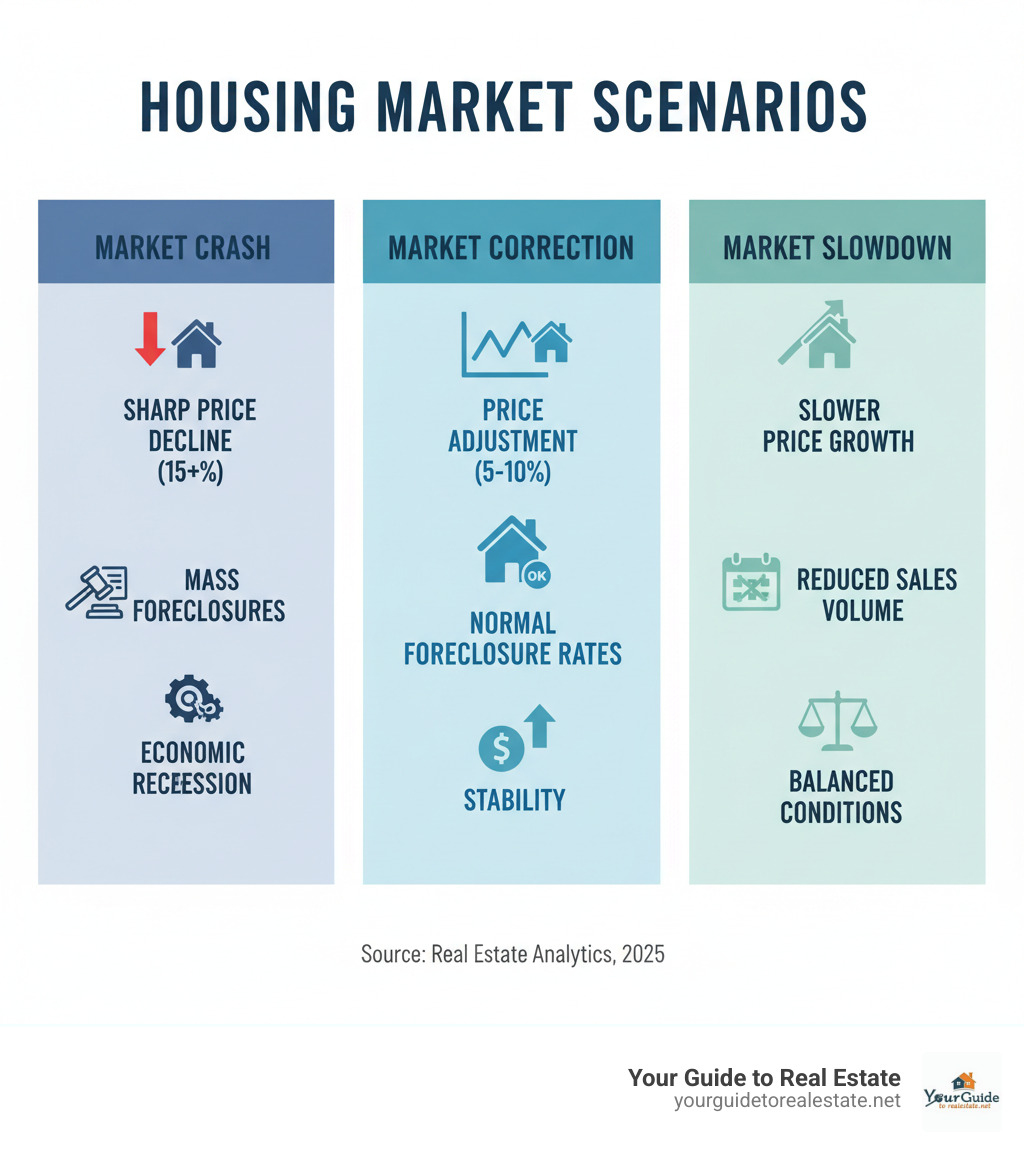
- Most likely outcome: Market correction, not crash
- Current trend: Price moderation (home values still rising, but slower)
- Key difference from 2008: Record-low inventory vs. massive oversupply in 2008
- Expert consensus: Crash unlikely due to stricter lending standards and housing shortage
- Timeline: Prices may decline 5-10% in some areas over next 2 years, but widespread collapse is improbable
The fear is understandable. During the 2008 crisis, 12 million American homes lost $6 trillion in collective value, and it took about six years for median home prices to fully recover. However, today’s market operates under completely different conditions.
Unlike the pre-2008 era of risky subprime mortgages and speculative lending, current lending standards are much stricter. We’re also dealing with a chronic housing shortage of 3.7 million homes rather than the oversupply that fueled the previous crash.
While some markets are experiencing price corrections – particularly those that saw dramatic pandemic-era increases – most economists agree that we’re seeing a market adjustment rather than an impending collapse. Home prices are still rising nationally, just at a more sustainable pace.
Key terms for housing market crash:
A Look Back: Understanding Historical Housing Market Crashes
Understanding today’s market means taking a journey through history. Real estate has always moved in cycles, with several peaks and busts shaped by economic patterns, land bubbles, and speculative lending. These historical cycles teach us valuable lessons about what can go wrong – and what’s different this time around.
The story of American real estate is really a story of human nature: periods of excitement and optimism followed by reality checks. By studying these patterns, we can better understand the key real estate statistics that define today’s market and why experts believe we’re in a fundamentally different situation now.
The 2008 Great Recession: Causes and Consequences
The most recent housing market crash hit between 2007 and 2009, with 2008 being the year that changed everything. This wasn’t just an American problem – it triggered a global financial crisis that affected families worldwide.
What made this crash so devastating was a perfect storm of bad decisions. Subprime mortgages were the main culprit. Lenders got incredibly loose with their standards, giving loans to people who couldn’t really afford them. The joke at the time was that you could get a mortgage with just a pulse – and sometimes even that seemed optional.
Adjustable-rate mortgages (ARMs) made things even worse. These loans started with tempting low rates that seemed affordable. But when the Federal Reserve raised interest rates from 1.25% to 5.25% between 2004 and 2006, monthly payments jumped by as much as 60%. Imagine your mortgage payment suddenly increasing by more than half – that’s exactly what happened to millions of families.
The result was predictable and heartbreaking. The foreclosure crisis saw hundreds of thousands of homes go into foreclosure. Entire neighborhoods became ghost towns with “For Sale” signs on every block. Major lenders went bankrupt, and the government had to step in with bailouts to prevent a complete financial meltdown.
The numbers tell the whole story. The median sales price hit $257,400 in early 2007. After the crash, it took six long years to recover, finally reaching $258,400 in early 2013. That’s six years of families watching their biggest investment lose value.
Major Crashes Before the 21st Century
While 2008 feels recent, America has seen real estate crashes for centuries. The 1800s were particularly wild, with boom-and-bust cycles happening regularly.
The Great Depression starting in 1929 was perhaps the most devastating. After the Wall Street crash, home prices fell by an incredible 67%. Manhattan alone lost more than half its value by 1933. It wasn’t until the 1950s – after World War II ended – that the real estate market truly recovered.
Earlier crashes followed similar patterns. The Panic of 1873 started with speculative railroad expansion and collapsed when major investment banks failed. The Panic of 1837 was fueled by a land bubble and loose lending standards (sound familiar?). That recession lasted nearly seven years, with unemployment hitting 25%.
These historical crashes share common themes: speculation runs wild, lending standards get too loose, and external shocks trigger the collapse. Interestingly, many economists point to an 18-year real estate cycle theory that suggests these booms and busts follow somewhat predictable patterns.
The lesson from history is clear – real estate crashes happen when fundamentals get ignored and speculation takes over. But as we’ll see next, today’s market operates under completely different rules than these historical examples.
For more insights into current market conditions, check out our 10 Must-Know Real Estate Statistics That Define Today’s Market.
Today’s Market vs. 2008: Why History Isn’t Repeating Itself
If you lived through 2008, it’s completely natural to feel nervous about today’s market conditions. But here’s the reassuring truth: the fundamentals driving today’s housing market are dramatically different from what caused the devastating crash 15 years ago.
Most experts agree that today’s market operates under completely different conditions than the house of cards that collapsed in 2008. While no one can predict the future with absolute certainty, the structural safeguards and market dynamics we have today make a similar catastrophic housing market crash highly unlikely.

When people ask “Will the housing market crash like 2008?” the answer consistently points to three major differences that make history unlikely to repeat itself.
Stricter Lending Standards and Higher Homeowner Equity
Remember those infamous “NINJA” loans from the 2000s? (That’s “No Income, No Job, No Assets” for those lucky enough to have missed that era.) Those days are long gone, and for good reason.
Today’s mortgage landscape is completely transformed. The risky subprime mortgages that fueled the 2008 disaster are virtually extinct. Lenders now require thorough income verification, solid credit scores, and substantial down payments. We’re talking about qualified mortgages that ensure borrowers can actually afford their payments – imagine that!
The results speak for themselves. Mortgage delinquency rates remain remarkably low compared to the pre-2008 period. The Board of Governors of the Federal Reserve System notes that today’s buyers aren’t stretching themselves financially the way borrowers did in the 2000s.
Here’s perhaps the most important difference: homeowners today have record-high equity levels. This creates a massive buffer against potential market downturns. When you owe much less than your home is worth, you’re far less likely to walk away from your mortgage, even if prices dip slightly. In 2008, many homeowners had little to no equity, making them extremely vulnerable to even small price declines.
The loan-to-value ratios today are much healthier, and here’s another crucial factor: 92% of mortgages in 2024 are fixed-rate loans. This means homeowners are protected from the payment shocks that devastated so many families when adjustable-rate mortgages reset to higher payments during the last crisis.
Even Federal Reserve Chair Jerome Powell acknowledged that while the pandemic market had bubble-like characteristics, the current correction is happening through reduced activity rather than the foreclosure-driven collapse we saw in 2008.
The Critical Role of Housing Supply and Demand
This might be the most important difference of all. Before 2008, we had way too many homes. Today, we have way too few.
The supply situation is completely flipped. In the lead-up to the last crash, we had nearly 13 months of housing supply sitting on the market. Today, we’re dealing with just 3-4 months of supply – far below the balanced market level of 6 months.
Months of Housing Supply: 2008 vs. Today
| Metric | Pre-2008 (Peak) | Today (Late 2023/Early 2024) |
|---|---|---|
| Months of Supply | Nearly 13 months | Record low (around 3-4 months) |
| Housing Surplus/Deficit | 1.5 million unit surplus | 3.7-4.5 million unit deficit |
| New Construction Pace | High, speculative | Slower, cautious |
| Existing Homes for Sale | 3.9 million (Oct 2007) | 1.2 million (Oct 2022) |
The U.S. currently faces a chronic inventory shortage, with estimates suggesting we’re short 3.7 to 4.5 million homes according to recent analysis. This isn’t just a small gap – it’s a massive housing deficit that continues to support prices even as other economic factors create headwinds.
Construction has been much more measured this time around. Builders learned their lesson from the speculative building spree that contributed to the last crash. Supply chain disruptions and labor shortages have also kept new construction at more sustainable levels.
Meanwhile, buyer demand remains strong despite higher interest rates. A large wave of millennials is entering their prime homebuying years, and many existing homeowners are reluctant to sell because they’ve locked in those historically low mortgage rates from 2020-2021. This creates what economists call the “rate lock-in effect,” further restricting already limited supply.
Basic economics tells us that when supply is extremely limited and demand remains solid, prices tend to hold steady or continue rising. It’s the opposite of the oversupply situation that fueled the last housing market crash.
New Regulatory Safeguards
The 2008 crisis didn’t just hurt millions of families – it also led to the most comprehensive financial reforms since the Great Depression. These aren’t just minor tweaks; they’re fundamental changes to how our financial system operates.
The Dodd-Frank Act completely transformed financial regulation, introducing stricter oversight of mortgage lending and creating new accountability standards. The Consumer Financial Protection Bureau (CFPB) was established specifically to protect consumers in mortgage transactions, ensuring fairer lending practices.
Modern financial oversight includes the Financial Stability Oversight Council (FSOC), which actively monitors markets for systemic risks. Think of it as an early warning system designed to spot problems before they spiral out of control.
Perhaps most importantly, banks now undergo regular stress testing to ensure they can handle severe economic downturns. These tests simulate various crisis scenarios, including housing market declines, to verify that financial institutions have adequate capital buffers.
These regulatory safeguards mean today’s market has multiple layers of protection that simply didn’t exist before 2008. While no system is perfect, these consumer protection measures and financial oversight mechanisms make our housing market much more resilient to economic shocks.
For more detailed insights into how these changes affect today’s market dynamics, explore our U.S. Housing Market Update 2025: Prices, Inventory, and Buyer Behavior.
Is a Housing Market Crash on the Horizon?
With all these protective factors working together, the overwhelming consensus among real estate experts is clear: a widespread housing market crash simply isn’t on the horizon. What we’re seeing instead is something much more manageable – continued price moderation and a market that’s slowly finding its footing again.
Think of it like a roller coaster that’s finally leveling out after a wild ride. The dramatic ups and downs of the pandemic era are giving way to a more predictable, stable pattern.
Key Indicators to Watch for a Potential Housing Market Crash
While a crash seems unlikely, it’s still smart to keep your eyes open for warning signs. Just like checking the weather before a picnic, staying informed helps you make better decisions.
The most telling indicators include rapidly increasing housing inventory beyond a six-month supply, which would signal a shift from our current shortage to oversupply. A spike in foreclosure rates compared to today’s historically low levels would also raise red flags.
Rising unemployment often triggers housing troubles since people can’t make mortgage payments without steady income. Similarly, a significant drop in buyer demand – evidenced by fewer showings, homes sitting longer on the market, and widespread price cuts – would indicate serious market stress.
We’d also watch for declining home sales volume that goes beyond the current “freeze effect” from high interest rates. Most concerning would be a return to risky lending practices or a situation where large numbers of homeowners owe more than their homes are worth.
As housing experts point out, seeing just one warning sign isn’t critical. But multiple signs appearing together in a short timeframe would be a much stronger indication that trouble might be brewing.
Current Market Trends and Expert Forecasts
So what’s actually happening right now? The data tells a story of gentle adjustment rather than dramatic collapse.
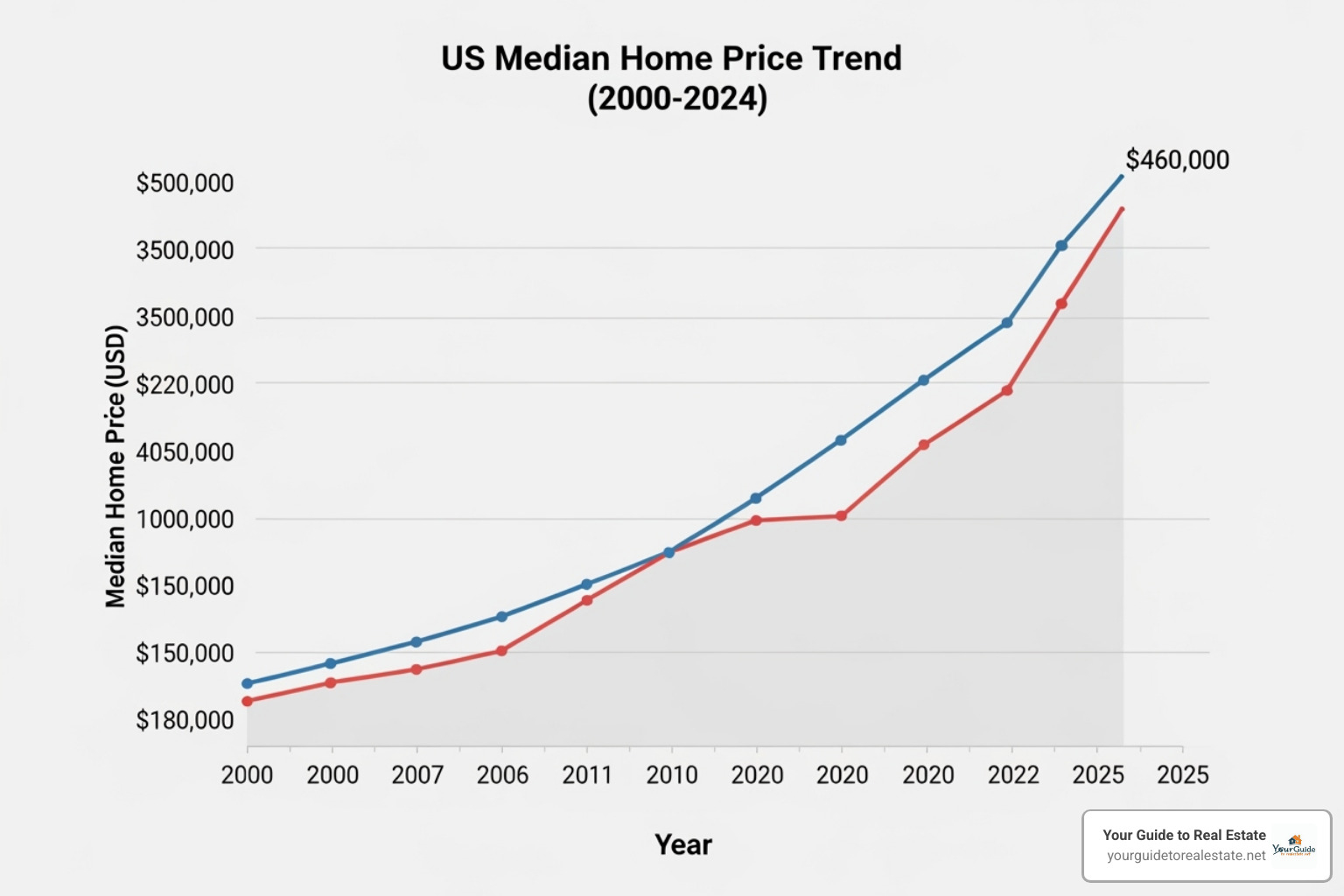
Price moderation is the name of the game. After hitting a peak of $479,500 in late 2022, median home prices cooled to $417,700 by the end of 2023. This isn’t a crash – it’s more like taking your foot off the gas pedal after driving too fast.
Home value forecasts from major analysts predict slower, healthier growth ahead. Zillow expects a modest 1.4% increase over the next year, which they describe as “neither exciting nor alarming” – exactly what a stabilizing market should look like. Their longer-term forecast suggests a 2.5% increase in 2025.
The low number of homes sold – about 4 million existing homes in 2023, the lowest in roughly 25 years – reflects what economists call the “freeze effect.” High mortgage rates have both buyers and sellers sitting on the sidelines, waiting for better conditions.
But here’s the encouraging news: housing inventory is slowly climbing. While still below normal levels, the number of homes for sale has reached its highest point since before the pandemic. This gradual increase is helping prevent the dramatic price drops that would signal a crash.
Why a Correction is More Likely Than a Crash
All signs point to a market correction rather than a catastrophic housing market crash. The difference matters enormously for your financial future.
A correction means we’re returning to a balanced market after years of extreme seller advantages. This shift brings benefits for everyone involved. Buyers are gaining increased negotiation power as inventory rises and competition decreases. They can take time to consider purchases, include contingencies, and even negotiate price reductions.
High mortgage rates continue to impact affordability, but they’re also serving as a natural cooling mechanism. Rather than letting the market overheat further, these rates are tempering both demand and price growth – exactly what’s needed for long-term stability.
Regional market variations tell an important part of this story. While national trends show moderation, some previously overinflated cities like Miami, Denver, and Seattle might see more significant price declines. Meanwhile, more affordable markets like Toledo and Pittsburgh are still experiencing healthy growth. This isn’t a uniform crash – it’s localized adjustments that reflect each area’s unique conditions.
As one real estate expert puts it, we’re looking at “a potential cooling-off period with possibly some small price declines” rather than a dramatic collapse. This sentiment echoes throughout the industry, suggesting that while change is coming, it’s the manageable kind that leads to healthier long-term conditions.
For deeper insights into what these trends mean for your specific situation, explore our Real Estate Market Projections for 2025: Key Numbers to Watch.
How to Steer a Volatile Housing Market
When markets get unpredictable, it’s natural to feel a bit overwhelmed. But here’s the thing – volatility doesn’t have to derail your real estate goals. Whether you’re thinking about buying, selling, or just holding tight, having a solid plan helps you steer uncertainty with confidence.
The key is staying focused on your personal situation rather than getting caught up in housing market crash headlines. Markets will always have ups and downs, but your financial preparedness and long-term strategy matter more than trying to time the perfect moment.
Potential Impacts on Home Buyers and Sellers
Let’s be honest – market shifts affect buyers and sellers differently, and understanding these impacts helps you make smarter decisions.
If you’re looking to buy, a correcting market actually brings some welcome changes. Remember those frenzied bidding wars where homes sold in hours? Those are becoming less common. You’ll likely have more time to think through decisions, schedule proper inspections, and negotiate terms that work for you.
However, high mortgage rates still impact affordability significantly. A LendingTree survey found that some buyers believe a crash is the “only way” they can afford a house. We get the frustration, but waiting for a crash is like waiting for lightning to strike twice – it’s a risky gamble that could leave you on the sidelines for years.
Instead, focus on finding the right home at a price that makes sense for your budget when you’re financially ready. The “perfect” market timing rarely exists, but personal financial readiness always matters.
For sellers, the landscape has definitely shifted. Those days of multiple offers above asking price aren’t completely gone, but they’re certainly less predictable. You’ll need to be more realistic about pricing and ensure your home is in excellent condition.
If you don’t absolutely need to sell right now, waiting might make sense until values strengthen again. But if selling is necessary, working with an experienced agent who understands current market conditions becomes crucial. They’ll help you price competitively while still maximizing your return.
The waiting game works differently for everyone. Homeowners who bought years ago and have significant equity have more flexibility than recent buyers who might be closer to breaking even.
Financial Strategies to Prepare for a Downturn
Smart financial preparation protects you regardless of what the market does next. Think of these strategies as your financial armor – they’ll serve you well whether markets go up, down, or sideways.
Building an emergency fund should be your first priority. Aim for three to six months of living expenses tucked away safely. This isn’t just about job loss – it covers unexpected repairs, medical bills, or any situation where you need financial breathing room.
Reducing high-interest debt frees up your monthly cash flow dramatically. Credit card balances and other high-rate loans eat away at your ability to save and qualify for better mortgage terms. Pay these down aggressively before taking on a mortgage.
Your credit score improvement efforts pay dividends in any market, but especially when rates are high. Even a 50-point increase in your credit score can mean thousands in savings over a loan’s lifetime. Check your credit report, dispute errors, and pay bills on time consistently.
When you do buy, securing a fixed-rate mortgage protects you from future rate increases. While adjustable-rate mortgages might offer lower initial payments, they expose you to payment shock if rates rise further – something we definitely learned from the 2008 experience.
Focusing on affordability means buying a home you can comfortably afford, not the most expensive one you qualify for. Leave room in your budget for maintenance, repairs, and life’s unexpected expenses. A house shouldn’t consume your entire financial capacity.
Consider making a larger down payment if possible. This reduces your monthly payments, helps you avoid private mortgage insurance, and builds equity faster. More equity provides a bigger cushion if home values decline temporarily.
For those just starting their homebuying journey, our First-Time Homebuyers Toolkit: Everything You Need to Know Before You Buy and Easy Steps to Buying Your First Home provide step-by-step guidance through the entire process.
Choosing the right real estate agent becomes even more important during uncertain times. An experienced agent understands local market conditions, can spot good deals, and helps you avoid costly mistakes that inexperienced agents might miss.
Frequently Asked Questions about a Housing Market Crash
We get these questions a lot, and honestly, they’re the same ones keeping many folks up at night. Let’s tackle the big ones with straight answers based on real data.
When did the most recent US housing market crash occur?
The most recent major housing market crash hit us between 2007 and 2009, with 2008 being the absolute worst year. This wasn’t just a housing problem – it became the spark that ignited the Great Recession, affecting the entire global economy.
What made it so devastating? A perfect storm of bad decisions. Banks were handing out subprime mortgages like candy on Halloween. Adjustable-rate mortgages started with sweet teaser rates, then jumped dramatically when the Federal Reserve raised rates from 1.25% to 5.25%. Suddenly, families saw their monthly payments shoot up by 60%, and foreclosures exploded across the country.
The ripple effects were massive. Major lenders went bankrupt, the government had to step in with bailouts, and millions of families lost their homes. It’s no wonder people are still nervous about another crash happening.
What is the likelihood of another housing market crash in the near future?
Here’s the good news: most economists and real estate experts agree that a housing market crash like 2008 is very unlikely in the next few years. We’re talking about a fundamentally different market today.
The key differences are huge. We have record-low housing inventory instead of the massive oversupply that fueled the 2008 crash. Lending standards are much stricter now – no more giving mortgages to people who can’t afford them. Homeowners today have record-high equity in their homes, which acts as a financial cushion.
While we’re seeing price moderation and some localized corrections in overheated markets, a widespread catastrophic collapse just isn’t in the cards. The market is cooling down, not crashing down. Think of it as taking a breather after running a marathon, not collapsing from exhaustion.
How has the US housing market recovered from the 2008 crash?
The recovery was slow but steady – kind of like watching grass grow, but eventually you notice the lawn is green again. It took about six years for median home prices to climb back to where they were before the crash.
Here’s the timeline: median home prices peaked at $257,400 in early 2007, then tumbled during the crash. By early 2013, prices had crawled back to $258,400, finally surpassing that pre-crash peak. From there, the market gained momentum, reaching $275,200 by early 2014.
Then came the real growth phase. From 2014 through the pandemic years, home values climbed steadily, eventually reaching a peak of $479,500 in late 2022. That’s when things got a bit crazy with pandemic buying and historically low interest rates.
Now we’re in a more balanced phase. Median home prices have moderated to around $417,700 as of late 2023. This isn’t a crash – it’s the market finding its footing after an unprecedented boom. We’re moving toward what experts call a “soft landing” rather than a hard crash.
The recovery taught us that real estate markets are resilient, but they need time to heal properly. Today’s market has learned from those painful lessons, which is why most experts remain cautiously optimistic about the future.
Conclusion: Building Your Real Estate Future with Confidence
We get it – all this talk about a potential housing market crash can feel overwhelming. But here’s the thing: after diving deep into the data, historical patterns, and expert opinions, we hope you’re feeling a lot more confident about where the market actually stands.
The reality is refreshingly different from the doom-and-scroll headlines you might be seeing. A widespread housing market crash simply isn’t on the horizon. The conditions that created the 2008 disaster – those risky subprime mortgages, loose lending standards, and massive oversupply – just don’t exist today.
Instead, what we’re witnessing is something much more manageable: a market correction. Think of it as the housing market taking a deep breath after running a marathon. Prices are moderating, not collapsing. Inventory is slowly increasing, which actually helps create a more balanced market for everyone.
The key takeaways that should give you confidence:
The fundamentals are solid. We have stricter lending standards keeping unqualified buyers out of the market. Homeowners today have record-high equity levels, creating a strong buffer against any potential downturn. And that chronic housing shortage? It’s still protecting home values across most of the country.
Some local markets might see slight price declines – especially those that saw crazy pandemic-era growth. But other areas are still experiencing steady, healthy appreciation. The beauty of real estate is that it’s always local, and understanding your specific market is what matters most.
Rather than making decisions based on fear or sensational headlines, we encourage you to focus on data over drama. Whether you’re eyeing your first home purchase, considering a sale, or thinking about investment opportunities, the fundamentals haven’t changed: buy when you’re financially ready, sell when it makes sense for your situation, and always think long-term.
At Your Guide to Real Estate, we’re here to cut through the noise and provide you with the proven framework and stress-free guidance you need to succeed in any market condition. We believe in empowering you with real insights, not fear-based speculation.
Ready to make your next move with confidence? Explore our Housing Market Forecast for more detailed insights and personalized strategies. Because when you’re armed with the right information and expert guidance, every market condition becomes an opportunity to build your real estate future.