

Understanding Housing Market Corrections: What You Need to Know
A housing market correction is a moderate decline in home prices, typically around 10% or less, that brings property values back to more sustainable levels after a period of rapid growth. Unlike a market crash, which involves severe price drops of 20-30% or more, a correction is a natural rebalancing that can actually benefit the overall economy.
Key Facts About Housing Market Corrections:
- Price Drop: Usually 10% or less from peak values
- Duration: Can last a few months to several years depending on economic factors
- Causes: Rising interest rates, increased inventory, reduced buyer demand, economic uncertainty
- Impact: Makes homes more affordable for buyers but may reduce seller profits
- Recovery: Market typically stabilizes and begins growing again once underlying factors improve
Housing market corrections occur roughly every 8-12 years as part of the natural real estate cycle. Recent data shows Canada experienced a significant correction in 2024-2025, with Toronto home prices dropping 12% and Hamilton falling 16% from their 2022 peaks. Similarly, experts predicted a 10-15% correction in many U.S. markets by 2023.
The correction process helps restore balance between housing supply and demand while addressing affordability concerns. As one expert noted, “prices that outrun wages eventually correct” – making these adjustments necessary for long-term market health.
For buyers, corrections can mean more affordable homes and less competition. For sellers, they may face longer selling times and lower offers. Understanding these dynamics is crucial whether you’re buying your first home, selling property, or investing in real estate.
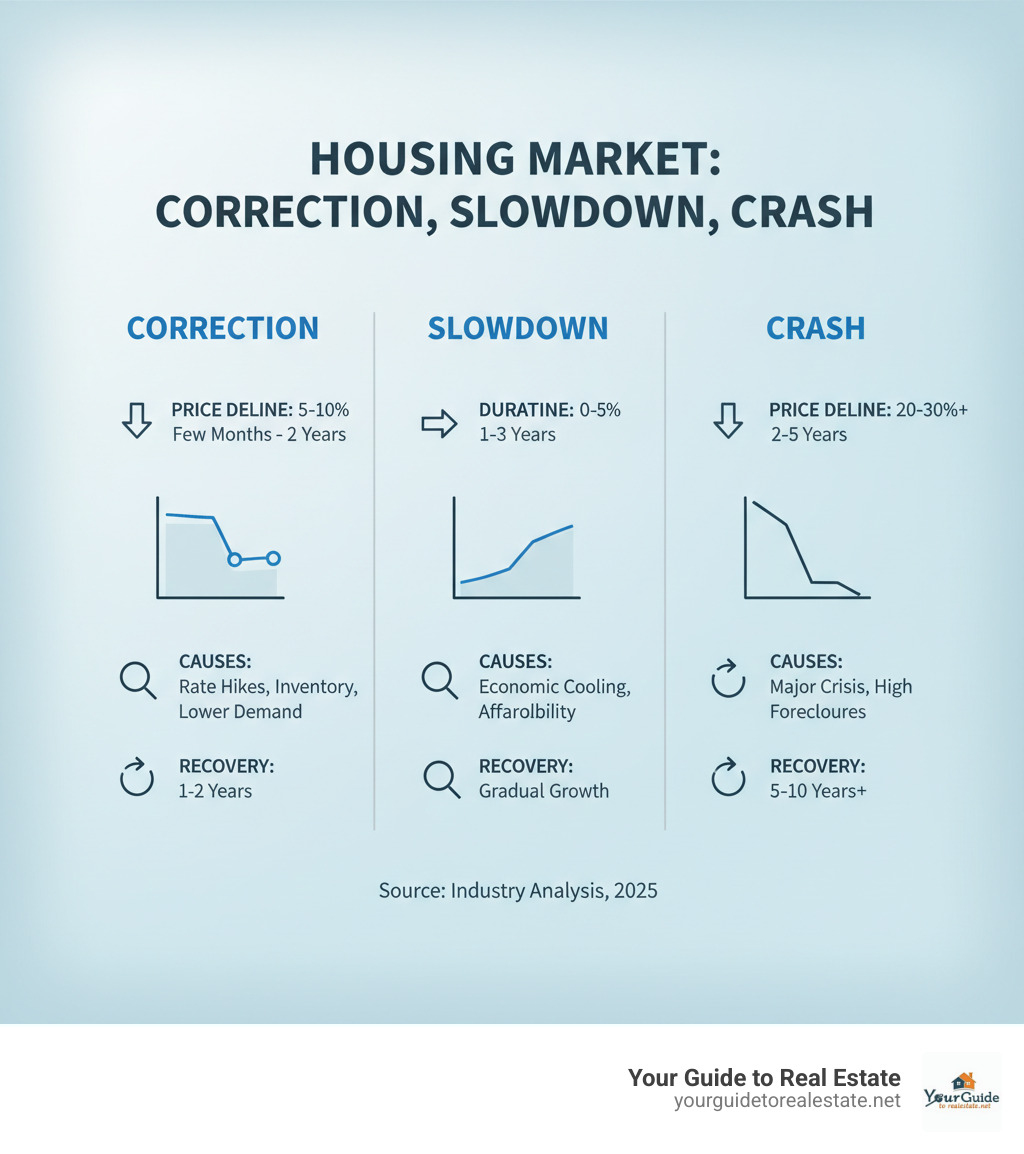
Quick housing market correction definitions:
What Is a Housing Market Correction?
Think of a housing market correction as your friend gently tapping you on the shoulder to say “slow down” after you’ve been sprinting. It’s not a brick wall – it’s more like a yellow traffic light that gives everyone a chance to catch their breath.
A housing market correction happens when home prices drop by around 10% or less from their peak. This isn’t some arbitrary number dreamed up by economists – it’s based on decades of market patterns. The key word here is “correction” because that’s exactly what’s happening. After a period where prices climbed faster than a kid on a jungle gym, the market naturally rebalances itself.
Here’s what makes this so important: when home prices outrun what people actually earn, something has to give. A correction brings those prices back down to earth, making homes more affordable for regular families again. It’s the market’s way of hitting the reset button.
Now, let’s clear up a common confusion. A housing market correction is absolutely not the same thing as a housing market crash. Think of it this way: a correction is like your car gently coasting to a stop, while a crash is like slamming into a tree. The differences matter a lot for your wallet and peace of mind.
Understanding how properties get their value helps you see why these corrections happen naturally. For a deeper dive into this topic, check out our guide on real estate valuation.
| Metric | Housing Market Correction | Housing Market Crash |
|---|---|---|
| Price Decline | Typically 10% or less from peak values | Often 20-30% or more from peak values |
| Duration | A few months to a few years | Can last several years |
| Economic Impact | Market rebalancing, increased affordability, moderate slowdown | Severe economic downturn, widespread foreclosures, recession |
| Recovery Speed | Market stabilizes and resumes growth relatively quickly | Long and arduous recovery |
| Underlying Cause | Overheated market, rising interest rates, supply adjustments | Systemic financial issues, subprime lending, economic collapse |
| Buyer Sentiment | Caution, opportunity for some | Fear, extreme uncertainty |
Key Causes and Indicators
What actually triggers a housing market correction? Usually, it’s not just one thing – it’s more like a perfect storm of economic changes that make the market pump the brakes.
Rising interest rates are often the biggest culprit. When mortgage rates climb, borrowing money becomes more expensive. Suddenly, that dream home costs a lot more each month, and some buyers find themselves priced out completely. Fewer buyers means less competition, and sellers start adjusting their expectations. If you’re wondering why rates seem to bounce around so much, our article on Why Are Mortgage Rates Going Up? breaks it down in simple terms.
Economic uncertainty also plays a huge role. When people worry about their jobs or the economy in general, they naturally become more cautious about making big purchases. Nobody wants to buy a house if they’re not sure they can afford the payments next year. This creates a ripple effect where both buyers and sellers adopt a wait-and-see attitude.
The Bank of Canada has been keeping a close eye on household debt levels, warning that too much borrowing can create serious problems. Their scientific research on household indebtedness shows how personal debt can trigger broader market corrections.
Several warning signs usually appear before a correction takes hold. Increased housing inventory means more homes sitting on the market, giving buyers plenty of options. Longer days on market become the new normal as homes take weeks or months to sell instead of days. Reduced buyer demand shows up as fewer showings, less competition, and the end of those crazy bidding wars.
When you start seeing these patterns in your local market, it’s often a sign that a natural adjustment is beginning.
How Long Do Corrections Typically Last?
Here’s the question everyone asks: “When will this be over?” Unfortunately, there’s no crystal ball for timing a housing market correction. These periods can last anywhere from several months to a few years, depending on what caused them in the first place.
If the correction stems from something temporary – like a short-term spike in interest rates – the market might bounce back within a year. But if deeper economic issues are at play, such as persistent inflation or high unemployment, it could take longer for things to stabilize.
Market conditions and economic factors work together to determine the timeline. The correction typically runs its course when the underlying problems start to resolve. Interest rates stabilize, consumer confidence returns, and people feel secure enough to make big financial decisions again.
Historical examples show us that these adjustment periods, while uncomfortable, are actually healthy for the long-term market. They prevent prices from getting so out of whack that only the wealthy can afford homes. Stabilization signs usually include steady inventory levels, consistent days on market, and renewed buyer interest.
The good news? Markets do recover. When the dust settles, you often end up with a more balanced, sustainable housing market that works better for everyone.
Case Study: The 2024-2025 Canadian Housing Market Correction
Let’s explore a real-world example that perfectly shows how a housing market correction unfolds: Canada’s recent experience in 2024-2025. What happened north of the border offers valuable lessons for anyone trying to understand these market shifts.
The Canadian housing market became a textbook case of how economic pressures can quickly cool an overheated market. Interest rates were the main culprit here. The Bank of Canada aggressively raised rates to fight inflation, making mortgages much more expensive almost overnight. This hit buyers hard – suddenly, the same house payment that seemed manageable became a stretch.
Here’s what made it particularly challenging: over one-third of Canadian mortgages are set to renew by 2026, many at significantly higher rates. Imagine finding your mortgage payment could jump by hundreds of dollars per month when renewal time comes. No wonder many potential buyers decided to wait it out.
Inflation added another layer of difficulty. When everything from groceries to gas costs more, people naturally become more cautious about taking on a massive mortgage. Trade tensions with the U.S. also played a role, creating uncertainty that made both buyers and sellers nervous about making big moves. While Canada eventually avoided some threatened tariffs, the uncertainty lingered and affected market confidence.
The numbers tell the story clearly. Canada’s composite MLS Home Price Index dropped for five straight months, falling 1.2% in April alone and 3.6% compared to the previous year. Experts predicted a national average price drop of around 2%, with the most expensive markets seeing even steeper declines. For more insights on how these broader trends might continue, check out our housing market forecast.
Regional Hotspots and Price Declines
Not every part of Canada felt the correction equally. Some areas got hit much harder than others, creating distinct patterns across the country.
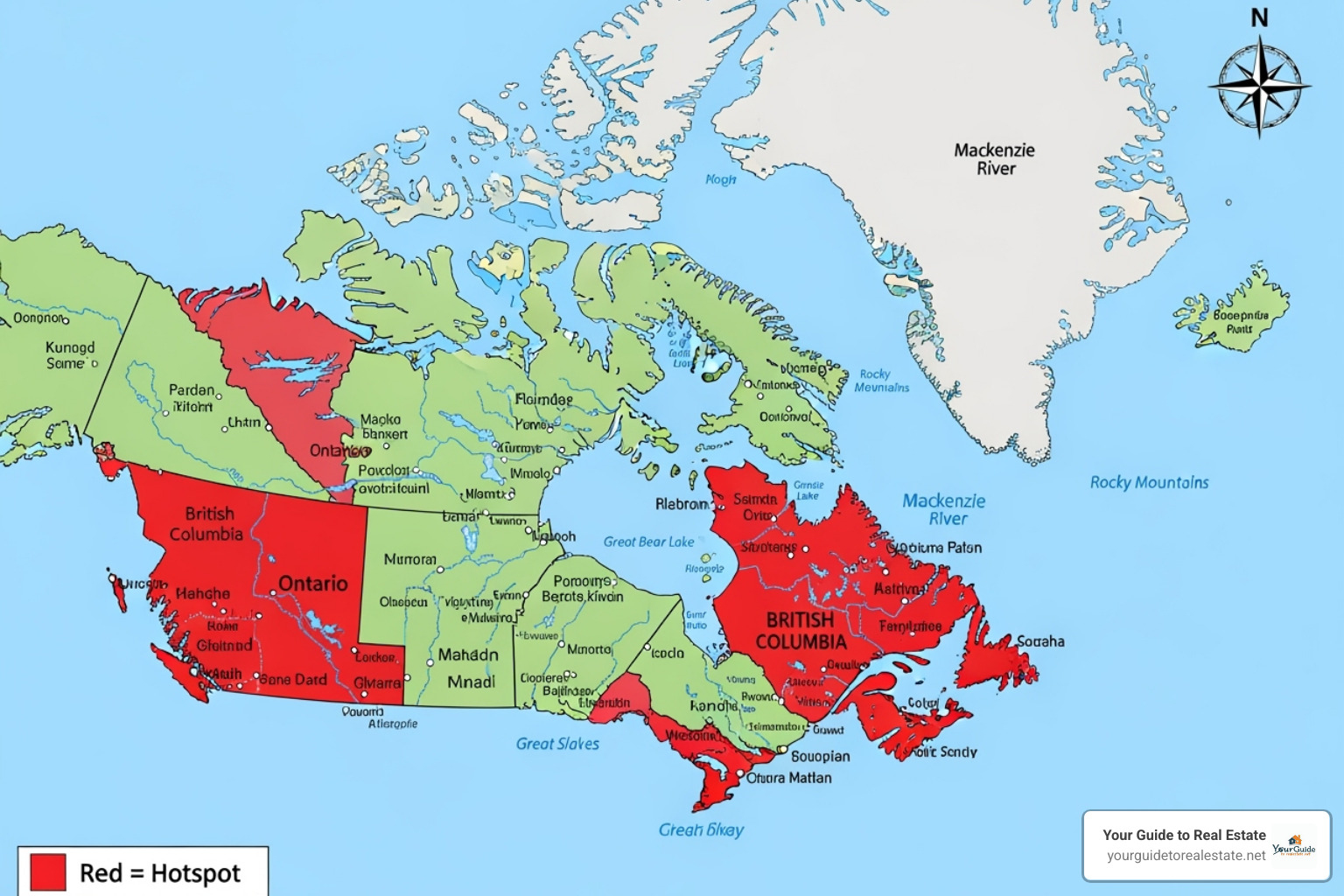
Southern Ontario and British Columbia bore the brunt of the correction. These were also the regions that saw the wildest price increases during the pandemic boom, so perhaps it’s no surprise they experienced the biggest adjustments.
Toronto led the way down, with its composite price index falling 6.2% over five months. From its 2022 peak, Toronto prices dropped a substantial 12%. But Toronto wasn’t alone in Ontario’s correction story. Hamilton saw prices fall 16% from its 2022 peaks, while London experienced a 7.7% drop and Kitchener-Waterloo fell 7.6%. Niagara wasn’t spared either, declining 6.9%. In fact, every single Ontario market recorded month-over-month price declines in April – a remarkable sweep across the province.
Out west, Vancouver and the Fraser Valley in British Columbia also felt the pinch, with composite prices dropping 2.8% over four months. The correction was real and measurable across Canada’s most expensive markets.
But here’s where it gets interesting – not every region joined the correction party. Alberta, Saskatchewan, Manitoba, Quebec, and Atlantic Canada showed remarkable resilience. These markets had more balanced fundamentals to begin with, so they continued seeing modest price growth even as the expensive markets cooled.
Quebec particularly stood out for its stability. Montreal actually saw both single-family home and condo prices rise in April, both monthly and annually. The province maintained stronger buyer sentiment and market momentum compared to its neighbors.
This regional variation perfectly illustrates how a housing market correction isn’t a one-size-fits-all event. Local market conditions, affordability levels, and economic factors all play crucial roles in determining who gets affected and by how much.
The Condo Market and Shifting Dynamics
The condo market became ground zero for Canada’s housing market correction, especially in the country’s biggest cities. If you wanted to see the correction in action, condos were where the drama unfolded.
Toronto’s condo market took a particularly hard hit. The condo MLS Home Price Index dropped 7.3% annually – a significant decline that caught many by surprise. Here’s a startling fact: around 70% of new rental condos in Toronto were actually losing money monthly for their owners. The benchmark apartment price, which hit $826,000 in 2022, is projected to fall to $648,000 by June 2025 – that’s a 22% drop. The median price tells a similar story, expected to fall from $803,000 to $611,000, a 24% decline.
Vancouver’s condo market also felt the pressure, with its condo price index falling 2%. While not as dramatic as Toronto, it still represented a meaningful shift in a market that had seen years of relentless growth.
What’s driving this condo correction? Rising inventories are flooding the market with choices. A 2024 report from the Canadian housing agency found that one in three new housing starts in major urban cities are rental apartments, with most expected to complete in 2026 and 2027. That’s a lot of new supply hitting markets that are already cooling.
This supply surge has completely flipped the seller-buyer power balance. Remember those frantic bidding wars where buyers had to make split-second decisions and waive inspections? Those days are largely gone, especially in Ontario and British Columbia. Now buyers can take their time, compare options, negotiate terms, and actually think through their decisions.
This shift represents exactly what a housing market correction is supposed to do – bring balance back to a market that had gotten out of hand. For buyers, especially first-time buyers who were previously shut out, this represents a real opportunity to enter markets that seemed impossible just a few years ago.
Navigating the Correction: Outlook and Strategies
Think of navigating a housing market correction like learning to drive in winter conditions – it’s not impossible, but you need to adjust your approach and know what to expect around each corner. The good news is that with the right strategies and mindset, these market shifts can actually create some excellent opportunities.

Looking ahead, market forecasts paint a picture of continued adjustments, especially in areas that saw prices skyrocket in recent years. The Canadian correction we discussed earlier isn’t finished yet – experts are predicting further price projections showing decreases in many regions. Some U.S. markets faced similar predictions, with experts expecting another 10% to 15% decrease by the second or third quarter of 2023 in certain areas.
What makes this particularly challenging is the economic uncertainty swirling around us. In Canada, for instance, over one-third of homeowners will face mortgage renewals by 2026, and many of these will be at significantly higher rates than what they’re currently paying. This creates what some economists are calling an “affordability time bomb.”
The million-dollar question everyone’s asking is Will Mortgage Rates Go Down? While central banks have hinted at potential rate cuts, the timing remains as predictable as the weather – which is to say, not very predictable at all.
What a Housing Market Correction Means for You
Here’s the thing about a housing market correction – it’s not universally good or bad news. It really depends on where you’re sitting at the real estate table.
For first-time homebuyers, this could be your moment to shine. The increased affordability that comes with moderating prices means homes that were once pipe dreams might actually fit your budget. Remember when we talked about prices outrunning wages? Well, corrections help bring those two back into balance.
You’ll also face less competition than buyers did during the market frenzy. Gone are the days of bidding wars where homes sold for $50,000 over asking within hours of being listed. Now you can actually take time to think, maybe even sleep on a decision – imagine that!
But here’s the catch: stricter lending standards mean lenders are being more careful about who they approve. Your credit score, down payment, and overall financial health matter more than ever. Our First-Time Homebuyer Tips can help you get your financial ducks in a row before you start house hunting.
For sellers, the correction requires a hefty dose of patience and realistic expectations. You might receive lower offers than your neighbor got six months ago, and your home could sit on the market for longer selling times. The key is strategic pricing from day one – overpricing in a correction is like wearing a winter coat in July; it just doesn’t work.
Working with an experienced agent who understands market dynamics becomes crucial. They can help you price competitively and market effectively. If you’re thinking about selling, our guide The Ultimate Guide to Selling Your Home: Tips, Timelines, and Tools offers comprehensive strategies for success.
For investors, corrections can be like finding a designer dress at a thrift store – if you know what to look for. Discounted properties become available, potentially setting you up for strong long-term returns. However, the focus needs to shift to cash flow rather than hoping for quick appreciation.
In Toronto, for example, many new rental properties are actually losing money monthly – about 70% of them. This highlights why understanding your numbers and focusing on long-term fundamentals is so important. Look for properties in good locations with solid rental demand, not just the cheapest options available.
Long-Term Implications for the Market
When we zoom out and look at the bigger picture, a housing market correction is often like a forest fire – destructive in the short term, but ultimately necessary for healthy regrowth.
Housing affordability is perhaps the most significant long-term benefit. When prices moderate, it gives wages a chance to catch up, making homeownership possible for more people. In places like Vancouver, where housing costs consumed over 90% of median household income, this rebalancing is desperately needed.
Market stability improves as corrections help prevent more severe crashes down the road. Think of it as releasing pressure from a steam valve – uncomfortable but necessary to prevent an explosion later.
The supply and demand balance also shifts during corrections. We’re seeing increased inventory, especially in condominiums, which helps temper future price growth. Government policies are playing an increasingly important role here too.
Government policy impact is becoming more pronounced. Canada’s federal government reduced immigration quotas through 2026 to ease housing pressure, directly affecting demand. Meanwhile, initiatives like Mark Carney’s housing plan focus on boosting supply and affordability through federal intervention and financing for prefab homes.
These changes are setting the stage for a more sustainable housing market – one that’s characterized by better affordability and greater resilience against future economic shocks. It won’t happen overnight, but the foundation is being laid for healthier long-term growth.
For deeper insights into where the market might be headed, check out our real estate market projections for 2025, which explores these trends in greater detail.
Frequently Asked Questions about Housing Market Corrections
We know that watching the housing market shift can stir up a lot of worries and questions. After all, for most people, their home is their biggest investment. Let’s tackle the questions we hear most often about housing market corrections and give you some straight answers.
Is a housing market correction a good time to buy a house?
Here’s the thing about timing the market – it’s a bit like trying to catch a falling leaf. You might get it right, but there are a lot of variables at play.
A housing market correction can absolutely be a great time to buy, especially if you’ve been watching from the sidelines. The affordability benefits are real – when prices drop even 10%, that could mean tens of thousands of dollars in savings on your dream home. Plus, you’ll likely face reduced competition. Gone are the days of bidding wars where you had to waive inspections and offer $50,000 over asking just to get noticed.
But let’s be honest about the challenges too. Interest rate risk is probably your biggest concern right now. Even if home prices are lower, higher mortgage rates might mean your monthly payment stays roughly the same – or even increases. It’s like getting a discount on the sticker price but paying more for financing.
The real question isn’t whether the market timing is perfect, but whether you’re ready. Are you financially stable with steady income? Do you have a solid emergency fund? Are you planning to stay put for at least five to seven years? If you can answer yes to these questions, then your personal financial readiness matters more than trying to perfectly time the market.
Our philosophy is simple: buy when you’re ready, not when you think the market is ready. A housing market correction just might make that decision a little easier on your wallet.
How can I tell if my local market is in a correction?
Spotting a housing market correction in your neighborhood is like being a detective – you need to look for clues and piece together the story.
Start with local price trends. Are homes selling for less than they did six months ago? Most real estate websites show historical price data, so you can see if there’s a consistent downward trend. We’re looking for that roughly 10% drop from peak prices that signals a correction.
Next, pay attention to inventory levels. Take a drive through your target neighborhoods on weekends. Are you seeing more “For Sale” signs than usual? When buyers have more choices, sellers have to be more competitive with both price and condition.
Here’s a telltale sign many people miss: days on market. If homes that used to sell in a week are now sitting for a month or more, that’s your market cooling off. You can usually find this information on listing websites or by asking a local real estate agent.
Don’t forget about sales volume either. Even if prices haven’t dropped dramatically, fewer people buying and selling can signal a market in transition.
For the most accurate picture of your specific area, consider getting a Competitive Market Analysis Complete Guide. This will give you the detailed, neighborhood-specific data you need to make informed decisions. After all, real estate is local, and what’s happening three towns over might not reflect your market at all.
Will a housing market correction lead to a crash?
This is the question that keeps people up at night, and we totally get it. The memory of 2008 is still fresh for many of us. But here’s some reassuring news: a housing market correction turning into a full-blown crash is pretty unlikely given today’s conditions.
The correction vs. crash distinction is crucial to understand. Think of a correction as your car slowing down when you see a yellow light, while a crash is like hitting a brick wall. They’re completely different experiences.
Several factors are working in favor of stability right now. The underlying economic health of most markets remains solid. Yes, we’re dealing with inflation and higher interest rates, but we’re not seeing the widespread job losses and economic collapse that typically trigger housing crashes.
Perhaps most importantly, we’re still dealing with a significant housing supply shortage in most markets. We’ve been under-building homes for over a decade, which means there simply aren’t enough houses to meet demand. This shortage acts like a floor under home prices – they can only fall so far when people still need places to live.
Today’s lending standards are also much stricter than they were before 2008. Buyers have to prove they can actually afford their mortgages, which means we’re unlikely to see the wave of foreclosures that characterized the last crash.
Could a crash happen? In theory, yes – some major economic shock could change everything. But based on current market fundamentals, we’re much more likely looking at a healthy correction that brings prices back to sustainable levels. That’s actually good news for the long-term health of the housing market and your investment in it.
Conclusion

A housing market correction doesn’t have to be something that keeps you up at night. Think of it more like your favorite recipe – sometimes you need to adjust the ingredients to get the perfect result. That’s exactly what a correction does for the housing market.
Throughout our journey together, we’ve finded that a housing market correction is simply the market’s way of hitting the reset button. When prices have been climbing faster than a squirrel up a tree, the market eventually says, “Hold on, let’s slow down and catch our breath.” This rebalancing brings home prices back to levels that actually make sense when you look at people’s incomes and the overall economy.
The most important thing to remember? A correction is fundamentally about creating balance. It’s not the scary monster under the bed that some people make it out to be. Instead, it’s a natural part of the real estate cycle that typically involves price drops of around 10% or less – quite different from the dramatic plunges you’d see in a market crash.
For buyers, this rebalancing creates genuine opportunities. You’ll find homes more within reach, less frantic competition, and actually have time to think about your decision instead of making split-second offers. Yes, mortgage rates might still be higher, but the reduced competition and lower prices can often balance that out.
Sellers face different challenges during these times. Your home might take longer to sell, and you may need to be more realistic about pricing. But remember, if you’re also buying another home, you’re benefiting from the same market conditions that are affecting your sale.
The key through all of this is having expert guidance you can trust. The real estate market has more moving parts than a Swiss watch, and trying to steer it alone can feel overwhelming. That’s where we come in. At Your Guide to Real Estate, we’ve built our proven framework around one simple goal: making your real estate journey as stress-free as possible.
Whether you’re taking your first steps into homeownership, ready to sell and move on to your next chapter, or looking to grow your investment portfolio, understanding market corrections gives you a real advantage. Knowledge is power, and now you’re armed with the insights to make confident decisions regardless of what the market throws your way.
Ready to stay ahead of the curve? Get the latest Housing Market Forecast and keep your finger on the pulse of what’s happening in real estate. After all, the best time to plant a tree was 20 years ago – the second best time is now.