
Why the Social Security Fairness Act Update Matters for Millions
The fairness act update has brought major changes to Social Security benefits for nearly 3 million Americans. On January 5, 2025, President Biden signed the Social Security Fairness Act into law, ending decades of reduced benefits for public service workers.
Key Updates at a Glance:
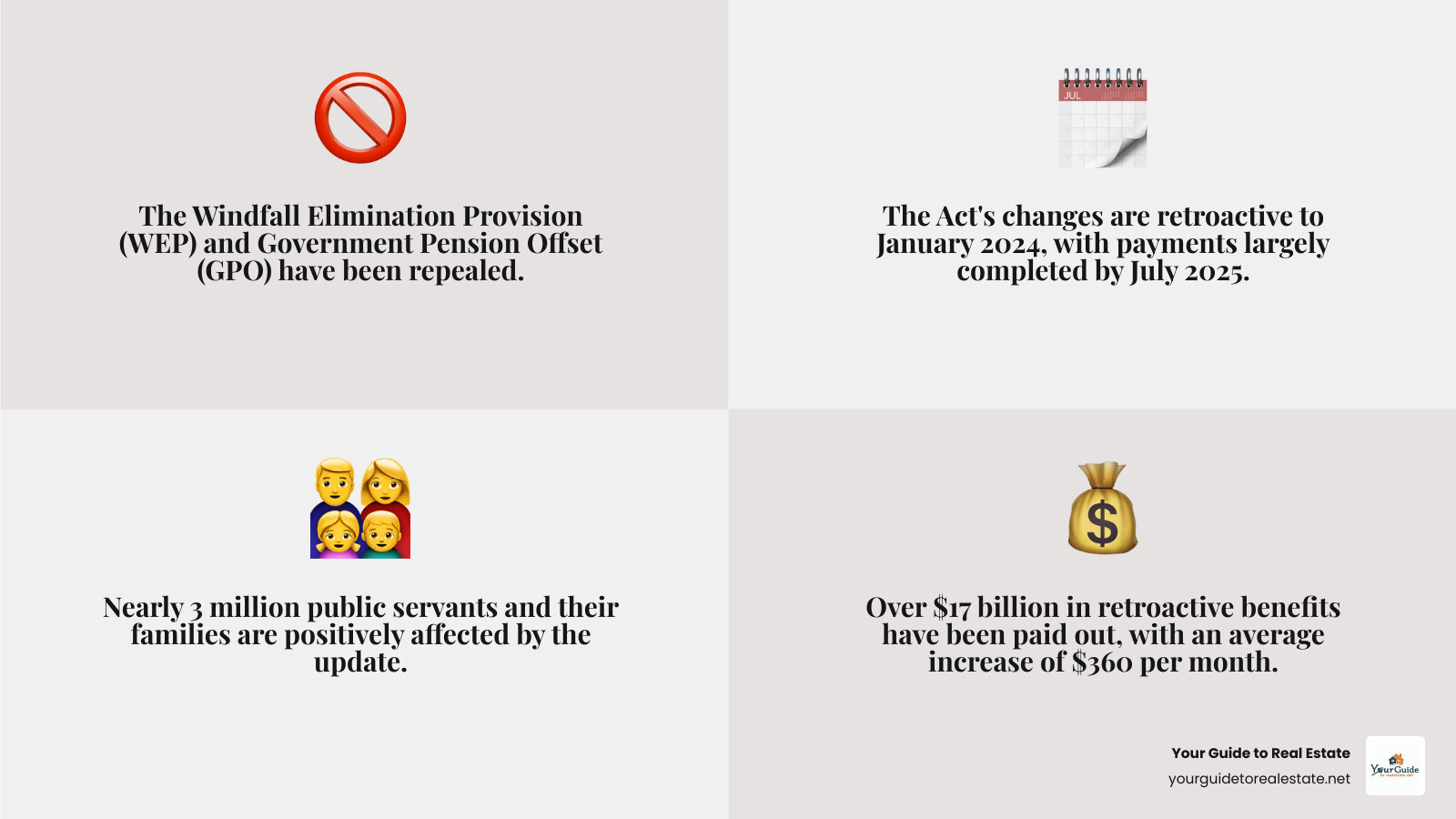
- Windfall Elimination Provision (WEP) – Repealed
- Government Pension Offset (GPO) – Repealed
- Effective Date – Retroactive to January 2024
- People Affected – Nearly 3 million public servants and their families
- Average Benefit Increase – $360 per month
- Total Payments Issued – Over $17 billion in retroactive benefits
This law specifically helps teachers, firefighters, police officers, postal workers, and other public employees who receive pensions from jobs that didn’t pay into Social Security. It also restores full benefits for their spouses and survivors.
The Act removes unfair penalties that reduced Social Security payments for people who worked both in public service and private sector jobs. About 72% of state and local public employees won’t see changes because they already pay Social Security taxes.
As of July 2025, the Social Security Administration has completed sending over 3.1 million payments totaling $17 billion – finishing 5 months ahead of schedule. If you’re affected by this change, you may have already received a lump sum payment covering benefits from January 2024 forward.
Fairness act update terminology:
What the Social Security Fairness Act Changes
The fairness act update represents one of the most significant changes to Social Security in decades. For years, public service workers faced unfair penalties that reduced their hard-earned benefits. Now, those days are finally over.
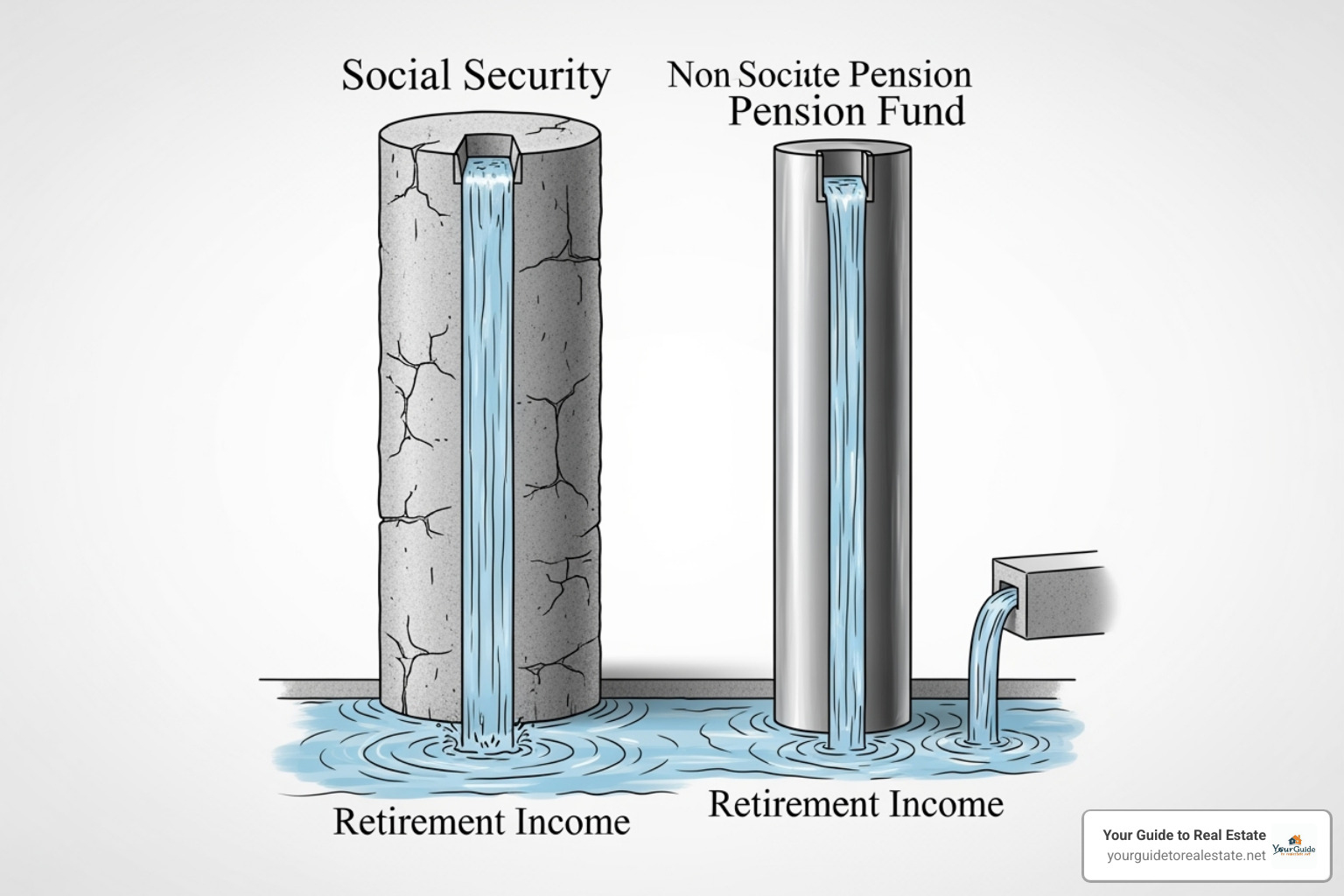
The heart of this issue involves something called “work not covered by Social Security.” This simply means jobs where neither you nor your employer paid Social Security taxes. Instead, you contributed to a separate pension system – like many teachers, firefighters, and police officers do with their state retirement plans.
Before this law, having one of these “non-covered” pensions could dramatically reduce your Social Security benefits through two complex rules: the Windfall Elimination Provision (WEP) and the Government Pension Offset (GPO). The fairness act update eliminates both of these provisions entirely. To understand how this fits into the broader picture of Social Security changes, check out our guide on What Changes Are Coming to Social Security in 2025?
The Old Rules: WEP and GPO Explained
Let’s talk about what made these old rules so frustrating for millions of public servants and their families.
The Windfall Elimination Provision (WEP) was designed to prevent what lawmakers saw as “double benefits” for people who worked both public service jobs and private sector jobs. The logic seemed simple: if you got a pension from work that didn’t pay into Social Security, your Social Security benefits should be reduced.
In practice, this meant that a teacher who worked 20 years in public schools and then 15 years for a private company could see their Social Security benefits slashed. The reduction could be hundreds of dollars per month – money they had legitimately earned through their private sector work.
The Government Pension Offset (GPO) hit spouses and survivors even harder. This rule reduced Social Security spousal or survivor benefits by two-thirds of any government pension from non-covered work. Picture this: a retired teacher whose spouse passes away might find their survivor benefits completely eliminated because of their own teaching pension.
These provisions affected real people in devastating ways. A firefighter’s widow could lose her survivor benefits entirely. A postal worker might see their Social Security cut by $400 monthly. About 2.8 million people faced WEP reductions, while hundreds of thousands more lost spousal and survivor benefits to GPO.
The impact wasn’t just financial – it felt deeply unfair. These were people who had dedicated their careers to serving their communities, only to be penalized in retirement for that service.
The New Rules: Full Benefits Restored
The fairness act update changes everything. Both WEP and GPO are completely repealed, effective January 2024. This means no more benefit reductions based on your non-covered pension.
If you were hit by WEP before, you’ll now receive your full Social Security retirement or disability benefit. If GPO was reducing your spousal or survivor benefits, those penalties are gone too. The government is treating your Social Security benefits as what they truly are – money you earned through your covered employment.
Here’s how the changes break down:
| Feature | Before Social Security Fairness Act (WEP/GPO in effect) | After Social Security Fairness Act (WEP/GPO repealed) |
|---|---|---|
| Own Social Security Benefit | Reduced if you had a non-covered pension (WEP) | Full benefit, no reduction due to non-covered pension |
| Spousal/Survivor Benefit | Reduced or eliminated if you had a non-covered pension (GPO) | Full benefit, no offset due to non-covered pension |
| Equity for Public Employees | Often felt unfair, leading to financial hardship | Improved equity, recognizing all earned benefits |
| Retroactivity | Not applicable | Retroactive to payments from January 2024 |
The best part? These changes are retroactive to January 2024. That means if you were affected, you’re not just getting higher monthly payments going forward – you’re also getting a lump sum to make up for the benefits you should have received over the past year.
This represents a massive shift toward fairness for public employees. No longer will your dedication to public service result in reduced Social Security benefits. You’ll get the full amount you earned, period.
Who Is Affected and How Will Benefits Change?
The fairness act update brings life-changing improvements to nearly 3 million Americans who’ve spent their careers serving the public. If you’re wondering whether this affects you or someone you love, the answer likely depends on your connection to public service work.
Teachers make up a large portion of those benefiting from these changes. Many educators, particularly in states like Texas, California, and Ohio, participate in state pension systems that don’t contribute to Social Security. After years of seeing their Social Security benefits reduced, they’re finally getting the full benefits they earned.
Firefighters and police officers represent another significant group. These brave first responders often rely on municipal or state pension plans instead of Social Security. The fairness act update means their heroic service won’t penalize their retirement security anymore.
Federal employees under the Civil Service Retirement System (CSRS), especially those who retired before 1984, are also seeing restored benefits. Their decades of federal service combined with any private sector work now receive proper recognition.
Perhaps most importantly, spouses and survivors of public servants are finally getting relief. If your spouse worked in public service and you’ve been watching your Social Security spousal or survivor benefits disappear due to the old GPO rules, those days are over.
The average monthly increase sits around $360, but don’t let that number fool you. Some people might see smaller bumps while others could receive over $1,000 more each month. Your specific situation determines your exact benefit boost. For detailed information about how these payments are being distributed, you can explore our guide on Social Security Fairness Act Retroactive Payments.
How the Fairness Act Update Affects Your Monthly Benefits
Your personal benefit increase from the fairness act update depends on several key factors that made your original situation unique. Think of it like a puzzle where each piece of your work history matters.
Your pension amount plays the biggest role in determining your increase. The larger your non-covered pension, the more your Social Security benefits were likely reduced under the old rules. Now that those reductions are gone, a bigger previous penalty means a bigger restoration.
The type of Social Security benefit you receive also matters significantly. Retirement benefits, disability benefits, and spousal or survivor benefits were all affected differently by the old WEP and GPO rules. The restoration process reflects these original differences, so your benefit type influences your specific increase.
Your complete earnings history from Social Security-covered work now gets its full due. Previously, the WEP formula artificially reduced how your earnings translated into benefits. With that gone, your true earning record determines your benefit amount.
Survivor benefits deserve special attention because they often saw the most dramatic improvements. Widows and widowers who watched their Social Security benefits shrink or disappear entirely due to their own government pensions are now receiving their full entitled amounts. This change provides crucial financial security during already difficult times.
The Social Security Administration has made remarkable progress implementing these changes. They’ve already completed over 3.1 million payments totaling $17 billion to eligible beneficiaries. The SSA achieved this milestone months ahead of schedule, showing their commitment to getting these benefits to people quickly. You can read the SSA’s official blog post on the milestone to learn more about this achievement.
Timeline for the Fairness Act Update Implementation
The fairness act update timeline shows how quickly things moved once the law passed, and when you can expect to see your benefits change.

January 2024 marks the crucial retroactive date. This means WEP and GPO stopped applying to benefits starting with January 2024 payments. Every month since then counts toward your increased benefit calculation, creating substantial lump-sum payments for many people.
January 5, 2025 brought the official signing of the Social Security Fairness Act into law. This historic moment ended decades of reduced benefits for public servants across America.
February 2025 saw the Social Security Administration spring into action. They began adjusting monthly payments and calculating those important one-time payments covering the retroactive period back to January 2024.
April 2025 became the month most people started seeing their new, higher monthly benefit amounts. If you were already receiving Social Security, your April payment likely reflected your first full month under the new rules.
July 7, 2025 marked an incredible milestone. The SSA announced they’d completed over 3.1 million payments totaling $17 billion to eligible beneficiaries. They finished this massive undertaking five months ahead of their original schedule, showing remarkable efficiency in implementing the fairness act update.
By mid-July 2025, the SSA had also processed 92% of the nearly 290,000 new applications received since the Act passed. This means people applying for benefits after the law changed were getting processed quickly too.
If you were already receiving reduced benefits, you should have received both a lump-sum payment covering January 2024 through your adjustment period and ongoing higher monthly payments by summer 2025. Most people saw these changes reflected in payments received by August 2025.
The SSA’s ahead-of-schedule performance demonstrates their dedication to implementing this fairness act update efficiently. While some complex cases might need additional time, the vast majority of affected beneficiaries have already seen their benefits restored to their rightful amounts.
The Latest Social Security Fairness Act Update: What You Need to Do
Here’s some great news about the fairness act update: if you’re already getting Social Security benefits that were reduced by WEP or GPO, you probably don’t need to lift a finger! The Social Security Administration has been working around the clock to find everyone affected and automatically fix their payments.
The SSA used their existing records to recalculate benefits and send out those retroactive payments we talked about earlier. If you’ve been getting reduced benefits, you should have already received your lump sum payment and seen your monthly amount increase.
That said, there are still some important steps you might want to take. Whether you’re applying for benefits for the first time or just want to make sure everything looks right, staying on top of your Social Security information is always smart. Speaking of staying informed, you might find our article on Social Security Transparency Initiatives helpful for understanding how the SSA is working to keep things more transparent.
Actions for Current and New Beneficiaries
Let’s break this down based on your specific situation, because what you need to do depends on where you stand with Social Security right now.
If you’re already getting Social Security benefits and were hit by WEP or GPO, you’re in luck. The SSA has automatically adjusted your benefits and sent out retroactive payments. You don’t need to do anything special, but it’s still wise to double-check that everything looks correct. Head over to your ‘my Social Security’ account and take a look at your benefit statements, earnings records, and contact information. Think of it as a quick health check for your Social Security account.
If you or your spouse never applied for Social Security benefits because WEP or GPO made it seem not worth it, now’s your time to shine! Those old rules that might have discouraged you from applying are gone. The easiest way to apply for retirement or spouse’s benefits is online at ssa.gov/apply. When you’re applying for spouse’s benefits, make sure to choose “Family Benefits” so the system considers all the benefits you might be eligible for.
Here’s something that might seem confusing: even though WEP and GPO are history, the application might still ask about your pension information. Don’t worry! This is just because the SSA is still updating their systems. Providing this information won’t hurt your benefits anymore under the new law.
For survivor benefits, things work a bit differently. You can’t apply for these online, so you’ll need to call the SSA at 1-800-772-1213. The phone representatives can walk you through the process and make sure you get all the benefits you’re entitled to.
There’s one more thing to keep in mind: Medicare premium adjustments. If you’ve been paying your Medicare premiums directly to the Centers for Medicare & Medicaid Services because your Social Security benefits were too low due to WEP or GPO, keep doing that for now. The SSA will let you know when they’re ready to start deducting your premiums from your newly increased Social Security benefits. If you’re using Medicare Easy Pay or your bank’s bill payment service, you can stop those payments by completing form SF-5510 or contacting your bank. Don’t worry about any premiums you’ve prepaid – you’ll get refunded for those.
What to Do If You Disagree with Your New Benefit Amount
Even though the SSA has done an impressive job rolling out this fairness act update, handling nearly 3 million cases is no small feat. Sometimes things don’t go perfectly, and you might find yourself looking at your new benefit amount thinking, “This doesn’t seem right.”
You’re not powerless if this happens. In fact, there’s been some confusion about how far back the retroactive payments should go, especially for spousal and survivor benefits. While the law clearly states that benefits should be retroactive to January 2024, some people have reported that the SSA initially applied their standard 6-month rule from when you applied, rather than going all the way back to January 2024. This is particularly important if you’re applying for spousal or survivor benefits now.
Your first step should always be to contact the SSA directly. Call their national number at 1-800-772-1213 between 8 a.m. and 7 p.m., Monday through Friday. Have your Social Security number handy and any documents that might help explain your situation. The representatives are generally helpful and can often clear up misunderstandings on the spot.
If calling doesn’t resolve your issue, or if you want to make sure your rights are protected while things get sorted out, you can file a formal appeal. This involves completing a Request for Reconsideration (Form SSA-561). Think of this as your official way of saying, “Hey, I think there’s been a mistake here.”
When you fill out this form, be crystal clear about what you’re asking for. Under “Issue Being Appealed,” write something like “Retroactive benefit under the Social Security Fairness Act.” Under the “I do not agree” section, be specific: “I am requesting full retroactive payments under the Social Security Fairness Act back to January 2024.” Skip the SSI section unless it actually applies to your situation, and mail the completed form to your local Social Security office.
Filing this form isn’t just about getting your issue resolved now – it also protects your rights if the SSA later clarifies their position or if Congress or the courts require them to stick more strictly to that January 2024 effective date for all cases.
The SSA is still working through complex cases and applications. Most people have seen their issues resolved smoothly, but if you have a unique employment history or complicated situation, it might take a bit longer. Be patient, but don’t be afraid to advocate for yourself and the benefits you’ve earned.
Frequently Asked Questions about the Fairness Act
Change can feel overwhelming, especially when it involves something as important as your Social Security benefits. The fairness act update has brought relief to millions of public servants, but it’s natural to have questions about how it all works. Let’s clear up some of the most common concerns we hear.
Will every public worker get a benefit increase?
This is probably the biggest misunderstanding about the fairness act update. The short answer is no – not every public worker will see their Social Security benefits go up.
Here’s why: The law only helps people whose benefits were previously cut by the Windfall Elimination Provision (WEP) or Government Pension Offset (GPO). These penalties only applied if you received a pension from work where you didn’t pay Social Security taxes.
Most public workers are actually unaffected. About 72% of state and local government employees already pay Social Security taxes on their jobs. If you’re in this group, your Social Security benefits were never reduced in the first place, so there’s nothing to restore.
You’ll only see an increase if you have a pension from “non-covered” work (where you didn’t pay Social Security taxes) and your Social Security benefits were previously reduced because of it. This typically includes certain teachers, firefighters, police officers, and federal employees under the old Civil Service Retirement System.
The key factor is your work history. If Social Security never penalized your benefits because of a non-covered pension, this law won’t change your monthly payments. But if you were one of the nearly 3 million people who did face these penalties, you should see a welcome boost in your benefits.
How does the SSA handle foreign or multiple non-covered pensions?
The fairness act update doesn’t just cover domestic government pensions. It also helps people with more complex situations involving foreign pensions or multiple non-covered pension sources.
Foreign pensions are included in this relief. If you worked abroad and have a pension from a foreign social security system that previously triggered WEP or GPO reductions, you should see your benefits restored. The Social Security Administration treats these situations similarly to domestic non-covered pensions since the core issue is the same – you have a pension from work that didn’t contribute to U.S. Social Security.
Multiple non-covered pensions are also covered. The beauty of repealing WEP and GPO entirely means that regardless of how many non-covered pensions you have, the old penalties are gone. The SSA will consider the total impact these pensions had on your benefits and eliminate those reductions.
These complex situations require careful handling though. Make sure the SSA knows about all your pension sources – accurate information helps them calculate your benefits correctly. For personalized guidance on how your specific mix of pensions affects your benefits, contact the Social Security Administration directly at 1-800-772-1213. Their representatives can walk you through how the changes apply to your unique situation.
Where can I find more official information and avoid scams?
With any major Social Security change, scammers unfortunately come out of the woodwork. The fairness act update has created opportunities for bad actors to prey on people seeking information about their benefits.
Stick to official sources for reliable information. The Social Security Administration has created a comprehensive resource page specifically for this law. Visit the Social Security Administration’s official FAQ page for the most current and accurate details about how the changes affect you.
For personal questions about your specific benefits, call the SSA directly at 1-800-772-1213. Their representatives are available Monday through Friday from 8 a.m. to 7 p.m. local time. You can also manage your information through your secure “my Social Security” account online at ssa.gov/myaccount.
Here’s what you need to know about scams: The Social Security Administration will never charge you for help with your benefits or threaten you with arrest if you don’t provide personal information. They won’t ask for payment in gift cards, wire transfers, or cryptocurrency.
Red flags to watch for include unsolicited calls, emails, or text messages claiming to be from Social Security and asking for personal information or money. If someone contacts you claiming they can help you get your Fairness Act benefits faster for a fee, hang up – it’s a scam.
If you encounter suspicious activity, report it to the SSA’s Office of the Inspector General at www.ssa.gov/scams. Don’t click on links in questionable emails, and never give personal information to someone who contacts you unexpectedly, even if they seem to know details about your benefits.
Legitimate help with Social Security is always free, and the real SSA won’t pressure you to act immediately or threaten consequences if you don’t comply with their demands.
Conclusion

What a journey it’s been for America’s public servants. After decades of watching their hard-earned Social Security benefits get reduced by confusing rules, the fairness act update has finally delivered the justice they deserved. This isn’t just another government program change – it’s a recognition that the people who teach our children, keep our communities safe, and serve our nation shouldn’t be penalized for their dedication.
The numbers tell an incredible story. Nearly 3 million Americans are now receiving the full Social Security benefits they always should have gotten. Teachers who spent 30 years in the classroom can finally retire with dignity. Police officers’ widows aren’t losing their survivor benefits anymore. Firefighters who worked part-time jobs to make ends meet aren’t being punished for it.
The impact goes far beyond monthly checks. When you suddenly have an extra $360 per month (or more), that opens doors you might have thought were closed forever. Maybe it’s finally time to consider that home you’ve been dreaming about. Perhaps you can help your grandchildren with college, or simply sleep better knowing your retirement is more secure.
At Your Guide to Real Estate, we see how financial confidence changes everything. When people feel secure about their income, they make bolder decisions about their future. They consider moving to that dream location, investing in rental property, or upgrading to a home that truly fits their golden years.
This legislative victory proves that persistence pays off. It took years of advocacy and countless stories from affected families to make this change happen. The same determination that drove this fairness act update can guide you in your own financial planning and real estate decisions.
Your newly restored Social Security benefits are just one piece of your financial puzzle. Understanding how all the pieces fit together – from retirement income to homeownership opportunities – helps you build the future you want. Secure your financial future by learning more with our beginner’s guide to home loans.