

Understanding the Statistical Shortcut That Simplifies Data Analysis
The empirical rule is a fundamental statistical principle that tells you exactly where most of your data points will fall in any normal distribution. Also known as the 68-95-99.7 rule or three-sigma rule, this powerful tool helps real estate professionals quickly analyze market data without complex calculations.
Here’s what the empirical rule tells us:
- 68% of data falls within 1 standard deviation of the mean
- 95% of data falls within 2 standard deviations of the mean
- 99.7% of data falls within 3 standard deviations of the mean
This statistical shortcut becomes invaluable when you’re analyzing home prices, rental rates, or market trends. Instead of examining every single data point, you can quickly estimate where most properties will be priced based on your neighborhood’s average.
For example, if homes in your area average $300,000 with a standard deviation of $50,000, you immediately know that roughly 68% of homes will be priced between $250,000 and $350,000.
The rule only works with normally distributed data – information that forms the classic bell curve shape when graphed. Most real estate markets follow this pattern, making the empirical rule a reliable tool for property valuation and market analysis.
Whether you’re setting listing prices, evaluating investment opportunities, or understanding market segments, this rule provides the foundation for data-driven real estate decisions.

Empirical rule vocabulary:
What is the Empirical Rule and Why Does It Matter?
Think of the empirical rule as your statistical best friend in real estate. It’s a simple yet powerful tool that helps you understand how data spreads out in what we call a normal distribution – that classic bell-shaped curve you’ve probably seen before.
The rule goes by several names: the 68-95-99.7 rule, the three-sigma rule, or simply the empirical rule. But don’t let the fancy names intimidate you. At its core, it’s just telling you where most of your data points will land when they’re arranged in that beautiful, symmetrical bell curve.
Here’s why this matters so much in real estate: instead of getting overwhelmed by hundreds of property prices or market data points, you can quickly understand the big picture. Want to know what’s considered a “typical” home price in your neighborhood? The empirical rule gives you that answer in seconds, not hours of number-crunching.
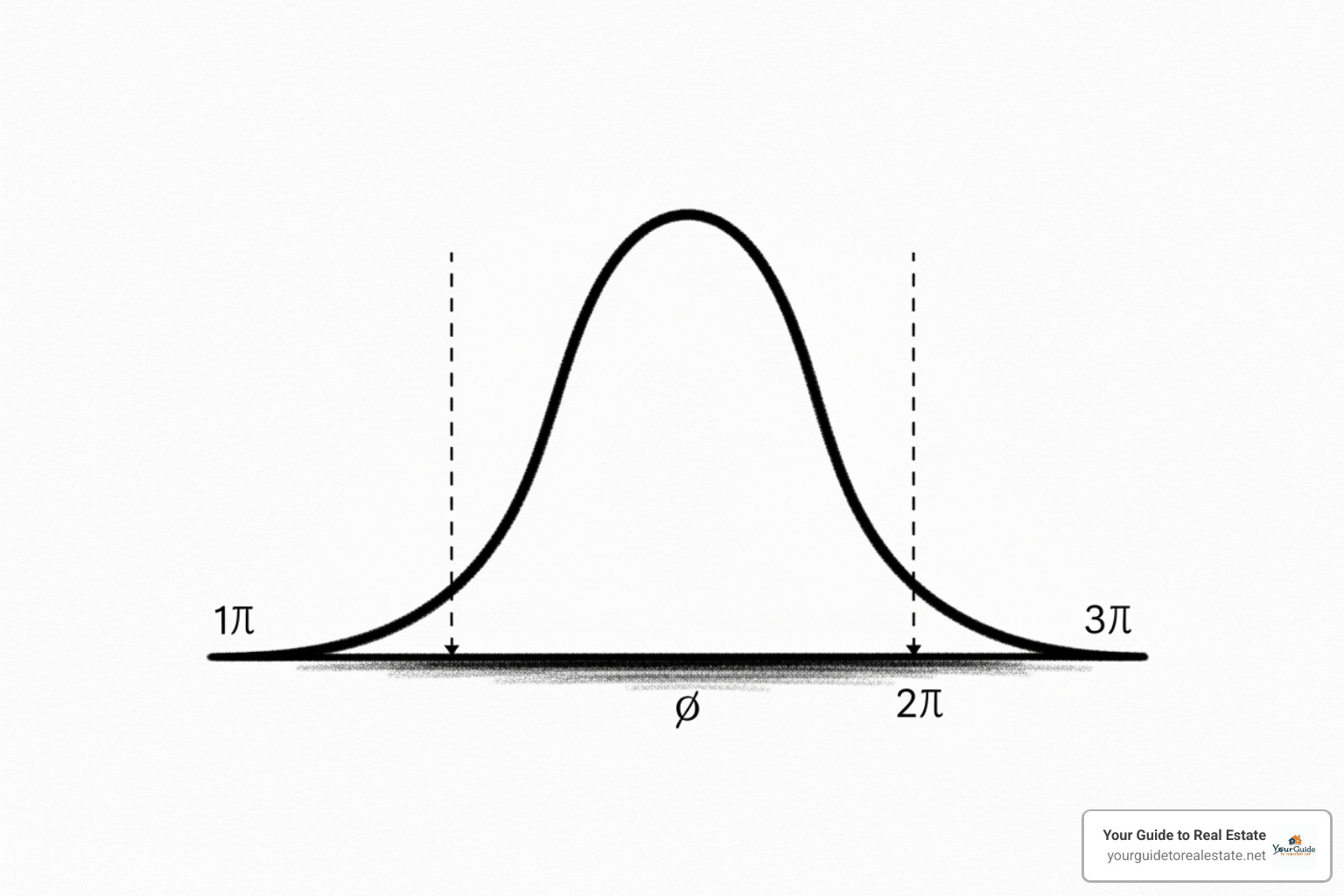
The Core Principles: The 68-95-99.7 Breakdown
The beauty of the empirical rule lies in its three magic numbers. These percentages tell you exactly how much of your data falls within specific ranges from the average.
68% of your data lives within one standard deviation of the mean. Picture this: if homes in your area average $350,000 with a standard deviation of $40,000, then roughly 68% of properties will be priced between $310,000 and $390,000. This is your bread-and-butter price range – where most buyers will be shopping.
95% of data falls within two standard deviations from the center. Expanding our example, about 95% of homes would be priced between $270,000 and $430,000. This captures nearly everything you’ll encounter in normal market conditions.
99.7% of data sits within three standard deviations of the mean. In our neighborhood, this means almost every single home falls between $230,000 and $470,000. Anything outside this range? That’s where things get interesting – we’re talking about potential outliers or truly unique properties.
These aren’t just theoretical numbers. They’re practical tools that help you spot great deals, identify overpriced listings, and understand market segments at a glance. You can dive deeper into More about the 68–95–99.7 rule if you’re curious about the mathematical foundations.
The Foundation: Understanding Normal Distribution
Before you can harness the power of the empirical rule, you need to understand its foundation: normal distribution. Don’t worry – it’s simpler than it sounds.
A normal distribution creates that famous bell-shaped curve where most of your data clusters around the middle, with fewer and fewer data points as you move toward the extremes. Think of it like a mountain: most hikers (data points) stick to the well-traveled paths near the center, while only a few venture to the steep edges.
For the empirical rule to work its magic, your data needs to meet certain requirements. The distribution must be symmetrical – if you folded that bell curve in half, both sides would match perfectly. The mean, median, and mode all sit at the exact center, like the peak of our mountain.
Most real estate markets naturally follow this pattern. Home sizes in a neighborhood, days on market during stable periods, and property values in established areas often create beautiful bell curves. When you’re conducting analysis – whether it’s a Competitive Market Analysis Real Estate or evaluating investment opportunities – checking for normal distribution is your first step.
But here’s the thing: the empirical rule is picky. It only applies when your data is truly normally distributed. If your market data is skewed (maybe you’re looking at luxury properties or a market with lots of foreclosures), the rule might not give you accurate results. That’s perfectly fine – we’ll explore alternatives for those situations later in this guide.
How to Apply the Empirical Rule: A Step-by-Step Guide
Ready to put the empirical rule to work? The good news is that once you understand the basics, applying it becomes second nature. You only need two pieces of information: your data’s mean (average) and its standard deviation. Think of these as your compass and map for navigating any normally distributed dataset.
The process is straightforward. First, calculate your mean by adding up all your values and dividing by how many data points you have. Next, determine your standard deviation – this tells you how spread out your data is. Finally, use the 68-95-99.7 percentages to create meaningful ranges around your mean.
Let’s walk through this together using real estate examples that you can apply immediately in your own market analysis.

Calculating Standard Deviation: The Key to the Rule
Standard deviation might sound intimidating, but it’s simply a measure of variability – how much your data points spread out from the average. Picture it as the “wiggle room” in your dataset. A small standard deviation means most values cluster tightly around the mean, while a large one indicates your data is more scattered.
Here’s how the calculation works behind the scenes. You start by finding how far each data point sits from the mean, then square those differences to eliminate negative numbers. Next, you average these squared differences to get the variance. Finally, take the square root of that variance, and you’ve got your standard deviation.
But here’s the beautiful part – you don’t need to do this math manually! Modern spreadsheet functions handle the heavy lifting for you. In Google Sheets or Excel, simply use the STDEV function with your data range. For detailed instructions, check out Using the STDEV function.
The data spread that standard deviation reveals becomes your key to open uping the empirical rule’s predictive power. Once you have this number, you can instantly estimate where most of your data points will fall.
Practical Application of the Empirical Rule in Real Estate
Now comes the exciting part – turning numbers into actionable insights for your real estate decisions. The empirical rule transforms raw market data into clear, understandable ranges that help you make smarter choices.
Let’s say you’re analyzing a neighborhood where the mean home price sits at $400,000 with a standard deviation of $60,000. Using our 68-95-99.7 framework, you immediately know that roughly 68% of homes will be priced between $340,000 and $460,000. This becomes your “typical” price range – perfect for setting realistic expectations with buyers or sellers.
Expanding to two standard deviations, about 95% of properties fall between $280,000 and $520,000. This broader range captures nearly the entire market, helping you understand the full spectrum of available options. Any homes priced outside this range deserve special attention – they might be unique properties or potential outliers.
For neighborhood valuation purposes, these ranges become incredibly powerful. You can quickly assess whether a listing is competitively priced, identify potential bargains, or spot overpriced properties. When estimating property value ranges, you’re no longer guessing – you’re using statistical principles to guide your analysis.
The empirical rule also helps you identify market segments within a single neighborhood. Maybe you find that starter homes cluster in the lower range while luxury properties occupy the upper bounds. This insight helps you tailor your marketing strategies and better serve different buyer demographics.
This statistical approach forms the backbone of professional Valuation and Market Analysis in Real Estate, giving you confidence in your pricing decisions and market assessments.
Using the Rule for Prediction and Analysis
The empirical rule becomes truly powerful when we move beyond just understanding our current data. It’s like having a crystal ball that helps us peek into future market behavior and catch data points that don’t quite fit the pattern.
Think of it this way: once you understand how your local market typically behaves, you can make educated guesses about what’s coming next. You can also spot those unusual properties that might represent hidden opportunities or potential red flags.
Forecasting Real Estate Market Trends
Market forecasting might sound intimidating, but the empirical rule makes it surprisingly straightforward for stable markets and short-term predictions. When you have solid historical data that follows a normal distribution, you’re essentially looking at a roadmap of future possibilities.
Let’s say you’ve been tracking rental income for two-bedroom apartments in your neighborhood. Over the past few years, the average monthly rent has been $1,800 with a standard deviation of $120. Using the empirical rule, you can confidently predict future rental ranges.
About 68% of similar apartments will likely rent between $1,680 and $1,920 per month. This gives you the sweet spot for competitive pricing.
Roughly 95% will fall between $1,560 and $2,040. This broader range helps you understand the full spectrum of what tenants are willing to pay.
Nearly all rentals (99.7%) will be priced between $1,440 and $2,160. Anything outside this range would be quite unusual.
This forecasting approach helps property managers set realistic rental rates and gives investors a solid foundation for calculating potential returns. It’s particularly valuable when you’re budgeting for the year ahead or trying to determine if a property investment makes financial sense.
The empirical rule provides that crucial baseline for understanding market stability, which connects beautifully with broader Real Estate Market Projections for 2025: Key Numbers to Watch.
Identifying Outliers and Testing for Normality
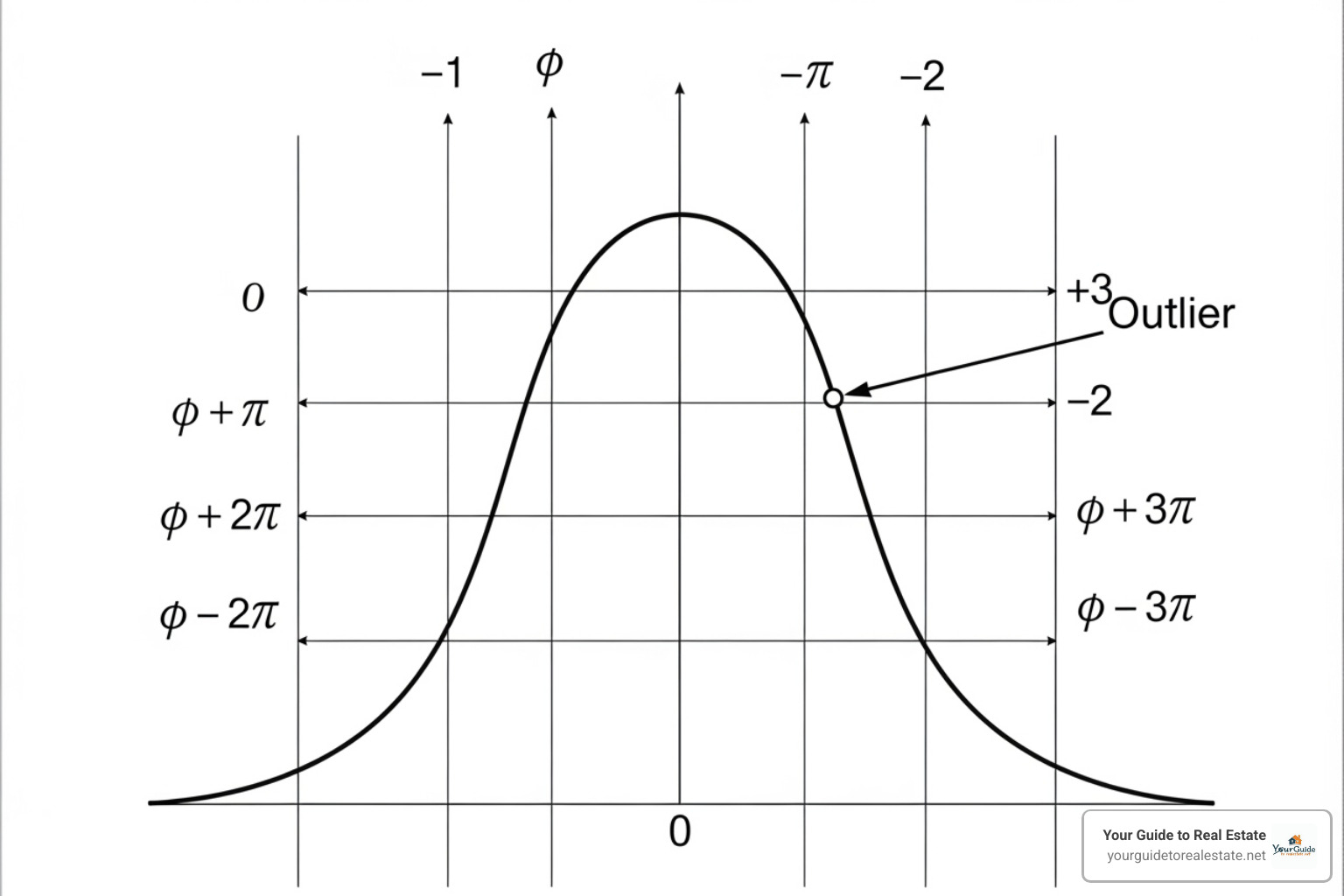
Here’s where the empirical rule becomes your data detective tool. Since 99.7% of normally distributed data falls within three standard deviations of the mean, anything beyond those three-sigma limits stands out like a neon sign.
Imagine you’re analyzing home sizes in a suburban neighborhood. The average home is 2,200 square feet with a standard deviation of 300 square feet. According to the empirical rule, almost all homes should fall between 1,300 and 3,100 square feet (that’s 2,200 ± 3×300).
Now, if you spot a 4,500-square-foot mansion in your data, that’s clearly an outlier. It might be a luxury estate that doesn’t represent the typical market, or perhaps it’s a data entry error where someone accidentally included a commercial building.
Spotting these outliers is incredibly valuable because they can skew your analysis and lead to poor decisions. That mansion might make the average home price look much higher than what most buyers can actually expect to pay.
The empirical rule also serves as a quick health check for your data. If you apply the rule and find that way more than 0.3% of your data points fall outside the three-sigma range, something’s up. Your data might not be normally distributed after all, which means you’ll need different tools for accurate analysis.
This outlier detection process is essential for maintaining data quality and ensuring your market analysis reflects reality. It’s a fundamental part of proper Identifying statistical outliers in any statistical analysis.
The beauty of using the empirical rule for prediction and analysis lies in its simplicity. You don’t need complex software or advanced degrees to apply these concepts. With just a calculator and understanding of your market’s mean and standard deviation, you can make informed predictions and catch data problems before they derail your analysis.
Limitations and Alternatives to the Empirical Rule
Even the most powerful tools have their limits, and the empirical rule is no exception. While it’s incredibly useful for quick statistical insights, it comes with some important restrictions that every real estate professional should understand.
The biggest catch? Your data absolutely must follow a normal distribution for the rule to work properly. When your data doesn’t form that perfect bell curve, those reliable 68-95-99.7 percentages can become misleading or downright wrong.
Think of it this way: the empirical rule is like a perfectly custom suit – it looks amazing when it fits, but it’s uncomfortable and unflattering when it doesn’t. Real-world data isn’t always as neat and tidy as we’d like it to be.
When the Empirical Rule Falls Short
The empirical rule starts to stumble when we encounter data that refuses to play by normal distribution rules. This happens more often than you might expect in real estate markets.
Skewed data sets are probably the most common culprit. Imagine analyzing home prices in a neighborhood where most properties are modest family homes, but a few luxury estates push the average way up. Your data will have a long tail stretching toward those high-priced properties, creating what statisticians call a “right-skewed” distribution.
In markets like this, the empirical rule might tell you that 68% of homes fall within a certain price range, but the reality could be quite different. You might find that most homes cluster at the lower end of your predicted range, with fewer properties scattered across the higher prices.
Small sample sizes present another challenge. If you’re analyzing a boutique market with only 20 recent sales, it’s nearly impossible to determine whether the underlying market truly follows a normal distribution. The empirical rule works best with larger datasets where patterns become clear.
Luxury real estate markets are particularly tricky. As we explore in Luxury Real Estate Trends in 2025: What High-End Buyers Want Now, high-end properties often don’t follow typical market patterns. A few ultra-expensive sales can dramatically skew your average, making the empirical rule’s predictions unreliable.
Fat tails – a phenomenon where extreme values occur more frequently than the normal distribution predicts – can also trip up the rule. This is especially relevant when analyzing market crashes or booms, where “once-in-a-lifetime” events seem to happen more often than expected.
Chebyshev’s Theorem: A Universal Alternative
When the empirical rule lets us down, Chebyshev’s Theorem steps in as our reliable backup. Think of it as the Swiss Army knife of statistical rules – it’s not as precise as specialized tools, but it works with absolutely any type of data distribution.
The trade-off is straightforward: Chebyshev’s Theorem gives us weaker but guaranteed results. Instead of the empirical rule’s precise percentages, Chebyshev provides minimum percentages that will always hold true, regardless of how your data is shaped.
Here’s how they compare side by side:
| Standard Deviations | Empirical Rule (Normal Only) | Chebyshev’s Theorem (Any Distribution) |
|---|---|---|
| 2σ | 95% | At least 75% |
| 3σ | 99.7% | At least 88.9% |
Chebyshev’s Theorem guarantees that at least 75% of your data will fall within two standard deviations of the mean, no matter what your distribution looks like. For three standard deviations, you’re guaranteed at least 88.9% of your data.
These percentages might seem less impressive than the empirical rule’s numbers, but they come with an ironclad guarantee. Whether you’re dealing with skewed luxury markets, small sample sizes, or any other non-normal distribution, Chebyshev’s bounds will hold true.
The key is knowing when to use which tool. For normally distributed real estate data, the empirical rule gives you precise, actionable insights. When your data gets messy or unusual, Chebyshev’s Theorem provides a safety net that ensures your analysis remains mathematically sound.
Frequently Asked Questions about the Empirical Rule
Let’s tackle some of the most common questions people ask about the empirical rule. These come up regularly when folks are trying to wrap their heads around this handy statistical tool.
What’s the difference between the empirical rule and Chebyshev’s theorem?
Think of these two rules as cousins with very different personalities. The empirical rule is the precise, detail-oriented cousin who gives you exact percentages – 68%, 95%, and 99.7% – but only when your data follows that perfect bell curve shape. It’s incredibly accurate, but it’s also quite picky about the conditions.
Chebyshev’s theorem is the laid-back cousin who gets along with everyone. It works with any type of data distribution, whether it’s skewed, flat, or shaped like a camel’s back. The trade-off? It’s more conservative with its promises. While the empirical rule tells you that 95% of normally distributed data falls within two standard deviations, Chebyshev’s theorem only guarantees that at least 75% will be there – but it makes this promise for any dataset, no matter how weird its shape.
Can the empirical rule be used for stock market analysis?
Here’s where things get interesting. While standard deviation is absolutely crucial for measuring stock market volatility, stock returns have a sneaky habit of not behaving like a perfect bell curve. They tend to have what we call “fat tails” – basically, extreme events (like market crashes or sudden booms) happen more often than the empirical rule would predict.
So yes, you can use the empirical rule as a starting point for understanding market volatility, but don’t bet the farm on it. It might give you a rough estimate of expected price ranges, but it could underestimate the chances of those dramatic market swings that make headlines. Think of it as a useful first approximation, but financial markets love to surprise us in ways that don’t fit neatly into statistical models.
How accurate is the empirical rule?
The empirical rule is remarkably accurate when your data truly follows a normal distribution. We’re talking about precision that would make a Swiss watchmaker proud. Those 68%, 95%, and 99.7% figures are spot-on approximations of the theoretical probabilities.
Even when your data is only “approximately” normal – which describes a lot of real-world situations – the rule still serves as an incredibly useful and quick rule of thumb. It’s like having a reliable shortcut that gets you close enough for most practical purposes.
However, if you need absolute precision for critical decisions, calculations using Z-scores will give you more exact probabilities. The empirical rule is your trusty calculator for everyday estimates, while Z-score calculations are like using a scientific calculator for research-grade precision. Both have their place, and knowing when to use which one is part of mastering data analysis.
Conclusion
The empirical rule has been your statistical companion throughout this journey, showing you how the simple 68-95-99.7 pattern can open up powerful insights from your data. Think of it as having a reliable friend who always knows where to find the most important information in any bell-shaped dataset.
This statistical shortcut transforms overwhelming spreadsheets of home prices into clear, actionable intelligence. When you’re staring at hundreds of property listings, the empirical rule whispers, “Hey, about 68% of these homes will fall right here in this sweet spot around the average.” It’s like having X-ray vision for market trends.
We’ve seen how calculating that crucial standard deviation opens doors to forecasting price ranges, spotting unusual properties, and understanding your local market’s personality. Whether you’re helping a first-time buyer understand realistic budgets or advising an investor on rental income expectations, these statistical insights give you confidence in your recommendations.
But remember – the empirical rule isn’t magic. It needs that beautiful bell curve to work its best, and real estate markets sometimes dance to different rhythms. Luxury markets might skew wildly, small neighborhoods might not have enough data, and sometimes Chebyshev’s Theorem becomes your backup plan. That’s perfectly normal in our business.
The beauty lies in knowing when to apply this tool and when to step back. It’s about building your analytical confidence while staying grounded in reality. Markets change, data shifts, but understanding how numbers behave around their averages? That knowledge stays with you.
At Your Guide to Real Estate, we’re passionate about giving you proven frameworks that actually work in the real world. The empirical rule is exactly that – a time-tested approach that simplifies complex market analysis without losing accuracy. When you master this concept, you’re not just crunching numbers anymore. You’re reading the story your market data is telling you.
Ready to take your valuation skills to the next level? Our comprehensive guide on Valuation and Market Analysis in Real Estate will show you how to weave the empirical rule into a complete market analysis strategy that impresses clients and drives results.