
The Basics of DSCR Loans
A dscr loan is a popular mortgage for investors buying or refinancing rental properties. It’s designed to simplify financing for income-producing properties.
So, what exactly is a DSCR loan?
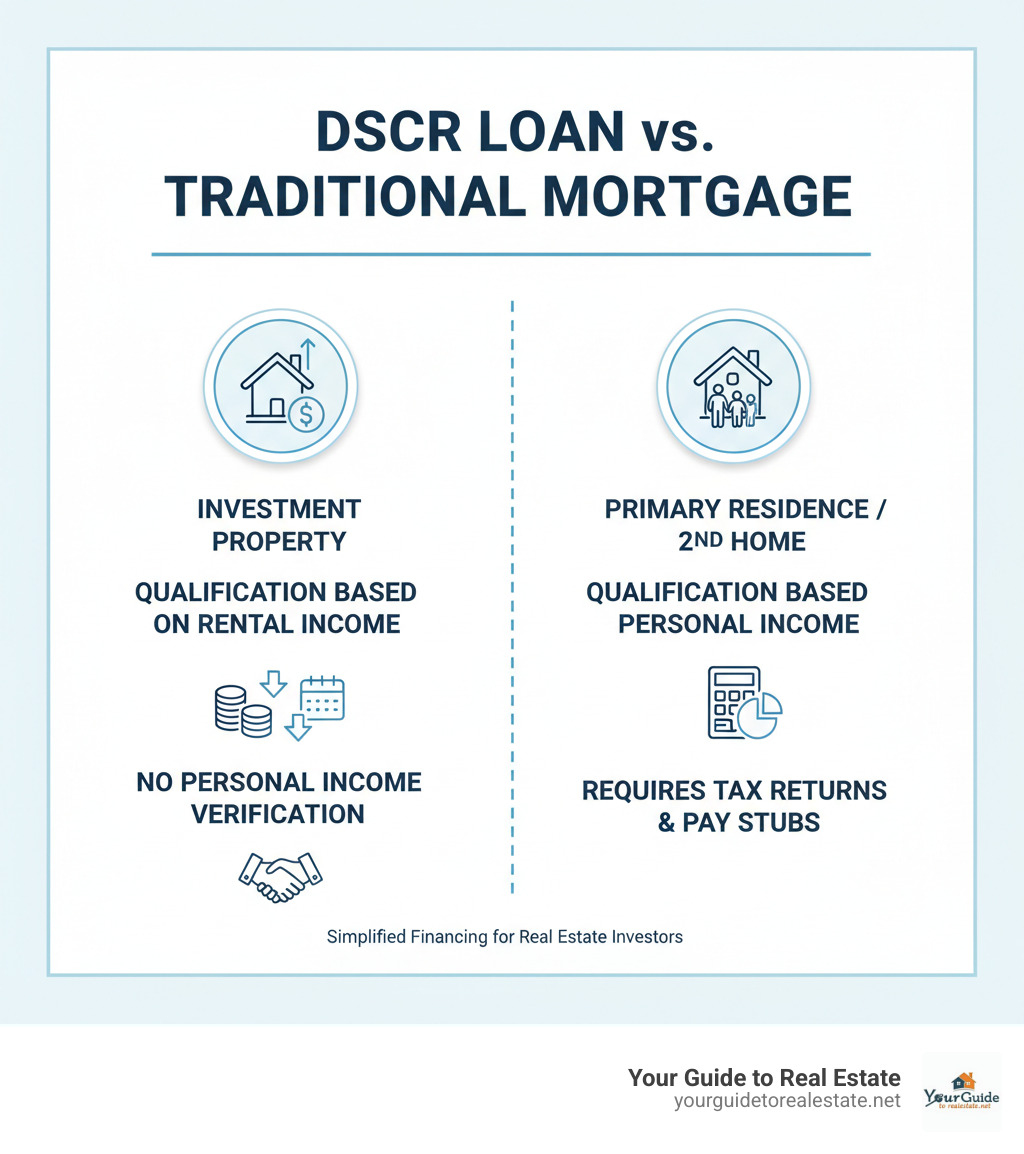
- It’s a loan for investment properties only.
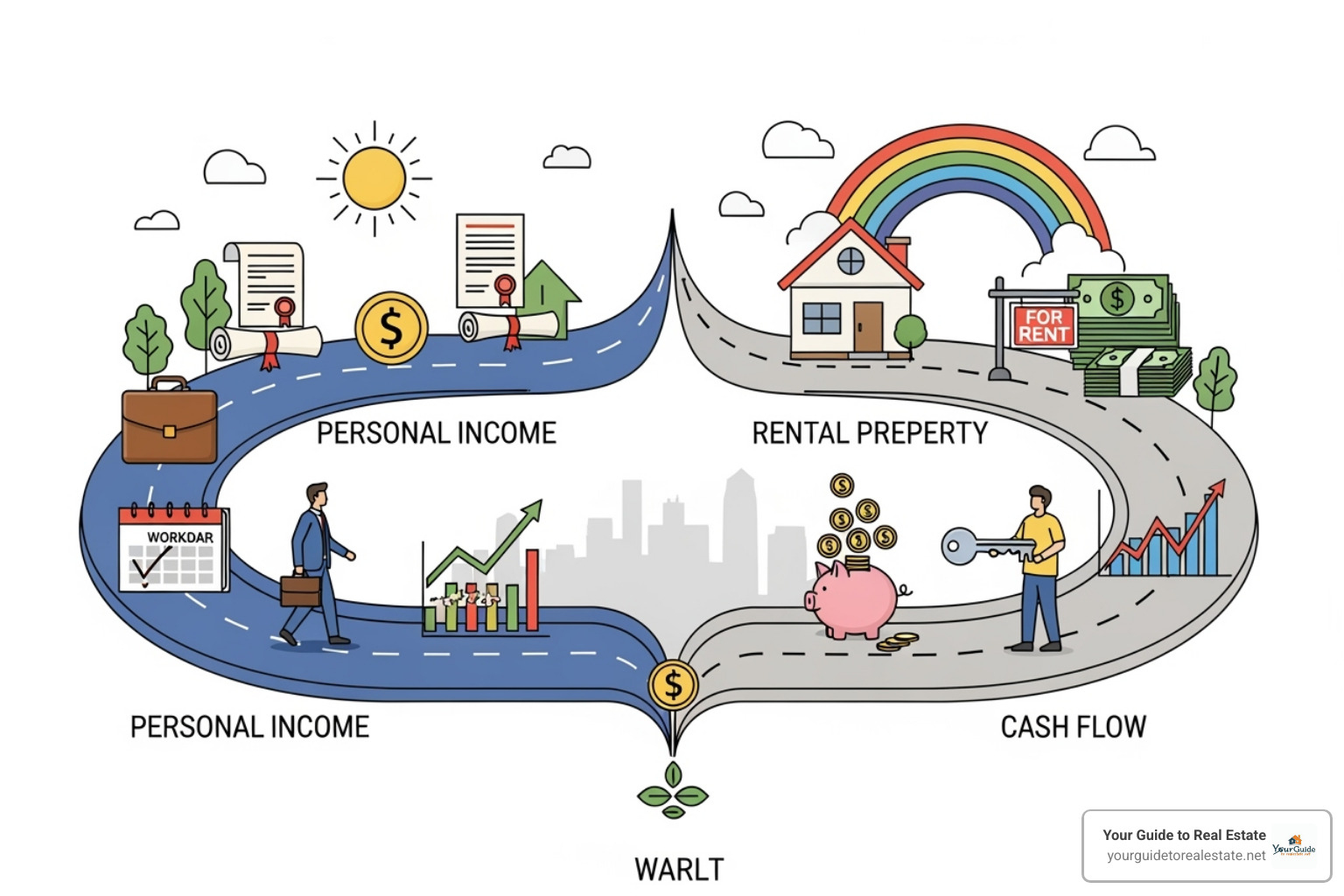
- Qualification is based on the property’s expected rental income, not your personal income.
- The property must prove it can cover its own mortgage and related expenses.
This alternative financing path helps real estate entrepreneurs expand their portfolios without traditional income verification problems. DSCR loans are a major player in the non-traditional mortgage market, making up about half of the 201,000 Non-QM loans rated by S&P Global between 2018 and February 2023, highlighting their growing importance.
Simple dscr loan glossary:
What is a DSCR Loan and How Does It Work?
A dscr loan (Debt Service Coverage Ratio loan) is a specialized non-qualified mortgage (Non-QM) for real estate investors. Unlike a conventional mortgage that scrutinizes your personal income and debt-to-income (DTI) ratio, a DSCR loan focuses on the investment property’s ability to generate enough income to cover its own expenses. It’s as if the property is applying for the loan, not you.
This is a game-changer for many investors, such as those who are self-employed, have complex tax write-offs, or want to avoid providing extensive personal documentation like W-2s and tax returns.
The mechanism is simple: the lender evaluates the property’s projected rental income against its total debt service (principal, interest, taxes, and insurance – PITIA). If the income adequately covers these costs, you’re approved. This allows investors to expand portfolios more efficiently, as personal income statements are no longer a bottleneck. Investor purchases of U.S. homes accounted for a significant 16% of the market in the third quarter of 2024, showing the growing need for flexible financing like DSCR loans.
This underwriting focus helps investors scale their portfolios without hitting personal DTI limits. It’s about leveraging the asset’s potential, not your paycheck. Understanding how to invest in real estate and financing tools for property investment is crucial.
Understanding and Calculating the Debt Service Coverage Ratio
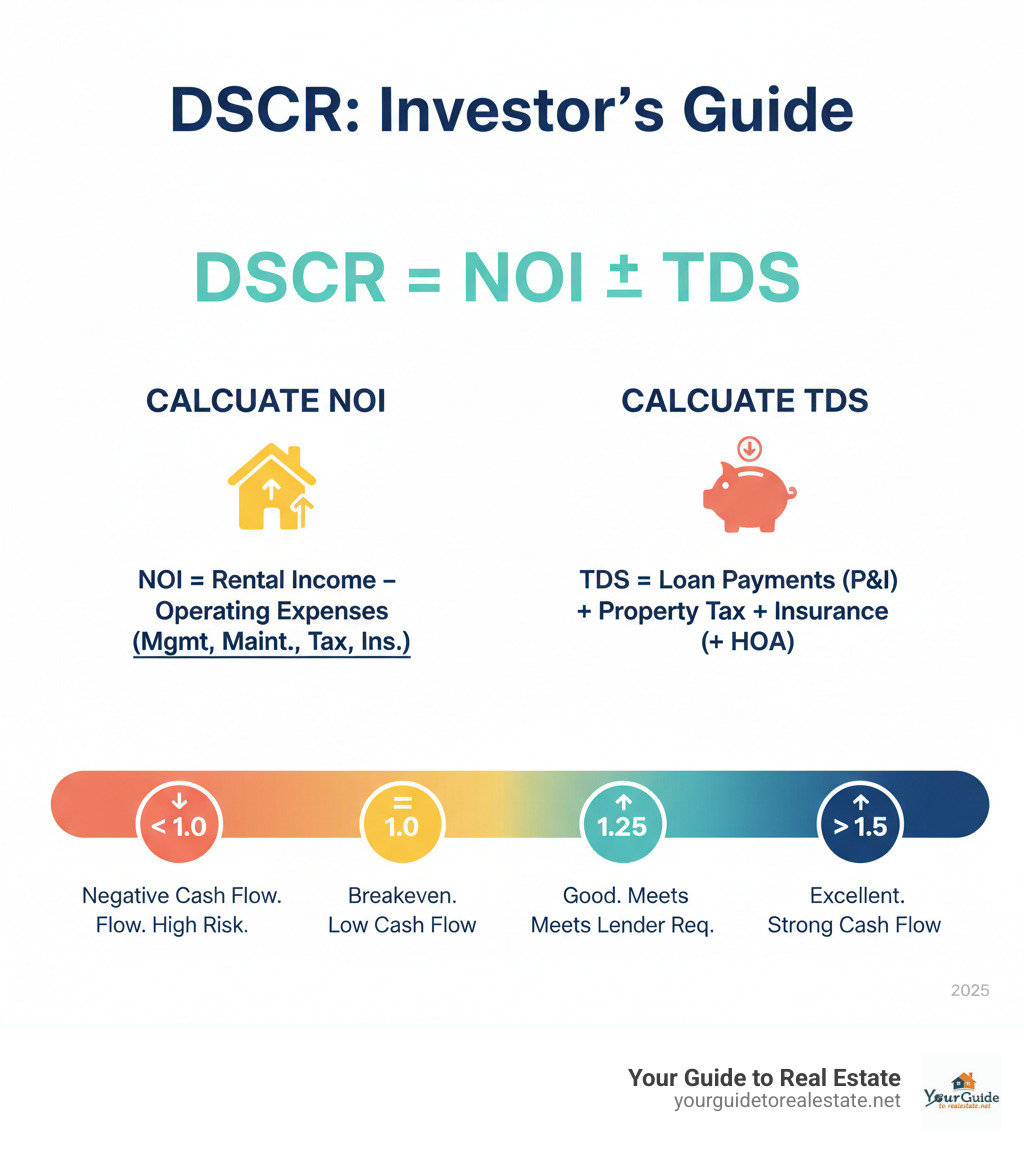
The heart of a dscr loan is the Debt Service Coverage Ratio (DSCR). This ratio is a property’s financial report card, showing lenders if its rental income is strong enough to cover mortgage payments and other expenses. It’s calculated by dividing the property’s Net Operating Income (NOI) by its Total Debt Service (TDS).
Let’s break down the terms:
- Net Operating Income (NOI): This is the property’s income after operating costs (like management fees, maintenance, and vacancy reserves) but before mortgage payments. Lenders may have their own way of calculating NOI, which can differ from an investor’s. For a deeper dive, see our guide on calculating net operating income.
- Total Debt Service (TDS): This is the total annual loan payment, including Principal, Interest, Taxes, and Insurance (PITIA), plus any HOA fees.
The DSCR formula is simple:
DSCR = Net Operating Income (NOI) / Total Debt Service (TDS)
For example, if a rental property has an NOI of $45,000 and its annual TDS is $40,000, the DSCR is:
$45,000 (NOI) / $40,000 (TDS) = 1.125
This 1.125 ratio means the property generates 12.5% more income than it needs to cover its debt. Lenders rely on an appraiser’s rent schedule (Form 1007) for an objective, market-based income estimate. To estimate your own, you can use online DSCR Calculators.
This ratio is a key indicator of a property’s financial health. For more on property value, check our guide on real estate valuation.
What is a Good DSCR?
What makes a DSCR “good” varies by lender and property, but here’s a general guide:
- Breakeven DSCR (1.0): A DSCR of 1.00 means income just covers debt, leaving no room for unexpected costs.
- Negative Cash Flow (< 1.0): A DSCR below 1.00 means the property has negative cash flow. While traditionally a “no,” some dscr loan lenders may approve ratios as low as 0.75 if the borrower makes a large down payment and the property has strong appreciation potential, though this comes with higher rates.
- Common Lender Minimum (1.25): For most dscr loan lenders, 1.25x is the minimum. This 25% income cushion is preferred and often qualifies for better loan terms.
- Strong DSCR (> 1.5-2.0): A DSCR of 1.5x or higher is considered very strong and will likely secure the best terms, including lower interest rates. Lenders love a high debt service coverage ratio because it signals low risk. Learn more about lender preferences for a high debt service coverage ratio.
A “good” DSCR meets lender requirements and gives you a comfortable safety net. A higher ratio often translates directly into better loan terms.
Qualifying for a DSCR Loan: Requirements and Process
Qualifying for a dscr loan is different from a traditional mortgage, as lenders focus on the property’s ability to pay for itself rather than your personal income. The spotlight is on the property’s earning potential, though your creditworthiness and down payment still play a key role in securing favorable terms.

Core requirements center on the property’s Loan-to-Value (LTV) ratio, down payment, credit score, and property type. The loan process for buying a house with a dscr loan is streamlined and often much faster than conventional mortgages.
Typical DSCR Loan Requirements
While lender criteria vary, here are common standards for a dscr loan:
- Down Payment: Typically 20% to 25%. Most lenders offer 80% LTV for purchases and 75% LTV for cash-out refinances.
- Credit Score: A minimum score between 620 and 680 is usually required, with 700 or above being ideal for better rates.
- Minimum Loan Amount: Generally starts at $100,000 to $150,000.
- Eligible Properties: Includes single-family homes, 2-4 unit properties, condos, townhomes, and vacation rentals (Airbnb/VRBO).
- Ineligible Properties: DSCR loans cannot be used for primary residences or fixer-uppers needing significant renovations.
- Property Reserves: Lenders usually require 3-6 months of PITIA payments in reserve.
The Role of Personal Finances and Business Structure
While a dscr loan focuses on property income, your credit score is still a key factor, with scores of 700+ often securing better rates. Some lenders may also require a personal guarantee, making you liable if the property’s income falls short.
Many investors purchase properties under a limited liability company (LLC) for:
- Asset protection: Shielding personal assets from property-related liabilities.
- Separation of finances: Keeping the loan off your personal DTI ratio.
- Scalability: Simplifying portfolio expansion.
Using an LLC is a recommended strategy for serious investors.
The Application and Approval Steps
The dscr loan application process is straightforward:
- Find an experienced lender: Seek out specialists, as terms vary widely.
- Complete the application: Focus on property financials, not personal income.
- Property appraisal and rent schedule: The lender orders an appraisal and a rent schedule (Form 1007) to estimate rental income.
- Underwriting review: The lender calculates the DSCR, evaluates your credit and LTV, and verifies reserves.
- Loan approval and closing: This can be very fast, sometimes within two weeks of the appraisal. Organized records streamline the process.
Pros, Cons, and Ideal Scenarios for a DSCR Loan
A dscr loan has unique pros and cons. Unlike conventional loans that focus on your personal income, a dscr loan shifts the focus to the property’s income-generating ability. This means less personal documentation, faster closing times, and the ability to borrow under an LLC for asset protection. While conventional loans may have lower rates, their underwriting is slower. Understanding these differences is key when planning how to invest in real estate and your property investment portfolio.
Advantages of a DSCR Loan
The benefits of a dscr loan are especially appealing for investors looking to scale efficiently:
- No W-2s or Tax Returns Required: Qualification is based on property income, a major advantage for self-employed investors or those with significant tax write-offs.
- Fast Closing Times: Less paperwork means a quicker underwriting process, with closings possible in as little as two weeks.
- Ability to Finance Multiple Properties: DSCR loans typically have no limit on the number of properties you can finance, unlike the usual 10-property cap on conventional loans.
- Ideal for Self-Employed Investors: These loans provide a straightforward financing path for those with non-traditional income.
- Ability to Close in an LLC Name: Closing in an LLC name offers legal protection and separates personal finances from investment properties.
- Flexible Loan Terms: Options often include 30-year fixed, 40-year interest-only (IO), and adjustable-rate mortgages (ARMs).
Risks and Disadvantages
It’s crucial to understand the potential drawbacks of dscr loans:
- Higher Interest Rates: As non-qualified mortgages, DSCR loans typically have higher interest rates than conventional loans.
- Higher Fees and Closing Costs: Expect to pay more in origination fees and other administrative costs.
- Prepayment Penalties: Many DSCR loans include penalties for paying off the loan early, often within the first one to five years. Always clarify this with your lender. You can learn more about prepayment penalties.
- Larger Down Payment Required: Most DSCR loans require a down payment of 20-25%, sometimes more for riskier properties.
- Market Risk from Rent Fluctuations: The loan’s viability depends on consistent rental income. Economic downturns can impact your ability to cover debt payments.
- Not for Owner-Occupied or Fixer-Upper Properties: These loans are strictly for income-generating investment properties.

Frequently Asked Questions about DSCR Loans
We’ve covered the essentials of dscr loans, but some questions frequently come up. Let’s explore the most common ones.
Can I use a DSCR loan for a short-term rental like an Airbnb?
Yes, dscr loans are an excellent fit for the short-term rental market. Lenders finance these properties based on their income-generating potential, using short-term rental data for evaluation.
Specific requirements for Airbnb and VRBO properties typically include:
- A minimum DSCR of 1.00.
- A minimum credit score around 700.
- Income assessment based on 12 months of trailing income data or market projections from appraisal tools like AirDNA.
- An expected occupancy rate exceeding 60%.
- A down payment of at least 25% for experienced hosts, or 30% for newcomers.
For investors who can demonstrate strong income potential, DSCR loans are a great match for short-term rental investments.
What happens if my property’s DSCR is below 1.0?
While a DSCR below 1.00 indicates negative cash flow, it’s not always a deal-breaker. Some lenders offer negative cash flow lending programs, accepting a DSCR as low as 0.75. This is typically for properties in high-appreciation markets.
However, be prepared for stricter requirements:
- A significantly larger down payment (25-30% or more).
- Substantial cash reserves (6-12 months of PITIA payments).
- Higher interest rates.
These are lender-specific programs, so you’ll need to find a specialist. We generally recommend aiming for a DSCR of at least 1.25 for better terms and a financial cushion.
Are DSCR loans the same as other alternative investment loans?
No, dscr loans are a distinct type of Non-Qualified Mortgage (Non-QM) and differ from other alternative financing.
- vs. Hard Money Loans: Hard money loans are short-term (6-24 months) with very high rates, focusing on property value for fix-and-flip projects. DSCR loans are long-term (30-40 year terms) with lower rates, designed for stabilized, cash-flowing properties.
- vs. Conventional Investment Loans: Conventional loans require extensive personal income documentation and limit investors to 10 financed properties. DSCR loans offer more flexibility by focusing on the property’s income, making them ideal for self-employed investors and those looking to scale.
DSCR loans fill a specific market gap: they are more sustainable than hard money for long-term holds and more flexible than conventional loans for portfolio builders.
Conclusion: Is a DSCR Loan Your Key to Real Estate Investment Success?
Is a dscr loan the right financing option for your investment journey? The answer depends on your specific goals.
DSCR loans are ideal for self-employed investors, those with complex tax write-offs, or anyone wanting to keep personal and business finances separate. They are also perfect for investors looking to scale quickly beyond the 10-property limit of conventional loans. Key benefits like no W-2s required, faster closings, and the ability to close in an LLC name make them attractive for building a serious portfolio.
However, be aware of the trade-offs: higher interest rates, larger down payments, and potential prepayment penalties. It’s crucial to ensure the property’s cash flow can support these costs while still providing a solid return.
The ideal DSCR loan candidate is a long-term investor with properties that generate strong rental income and has the financial cushion for a larger down payment.
At Your Guide to Real Estate, our proven framework helps you determine if a DSCR loan is right for you and how to structure it for success. Before deciding, explore our guide on understanding mortgages: a beginner’s guide to home loans to see how they compare to other options.
While not a magic bullet, for the right investor and property, a dscr loan can be the key to open uping real estate investment success.