

Yes, President Biden Signed the Social Security Fairness Act into Law
Did Biden sign the Social Security Fairness Act? Yes, President Joe Biden signed the Social Security Fairness Act (H.R. 82) into law on January 5, 2025, marking the first expansion of Social Security benefits in decades.
Quick Answer:
- Signed: January 5, 2025
- Effective Date: Benefits payable after December 2023 (retroactive to January 2024)
- Impact: Nearly 3 million public sector workers, retirees, and families
- Key Change: Eliminates Windfall Elimination Provision (WEP) and Government Pension Offset (GPO)
- Average Benefit Increase: $360 per month
This historic legislation ends two federal rules that unfairly reduced Social Security payments for public service workers like teachers, firefighters, police officers, and other government employees. The law eliminates the Windfall Elimination Provision (WEP) and Government Pension Offset (GPO) – provisions that have penalized millions of Americans who dedicated their careers to public service.
The Social Security Administration began processing retroactive payments and benefit adjustments in February 2025. As of July 2025, over 3.1 million payments totaling $17 billion have been sent to eligible beneficiaries – five months ahead of schedule.
For many public sector retirees and their families, this represents thousands of dollars in additional annual income and the restoration of benefits they earned through years of service.
Did biden sign the social security fairness act vocabulary:
- wep repeal
- social security fairness act back pay
- when will the social security fairness act go into effect
What is the Social Security Fairness Act?
The Social Security Fairness Act, officially known as H.R. 82, represents a historic victory for millions of public servants who have been shortchanged by an unfair system for far too long. This groundbreaking legislation eliminates two controversial provisions that have reduced Social Security benefits for teachers, firefighters, police officers, and other dedicated public workers.
For decades, the Windfall Elimination Provision (WEP) and Government Pension Offset (GPO) have created a two-tier system where public employees received less than their fair share of Social Security benefits. The Social Security Fairness Act changes all of that by completely repealing both provisions.
This isn’t just any ordinary legislation – it marks the first Social Security expansion in decades. The bipartisan support it received shows that protecting our public servants’ retirement security transcends political divides. When you consider that nearly 3 million Americans have been affected by these unfair reductions, the significance becomes crystal clear.
The question “did Biden sign the Social Security Fairness Act” has been answered with a resounding yes, but understanding what this Act actually does is equally important for anyone impacted by these changes. For the latest updates on Social Security developments, you can always check our Social Security News section.
The Journey to Becoming Law
The road to this victory wasn’t easy – it took years of persistent advocacy from labor unions, public employee associations, and countless individuals who refused to accept an unfair system. What makes this success story even more remarkable is the genuine bipartisan support it garnered along the way.
The momentum really picked up steam in 2024. Representatives Abigail Spanberger from Virginia and Garret Graves from Louisiana led the charge in the House, filing a discharge petition that forced the bill to a floor vote. This strategic move bypassed committee bottlenecks that had stalled similar efforts in the past.
The House passage was just the beginning. The real test came when the Senate took up the bill in December 2024. On December 20th, senators voted 76-20 in favor of the legislation – an overwhelming show of support that surprised even some of the bill’s strongest advocates.
Then came the moment everyone had been waiting for. On January 5, 2025, President Biden signed the Social Security Fairness Act into law, calling it a fulfillment of a “sacred promise” to public employees. The signing ceremony was an emotional event, with many advocates who had fought for decades finally seeing their efforts come to fruition.
If you’re interested in diving deeper into the specifics, you can read the full text of the Act to see exactly how these changes will work.
Understanding WEP and GPO: The Provisions Repealed by the Act
To truly appreciate why did Biden sign the Social Security Fairness Act into law, we need to understand the two provisions that made millions of public servants feel cheated out of benefits they rightfully earned. The Windfall Elimination Provision (WEP) and Government Pension Offset (GPO) were complex rules that reduced or eliminated Social Security benefits for people who dedicated their careers to serving others.
These provisions affected public service workers who had jobs that didn’t pay into Social Security – like teachers, firefighters, and police officers. The rules were meant to prevent what lawmakers called “windfall” benefits, but in reality, they often punished hardworking Americans who simply chose careers in public service.

This flowchart shows exactly how these unfair provisions worked. If you had a government pension from non-covered employment and qualified for Social Security benefits from other work, these rules could slash your monthly payments dramatically.
The Windfall Elimination Provision (WEP) Explained
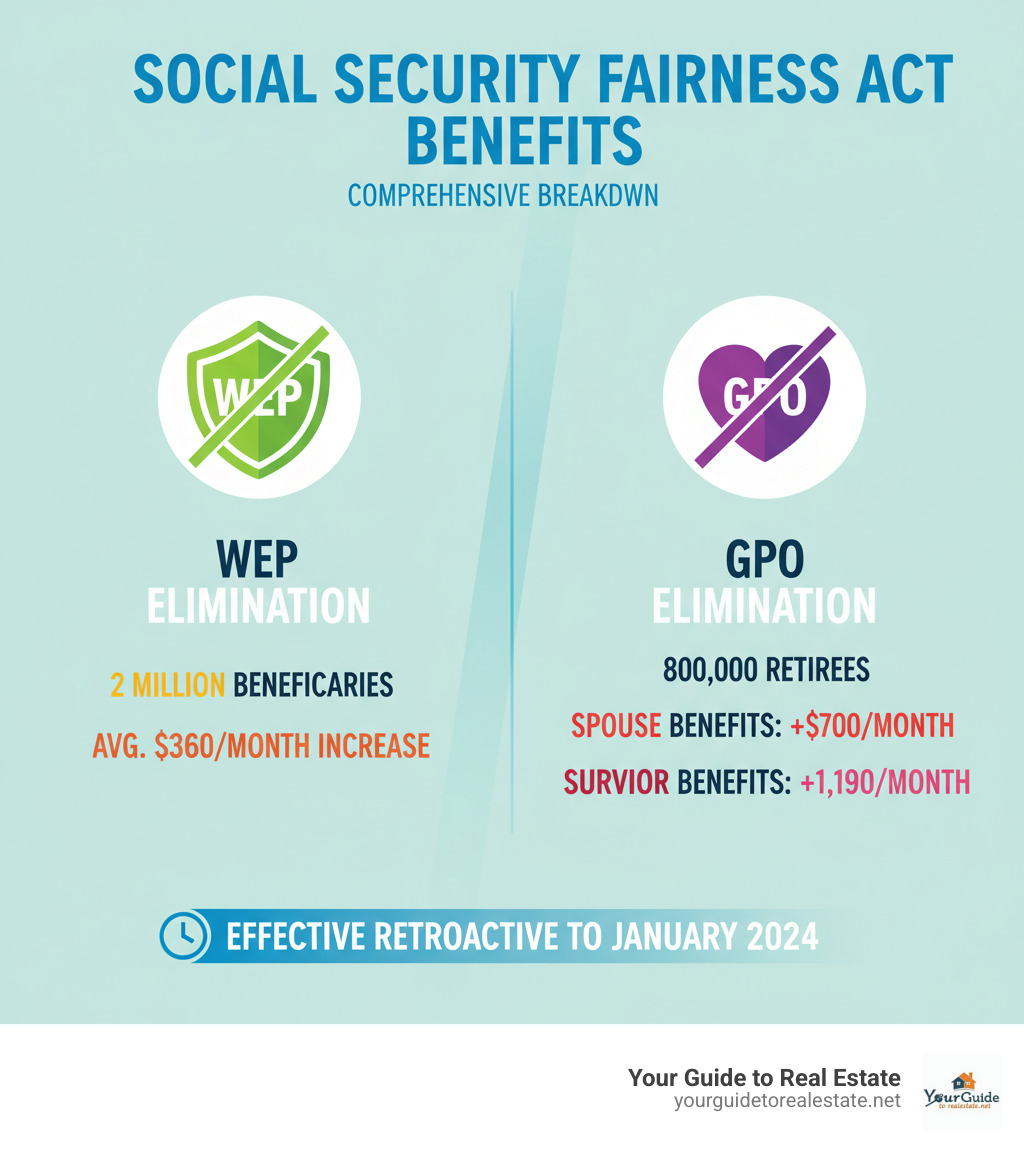
The WEP hit close to home for about 2 million Social Security beneficiaries across America. Created in 1983, this provision targeted people who worked jobs that didn’t pay Social Security taxes – think teachers in certain states or federal employees under the old Civil Service Retirement System.
Here’s where it got unfair: Social Security’s benefit formula is designed to help lower-income workers by replacing a higher percentage of their earnings. But if you worked a second job or had previous employment where you did pay Social Security taxes, the WEP would kick in and reduce your benefits significantly.
Let’s say you taught school for 30 years without paying into Social Security, then worked part-time retail jobs that did contribute to Social Security. Even though you earned those Social Security credits fair and square, the WEP could cut your monthly benefits by hundreds of dollars. Many retirees felt this was like being penalized twice – first for choosing public service, then for trying to supplement their income.
The WEP affected people who had at least 40 quarters (10 years) of Social Security-covered employment alongside their non-covered pension. It adjusted the benefit calculation formula, often resulting in substantially lower monthly payments than what these workers expected based on their Social Security earnings record.
For more detailed information about how the WEP worked, you can read More on the WEP from the Congressional Research Service.
The Government Pension Offset (GPO) Explained
The GPO was even more devastating for many families, affecting approximately 800,000 retirees who thought they could count on spousal or survivor Social Security benefits. This provision specifically targeted spouses and survivors of Social Security beneficiaries who also received government pensions from non-covered employment.
The GPO used what’s called the “two-thirds reduction rule.” If you received a government pension, your Social Security spousal or survivor benefits would be reduced by two-thirds of your pension amount. In many cases, this completely wiped out the Social Security benefit entirely.
Imagine being a teacher who lost your spouse, expecting to receive survivor benefits to help make ends meet. Under the GPO, if your teacher’s pension was $1,800 per month and you qualified for $1,000 in survivor benefits, you’d lose $1,200 (two-thirds of your pension) from your Social Security benefit. That would leave you with nothing – despite your spouse paying into Social Security for decades.
This felt especially cruel to surviving spouses who suddenly found themselves with reduced income during an already difficult time. The GPO affected not just survivors, but also spouses who were counting on these benefits as part of their retirement planning.
The elimination of both WEP and GPO means that public servants and their families can finally receive the full Social Security benefits they earned through their contributions to the system. It’s a long-overdue correction that recognizes the value of public service careers.
You can learn more about the technical details of the GPO by reviewing More on the GPO from the Congressional Research Service.
Who Is Impacted and What Are the Financial Benefits?
The question “did Biden sign the Social Security Fairness Act” has been answered with a resounding yes, and the impact reaches deep into communities across America. This historic legislation brings life-changing financial relief to the dedicated public servants who form the backbone of our society.

The heroes affected by this change are the people we see every day in our communities. Teachers who shaped generations of students, firefighters who rushed into danger to protect our families, police officers who kept our neighborhoods safe, and countless other state and local government employees who chose service over higher pay. Federal employees under the Civil Service Retirement System (CSRS) also benefit significantly from these changes.
For years, these dedicated individuals faced a frustrating reality. They worked jobs that didn’t pay into Social Security, but when they earned Social Security benefits through second jobs or spousal benefits, WEP and GPO slashed those payments. It felt like being penalized twice – first for choosing public service, then for trying to supplement their retirement security.
Now, with the repeal of these unfair provisions, millions of public sector workers and their families will see their financial security restored. Many will receive substantial retroactive payments covering benefits they should have received since January 2024. For comprehensive details about these payments and when to expect them, check out our guide on Social Security Fairness Act Retroactive Payments.
Estimated Benefit Increases for Retirees
The numbers tell a powerful story of financial relief. We’re not just talking about small adjustments – these are substantial monthly increases that can transform retirement security for millions of Americans.
| Provision Repealed | Impacted Group | Estimated Average Monthly Increase (by Dec 2025) | Total Beneficiaries Affected |
|---|---|---|---|
| WEP | Individuals | $360 | ~2 million |
| GPO | Spouses | $700 | ~380,000 |
| GPO | Surviving Spouses | $1,190 | ~390,000 |
(Source: Congressional Budget Office, Congressional Research Service, SSA estimates)
Think about what these increases mean in real life. The average increase of $360 per month for WEP-affected individuals adds up to over $4,300 annually. For surviving spouses previously hit by GPO, an average increase of $1,190 monthly means an additional $14,280 per year – money that can make the difference between struggling and living with dignity.
Some individuals will see even larger increases. WEP repeal could boost monthly Social Security benefits by as much as $613 for certain beneficiaries in 2025. These aren’t just statistics – they represent grocery money, prescription drug coverage, and the ability to stay in your home during retirement.
The lump-sum retroactive payments are equally significant. These payments cover the period from January 2024 through when monthly payments are adjusted, essentially giving beneficiaries the money they should have received all along.
State-Specific Impacts
While this federal law helps public servants nationwide, certain states feel the impact more deeply due to their large populations of public employees in non-covered pension systems.
Ohio stands out with approximately 230,000 residents directly benefiting from WEP and GPO elimination. That’s nearly a quarter of a million Ohioans who will see their Social Security benefits restored to their rightful levels. Local representatives have called this a major victory for Ohio seniors who dedicated their careers to public service.
Massachusetts sees relief for about 93,000 Social Security beneficiaries previously affected by WEP alone. The GPO impact was equally severe, with over 42,000 beneficiaries affected and nearly 29,000 seeing their spousal or survivor benefits completely eliminated. Now these benefits are fully restored.
Connecticut’s impact affects more than 22,540 Social Security beneficiaries who were hit by WEP reductions, plus nearly 21,790 retirees who faced GPO penalties. For these Connecticut families, the law’s passage means financial security they thought they’d lost forever.
These state-specific numbers show how federal policy touches real communities. Every number represents a teacher who can now afford their medications, a retired firefighter who doesn’t have to choose between heating and eating, or a police officer’s widow who can keep her home.
The ripple effects extend beyond individual families too. When retirees have more spending power, local economies benefit. That extra income gets spent at local businesses, supporting jobs and community growth.
To understand how the Social Security Fairness Act fits into the broader picture of retirement benefit changes, explore our comprehensive guide on What Changes Are Coming to Social Security in 2025?.
Did Biden Sign the Social Security Fairness Act? Implementation and Next Steps
The answer to “did Biden sign the Social Security Fairness Act?” is a definitive yes! President Biden’s signature on January 5, 2025, marked the end of a long journey and the beginning of real change for millions of Americans. But signing the law was just the first step – now comes the massive task of putting it into action.
The Social Security Administration (SSA) has been working around the clock to implement this historic change. Think about it – they need to recalculate benefits for nearly 3 million people and process retroactive payments going back to January 2024. It’s like updating the records for an entire city, but the SSA has been making impressive progress.
The law makes benefits payable after December 2023, which means if you’ve been affected by WEP or GPO, you’re entitled to back payments from January 2024 forward. That’s real money that many families have been waiting years to receive. For the latest updates on how implementation is progressing, check our Social Security Fairness Act Update.
So, did Biden sign the Social Security Fairness Act into law?
Yes, absolutely! President Joe Biden signed the Social Security Fairness Act (H.R. 82) into law on Sunday, January 5, 2025. This wasn’t just a ceremonial signing – it immediately eliminated the Windfall Elimination Provision (WEP) and Government Pension Offset (GPO) for all Social Security benefits payable from January 2024 onward.
What makes this even better is that the law works retroactively. If you’ve been receiving reduced benefits because of WEP or GPO since January 2024, you’re now entitled to the difference. The SSA has been processing these adjustments and sending out payments faster than originally expected.
This signing represents decades of advocacy finally paying off. For millions of public sector retirees and their families, it means financial security they thought they’d never see.
What actions do I need to take now that the Social Security Fairness Act is signed?
Here’s some great news – if you’re already receiving Social Security benefits that were reduced by WEP or GPO, you probably don’t need to do anything right now. The SSA is automatically recalculating benefits and sending out payments. But there are a few smart steps you can take to make sure everything goes smoothly.
First, double-check your contact information with the SSA. Make sure your mailing address and direct deposit details are current in your my Social Security account. If you don’t have an online account yet, setting one up takes just a few minutes and gives you access to all your Social Security information.
If you never applied for Social Security benefits because you thought WEP or GPO would wipe them out, now’s the time to apply. Many people avoided applying for retirement, spousal, or survivor benefits because they figured, “What’s the point?” Well, now there’s definitely a point! You can apply for benefits here online, and the SSA encourages anyone who thinks they might be eligible to go ahead and apply.
For surviving spouses, the process is a bit different. You’ll need to call the SSA at 1-800-772-1213. When the automated system answers, just say “Fairness Act” and you’ll be connected with a specially trained representative who understands the new law and can help you through the application.
Here’s something important about Medicare premiums – if you’ve been paying your Medicare premiums directly because your Social Security benefits were too low due to WEP or GPO, keep making those payments for now. Once your Social Security benefits increase, Medicare will likely start deducting premiums automatically from your monthly payment. You’ll then need to cancel any automatic payments you set up with Medicare to avoid paying twice.
The SSA has created a comprehensive resource page with all the implementation details. We strongly recommend visiting the official SSA implementation page to get the most up-to-date information straight from the source.
The bottom line? This law is already helping millions of Americans, and the SSA is working hard to make sure everyone gets the benefits they’ve earned. It’s been a long time coming, but the wait is finally over.
Potential Criticisms and Long-Term Concerns
While millions of public sector retirees are celebrating the passage of the Social Security Fairness Act, it’s important to acknowledge that not everyone views this legislation as entirely positive. The reality is that any major change to Social Security comes with trade-offs, and this historic expansion has sparked legitimate concerns about the program’s long-term financial health.
The most significant criticism centers on Social Security’s solvency. The Congressional Budget Office (CBO) has estimated that eliminating WEP and GPO will cost approximately $200 billion over the next decade. To put this in perspective, this represents roughly a 1% increase in Social Security’s overall costs. While that might not sound like much, critics argue it could push the program’s insolvency date forward by about six months.
Here’s the sobering reality: even before did Biden sign the Social Security Fairness Act became a question with a “yes” answer, Social Security was already facing financial challenges. Current projections suggest the program will only be able to pay full benefits through 2035. After that point, without congressional action, benefits would be automatically reduced to match incoming revenue – likely around 80% of scheduled benefits.
This timeline creates a difficult balancing act. On one hand, the Act corrects what many viewed as a fundamental unfairness that penalized public servants for decades. Teachers, firefighters, and police officers who paid into Social Security through second jobs or earlier careers deserved their full benefits. On the other hand, increasing benefits without finding new revenue sources does add pressure to an already strained system.
Some policy experts had advocated for reforming rather than fully repealing WEP and GPO. These compromise proposals might have restored some benefits while keeping costs lower. However, advocates argued that partial fixes would still leave many public sector retirees facing reduced benefits they rightfully earned.
The debate ultimately reflects different priorities. Supporters of the Act prioritized immediate financial relief and fairness for current retirees who had been waiting decades for this correction. Critics worried more about the federal budget impact and the precedent of expanding benefits without addressing Social Security’s broader funding challenges.
What’s clear is that this legislation represents just one piece of a much larger conversation about Social Security’s future. Eventually, Congress will need to address the program’s long-term financing through some combination of benefit adjustments, tax increases, or other reforms. The Social Security Fairness Act doesn’t solve those bigger challenges, but it does ensure that millions of public servants receive the benefits they earned through their years of service.
For a deeper dive into the fiscal implications and budget discussions surrounding this legislation, you can read analysis on the Act’s budget impact.
Frequently Asked Questions about the Social Security Fairness Act
We understand that major changes to Social Security can feel overwhelming, and you likely have questions about how the Social Security Fairness Act affects you personally. Since did Biden sign the Social Security Fairness Act became law, we’ve been hearing from many of you who want to know what comes next. Let’s walk through the most important questions together.
When will I receive my increased benefits and retroactive payment?
The great news is that the Social Security Administration has been working incredibly hard to get these benefits to you as quickly as possible. They began processing both monthly benefit adjustments and one-time retroactive payments during the week of February 24, 2025.
If you were already receiving Social Security benefits that were reduced by WEP or GPO, you should have received your retroactive payment by the end of March 2025. Your new, higher monthly benefits began showing up in your April 2025 payments, which actually cover the March benefit period.
Here’s something that will make you smile: as of July 7, 2025, the SSA announced they had successfully sent out over 3.1 million payments totaling $17 billion to eligible beneficiaries. Even better? They finished this massive undertaking five months ahead of schedule! This means millions of public servants and their families received the financial relief they deserved much sooner than originally expected.
For the most current updates on payment schedules and implementation progress, we recommend you check the SSA’s official timeline.
Do I need to apply again if I was previously denied or didn’t apply because of WEP/GPO?
This is such an important question, and the answer is yes, you should definitely apply. If you were previously denied Social Security benefits because of WEP or GPO, or if you decided not to apply in the first place because you knew these provisions would wipe out your benefits, the game has completely changed.
The Social Security Fairness Act has fundamentally transformed your eligibility. Benefits that may have been reduced to zero or nearly zero under the old rules could now provide meaningful monthly income. The SSA is actively encouraging anyone who believes they might now be eligible to file a new application.
Don’t worry if you’re not sure whether you applied before – it’s always better to submit a fresh application to make sure your claim gets considered under the new law. You can apply conveniently online or by calling the SSA directly. The process is straightforward, and you can get started right away at You can apply for benefits here.
How can I avoid scams related to these new benefit changes?
Unfortunately, whenever there are big changes to Social Security, scammers come out of the woodwork. But don’t let this worry you – just stay informed and trust your instincts.
The most important thing to remember is that the SSA will never ask you for payment to help adjust your benefits or increase your payments. If someone contacts you asking for money in exchange for Social Security assistance, it’s definitely a scam. You should never have to pay anyone to receive the benefits you’ve earned.
Be especially cautious of unsolicited calls, emails, or text messages claiming to be from Social Security. The SSA typically communicates through official mail, not surprise phone calls or suspicious emails. If something feels off, hang up or delete the message. Never click on links or share your personal information with unverified contacts.
If you encounter a scam, please report it to the SSA Office of the Inspector General at ssa.gov/scams. Your report helps protect other retirees from falling victim to these schemes.
You can always get reliable information and assistance through official SSA channels – their website at ssa.gov, their toll-free number at 1-800-772-1213, or by visiting your local Social Security office in person.
Conclusion
Did Biden sign the Social Security Fairness Act? Absolutely, and it’s been life-changing for millions. President Biden’s signature on January 5, 2025, marked a truly historic moment that ended decades of unfair treatment for public sector employees and their families.
This wasn’t just another piece of legislation – it was a victory for every teacher who worked weekends tutoring students, every firefighter who risked their life for our communities, and every police officer who protected our neighborhoods. After years of having their hard-earned Social Security benefits reduced or eliminated by the Windfall Elimination Provision (WEP) and Government Pension Offset (GPO), these dedicated public servants finally received the justice they deserved.
The numbers tell an incredible story. Nearly 3 million Americans now have greater economic security, with many seeing their monthly benefits increase by hundreds or even over a thousand dollars. That’s not just money – that’s the difference between worrying about bills and sleeping peacefully at night. It’s the ability to visit grandchildren, take that long-postponed vacation, or simply enjoy retirement with dignity.
Financial security opens doors. We’ve seen this truth countless times in our work at Your Guide to Real Estate. When people feel confident about their monthly income, they start dreaming bigger. Maybe it’s finally buying that perfect retirement home in a quiet neighborhood. Perhaps it’s downsizing to a cozy place that’s easier to maintain. Or maybe it’s helping adult children with their first home purchase.
Your increased Social Security benefits could be the key that open ups these possibilities. A higher monthly income often means better mortgage qualification, more buying power, and greater confidence in making real estate decisions.
We’re here to help you turn that financial security into your next chapter. Whether you’re ready to explore homeownership for the first time or looking to make a strategic move, our Beginner’s Guide to Home Loans can help you steer the process with confidence.
The Social Security Fairness Act proved that when we fight for what’s right, change is possible. Now it’s time to use that victory to build the future you’ve always wanted.