
Why Commercial Real Estate Agent Salaries Stand Out
The commercial real estate agent salary typically reaches six figures, making it one of the most lucrative paths in real estate. This earning potential comes from handling larger, more complex deals that can generate substantial commissions from single transactions.
Quick Answer: Commercial Real Estate Agent Salary Ranges
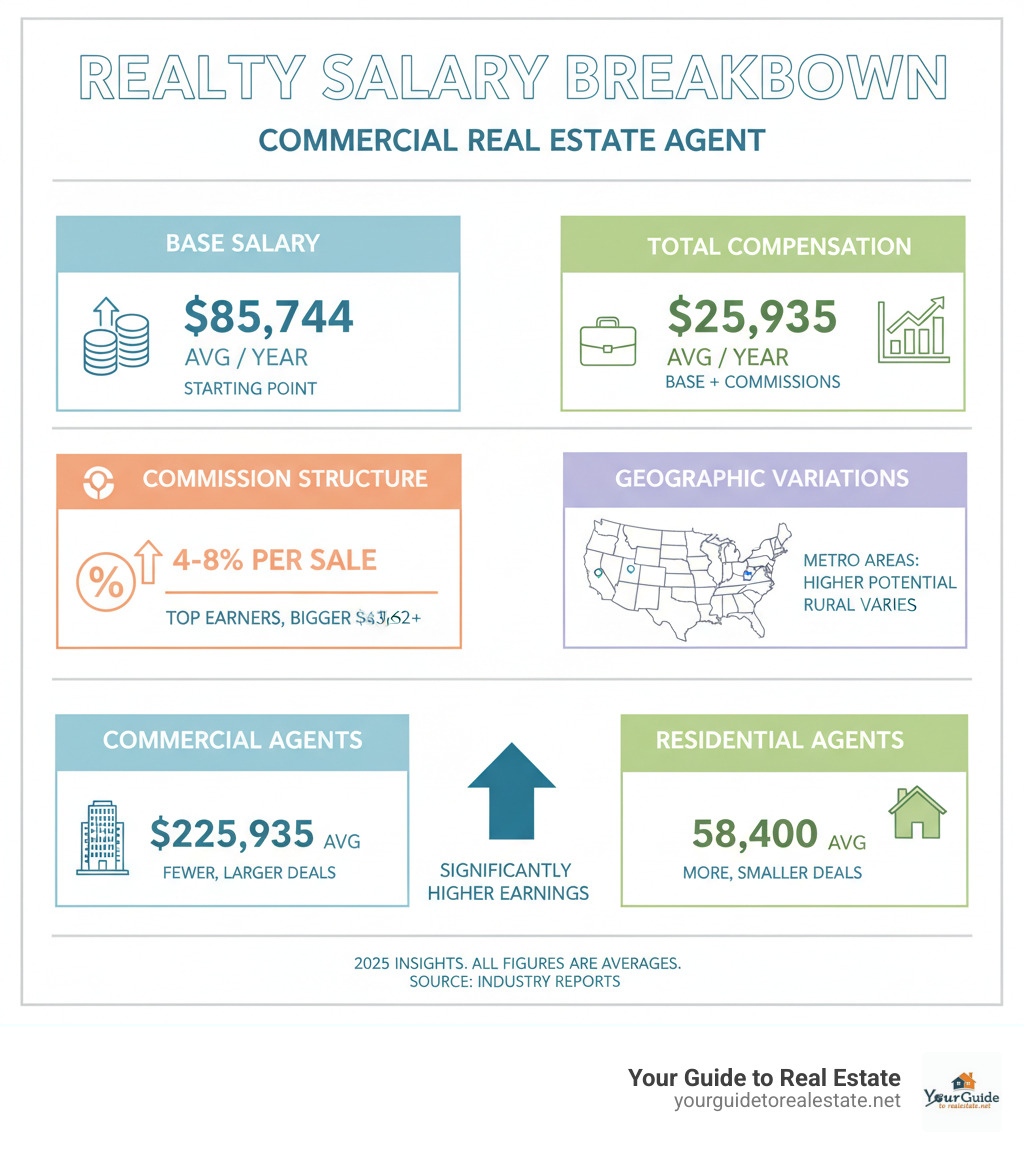
- Average Base Salary: $85,744 per year
- Total Average Pay: $235,935 per year (including commissions)
- Salary Range: $177K – $328K annually
- Top Earners: Up to $431,762 (90th percentile)
- Commission Structure: 4-8% on sales transactions
- Broker Earnings: $258,371 average total pay
Unlike residential agents who earn an average of $58,400 annually, commercial agents deal with fewer but much larger deals. A single multi-million dollar commercial transaction can provide income for several years, explaining why the typical commercial real estate agent salary is significantly higher.
The learning curve is steep – ranging from six months to six years according to industry experts. But this investment in knowledge and expertise pays off through the substantial earning potential that comes with handling office buildings, retail spaces, and industrial properties rather than residential homes.
As Thomas Riley, a New Hampshire commercial agent and former NAR treasurer, notes: “There’s a reason the typical commercial real estate agent salary is six figures” – it reflects the intense training, specialized knowledge, and complex deal structures that define this career path.
Essential commercial real estate agent salary terms:
What is the Average Commercial Real Estate Agent Salary?
Understanding the commercial real estate agent salary can be a bit like solving a puzzle – there are several pieces that need to fit together to see the complete picture. The numbers you’ll find online often vary significantly, and there’s a good reason for that.
According to Indeed, the average base salary sits around $85,744 per year. But here’s where it gets interesting – most commercial agents don’t rely on their base salary at all. The real money comes from commissions, which can dwarf that base figure entirely.
When you look at total compensation, the picture becomes much brighter. Glassdoor estimates that the commercial real estate agent salary averages $235,935 per year when you include commissions. This total pay typically ranges between $177,000 and $328,000 annually, with top performers earning up to $431,762 at the 90th percentile.
Why such a wide range? It all comes down to the nature of commercial deals. A single multi-million dollar transaction can generate more income than many people make in several years. Commission rates typically fall between 4-8% of the sale price, so when you’re dealing with office buildings, shopping centers, or industrial complexes, even one successful deal can be life-changing.
The salary data discrepancies you’ll see across different websites reflect this reality – some focus on base salaries, others on total compensation, and many agents have vastly different earning patterns depending on their deal flow.
For a deeper understanding of how these earnings work in practice, check out our guide on How Much Do Real Estate Agents Really Make With Real Numbers?.
Here’s how the numbers stack up across different roles:
| Role | Average Annual Earnings |
|---|---|
| Residential Real Estate Agent | $58,400 |
| Commercial Real Estate Agent | $235,935 |
| Commercial Real Estate Broker | $258,371 |
Commercial vs. Residential Agent Earnings
The difference between commercial and residential agent earnings is striking, and it’s not just about the bigger price tags on commercial properties. While residential agents might close 20-30 deals per year helping families find homes, commercial agents typically handle far fewer transactions – but each one packs a much bigger financial punch.
Residential agents average around $58,400 annually, working with individual buyers and sellers in a market they know well. It’s rewarding work, but the commercial real estate agent salary potential tells a different story entirely.
Commercial agents enter a world where a single office building sale can generate more commission than a residential agent might see in an entire year. These deals are incredibly complex, requiring deep knowledge of market analysis, financial modeling, zoning regulations, and business strategy. The learning curve is steep – industry experts say it can take anywhere from six months to six years to really hit your stride.
But that complexity is exactly what drives the higher earning potential. When you’re helping a corporation relocate their headquarters or assisting an investor in acquiring a shopping center, you’re not just facilitating a transaction – you’re providing strategic business counsel that can impact millions of dollars in value.
The deal size and complexity mean commercial agents often work with fewer clients but develop much deeper, longer-term relationships. It’s not uncommon for a commercial agent to work on a single deal for months or even years before closing.
Want to understand more about these two different worlds? What is the difference between the two? This guide helps to explain it.
Agent vs. Broker Earning Potential
Moving from agent to broker represents more than just a title change – it’s a significant leap in both responsibility and earning potential. While agents focus primarily on working deals, brokers take on the additional roles of managing other agents, handling brokerage operations, and often carrying more liability.
The numbers reflect this added responsibility. While the average commercial real estate agent salary sits at $235,935, commercial brokers typically earn around $258,371 annually. This increase comes from multiple income streams – brokers earn money from their own deals plus a percentage of commissions from agents working under their license.
Broker responsibilities extend far beyond closing deals. They’re managing teams, ensuring compliance with regulations, handling disputes, and often serving as mentors to newer agents. The increased liability means they need more insurance and face greater legal exposure, but the higher commission splits often make it worthwhile.
Many successful agents eventually make the transition to broker status, either to increase their earning potential or to have more control over their business operations. Some choose to work as brokers within existing firms, while others strike out on their own to build their own brokerages.
Understanding how brokerages operate and the opportunities they present is crucial for anyone considering this career path. Our comprehensive guide, What is a Real Estate Brokerage? A Beginner’s Complete Guide, breaks down everything you need to know about these business structures and how they can impact your earning potential.
How Commercial Real Estate Agents Are Compensated

Here’s the reality of working in commercial real estate: your commercial real estate agent salary depends entirely on your ability to close deals. There’s no steady paycheck waiting for you every two weeks. If you don’t close a deal, you don’t get paid. Period.
This might sound scary at first, but it’s actually what makes this career so exciting. Unlike jobs with salary caps, your earning potential is truly unlimited. The harder you work and the more valuable deals you close, the more money you make. It’s that simple.
Both sales and lease transactions work on commission, though they’re calculated differently. Understanding these payment structures is crucial for anyone considering this career path. For those interested in more flexible arrangements, exploring a Virtual Commercial Brokerage Guide can open up additional opportunities.
Understanding Commission on Sales
When you help someone sell a commercial property, you earn a percentage of the final sale price. This isn’t a fixed rate across the industry – it’s negotiated in the listing agreement between the seller and the listing broker.
Typical commission rates range from 4-8% of the gross sale price. The exact percentage depends on several factors: market conditions, property type, deal complexity, and the property’s size and value. Larger, more expensive properties often justify higher commission rates because they require more intensive work and expertise.
Let’s look at a real example. Say you broker the sale of a $5 million office building with a 6% commission rate. Here’s how it breaks down:
$5,000,000 × 0.06 = $300,000 total commission
That $300,000 doesn’t all go to you, though. It gets split between the listing brokerage and buyer’s brokerage, then further divided with the individual agents involved. Even after splits, a single deal like this can make your entire year financially successful.
Calculating Commission on Leases
Lease commissions work differently than sales, and many new agents find this confusing at first. You’re not paid on just one year of rent – you earn commission on the total lease value over the entire term.
This is where long-term leases become really attractive. A five-year lease generates five years’ worth of commission, all paid when the lease is signed.
Here’s how it works: Imagine you help a business secure a five-year office lease at $3,000 per month. First, calculate the total lease value:
$3,000 monthly rent × 60 months = $180,000 total lease value
If the commission rate is 5% of the total lease value:
$180,000 × 0.05 = $9,000 commission
While individual lease commissions might seem smaller than major sales, successful commercial agents handle multiple leases throughout the year. These add up quickly and provide a steady foundation for your commercial real estate agent salary.
Common Commission Split Models
Once you earn that gross commission, you don’t keep it all. The money gets split between you, your brokerage, and potentially other agents involved in the transaction. Understanding these splits is essential before choosing where to work.
Traditional 50/50 splits are common starting points, especially for newer agents. You and your brokerage each take half. So a $30,000 commission becomes $15,000 for you and $15,000 for the brokerage.
Tiered commission plans reward high performers. You might start at 50/50, but as your annual production increases, your split improves. Hit $50,000 in gross commissions and move to 60/40 in your favor. Reach $100,000 and jump to 70/30. This motivates agents to close bigger deals and work harder.
100% commission models appeal to experienced agents. You pay a fixed monthly desk fee or per-transaction fee, then keep 100% of your commissions. This works great if you’re consistently closing deals and can cover the fees, but it can be risky for newer agents still building their business.
Choosing the right brokerage and commission structure is one of the most important decisions you’ll make. The wrong choice can cost you thousands of dollars per year. Our guide on How to Choose a Broker as a Real Estate Agent walks you through everything you need to consider before making this crucial decision.
Key Factors That Influence Your Earnings
Your commercial real estate agent salary isn’t just a matter of showing up and hoping for the best. Several key factors can make the difference between earning a decent living and building serious wealth in this field. Think of these as the levers you can pull to maximize your income potential.
The beauty of commercial real estate is that you have some control over these factors. While you can’t change the economy overnight, you can choose where to focus your efforts, what type of properties to specialize in, and how to position yourself in the market.
When you’re starting out or considering a career change, these factors should heavily influence your decisions about which brokerage to join. Our guide on the Top 5 Things to Look For When Choosing a Real Estate Brokerage as a New Agent can help you make this crucial choice.
Geographic Location
Here’s the truth: where you work matters a lot. A commercial real estate agent in Manhattan isn’t playing the same game as someone in a small Midwest town. Property values, deal sizes, and market activity can vary dramatically from city to city.
While the national average commercial real estate agent salary hovers around $235,935, some markets offer significantly higher earning potential. Take Tampa, FL, where commercial agents average $131,935 per year. Move up the coast to Fort Lauderdale and that jumps to $183,708 annually. Sarasota agents see even better numbers at $173,054 per year.
The top-paying states tell an interesting story. Washington leads the pack at $122,086 yearly, followed by New York at $109,258. Vermont might surprise you at $107,157, while California comes in at $104,186 and Maine rounds out the top five at $101,357.
At Your Guide to Real Estate, we’ve seen how market dynamics play out across different regions. We serve agents nationwide, including thriving markets like Dallas-Fort Worth, which was recognized as a top U.S. commercial real estate market even during challenging economic times. The Oklahoma City and broader Oklahoma markets we serve have also shown remarkable resilience.
Of course, higher-paying markets often come with higher living costs. But if you can establish yourself in an active commercial market with strong property values, the income potential can be substantial.
Property Specialization
While some agents try to be everything to everyone, the smartest money is often on becoming really good at one thing. Specializing in a specific property type can dramatically boost your earning potential and make you the go-to expert in your niche.
Office buildings represent one of the most lucrative specializations, dealing with corporate leases and complex sales of office parks. Retail spaces offer another path, focusing on shopping centers, standalone stores, and restaurant locations that require deep understanding of foot traffic and consumer patterns.
Industrial properties like warehouses and distribution centers have become increasingly valuable, especially with the growth of e-commerce. Multifamily units – apartment complexes and residential income properties – offer steady deal flow and repeat business opportunities.
Some agents focus on land development, working with developers on raw land purchases for future commercial projects. This specialization requires understanding zoning laws, development potential, and long-term market trends.
When you specialize, something interesting happens. You develop deeper market knowledge, build stronger relationships within that niche, and can command higher fees because of your expertise. Clients trust specialists more, and trust translates directly into higher commissions.
Economic and Market Trends
Let’s be honest – your commercial real estate agent salary rises and falls with the broader economy. Unlike residential real estate, which people need regardless of economic conditions, commercial real estate is directly tied to business health and expansion plans.
Economic cycles hit commercial real estate hard. During growth periods, businesses expand and need more space. They lease larger offices, open new retail locations, and invest in industrial facilities. This creates a feeding frenzy of deals and higher property values. But when the economy contracts, businesses downsize, sublease excess space, and postpone expansion plans.
Interest rate fluctuations add another layer of complexity. When rates are low, investors can afford bigger deals and developers launch new projects. Higher rates? Everything slows down as financing becomes more expensive. Smart agents track these trends and adjust their strategies accordingly.
Job growth in your market is like a crystal ball for future deals. More jobs mean more workers, which means more demand for office space, retail services, and industrial facilities. Areas with strong employment growth consistently outperform stagnant markets.
The good news? The overall job outlook for commercial real estate remains positive. As the economy expands, the commission-based nature of this field allows top performers to significantly increase their earnings. The key is staying informed about these macro trends and positioning yourself accordingly.
Understanding these factors isn’t just academic – it’s essential for building a sustainable, high-earning career in commercial real estate.
Becoming a High-Earning Commercial Real Estate Agent

Building a high commercial real estate agent salary isn’t about luck – it’s about mastering a complex profession that demands both analytical thinking and relationship-building skills. The agents who earn six figures consistently understand that success comes from strategic career development, continuous learning, and genuine dedication to their clients’ success.
Think of it this way: while residential agents might show ten houses in a weekend, commercial agents spend months analyzing a single office building deal. The stakes are higher, the knowledge requirements deeper, and yes, the rewards much greater. For those serious about growing their business, our guide on Real Estate Business Growth offers valuable insights for taking your career to the next level.
Typical Duties and Responsibilities
The daily reality of commercial real estate goes far beyond the “show and sell” image many people have of real estate agents. Your day might start with analyzing demographic data for a retail client and end with coordinating environmental assessments for an industrial property sale.
Market analysis forms the backbone of everything you do. You’ll spend considerable time researching market trends, tracking property values, and studying economic indicators. This isn’t just number-crunching – it’s detective work that helps you spot opportunities before your competitors do.
Client acquisition requires a proactive mindset. You’re constantly networking at industry events, making strategic phone calls, and building relationships with developers, investors, and business owners. Unlike residential real estate where clients often find you through online searches, commercial clients typically work with agents they know and trust.
The property valuation process involves conducting thorough comparative market analyses and complex financial modeling. You’ll need to understand cap rates, cash flow projections, and return on investment calculations – skills that separate commercial agents from their residential counterparts.
Negotiation becomes an art form when you’re representing clients in million-dollar transactions. Every lease clause, every purchase term, every contingency can impact your client’s bottom line for years to come. The pressure is real, but so is the satisfaction when you secure favorable terms.
Due diligence coordination means managing a complex web of inspections, environmental assessments, legal reviews, and financial audits. You become the quarterback, keeping everyone on schedule and ensuring nothing falls through the cracks.
Finally, closing coordination requires patience and attention to detail as you guide clients through what can be months-long processes involving attorneys, lenders, and multiple stakeholders. Our article on The Day-to-Day Life of a Real Estate Agent: What You Didn’t Know gives you a deeper look into this dynamic career.
Essential Skills and Qualifications for a High Commercial Real Estate Agent Salary
Earning a top-tier commercial real estate agent salary requires a sophisticated skill set that goes well beyond basic real estate knowledge. The complexity of commercial deals demands expertise that many agents spend years developing.
Data analysis and financial modeling skills are absolutely crucial. You need to understand financial statements, calculate complex valuations, and analyze market data like a pro. Many successful commercial agents have backgrounds in finance or business – and for good reason. When you can confidently explain why a property is worth $5 million instead of $4.5 million, clients trust your expertise.
Negotiation skills separate good agents from great ones. Commercial transactions involve sophisticated parties who know their stuff, so your ability to negotiate effectively directly impacts your commission checks. Every percentage point you secure for a client translates into real dollars for both of you.
Networking ability might be your most valuable skill. In commercial real estate, your network truly is your net worth. The agent who knows the right developer, the best commercial lender, or the city planner reviewing zoning applications has a massive advantage.
Strong communication skills help you explain complex concepts clearly, whether you’re presenting to a board of directors or walking a small business owner through their first commercial lease. Your ability to build rapport and trust often determines whether you get the listing.
State licensing requirements are your entry point, but they’re just the beginning. You’ll need to complete pre-licensing courses, pass your state exam, and often complete post-licensing education. The specific requirements vary by state, so check with your local real estate commission.
Interestingly, sixty-eight percent of commercial agents have bachelor’s degrees or higher, often in finance or marketing. This educational background helps tremendously when you’re dealing with underwriting, lending, and tax implications that can make or break a deal. For a comprehensive look at essential skills, our Real Estate Agent Skills guide covers both general and specialized competencies.
Strategies to Maximize Your Commercial Real Estate Agent Salary
The agents earning the highest commercial real estate agent salaries don’t just work harder – they work smarter. They understand that commercial real estate success comes from strategic relationship-building, selective deal-making, and continuous professional development.
Building a strong network is your most powerful income-generating activity. Attend industry events, join professional organizations like the local commercial association, and actively cultivate relationships with developers, investors, attorneys, and lenders. The agent who gets the call when a major investor wants to buy office buildings is the one who’s been building relationships for years, not months.
Providing excellent customer service creates a ripple effect that can sustain your career. Satisfied commercial clients don’t just come back – they refer other business owners, recommend you to their attorneys and accountants, and become advocates for your expertise. In a relationship-driven industry, your reputation is everything.
Being selective about deals becomes increasingly important as you gain experience. Unlike residential agents who might benefit from high volume, commercial agents often do better focusing on fewer, higher-quality opportunities. Spend time qualifying clients early, clarify expectations upfront, and don’t be afraid to walk away from deals that don’t make financial sense.
Continuing education keeps you ahead of market changes and new opportunities. The commercial real estate landscape evolves constantly, with new technologies, changing regulations, and shifting market dynamics. Agents who stay current command higher fees and attract better clients.
Professional designations can significantly boost your credibility and earning potential. The Certified Commercial Investment Member (CCIM) designation is one of the most respected in the industry. According to the National Association of REALTORS®, a Certified Commercial Investment Member is a recognized expert in commercial and investment real estate. While the coursework and comprehensive exam require significant effort, CCIM designation holders often command higher commissions and attract more sophisticated clients.
The path to a six-figure commercial real estate agent salary requires dedication, but the financial rewards and professional satisfaction make the journey worthwhile. By consistently applying these strategies and maintaining a long-term perspective, you can build a thriving commercial real estate practice that provides both financial security and personal fulfillment.
Frequently Asked Questions about Commercial Real Estate Agent Salaries
We understand you might have more questions about what it’s truly like to earn a commercial real estate agent salary. These are the questions we hear most often from people considering this exciting career path.
How long does it take to start earning a good salary in commercial real estate?
Here’s the honest truth: becoming successful in commercial real estate isn’t an overnight journey. The learning curve ranges from six months to six years, according to industry experts. This wide range reflects the complexity of the field and the individual effort each agent puts into building their career.
Most new agents spend their first year or two laying the groundwork. You’ll be building your foundational knowledge, developing your professional network, and learning the intricate details of commercial markets. Unlike residential real estate where you might close several deals quickly, commercial transactions are larger, more complex, and naturally take longer to complete.
Building a solid client base takes time. Your first significant deal might take several months, or even over a year, to close. This is completely normal in the commercial world, where relationships and trust are everything.
The importance of mentorship and comprehensive training cannot be overstated during this initial period. Some brokerages offer new agents a small stipend or base salary combined with commission to help bridge the gap while building their business. However, many agents operate on straight commission from day one, which requires careful financial planning and genuine resilience.
Yes, the initial investment in time and effort is substantial. But for those who stick with it, the long-term earning potential makes every challenging month worthwhile.
Do commercial real estate agents receive benefits like health insurance?
For most commercial real estate agents, traditional employee benefits aren’t part of the package. This is because most agents work as independent contractors affiliated with a brokerage, rather than as full-time employees.
As an independent contractor, you’re responsible for your own health insurance, retirement planning, and other benefits. This means factoring these costs into your financial planning from day one. Some larger brokerages might offer access to group rates for health insurance, but you’ll typically pay for it yourself.
There are some exceptions. If you’re hired directly by a corporation – say, a large company needs an in-house real estate specialist to manage their property portfolio – you might receive a salary plus traditional benefits. But for most agents building their own book of business, self-funding benefits is the norm.
This is an important consideration when comparing a commercial real estate agent salary to traditional salaried positions. The higher earning potential often needs to cover these additional costs.
For insights into choosing the right brokerage structure for your needs, our Best Real Estate Broker Guide offers valuable perspectives on different models and what they mean for your career.
Can you work part-time as a commercial real estate agent?
While real estate is often praised for its flexibility, working part-time as a commercial real estate agent is extremely challenging and rarely successful. The high demands and long hours required in commercial real estate make it nearly impossible to succeed without a full-time commitment.
As commercial broker experts note, working part-time is rare among commercial agents. The complexity of commercial deals requires consistent availability during business hours. You’ll need to conduct extensive market research, meet with sophisticated clients, tour large properties, and negotiate intricate contracts that can span weeks or months.
Unlike residential real estate where agents might show homes on weekends, commercial real estate operates on a business schedule. Clients expect dedicated, professional service and immediate responsiveness to opportunities and challenges.
Building momentum part-time is extremely difficult. The commercial market involves fewer but much larger deals, and each transaction requires significant time investment. Establishing the relationships and reputation needed for a substantial commercial real estate agent salary typically demands full-time dedication.
If you’re considering commercial real estate, plan for it to be your primary professional focus. The rewards are there for those willing to make the commitment, but success rarely comes to those treating it as a side venture.
Conclusion
The world of commercial real estate agent salary opportunities is both exciting and rewarding for those willing to put in the work. Throughout this guide, we’ve seen how commercial agents consistently out-earn their residential counterparts, with average total compensation reaching $235,935 annually compared to just $58,400 for residential agents.
The commission-based structure we explored means your earning potential is truly unlimited. Whether you’re calculating 4-8% commissions on multi-million dollar sales or working with the total lease value on long-term commercial leases, each successful transaction can provide substantial income that might sustain you for months or even years.
Several key factors will shape your success. Geographic location plays a huge role – markets like Washington, New York, and California offer some of the highest compensation in the country. Property specialization allows you to become the go-to expert in office buildings, retail spaces, industrial properties, or multifamily units. And staying aware of economic and market trends helps you steer the cycles that inevitably affect our industry.
The path to a high commercial real estate agent salary requires dedication, continuous learning, and strategic networking. Building strong relationships, providing exceptional customer service, and being selective about your deals are all crucial strategies. Earning professional designations like the CCIM can significantly boost your credibility and income potential.
Yes, there’s a learning curve that can range from six months to six years. And yes, most agents work as independent contractors without traditional benefits. But for those who commit fully to this career – part-time rarely works in commercial real estate – the financial rewards are truly exceptional.
At Your Guide to Real Estate, we’ve seen countless agents transform their careers by understanding these fundamentals and applying them consistently. The commercial real estate industry offers one of the most lucrative paths in real estate, but it rewards those who approach it with professionalism, expertise, and unwavering commitment to their clients.
Ready to dive deeper into your real estate journey? Explore more resources for real estate agents and find how you can build the successful career you’ve been dreaming of.