

Understanding the Dual Nature of Citizen Free Press
Citizen free press refers to two distinct but related concepts that often confuse people searching for information about independent media and journalism.
Quick Answer:
- Historical: The Citizen-free press was a real newspaper published in Cisco, Texas from 1934-1935
- Modern: “Citizen free press” describes independent, user-generated news content created by ordinary people
- Website: CitizenFreePress.com is a modern news aggregation site that curates stories from various sources
- Movement: The broader concept represents grassroots journalism filling gaps left by traditional media
The term carries significant weight in today’s media landscape. As one media analyst noted when discussing the rise of citizen journalism: newspapers and stations are “turning to ‘citizen journalists’ to help fill reporting void.”
This dual meaning creates confusion for anyone trying to understand what “citizen free press” actually means. The historical newspaper from Texas has little connection to modern citizen journalism movements, yet both represent attempts to serve communities with independent reporting.
Why does this matter? In an era where media bias and credibility are hot topics, understanding the difference between historical local newspapers and modern citizen-led media helps you make better decisions about your news sources.
The stakes are high. Just as you wouldn’t buy a house without understanding the market, you shouldn’t consume news without understanding its source and potential biases.
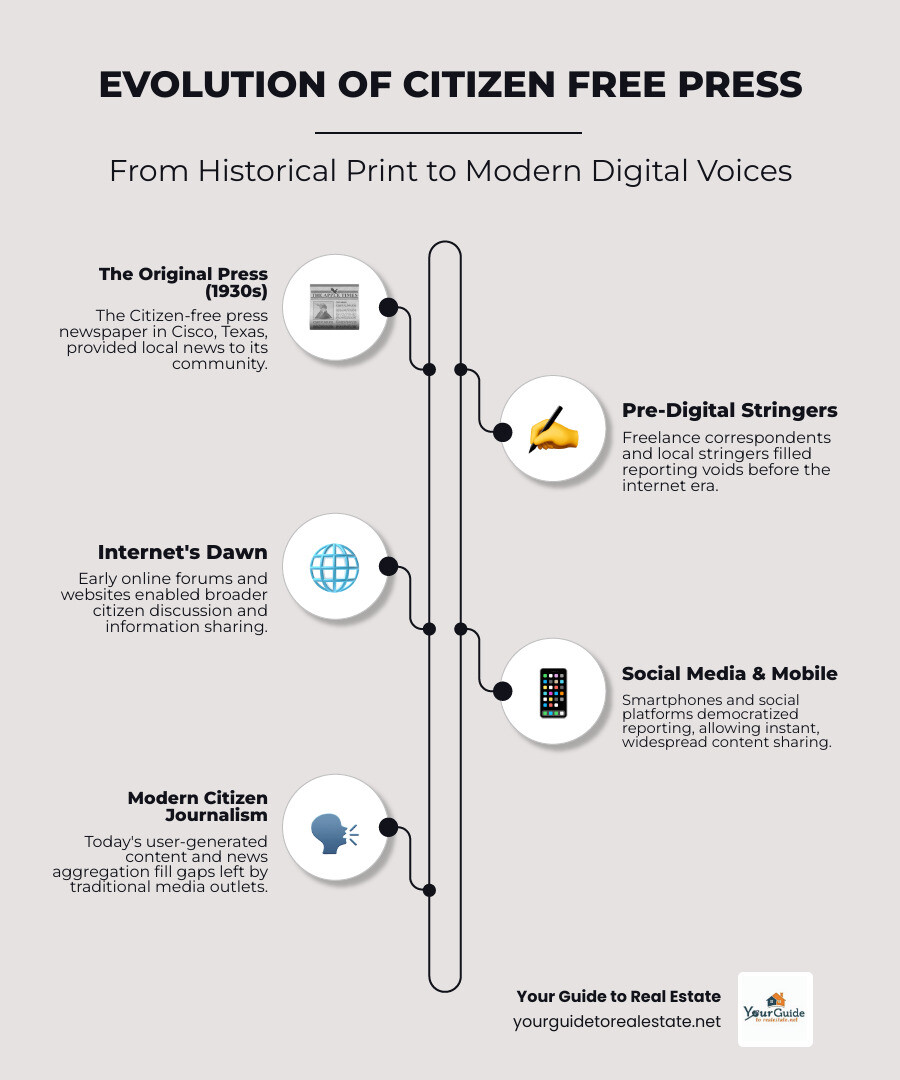
Citizen free press word guide:
From Print to Pixels: The Two Faces of “Citizen Free Press”
When you hear “citizen free press,” you’re actually encountering two completely different stories that happen to share the same name. It’s a bit like finding that your neighborhood “Main Street” exists in thousands of towns across America – same name, totally different places.
Think of it this way: one story takes place in 1930s Texas with actual printing presses and paper routes. The other unfolds in today’s digital world where anyone with a smartphone can break news. Both represent the same human desire for independent voices and community connection, just separated by nearly a century of technological revolution.
The Historical ‘Citizen-free press’ of Cisco, Texas
Let’s start our journey in Cisco, Texas, during the Great Depression. Picture a small town where everyone knew their neighbors, and the local newspaper was as essential as the corner store.

The story begins with the Cisco Weekly Citizen, a paper that served the community with local news and happenings. But in 1934, something interesting happened. The publishers decided to rebrand and increase their game – they transformed into ‘The Citizen-free press’ and doubled down on community service.
This wasn’t just a name change. The new publication came out twice weekly instead of once, giving residents more frequent updates on local events. Imagine the excitement of getting fresh news twice a week instead of once! For a small Texas town in the 1930s, this was like upgrading from dial-up to broadband.
The Citizen-free press had a brief but meaningful run from 1934 to 1935. While we don’t have extensive details about specific stories or editors, the Southwest Collection at Texas Tech University preserves records of this publication. The very fact that it existed tells us something important about community journalism during tough economic times.
The newspaper’s story didn’t end there, though. In August 1935, it evolved once more, becoming the Cisco Daily Press. Weekly to twice-weekly to daily – this progression mirrors how news has always pushed toward faster, more immediate delivery. Sound familiar? It’s the same drive that eventually led us to 24/7 news cycles and instant social media updates.
The Modern Concept of a Citizen Free Press
Now let’s fast-forward to today’s digital world, where citizen free press means something entirely different but equally powerful.
Modern citizen journalism puts the power of reporting directly into ordinary people’s hands. No journalism degree required, no newspaper job necessary. If you’ve ever shared a video of a local event or posted about a community issue, you’ve participated in this movement.
Technology changed everything. Smartphones became portable newsrooms. Social media platforms turned into instant distribution networks. Suddenly, anyone could capture breaking news, share eyewitness accounts, or investigate local issues that bigger outlets might miss.
The website citizenfreepress.com represents this modern interpretation perfectly. Rather than generating original reports, it functions as a news aggregation platform, curating stories from various sources and presenting them with a particular perspective. It’s like having a friend who reads everything and shares the most interesting stories with you.
User-generated content now shapes how we consume news. From live-streamed protests to detailed blog analyses of local politics, citizens have become active participants rather than passive consumers. Social media platforms serve as the printing presses of our era, spreading information at speeds that would have amazed those 1930s Cisco newspaper editors.
The connection between historical ‘The Citizen-free press’ and today’s citizen journalism movement is mostly in name only. But both share something beautiful: the belief that communities deserve independent voices and local perspective. Whether it’s a twice-weekly paper in Depression-era Texas or a global network of citizen reporters today, the core mission remains the same – keeping people informed and connected.
Just as navigating today’s complex media landscape requires understanding different sources and perspectives, success in any field – including real estate – benefits from having multiple viewpoints and reliable information sources.
The Citizen Journalist: Yesterday vs. Today
The idea of everyday people contributing to news isn’t exactly new. Think about it – long before anyone had a smartphone or even knew what the internet was, there were folks in every community keeping tabs on what was happening and sharing those stories. But wow, has the game changed!

The shift from then to now is pretty remarkable. It’s like comparing a horse-drawn carriage to a Tesla – they’ll both get you where you’re going, but the experience is completely different.
The Role of Citizen Journalists in the Past
Back when ‘The Citizen-free press’ was rolling off printing presses in Cisco, Texas, citizen journalists existed, though nobody called them that. These were your local correspondents – often just regular folks who happened to be good storytellers and had their finger on the pulse of the community.
These people were sometimes called “stringers” or “freelancers.” They’d string together stories about what was happening around town, or they’d free up their evenings to cover the high school football game or the town council meeting. Pretty straightforward stuff, but incredibly important.
Their world revolved around community news. We’re talking about the real nitty-gritty of small-town life: school board elections, church fundraisers, local business openings, and who won the pie contest at the county fair. This hyper-local focus meant they knew their audience personally – probably went to church with half of them!
But here’s the thing – their reach and resources were pretty limited. These folks worked with pen and paper, maybe a typewriter if they were fancy. Getting a story from their notebook to the public meant calling the newspaper office or literally walking their handwritten notes over to the editor. No instant anything back then.
The pre-internet era reporting methods were all about patience and persistence. You couldn’t just tweet out breaking news or post a Facebook update. Everything moved at the speed of print, which meant stories might take days or even weeks to reach readers.
Challenges and Opportunities for Today’s Citizen Journalist
Fast forward to today, and the landscape has exploded in ways those 1930s correspondents never could have imagined. The same basic need still exists – filling reporting gaps in local news – but now it’s even more urgent.
Here’s what happened: traditional newspapers have been hit hard by economic pressures. Staff cuts, budget reductions, and ownership changes have created massive holes in local coverage. As the saying goes, nature abhors a vacuum, and so does news coverage. This is where modern citizen free press movements step in to save the day.
The opportunity is huge. We’re literally democratizing information in ways that would have seemed like science fiction to our Texas newspaper friends from the 1930s. Newspapers are turning to ‘citizen journalists’ to fill voids left by shrinking newsrooms.
Technology has become the great equalizer. Your smartphone is more powerful than entire newsrooms used to be. You can record video, take photos, write articles, fact-check information, and publish everything instantly to a global audience. Pretty amazing when you think about it!
But – and this is a big but – with great power comes great responsibility. The ethical challenges are real. Without editors looking over shoulders or journalism school training, there’s more room for bias, mistakes, or even intentional misinformation to slip through.
Credibility and verification have become everyone’s job now. In the old days, you trusted your local paper because you knew the editor and the reporter. Today, you might be getting news from someone you’ve never met, who might not have any formal training in journalism ethics or fact-checking.
The beauty and the beast of citizen journalism is the same thing: anyone can do it. This means we get diverse voices and perspectives that traditional media might miss. But it also means we need to be smarter consumers of information. For insights into how these industry trends affect various sectors, check out more on industry news and analysis.
The bottom line? Today’s citizen journalists have incredible tools and opportunities that would have amazed their predecessors. But with that power comes the responsibility to be thoughtful, accurate, and honest – qualities that good reporters have always needed, whether they worked for The Citizen-free press in 1934 or run a news blog today.
Your Guide to Evaluating Media Bias and Credibility
In today’s information-packed world, knowing how to spot bias and judge credibility has become as essential as checking a home’s foundation before you buy. This skill becomes even more critical when you’re reading content from a citizen free press source, where editorial standards can swing from excellent to, well, questionable.
Think of it this way: you wouldn’t buy a house based solely on pretty photos, right? The same logic applies to news consumption. Every piece of information needs a thorough inspection.
Understanding the Media Bias Chart
Here’s where things get interesting. Organizations like Ad Fontes Media and AllSides have created something like a “home inspection report” for news sources. These media bias charts help you see exactly where different outlets stand politically and how reliable their reporting tends to be.
Picture a graph with two important lines. The political spectrum axis runs horizontally, showing everything from far-left to far-right viewpoints. The reliability scale runs vertically, with the most factual, well-sourced reporting at the top and questionable or fabricated content at the bottom.
Ad Fontes Media updates their chart regularly, which is smart because news outlets can change over time. They show you exactly how they place each source and explain their reasoning. It’s like having a constantly updated market analysis for your news diet.
AllSides takes a different but equally valuable approach. They use blind surveys from people across the political spectrum, along with analysis from multiple viewpoints and thousands of user ratings. This covers nearly 600 media outlets and individual writers. It’s crowdsourced wisdom at its finest.
These tools give you a quick snapshot of any source’s potential leanings and track record. You can dive deeper by using the Interactive Media Bias Chart or consulting Media Bias Ratings to get the full picture.
Applying Critical Evaluation to any Citizen Free Press
While bias charts are fantastic starting points, they can’t cover every single citizen free press source out there. Individual citizen journalists and smaller outlets often fly under the radar of these rating systems. That’s where your own detective skills come in handy.
When you encounter any news source, especially citizen-generated content, ask yourself these essential questions:
Who’s behind this story, and what might they want? Look into the author’s background and potential motivations. Are they trying to sell you something, push an agenda, or genuinely inform? Someone with skin in the game might present information differently than a neutral observer.
What’s the real purpose here? Some content aims to inform, while other pieces want to persuade, entertain, or even outrage you. Identifying the author’s purpose helps you adjust your expectations and guard against manipulation.
Where’s the proof? Solid reporting includes verifiable evidence like links to original sources, specific data, expert quotes, or observations. Vague claims without backup should raise red flags. Cross-referencing sources becomes your best friend here.
How does this sound? Pay attention to the language used. Spotting emotional or loaded language like “shocking,” “outrageous,” or “unbelievable” often signals an attempt to trigger your emotions rather than inform your mind. Neutral reporting sounds different from opinion pieces, and you should know which you’re reading.
Can I find this elsewhere? Distinguishing fact from opinion becomes easier when you check multiple sources. If only one outlet reports something extraordinary, especially something that confirms your existing beliefs, take a step back and investigate further.
The beauty of developing these evaluation skills is that they work everywhere. Whether you’re reading a major newspaper, a local blog, or content from any citizen free press platform, these questions help you separate reliable information from everything else.
Just like you wouldn’t make a major real estate decision without doing your homework, don’t make important decisions based on unverified news. Your future self will thank you for the extra effort.
Frequently Asked Questions about Citizen Journalism
When people find citizen free press, they naturally have questions. It’s like when someone first learns about real estate investing – there’s excitement mixed with uncertainty about what it all means.
Let me walk you through the most common questions I hear about citizen journalism.
What is the difference between a citizen journalist and a professional journalist?
Think of it this way: a professional journalist is like a licensed real estate agent, while a citizen journalist is more like a neighbor who knows the local market really well.
Professional journalists come with formal credentials and training. They’ve studied journalism in college, learned about ethics and media law, and work within established newsroom structures. When they publish a story, it goes through multiple editors and fact-checkers before you see it.
Citizen journalists are everyday people who see something newsworthy and decide to share it. They might not have journalism degrees, but they have something equally valuable – they’re often right there when news happens.
The accountability standards differ significantly too. Professional news organizations follow strict codes of ethics and have legal teams backing them up. With citizen free press sources, you’re often dealing with individuals who set their own standards.
Available resources tell another part of the story. Professional journalists have access to expensive equipment, research databases, and travel budgets. Citizen journalists typically work with what they have – usually a smartphone and their own time.
The biggest difference? Editorial oversight. Traditional newsrooms act as gatekeepers, deciding what gets published and how. Citizen journalism bypasses these gatekeepers entirely, which can be both liberating and risky.
How has technology impacted citizen journalism?
Technology didn’t just change citizen journalism – it basically created the modern version of it. Without smartphones and social media, we’d still be back in the era of that 1930s Cisco, Texas newspaper.
Smartphones transformed everyone into potential reporters. That device in your pocket has better video quality than professional news cameras from just a decade ago. When something newsworthy happens, citizen journalists can capture it instantly.
Social media platforms like Facebook, X, and Instagram became the distribution network. A citizen journalist can now share breaking news with thousands of people in seconds, not hours or days.
Live streaming changed everything again. Platforms like Facebook Live and YouTube Live let citizen journalists broadcast events as they happen. No editing, no delays – just raw, real-time reporting.
The global reach is mind-blowing. A citizen journalist reporting from a small town can now reach readers worldwide. Geography doesn’t matter anymore.
But here’s the double-edged sword: speed versus accuracy. Citizen journalists can share information faster than traditional outlets can verify it. This creates incredible opportunities for breaking news, but also opens the door for misinformation to spread.
Is information from a citizen free press reliable?
This is the million-dollar question, and honestly, the answer is “it depends.”
Quality varies wildly in citizen journalism. Some citizen journalists are incredibly thorough and accurate. They fact-check their work, disclose their sources, and follow ethical guidelines. Others… well, not so much.
The lack of editorial oversight means errors can slip through easily. When a professional journalist writes a story, several people review it before publication. When a citizen journalist posts something, they’re often the only set of eyes that sees it first.
Bias is another challenge. Everyone has perspectives and opinions, and citizen journalists don’t always have training in recognizing their own biases. This isn’t necessarily bad – diverse viewpoints can be valuable – but it means you need to read with awareness.
Personal verification becomes crucial. When you’re consuming citizen free press content, you become part of the fact-checking process. Cross-reference what you read. Look for multiple sources. Ask yourself if the claims make sense.
Here’s what gives me hope: crowdsourced fact-checking. Online communities can be remarkably good at identifying false information and correcting errors. It’s not perfect, but it’s a powerful counterbalance to the lack of traditional oversight.
The bottom line? Citizen free press sources can provide incredibly valuable, timely information that you won’t find anywhere else. But they require you to be an active, critical reader rather than a passive news consumer.
Just like evaluating a property requires understanding the market, evaluating citizen journalism requires understanding the source and applying your own judgment.
Conclusion: Empowering Your Information Consumption
We’ve traveled quite a journey together, haven’t we? From the dusty archives of a 1930s Texas newspaper to the busy digital world of modern citizen journalism. The citizen free press concept has two distinct faces, yet both share something beautiful: the belief that ordinary people deserve access to honest, independent information.
Think about it. Whether we’re talking about that twice-weekly paper in Cisco, Texas, or today’s smartphone-wielding citizen journalists, the core mission remains the same. People want news that matters to their lives, reported by voices they can trust.
The most crucial takeaway? In our information-saturated world, knowing how to evaluate news matters more than knowing where to find it. You’ve learned to spot bias, question sources, and think critically about what you read. These aren’t just nice-to-have skills anymore – they’re essential survival tools in the digital age.
The historical context we explored shows us that media has always evolved with technology. The economic pressures reshaping today’s newsrooms aren’t entirely new either. What is new is your power as a consumer to seek out diverse perspectives and verify information yourself.
Here’s what makes this so important: An informed citizenry forms the backbone of any healthy democracy. When people can distinguish between reliable reporting and opinion disguised as news, everyone benefits. When citizens can fill reporting gaps in their communities while maintaining ethical standards, local democracy thrives.
Just like we help you steer the complexities of real estate with proven frameworks and expert guidance, we believe in giving you the tools to steer information with confidence. The same principles apply: do your research, understand the market, and don’t rush into decisions without proper due diligence.
Whether you’re evaluating a news story or a property investment, critical thinking and careful analysis will serve you well. Both require you to look beyond the surface, consider multiple perspectives, and make informed decisions based on facts rather than emotions.
The spirit of a truly citizen free press – one that provides accurate, relevant, and diverse information – depends on readers like you who demand quality and accountability. By applying what you’ve learned here, you’re not just protecting yourself from misinformation; you’re contributing to a more informed society.
Just as navigating the media landscape requires a clear framework, so does navigating complex markets. If you’re ready for that same level of expert guidance and stress-free support in real estate, explore our guide to navigating the modern real estate market.