
Why Boat Loan Interest Rates Can Make or Break Your Dream Purchase
Boat loan interest rates are the single most important factor that determines whether your dream boat becomes an affordable reality or an expensive burden. With rates currently ranging from as low as 5.99% to over 30% depending on your financial profile, understanding these rates can save you thousands of dollars over the life of your loan.
Current boat loan interest rates at a glance:
- Excellent Credit (740+): 6.49% – 7.87% APR
- Good Credit (670-739): 8.12% – 9.78% APR
- Fair Credit (600-669): 9.00% – 11.6% APR
- Average loan terms: 10-20 years (up to 240 months)
- Typical down payment: 10-20% of boat value
Whether you’re eyeing a sleek fishing boat or a family cruiser, the interest rate on your boat loan will directly impact your monthly payment and total cost. A borrower with excellent credit might secure a rate around 7.87% for a 20-year term, while someone with fair credit could face rates exceeding 10%.
The stakes are high. On a $100,000 boat loan, the difference between a 7% and 10% interest rate means paying an extra $200+ per month – that’s over $48,000 more over the life of a 20-year loan.
Most borrowers focus on finding the perfect boat but overlook the financing details until it’s too late. Smart buyers know that securing the best possible rate requires preparation, comparison shopping, and understanding exactly how lenders evaluate boat loan applications.
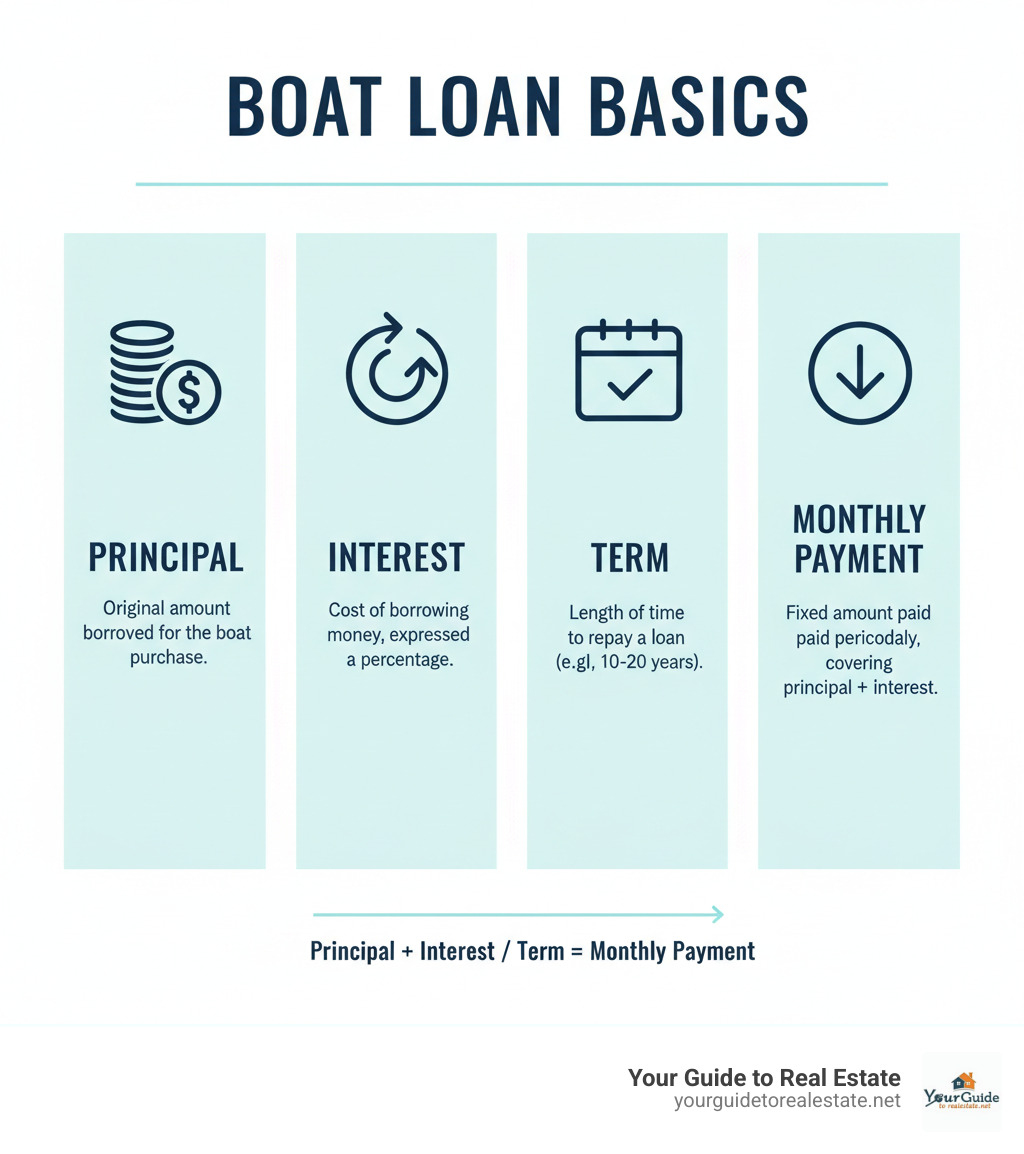
Basic boat loan interest rates glossary:
What Are Current Boat Loan Interest Rates?
Understanding today’s boat loan interest rates is like checking the weather before setting sail – you need accurate, up-to-date information to make the best decisions. The good news? We’ve done the heavy lifting to bring you the latest market data and trends.
Right now, competitive boat loan interest rates start as low as 5.99% APR for the most qualified borrowers, though these rock-bottom rates often come with specific requirements. More realistically, you’ll find rates beginning around 6.74% to 7.12% APR for both new and used boats, especially if you have excellent credit.
The current market shows some encouraging trends. As of September 2023, the best rates typically started around 7.12%, with competitive offers ranging from about 7.87% to over 10%. Even better, rates were trending downward heading into late 2025, making boat ownership more accessible for many families.
Market conditions remain dynamic, though. Economic factors like inflation, Federal Reserve decisions, and seasonal demand all influence where rates land on any given day. That’s why timing your research and moving quickly on good offers can make a real difference in your monthly payment.
For the most current rates, tools like Current Boat Loan Rates estimators can give you real-time quotes based on your specific situation.
Understanding the Numbers: What is a Good Rate Today?
So what exactly counts as a “good” boat loan interest rate in today’s market? If you can secure anything close to 7% or under 8%, you’re doing quite well. For perspective, a borrower with excellent credit financing a $250,000 boat over 20 years might see rates around 7.87% – that’s considered competitive.
Your credit score plays the starring role in determining your rate. Borrowers with excellent credit (740+) typically see the best deals. If your score sits between 800-850, you might qualify for rates around 7.87% on a 20-year loan. Those with scores between 760-799 usually see slightly higher rates at about 8.12%. Recent data from Q2 2025 shows the average APR for excellent and very good credit hovering around 8.03%.
The average APR currently sits around 8-9%, with the overall average boat loan rate hitting 9.02% in the second quarter of 2025. This gives you a solid benchmark – anything significantly below this average means you’re getting a good deal.
Borrowers with good credit (670-739) face higher rates, averaging around 9.78% in Q2 2025. While not as attractive as excellent credit rates, these are still manageable for most budgets.
Fair credit borrowers (600-669) see rates climb more steeply, with averages around 11.6% in recent data. Some lenders might quote rates as high as 30% for higher-risk borrowers, making credit improvement a worthwhile investment before applying.
Here’s a real-world example: a borrower with an 800+ credit score might see rates around 7.87% for a 20-year term, while someone with a 680 credit score could face rates above 9%. On a $75,000 loan, that difference costs about $150 more per month.
The Difference Between Interest Rate and APR
When shopping for boat loan interest rates, you’ll encounter two key numbers that sound similar but tell very different stories about your loan’s true cost. Understanding both can save you from expensive surprises down the road.
The interest rate is straightforward – it’s the percentage the lender charges on your loan balance each year. If you borrow $100,000 at 7%, you’ll pay $7,000 in interest during the first year (before principal payments reduce the balance). This rate directly determines your monthly payment calculation.
Annual Percentage Rate (APR) tells a more complete story. Think of APR as the “all-in” cost of your loan, including not just the interest rate but also various fees rolled into one annual percentage. The APR includes origination fees for processing your loan, lender fees for underwriting and administration, and sometimes points or other closing costs.
Why APR matters more than interest rate: Two loans might advertise the same 7.5% interest rate, but one could have a 7.8% APR while the other shows 8.2% APR. The second loan’s higher fees make it more expensive overall, even though the base interest rates match.
Always compare APRs when evaluating loan offers – it’s the only way to make a true apples-to-apples comparison. A loan with a slightly higher interest rate but lower fees might actually cost you less than one with a lower advertised rate but hefty upfront charges.
This concept works similarly to Understanding Mortgage Rates for home loans, where the full picture matters more than any single number.
Key Factors That Drive Your Boat Loan Interest Rates
Ever wonder why your friend got a fantastic rate on their boat loan while you’re stuck with something less appealing? The truth is, it’s not just luck or who you know. Boat loan interest rates are determined by a careful dance between risk and reward, and lenders have become quite sophisticated at sizing up borrowers.
Think of it this way: every time a lender approves a boat loan, they’re essentially placing a bet on you. Will you make your payments on time? Will you take care of the boat? If something goes wrong, how likely are they to get their money back? The answers to these questions directly influence the rate you’ll receive.
The good news is that many of these factors are within your control. Others, like broader economic conditions, are simply part of the landscape we all steer together. Understanding both types can help you position yourself for the best possible rate.
Your Credit Score and History
Your credit score isn’t just a number—it’s your financial reputation distilled into three digits. And when it comes to boat loan interest rates, it’s absolutely the most powerful factor in your corner.
Lenders view your credit score as a crystal ball into your borrowing future. A high score (typically 740 and above) tells them you’ve consistently paid bills on time, kept debt levels manageable, and handled credit responsibly. It’s like having a stellar recommendation letter from every creditor you’ve ever worked with.
The impact on your rates is dramatic and immediate. A borrower with an excellent credit score in the 800-850 range might secure a rate around 7.87% for a 20-year boat loan. Drop down to the 760-790 range, and that rate could climb to about 8.12%. While that might seem like a small difference, it translates to real money over time.
Credit scoring works in tiers, and each tier comes with its own rate reality. Excellent credit (740+) opens the door to the most competitive rates available. Good credit (670-739) still gets you reasonable rates, but you’ll pay a bit more. Fair credit (600-669) means noticeably higher rates and potentially less flexible terms. Below 600, and you’re looking at significantly higher rates—sometimes well into double digits—or difficulty getting approved at all.
Your payment history carries the most weight in these calculations. Lenders want to see a consistent pattern of on-time payments, not just on credit cards, but on mortgages, car loans, and even utility bills. If you’ve been working on rebuilding credit, consider exploring options like a Debt Consolidation Loan to streamline your payments and improve your credit profile.
Down Payment and Loan-to-Value (LTV) Ratio
The size of your down payment speaks volumes to lenders, and it directly influences the boat loan interest rates you’ll be offered. It all comes down to something called the Loan-to-Value ratio, or LTV.
LTV is simply math: take your loan amount and divide it by the boat’s value. If you’re buying a $100,000 boat and putting down $20,000, your loan is $80,000. That gives you an LTV of 80%. The lower this percentage, the happier your lender will be.
Why does this matter so much? A larger down payment reduces the lender’s risk in several ways. First, it shows you’re financially committed to the purchase—you’ve got real skin in the game. Second, if something goes wrong and they need to repossess the boat, that equity cushion protects them from losses.
Most boat loans require a down payment between 10% and 20%, though some lenders might finance up to 90% for well-qualified buyers. While 10% might get you approved, aiming for 20% or more often open ups better rates and terms.
The math is compelling: a lower LTV ratio typically translates directly to lower boat loan interest rates. Lenders reward borrowers who reduce their risk exposure. Plus, a substantial down payment helps you avoid being “upside-down” on your loan—owing more than the boat is worth—which can happen quickly with depreciating assets.
Boat Age, Value, and Type (New vs. Used)
Not all boats are created equal in the eyes of lenders. The age, condition, and type of vessel you choose will influence your boat loan interest rates in ways that might surprise you.
New boats generally get preferential treatment when it comes to rates. They’re seen as lower risk because they’re less likely to break down, easier to resell if necessary, and their values are more predictable. It’s similar to how new cars typically get better financing than used ones.
The rate difference between new and used boats can be significant. New boat APRs might start as low as 6.95% for shorter terms, while used boat APRs for the same term could begin around 7.45%. For longer terms, the gap often widens further—new boats might get 8.95% while used boats face 9.90% for the same loan period.
Determining a boat’s value is more art than science, especially for used vessels. For new boats, lenders typically work with the manufacturer’s suggested retail price or factory invoice. Used boats require more detective work.
BUC and NADA book values serve as the marine equivalent of Kelley Blue Book, providing standardized value estimates for used boats. For older or higher-value vessels, lenders often require a professional marine survey—a thorough inspection by a qualified surveyor who assesses the boat’s condition, safety features, and fair market value.
This process ensures the boat is actually worth what you’re asking to borrow. After all, like any significant What is Investment?, lenders want confidence in the asset securing their loan.
Economic and Market Conditions
Some factors affecting boat loan interest rates are completely beyond your control, but they’re worth understanding because they influence the entire lending landscape.
Inflation acts like a tide that lifts all interest rates. When inflation rises, money loses purchasing power over time. Lenders respond by increasing rates to ensure their returns keep pace with the declining value of dollars.
Federal Reserve decisions send ripples through every corner of the lending market. When the Fed raises the federal funds rate to combat inflation, boat loan rates typically follow suit. When they cut rates to stimulate economic growth, borrowing generally becomes more affordable across the board.
The boating market itself creates its own dynamics. High demand and limited supply can drive boat prices up, affecting loan amounts and risk calculations. A thriving marine industry might encourage more lenders to compete for business, potentially leading to better rates.
Economic uncertainty tends to make lenders more cautious, often resulting in higher rates and stricter qualification requirements. During stable economic periods, competition among lenders typically benefits borrowers with more attractive rate offerings.
These market forces operate much like the factors that influence Why Are Mortgage Rates Going Up? in the housing market—they’re part of the larger economic ecosystem we all steer together.
How to Get the Best Rate on Your Boat Loan
Now that we understand what drives boat loan interest rates, let’s talk strategy. Securing the best possible rate isn’t about magic; it’s about preparation and smart shopping. Think of it as preparing for a big fishing trip – you wouldn’t just grab a rod and hope for the best, would you?
The good news is that you have more control than you might think. While you can’t change the Federal Reserve’s decisions or economic conditions, you absolutely can strengthen your position as a borrower and become the kind of customer lenders compete for.

Strengthen Your Financial Profile
This is your first and most impactful step. A strong financial profile tells lenders you’re a low-risk borrower, making them eager to offer you their best boat loan interest rates.
Start by checking your credit report from all three major bureaus – Equifax, Experian, and TransUnion. You’d be surprised how often we find errors that are unnecessarily dragging down someone’s score. Disputing and correcting these mistakes can quickly boost your score, sometimes by 50 points or more.
Next, focus on paying down existing debt. High credit card balances hurt your credit utilization ratio, which is a major factor in your credit score. If you have multiple cards with balances, consider the avalanche method – pay minimums on all cards while putting extra money toward the highest interest rate card first.
Increasing your credit score takes time, but every point counts. Make all payments on time (set up autopay if needed), keep old credit accounts open to maintain your credit history length, and avoid applying for new credit in the months before your boat loan application. Each hard inquiry can temporarily lower your score.
Your debt-to-income ratio is equally important. Lenders want to see that your total monthly debt payments don’t exceed 36% of your gross monthly income. If you’re close to this threshold, consider paying off smaller debts entirely before applying for your boat loan.
Finally, save for a larger down payment. A bigger down payment means a lower loan-to-value ratio, which directly translates to better rates. While 10% might be the minimum, aiming for 20% or more puts you in the driver’s seat during negotiations.
Shop Around and Compare Offers
Once your financial profile is sparkling, it’s time to cast a wide net. Don’t fall into the trap of accepting the first offer you receive – that’s leaving money on the table.
Banks are an obvious starting point, especially if you have an existing relationship. Your current bank might offer relationship discounts or be more flexible with someone they already know and trust.
Credit unions often provide some of the most competitive boat loan interest rates available. As member-owned institutions, they prioritize member benefits over shareholder profits. Even if you’re not currently a member, many credit unions have simple membership requirements.
Specialized marine lenders bring deep expertise to the table. They understand the boating market intimately and often have products custom for specific boat types or ages. They might also be more flexible with older boats that traditional lenders shy away from.
Boat loan brokers can be incredibly valuable, especially if you’re short on time. These professionals work with networks of 14 or more lenders to find the best rates and terms for your specific situation. They can also help you avoid multiple credit pulls by shopping your application around.
When gathering quotes, apply with several lenders within a 14-45 day window. Credit scoring models recognize when you’re rate shopping and typically count multiple inquiries as a single pull, minimizing the impact on your credit score.
Don’t be shy about using offers from one lender to negotiate better terms with another. Lenders want your business, and they’re often willing to match or beat a competitor’s offer. This process mirrors what we teach buyers about How to Compare Mortgages – knowledge is power in negotiations.
Beware of Misleading Advertised Boat Loan Interest Rates
Here’s where things get a bit murky. The internet is full of advertised boat loan interest rates that seem too good to be true – and they usually are.
You’ll often see ads promising rates under 3% or even 0.00% APR. While these numbers grab attention, they come with serious catches that make them impractical for most borrowers.
The biggest red flag is extremely short loan terms. That attractive 3% rate might only be available for 36 months. Let’s do the math: a $96,000 loan at 3% over three years results in monthly payments of about $2,792. That’s not exactly budget-friendly for most families.
Reputable lenders understand this reality. They often refuse to offer such short terms because they know it leads to borrower distress and potential defaults. Their goal – and ours – is sustainable boat ownership, not setting you up for financial stress.
Watch out for hidden fees that aren’t reflected in the advertised rate. A low interest rate loses its appeal when it’s paired with hefty origination fees or processing charges that drive up the actual APR.
Some advertised rates are simply outdated or come with restrictive conditions that few borrowers actually qualify for. The rate might only apply to specific boat types, loan amounts, or credit profiles that exclude most applicants.
Always verify lender legitimacy before sharing personal information. Resources like NMLS Consumer Access help you confirm that lenders are properly licensed and regulated.
Remember to focus on the complete picture – the APR, loan term, total interest paid, and all associated fees. A slightly higher rate with reasonable terms and transparent pricing often beats a “too good to be true” offer that comes with unpleasant surprises.
Decoding Loan Terms: How 10 vs. 20 Years Impacts Your Wallet
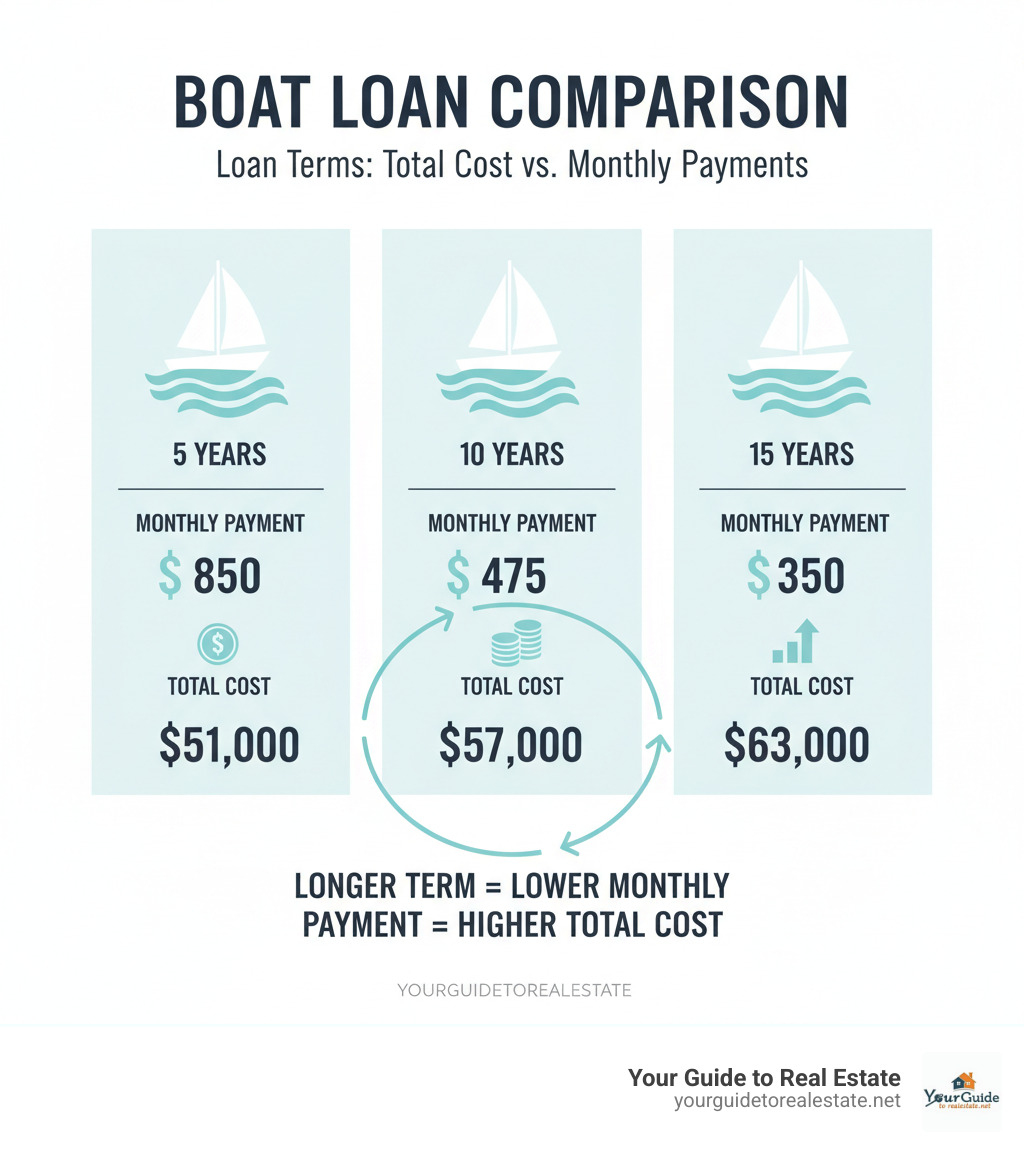
When it comes to boat loan interest rates and payments, choosing your loan term is like picking the right fishing spot – it can make all the difference in your success. Most boat loans offer terms ranging from 10 to 20 years, and some lenders even extend up to 21 years (252 months). But here’s the thing: there’s always a trade-off between what you pay monthly and what you pay overall.
Think of it this way: a longer loan term spreads your payments out over more months, making each payment smaller. But just like paying the minimum on a credit card, you’ll end up paying much more in interest over time. It’s one of those financial decisions where the “easy” choice now can cost you significantly later.
Comparing Monthly Payments and Total Interest
Let’s break this down with real numbers that might surprise you. Imagine you’re financing a $50,000 boat at a fixed boat loan interest rate of 8% APR. The difference between a 10-year and 20-year loan is pretty dramatic:
| Loan Term | Monthly Payment | Total Interest Paid (Approx.) | Total Cost (Principal + Interest) |
|---|---|---|---|
| 10 Years (120 months) | $606.64 | $22,796.80 | $72,796.80 |
| 20 Years (240 months) | $418.22 | $50,372.80 | $100,372.80 |
(These calculations are approximate and for illustration purposes, assuming no additional fees beyond interest.)
The monthly payment difference is significant – you’ll save nearly $190 per month by choosing the longer term. For many families, that extra breathing room in the monthly budget makes boat ownership possible when it otherwise wouldn’t be. A real-world example shows this clearly: an $88,000 loan for 20 years with a fixed rate of 7.74% would result in 240 payments of $721.89.
But here’s where it gets expensive – that 20-year loan costs you an extra $27,576 in total interest compared to the 10-year option. That’s more than half the original loan amount! The reason is simple: your principal balance stays higher for longer, which means more interest accumulates over time.
Choosing the right term depends entirely on your financial priorities. If keeping your monthly budget flexible is most important, the longer term makes sense. If you want to build equity faster and pay less overall, the shorter term is better – assuming you can comfortably handle the higher payments.
Some smart borrowers take a middle approach: they choose the longer term for the lower required payment but make extra principal payments whenever possible. This gives them flexibility during tight months while still saving on interest when they can afford it.
Before making your decision, we recommend using a Mortgage Payment Calculator Online to experiment with different scenarios. Play around with various loan amounts, interest rates, and terms until you find the sweet spot that works for your specific situation.
Frequently Asked Questions About Boat Loans
Buying a boat is exciting, but we know the financing side can feel overwhelming. You’re definitely not alone in having questions about boat loan interest rates and how the whole process works. Let’s tackle some of the most common concerns we hear from folks just like you.
Can refinancing a boat loan lead to a lower interest rate?
Absolutely! Refinancing your boat loan can be a smart financial move, especially if circumstances have changed since you first got your loan.
Yes, if rates have dropped significantly since you originally financed your boat. Market conditions change, and if boat loan interest rates have come down, you could potentially save hundreds or even thousands of dollars over the life of your loan.
When it makes sense to refinance really depends on the numbers. If you can secure a rate that’s at least 1-2 percentage points lower than your current rate, refinancing often makes financial sense. You’ll also want to consider how much time is left on your current loan – if you’re already several years into payments, the savings might be less dramatic.
Improving your credit score first can make a huge difference. If your credit has improved since your original loan, you’re now seen as less risky to lenders. This could qualify you for much better terms than when you first bought your boat.
Potential refinancing costs do exist, though. Just like with Mortgage Refinancing Explained, you’ll want to factor in any application fees, processing costs, or other charges. Make sure your monthly savings will cover these costs within a reasonable timeframe.
How long does it take to get approved for a boat loan?
The good news? Getting approved for a boat loan is typically much faster than you might expect, especially compared to other major purchases.
Typical timeline for most lenders is pretty quick. Many can give you a decision on your application within the same day, sometimes within just a few hours if you apply early and have all your paperwork ready.
Same-day decisions are increasingly common, particularly with online lenders and specialized marine financing companies. They’ve streamlined their processes to compete for your business.
Full approval and funding usually takes 24-48 hours once you’re approved. Some lenders can even wire funds directly to the boat dealer or seller within a day or two. It’s much faster than waiting weeks for a mortgage!
Pre-approval process is available with many lenders, though not all offer it. Getting pre-approved gives you a clear budget and shows sellers you’re serious. It’s like having cash in hand when you’re boat shopping.
Factors that can cause delays are usually pretty avoidable with good preparation. Having incomplete documentation, credit report issues, or needing a marine survey for an older boat can slow things down. Being organized and responsive, similar to navigating the Loan Process for Buying a House, keeps everything moving smoothly.
Is the interest on a boat loan tax-deductible?
This is one of those pleasant surprises that many boat owners don’t know about! The answer isn’t a simple yes or no, but there’s definitely potential for tax savings.
Potential for tax deduction exists if your boat qualifies as a second home under IRS rules. When it does qualify, you can deduct the interest on your boat loan just like you would mortgage interest on a vacation home.
Qualifying as a second home requires your boat to meet specific criteria that make it suitable for living. The IRS looks for three main features: sleeping quarters (a proper berth or cabin where people can sleep), galley (a kitchen area with cooking facilities), and head (a bathroom with toilet facilities). Essentially, your boat needs to be a place where someone could reasonably live, even temporarily.
Many larger cruisers, houseboats, and live-aboard sailboats easily meet these requirements. Smaller fishing boats or day cruisers typically don’t qualify.
Consulting a tax advisor is crucial because tax laws change, and everyone’s situation is different. What works for your neighbor might not work for you, depending on your income, other deductions, and how you use the boat. A qualified tax professional can look at your specific circumstances and help you maximize any potential savings.
The potential tax benefits can make boat ownership even more attractive financially, but it’s definitely worth getting professional advice to make sure you’re doing everything correctly.
Conclusion
What a journey we’ve taken together through the waters of boat loan interest rates! From understanding what makes a good rate in today’s market to finding the strategies that can save you thousands, we’ve covered everything you need to know to make your boat ownership dreams a reality without breaking the bank.
The truth is, securing the best boat loan interest rates isn’t about luck or timing the market perfectly. It’s about preparation and knowledge. Your credit score remains the single most powerful tool in your arsenal – a borrower with excellent credit can save hundreds of dollars every month compared to someone with fair credit. That’s real money that stays in your pocket for fuel, maintenance, or your next adventure on the water.
Comparing APR is absolutely crucial – we can’t stress this enough. Those seemingly attractive low interest rates you see advertised often hide fees and terms that make them far more expensive than they appear. Always look at the full picture, including all costs rolled into the APR. It’s the only way to make an honest comparison between lenders.
Loan terms are a balancing act. While stretching your payments over 20 years might make that monthly payment more manageable, you’ll pay significantly more in total interest. Sometimes a 15-year term hits that sweet spot between affordability and total cost. Run the numbers for your specific situation.
Shopping around isn’t just recommended – it’s essential. Credit unions often surprise borrowers with their competitive rates, while specialized marine lenders understand the boating market in ways traditional banks might not. Don’t be afraid to negotiate or use one offer to improve another.
At Your Guide to Real Estate, we believe that financial literacy empowers you to make confident decisions about all your major purchases. Whether you’re buying your first home, investing in property, or financing that perfect boat, understanding how lending works puts you in the driver’s seat.
The boating lifestyle offers incredible rewards – family memories, peaceful mornings on the water, and the freedom to explore. With the right financing approach, you can enjoy all of this without the stress of overwhelming payments or unfavorable terms.
Ready to expand your financial knowledge even further? Our comprehensive guide Understanding Mortgages: A Beginner’s Guide to Home Loans applies many of these same principles to home financing, helping you build wealth through smart real estate decisions.