
Why Becoming a Real Estate Agent is an Attractive Career Path
How to become a real estate agent is a common question for those considering a career change or entering the workforce. The path involves completing pre-licensing education, passing a state exam, finding a sponsoring brokerage, and applying for your license – typically taking 4-6 months from start to finish.
Quick Steps to Become a Real Estate Agent:
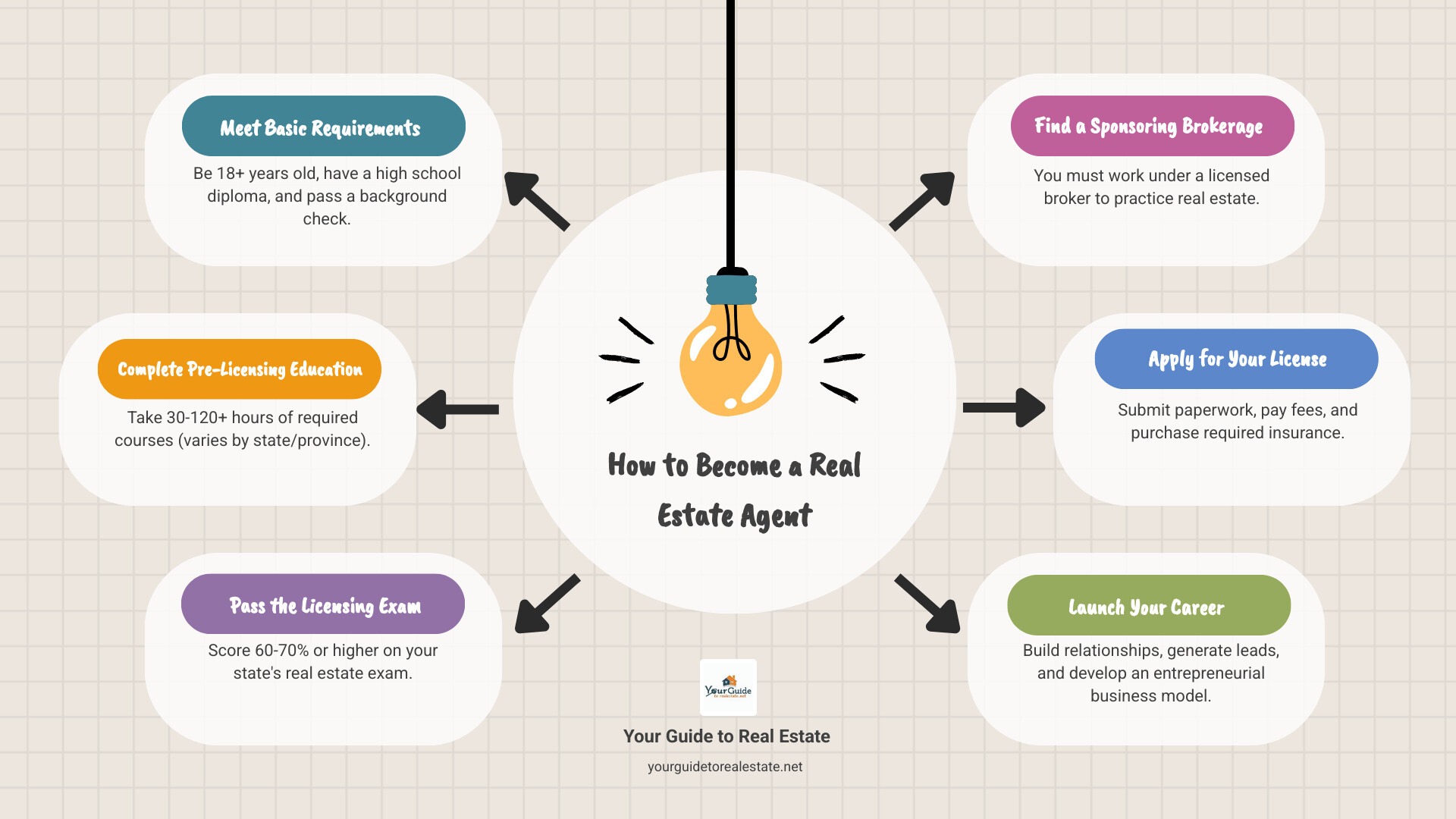
- Meet basic requirements – Be 18+ years old, have a high school diploma, and pass a background check
- Complete pre-licensing education – Take 30-120+ hours of required courses (varies by state)
- Pass the licensing exam – Score 60-70% or higher on your state’s real estate exam
- Find a sponsoring brokerage – You must work under a licensed broker to practice
- Apply for your license – Submit paperwork, pay fees, and purchase required insurance
The real estate industry offers compelling opportunities for those seeking financial independence and career flexibility. With a median salary around $49,040 to $65,850 and the potential for much higher earnings, real estate attracts people from all backgrounds and career stages.
Real estate is a regulated profession in every state, which means you must follow specific steps to legally help clients buy, sell, or rent properties. The Real Estate Council of Ontario (RECO) notes that their mission is consumer protection by ensuring agents follow the law – a principle that applies across all regulatory bodies.
However, becoming licensed is just the beginning. As one industry expert puts it: “Starting a full-time career as a real estate agent requires a full commitment and cannot be treated like a hobby.” Success depends on your ability to build relationships, generate leads, and steer an entrepreneurial business model.
Important how to become a real estate agent terms:
Understanding the Foundations of a Real Estate Career
Ready to start on an exciting journey into real estate? That’s wonderful! Before you dive into showing homes or sealing deals, it’s super important to grasp the basic requirements and the rules that guide this amazing profession. The great news is, whether you’re dreaming of working in a busy market or a quiet town, the core steps to become a real estate agent are pretty similar everywhere. These foundational steps ensure that everyone involved — you, your clients, and the industry as a whole — is protected and operates with professionalism.
What are the general requirements for how to become a real estate agent?
Before you can even imagine handing over keys to a happy new homeowner, there are some fundamental boxes you’ll need to tick. Think of these as your entry ticket into real estate! They’re not just arbitrary rules; they’re in place to ensure you’re ready for the big responsibilities ahead.
First off, let’s talk about age. Most places will ask that you’re at least 18 years old. In some areas, it might be 21. For example, in Ontario, Canada, being 18 is the minimum. This ensures you’re legally mature enough to handle important contracts and financial matters for your clients.
Next up is your education. You’ll typically need a high school diploma or its equivalent (like a GED). While a college degree isn’t usually required to become a real estate agent, having one can definitely give you a leg up or even help with some pre-licensing course hours. It simply gives you a strong learning foundation for the specialized real estate courses to come.
You’ll also need to show legal residency. This means you’re authorized to work in the country. You might need to provide things like a social security number to confirm this.
Perhaps one of the most crucial steps that speaks to the trust clients place in agents is the background check. Regulatory bodies want to make sure everyone joining the real estate family is trustworthy. This often involves submitting your fingerprints and undergoing a criminal record check. In Ontario, for instance, RECO uses these checks to make sure you’re a good fit for the job, always keeping consumer protection in mind. The main goal here is to ensure you can act with integrity and responsibility. Always follow your local real estate commission’s specific instructions for this check to avoid any extra, unnecessary costs.
Finally, while they might not be written down like age or education, financial responsibility and integrity are huge expectations. The industry looks for people who manage their own affairs wisely and who will always uphold the highest ethical standards, putting their clients’ best interests first.
The Role of Regulatory Bodies
Real estate is so much more than just sales; it’s a carefully structured industry built to protect people. And that’s where regulatory bodies come in! Each state or province has its own real estate commission or council. In Ontario, Canada, this important job belongs to the Real Estate Council of Ontario (RECO).
These organizations act like guardians for the industry. Their main goal is consumer protection, making sure you, as a client, are safe when buying or selling. They set the bar for ethical behavior and professionalism. They also play a big part in enforcing legislation, like how RECO in Ontario makes sure agents follow the Trust in Real Estate Services Act, 2002 (TRESA).
Think of them as the gatekeepers for the profession. They are the licensing authority, setting the rules for how to become a real estate agent, giving out the exams, and issuing your license. They also handle renewals and, if needed, any disciplinary actions. They establish clear professional conduct standards, including rules for advertising and how client money is handled. And if someone has a problem with an agent, these bodies are usually the first stop for handling complaints and investigating issues.
Understanding these regulatory bodies is key. They aren’t just paperwork producers; they ensure the industry stays honest and reliable. This means when you work with a licensed real estate agent, you can trust you’re dealing with someone qualified and accountable. We at Your Guide to Real Estate believe this framework is the backbone of a strong, trustworthy market. You can learn more about how this oversight works by checking out The role of Ontario’s regulator, RECO.
Is a Real Estate Career Right for You?
So, you’ve checked off the basic requirements and now you understand who keeps the industry in line. The next big question is: Does a real estate career truly align with your personality and dreams? It’s a field that offers amazing rewards, but it also comes with its own set of unique challenges.

One of the biggest draws to real estate is the chance for financial independence and flexibility. But with that freedom comes a big need for self-motivation. As an agent, you’re essentially running your own small business, even if you’re part of a larger brokerage. There’s no fixed salary here; your income is usually commission-based. This means your hard work and determination directly impact your paycheck.
People skills are absolutely vital. Real estate is all about people! You’ll meet so many different clients, from first-time buyers to experienced investors. Everyone has different needs, feelings, and expectations. Being a great listener, a clear communicator, and an empathetic guide is far more important than just being a smooth talker. As we often say, successful agents don’t just sell houses; they build lasting relationships. Curious about what skills you’ll need? Our guide on Real Estate Agent Skills has you covered.
An entrepreneurial spirit is also a must-have. You’ll be in charge of finding clients, marketing yourself and your listings, and managing your own time. Those first few months can feel slow, and it might take a while before your first big sale. This period calls for resilience and treating it like an “apprenticeship” in building your client base. This isn’t your typical 9-to-5 job; it often involves evenings, weekends, and fitting into your clients’ schedules. To get a real peek into what a day in the life looks like, check out The Day-to-Day Life of a Real Estate Agent: What You Didn’t Know.
Finally, you need to be ready for market fluctuations. The real estate market can be a bit of a rollercoaster, influenced by the economy, interest rates, and local trends. A truly successful agent learns to adapt, change course when needed, and keep learning to steer these shifts.
If you love a good challenge, enjoy working with people, are highly motivated, and are comfortable with an income based on your efforts, then a career in real estate could be incredibly rewarding and fulfilling for you!
The Step-by-Step Guide on How to Become a Real Estate Agent
Ready to turn your real estate dreams into reality? The journey to become a real estate agent follows a clear, structured path that’s designed to prepare you for success while protecting consumers. Think of it as your roadmap to a rewarding career – each step builds on the last, creating a solid foundation for your professional future.
Let’s walk through this journey together, breaking down exactly what you need to do and what to expect along the way.
Step 1: Complete Your Pre-Licensing Education
Your real estate education is where everything begins – and honestly, it’s one of the most important investments you’ll make in your career. These aren’t just classes you need to check off a list; they’re your introduction to the knowledge that will help you guide families through one of the biggest decisions of their lives.

The required hours for pre-licensing courses vary quite a bit depending on where you live. Most states ask for somewhere between 30 to 90 hours of classroom time, though some places like Texas require up to 120 hours. It might seem like a lot, but remember – you’re learning to handle transactions worth hundreds of thousands of dollars. The time investment makes perfect sense when you think about it that way.
During your coursework, you’ll dive into fascinating topics that form the backbone of real estate practice. Real estate principles will introduce you to the language and concepts of the industry. You’ll study contracts and real estate law, learning how to protect your clients’ interests legally. Finance and market analysis sections will teach you how mortgages work and how to help clients understand property values. Perhaps most importantly, you’ll learn about agency relationships – the sacred trust between you and your clients.
When it comes to choosing a school, you’ve got options that fit different lifestyles. Online courses offer incredible flexibility, perfect if you’re transitioning from another career or balancing family responsibilities. You can study during your lunch break, late at night, or whenever works best for you. In-person classes provide that traditional classroom experience with direct access to instructors and fellow students – some people just learn better in that environment.
Look for schools with solid reputations and instructors who genuinely care about student success. The cost typically ranges from a few hundred to over a thousand dollars, but think of it as tuition for your new career, not just an expense.
Step 2: Pass the Real Estate Licensing Exam
After weeks of studying, you’ll face the moment of truth: your state licensing exam. Take a deep breath – you’ve prepared for this, and thousands of people pass this test every year. You can too.
The exam typically has two main sections that work together to test your readiness. The national section covers those universal real estate principles you’ve been studying – things like property ownership, contracts, and basic real estate math that apply everywhere. The state-specific section focuses on your local laws and regulations, testing your knowledge of disclosure requirements and ethical standards specific to your area.
Most exams are administered through official testing providers like PSI Services or Pearson VUE, who partner with state real estate commissions. You’ll schedule your exam through their systems, and they’ll provide a professional testing environment designed to be fair and secure.
Here’s where preparation really pays off. Practice exams are your secret weapon – they help you get comfortable with the question format and identify any weak spots in your knowledge. Don’t just memorize facts; make sure you truly understand the concepts. The math portions might feel intimidating, but they’re usually straightforward calculations once you practice them.
Most states require you to score 60-70% or higher to pass. If you don’t pass on your first try, don’t get discouraged. Many successful agents needed multiple attempts, and each try teaches you something valuable. Our real estate exam preparation tips can help you approach this challenge with confidence.
Step 3: Find a Sponsoring Real Estate Brokerage
Congratulations on passing your exam! But here’s something that surprises many new agents: you can’t just start selling houses on your own. You’ll need to find a sponsoring brokerage to work under – think of it as your professional home base and safety net rolled into one.

Your brokerage provides essential support that goes far beyond just having an office. They give you access to the Multiple Listing Service (MLS), provide legal oversight to keep you compliant, and offer the resources you need to serve clients professionally. The broker takes responsibility for your actions while you’re learning the ropes, which protects both you and the public.
Choosing the right brokerage deserves serious thought because it can make or break your early career experience. Take time to interview several options – this is like dating, but for your professional future.
Commission splits will directly impact your income, ranging from 50/50 arrangements to more generous splits as you gain experience. Some brokerages even offer 100% commission models with monthly fees. Training and mentorship programs can be invaluable, especially in your first year when everything feels new and overwhelming. Look for companies that pair new agents with experienced mentors who genuinely want to see you succeed.
Company culture matters more than you might think. Do you thrive in competitive environments, or do you prefer collaborative, supportive teams? Some brokerages focus on individual achievement, while others emphasize teamwork and shared success. Technology and resources are crucial too – modern real estate requires robust CRM systems, marketing support, and professional tools.
We’ve created comprehensive guides to help you steer this decision, including What is a Real Estate Brokerage: A Beginner’s Complete Guide and How to Choose a Broker as a Real Estate Agent. Don’t rush this choice – the right brokerage can accelerate your success, while the wrong one can leave you struggling unnecessarily.
Step 4: Apply for Your License and Purchase Insurance
You’re in the home stretch now! With your education complete, exam passed, and sponsoring broker chosen, it’s time to make everything official by applying for your real estate license.
The application process is typically straightforward but requires attention to detail. You’ll complete an official application through your state’s real estate commission, often using online portals that streamline the process. In Ontario, for example, agents use RECO’s MyWeb portal to submit their applications.
You’ll need to gather required documents including proof of your completed education, official exam results, and information about your sponsoring broker. There’s also an application fee to pay, usually ranging from $100-$200 depending on your state.
The background check process gets finalized during this step if you haven’t completed it already. This typically involves fingerprint submission and demonstrates your commitment to maintaining the profession’s integrity standards.
Here’s a crucial piece that many new agents don’t fully appreciate: Errors & Omissions (E&O) insurance. This professional liability coverage protects both you and your clients if mistakes happen during transactions. It’s not just recommended – it’s often mandatory. In Ontario, all agents must participate in RECO’s professional liability insurance program, which also includes consumer deposit and commission protection.
You cannot start practicing real estate until your application is approved and your insurance is in place. This might feel like bureaucratic red tape, but it’s actually a safety net that protects everyone involved in real estate transactions.
Remember to apply within the required timeframe – many states give you about a year from completing your education to submit your application. Don’t wait until the last minute; start this process as soon as you’ve secured your sponsoring broker.
Once everything is approved, you’ll officially be a licensed real estate agent. Welcome to an industry where your success is limited only by your dedication and willingness to serve others!
Breaking Down the Costs and Earning Potential
Alright, let’s talk numbers! It’s completely natural to wonder, “How much will this cost me?” and “How much can I actually make?” Understanding the financial side of things is a huge piece of the puzzle when you’re thinking about how to become a real estate agent. Think of it as an investment in your future!
You’ll encounter several expenses along the way, starting with your pre-licensing education, exam fees, and the official application for your license. Then, there are ongoing costs like brokerage fees and making sure you’re protected with Errors & Omissions (E&O) insurance. Don’t forget those initial marketing costs too – you’re building a business, after all! Our research shows that the total cost to get your license and start strong can range from a few hundred dollars to well over a thousand, depending on where you live and how you choose to learn.
How Much Does It Cost to Get Licensed?
Let’s shine a light on the typical financial investments you can expect as you start on your journey to become a real estate agent. These aren’t just fees; they’re your tickets to a brand new career!
First up is the Pre-licensing Course. This is often the biggest chunk of your initial investment, and its cost can vary quite a bit. Depending on your state’s required hours (some demand 30, others 120+, like Texas!) and whether you pick flexible online classes or a more structured in-person setting, you might spend anywhere from $200 to $900 or even more. Online options tend to be in the $200-$800 range, while live online or traditional classroom settings could be $300-$900+.
Once your studies are complete, you’ll need to pay an Exam Fee to take your state’s licensing test. This usually falls somewhere between $60 to $100 per attempt. After you’ve aced that exam (you got this!), there’s a License Application Fee to formally submit your paperwork to the state. Budget about $100 to $200 for this.
You’ll also have a Background Check/Fingerprinting expense, which helps ensure the integrity of the profession. This can add another $30 to $100 to your initial costs.
Then comes Errors & Omissions (E&O) Insurance. This is super important professional liability coverage that protects you in case of any honest mistakes. While it’s an annual cost, you’ll likely have an initial pro-rated payment. Think of it as your professional safety net!
Once you join a brokerage, you’ll encounter other fees like Brokerage Fees/MLS Dues. These cover your access to the Multiple Listing Service (MLS), local real estate board memberships, and sometimes even desk or technology fees. These can really vary depending on your brokerage agreement.
And finally, don’t forget the Marketing & Startup Supplies! Things like business cards, setting up a simple website, professional headshots, and initial marketing materials are all part of launching your personal brand.
Adding all this up, a realistic estimate for getting fully licensed and ready to roll can be anywhere from $500 to $1500+. It’s a genuine investment, but one that opens the door to a truly rewarding career.
Understanding Your Earning Potential
Now for the exciting part: how much can you actually earn? One of the biggest draws of a real estate career is the incredible potential for financial independence. Unlike many jobs with a fixed salary, your income as a real estate agent is largely commission-based. This means your earnings are directly linked to how many properties you help clients buy or sell, and the commission percentage on those transactions. Your hustle directly impacts your wallet!
While the sky’s the limit for top performers, it’s good to look at the big picture. Our research points to the median salary for a real estate agent being around $49,040 in 2020, and it rose to roughly $65,850 in 2022, according to the U.S. Department of Labor. But here’s a friendly heads-up: these numbers often include the earnings of highly seasoned and successful agents. New agents should understand that building up to those figures takes time, effort, and dedication.
The projected job growth for real estate agents is about 4% between 2020-2030, which is considered about average. This just highlights that while the market is competitive, there’s always room for passionate, skilled professionals.
Several key factors will play a huge role in your earning potential:
- Market Conditions: When the market is booming, there are generally more transactions, which means more opportunities for you!
- Your Location: “Location, location, location” isn’t just for properties; it’s for agents too! Hot markets, like busy Dallas, Texas, or growing neighborhoods in Oklahoma City, might offer more chances than quieter areas.
- Niche Specialization: Focusing on a specific area can really boost your income. Agents who specialize in luxury homes, commercial properties (which often bring higher revenue than residential deals!), or particular investment types often see higher commissions.
- Experience and Reputation: As you gain experience, build a strong client base, and earn a stellar reputation, referrals and repeat business will naturally flow in, significantly increasing your income.
- Effort and Skill: Your dedication, sales prowess, negotiation skills, and ability to build genuine relationships with clients are the biggest drivers of your success. You get out what you put in!
That commission-based structure means your income can fluctuate, especially during your first few years. It’s smart to plan your finances carefully and focus on a robust strategy for business growth. For more insights on scaling your success, check out our guide on Real Estate Business Growth.
Beyond the License: Career Growth and Specialization
Congratulations, you’re licensed! This is a fantastic achievement, but getting your license is just the beginning. The real estate world is constantly evolving, and ongoing learning and specialization are key to a long, successful career.
What are the ongoing requirements after you become a real estate agent?
Maintaining your license and staying competitive requires a commitment to continuous learning and professional development. Here’s what you can expect:
- Post-Licensing Education: Many states require new agents to complete additional post-licensing education within their first year or two of licensure. This typically consists of more in-depth courses designed to bridge the gap between theoretical knowledge and practical application. For example, in Ontario, you must complete a Post-Registration Phase of the Real Estate Salesperson Program to be eligible to renew your registration at the end of your initial two-year cycle.
- Continuing Education (CE): To keep your license active, you’ll need to complete a certain number of continuing education hours every renewal cycle. Most states require regular license renewal every 2-4 years, and CE courses ensure you stay updated on changes in real estate law, market trends, and ethical practices.
- License Renewal: This is a recurring process that involves submitting renewal applications, paying fees, and demonstrating completion of your CE requirements. Missing a renewal deadline can lead to an inactive license, preventing you from practicing.
- Professional Organization Membership: While not always mandatory for licensure, joining professional organizations like the National Association of Realtors (NAR) is highly recommended. A “Realtor” is a licensed agent who is also a member of NAR, adhering to its strict Code of Ethics. Membership provides access to valuable resources, market data, networking opportunities, and a higher level of professional credibility.
- Code of Ethics: Adhering to a strict Code of Ethics is a cornerstone of the real estate profession. Organizations like NAR have detailed codes that guide professional conduct, ensuring honesty, integrity, and fair dealing in all transactions.
These ongoing requirements ensure that real estate professionals remain competent, ethical, and informed, ultimately serving clients better.
Real Estate Salesperson vs. Broker
As you gain experience, you might consider advancing your career from a real estate salesperson (often simply called an agent) to a real estate broker. While both roles are vital, there are distinct differences in their responsibilities, requirements, and authority.
| Feature | Real Estate Salesperson (Agent) | Real Estate Broker |
|---|---|---|
| Education Requirements | Completes state-mandated pre-licensing courses. | Completes additional, more advanced brokerage courses. |
| Experience Needed | Typically no prior experience required before licensing. | Requires a specified number of years (e.g., 2-3) as a salesperson. |
| Responsibilities | Represents buyers/sellers, negotiates deals, markets properties. Works under a broker’s license. | Oversees salespersons, manages brokerage operations, handles complex transactions. |
| Ability to Work Independently | Must work under a licensed broker. Cannot operate their own brokerage. | Can work independently, operate their own brokerage, or manage a team of agents. |
| Sponsoring Other Agents | Cannot sponsor or supervise other agents. | Can sponsor, hire, and supervise other real estate salespersons. |
A real estate broker holds a higher license, signifying more extensive education, experience, and legal responsibility. They are the ones who can establish and operate their own real estate businesses, employing and supervising salespersons. For more details on this advanced role, check out our guide on Real Estate Broker.
Exploring Different Career Paths
The beauty of a real estate license is that it opens doors to a diverse range of career paths, extending far beyond simply buying and selling homes. Once you’ve become a real estate agent, you can specialize in areas that align with your interests and strengths.
Here are some popular specializations:
- Residential Real Estate: This is what most people think of when they picture a real estate agent. Residential agents help individuals and families buy, sell, or lease homes. They are experts in the local housing market, financing options, and the intricate process of homeownership. This path often involves working closely with clients, understanding their needs, and guiding them through one of the most significant transactions of their lives.
- Commercial Real Estate: If you’re drawn to business and investment, commercial real estate might be your calling. Commercial agents specialize in income-producing properties such as office buildings, retail spaces, warehouses, and industrial parks. This field requires an in-depth understanding of market trends, local economic factors, current income tax regulations, and various purchasing arrangements. It’s a complex but potentially very lucrative area.
- Property Management: Property managers oversee residential or commercial properties on behalf of owners. Their role is to protect the owner’s investment, handle tenant relations, manage maintenance, and ensure the property generates income. This path is less about sales and more about ongoing management and problem-solving.
- Real Estate Investing: While not typically a direct “agent” role, many licensed professionals use their knowledge to become real estate investors themselves. They buy, sell, and manage their own properties for profit, leveraging their market insights and transactional expertise. If this piques your interest, explore How to Invest in Real Estate for a deeper dive.
- Real Estate Appraisal: Appraisers determine the value of properties, a crucial step in financing, sales, and property tax assessments. This role requires specialized training in appraisal principles, technical education, and a keen eye for market analysis.
- Real Estate Financing: Professionals in this area work with banks, lenders, developers, or investment funds, specializing in mortgages and other real estate financial products. This requires expertise in tax law, financial regulations, and accounting.
The diverse nature of the real estate industry means there’s likely a niche that perfectly suits your skills and passions. Whether it’s helping families find their dream home or facilitating multi-million dollar commercial deals, your license is your passport. For a deeper dive into one of these exciting areas, consider our resource on Commercial Real Estate.
Frequently Asked Questions about Becoming a Real Estate Agent
Thinking about making the leap into real estate? You’re not alone! We hear these questions all the time from people considering how to become a real estate agent. Let’s tackle the most common concerns with straight answers that’ll help you make an informed decision.
How long does it take to get a real estate license?
Here’s the realistic timeline: most people complete the entire licensing process in four to six months from their first day of pre-licensing education to holding their official license. But like most things in life, your mileage may vary!
The biggest factor affecting your timeline is your state’s requirements. Some states require just 30 hours of pre-licensing education, while others (looking at you, Texas) demand up to 120 hours. More hours naturally means more study time, whether you’re cramming through an intensive online program or taking a leisurely evening class that meets once a week.
Your personal schedule plays a huge role too. If you’re juggling a full-time job or family responsibilities, it might take longer to complete your coursework. On the flip side, if you can dedicate focused time to studying, some online courses can be completed in as little as 8 weeks.
Don’t forget about the administrative side! After you pass your exam (congratulations in advance!), your state’s regulatory body needs time to process your application, run background checks, and issue your license. This usually adds a few weeks to your timeline.
The key is setting realistic expectations based on your situation. Whether it takes you 3 months or 6 months, you’re still making progress toward an exciting new career.
Do you need a college degree to be a real estate agent?
Great news for anyone worried about this: you do not need a college degree to become a real estate agent! The standard requirement across virtually all states is simply a high school diploma or GED.
The real estate industry focuses much more on your ability to learn the specific laws, ethics, and practices of real estate rather than your academic background. Your state-mandated pre-licensing education and licensing exam are designed to give you exactly the knowledge you need to serve clients effectively.
That said, if you do have a college degree, especially in business, marketing, or finance, it can certainly give you a helpful foundation. Some states might even waive certain pre-licensing course hours if you have relevant higher education. But it’s definitely not required to get started.
What matters most is your commitment to learning the ins and outs of real estate and your dedication to serving your future clients with integrity and expertise. Your work ethic and people skills will take you much further than any diploma hanging on your wall.
Can I be a real estate agent part-time?
Absolutely! Many people start their real estate careers part-time, and it’s one of the profession’s biggest advantages. The flexibility to set your own schedule makes it possible to ease into the business while maintaining other income sources or managing family commitments.
However, let’s be honest about what part-time really means in real estate. Your clients don’t always operate on a traditional schedule. They want to see houses on Saturday mornings, submit offers on Sunday evenings, and sometimes need to close on a Tuesday afternoon. Excellent time management becomes your superpower when you’re balancing real estate with other responsibilities.
The challenge is that client needs can be demanding, and being responsive is crucial for building your reputation. If you can only show properties on Thursday afternoons, you might miss out on some opportunities. Successful part-time agents get creative with their scheduling and set clear expectations with clients about their availability.
Here’s the reality check: starting out can be slow, especially part-time. It might take several months before your first commission check, so managing expectations is crucial. Don’t expect to replace your full-time income immediately. Think of your early part-time phase as an investment in learning the business and building your client base.
Many agents find that as their business grows and their confidence increases, they naturally transition to full-time. The beauty of real estate is that you can scale your involvement as your success and circumstances allow.
Conclusion
Congratulations! You’ve now got a complete roadmap for how to become a real estate agent. From understanding the basic eligibility requirements to mastering the licensing exam, finding the perfect brokerage, and planning your long-term career growth, you’re equipped with everything you need to make an informed decision about this exciting profession.
The journey isn’t always easy, but it’s incredibly rewarding for those who accept it wholeheartedly. Getting your license is just the beginning of your real estate story. The real magic happens when you start building relationships, helping clients achieve their dreams, and creating the flexible, entrepreneurial lifestyle that drew you to this field in the first place.
Success in real estate comes down to commitment. You’ll need that entrepreneurial spirit we talked about, genuine care for your clients, and the determination to keep learning and growing. Whether you’re helping a young family buy their first home in Dallas, assisting investors in Oklahoma City, or guiding someone through the emotional process of selling a longtime family property, you’ll be making a real difference in people’s lives.
The financial investment to get started – typically between $500 to $1500+ – is modest compared to many other professional paths. And while your income will fluctuate, especially in those early months, the earning potential is truly unlimited for agents who are willing to put in the work.
Don’t forget that this industry is constantly evolving. Market conditions change, new technologies emerge, and client expectations shift. The most successful agents are those who stay curious, complete their continuing education requirements enthusiastically (not just grudgingly), and always look for ways to better serve their clients.
At Your Guide to Real Estate, we believe that with the right knowledge and support, anyone can build a thriving real estate career. Our proven framework and stress-free guidance are designed to help you not just survive, but truly flourish in this dynamic industry.
Ready to turn your real estate dreams into reality? Explore more resources for agents and let us be your trusted guide every step of the way. Your future clients are out there waiting for exactly the kind of dedicated, knowledgeable agent you’re going to become.