

Why an Appraisal Contingency is Your Most Important Financial Protection
An appraisal contingency is a clause in your purchase agreement that lets you back out of buying a home (and get your earnest money back) if the property appraises for less than what you agreed to pay. Here’s what you need to know:
Quick Answer: Appraisal Contingency Basics
- What it is: A contract condition that protects buyers from overpaying
- How it works: If appraisal < offer price, you can renegotiate or walk away
- Why it matters: Prevents you from losing money on an overpriced home
- The stats: 8% of appraisals come in low, but 22% of buyers waived this protection in 2024
- Your options: Renegotiate price, cover the gap with cash, or cancel the deal
Picture this: You fall in love with a house and offer $500,000. Your lender orders an appraisal, but it comes back at only $450,000. Without an appraisal contingency, you’d either need to come up with an extra $50,000 in cash or risk losing your earnest money deposit.
This scenario happens more often than you might think. In today’s competitive market, many buyers are tempted to waive contingencies to make their offers more attractive. But doing so shifts significant financial risk onto your shoulders.
The bottom line: An appraisal contingency acts as your financial safety net during one of the biggest purchases of your life. It ensures you don’t pay more than a property is actually worth and gives you leverage to negotiate when things don’t go as planned.
Quick appraisal contingency terms:
What Is an Appraisal Contingency and How Does It Work?
When you’re buying a home, your lender isn’t just going to take your word that the property is worth what you’re paying for it. They want proof. That’s where the home appraisal comes in—and more importantly for you, that’s where the appraisal contingency becomes your best friend.
Think of it this way: your lender is about to loan you hundreds of thousands of dollars, and they want to make sure the house could actually sell for that amount if things go sideways. The appraisal helps establish the fair market value of the property, which directly impacts your mortgage approval.
Most lenders require an appraisal before they’ll approve your loan. It’s not optional—it’s a standard part of the process. But here’s the thing: what happens if that appraisal comes back lower than your offer price? That’s exactly why you need an appraisal contingency written into your purchase agreement.
The Core Definition of an Appraisal Contingency
An appraisal contingency is essentially a safety valve built into your real estate contract. It’s a condition that says the sale only goes through if the property appraises for at least the amount you agreed to pay.
This financial safety net gives you some real power. If the appraisal comes in low, you’re not stuck. Instead, you have the buyer’s right to back out of the deal entirely and get your earnest money back. No penalties, no drama—you just walk away.
But backing out isn’t your only option. The contingency also gives you room to renegotiate the purchase price with the seller or decide to cover the difference yourself if you really love the house. It’s this flexibility that makes it such a key contract safeguard for buyers.
The beauty of this clause is that it protects you from overpaying while also helping you secure your loan. Your lender won’t approve a mortgage for more than the appraised value, so without this protection, you could find yourself scrambling to come up with extra cash or losing your earnest money.
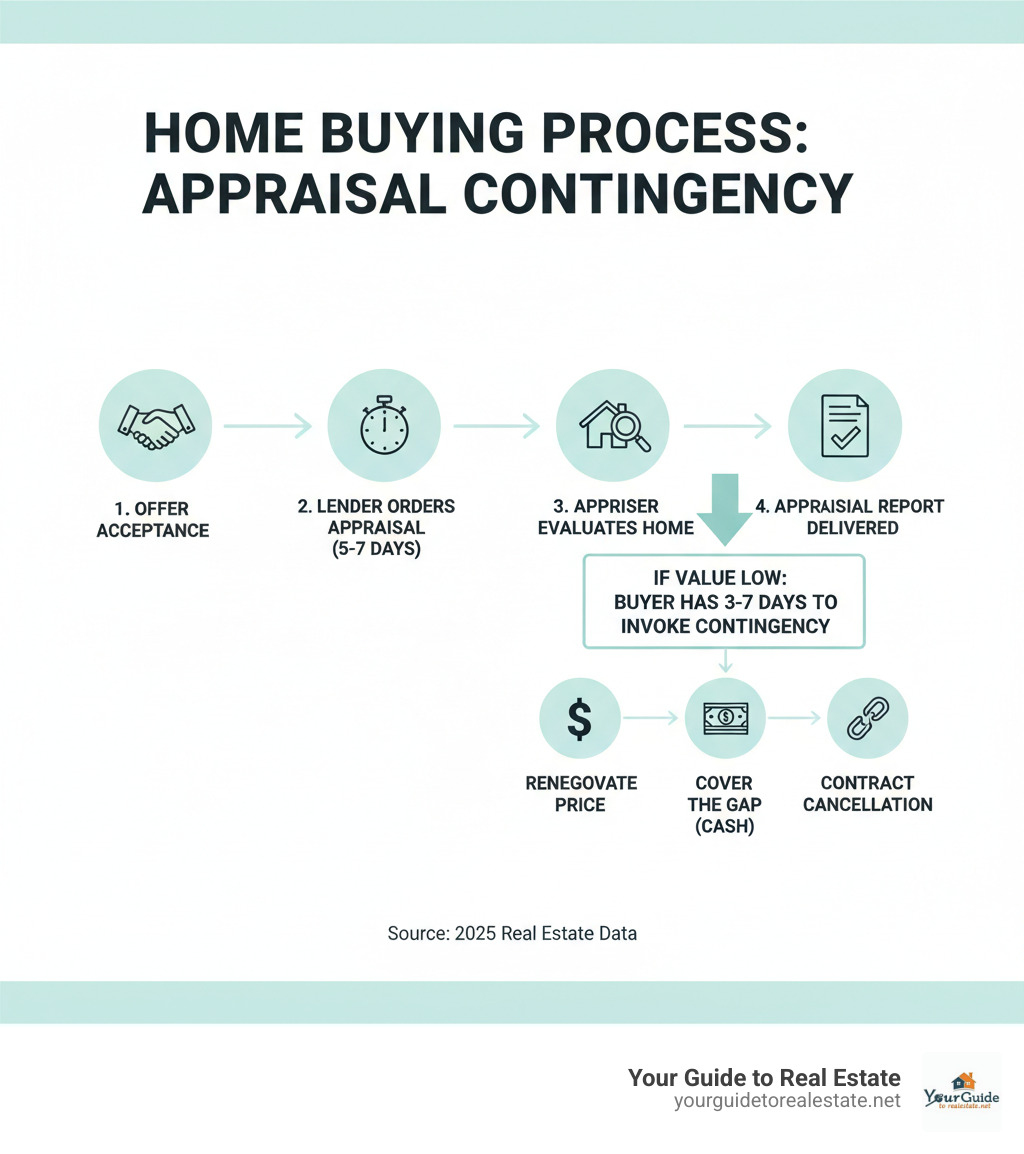
The Step-by-Step Process
Let’s walk through exactly how an appraisal contingency plays out in real life. It’s actually pretty straightforward once you understand the timeline.
Everything starts when you submit your offer. If you’re smart (and we hope you are), you’ll include an appraisal contingency clause in that offer. This makes the entire sale conditional on the appraisal results.
Once your offer gets accepted and you start the mortgage process, your lender orders the appraisal. They typically do this within a few days of receiving your loan application. You’ll pay for it—usually around $500 to $600—but it’s money well spent for the protection it provides.
Next comes the actual evaluation. A licensed appraiser who doesn’t know you or the seller will visit the property. They’re looking at everything: the condition of the house, its features, recent improvements, and the neighborhood. They’ll also research recent sales of similar homes nearby to determine what your house is really worth.
The appraiser then creates a detailed report and delivers it to your lender. You’ll usually get a copy too. This is the moment of truth—the report states the appraiser’s professional opinion of the home’s value.
Here’s where timing gets important. Your purchase agreement will specify a contingency period deadline—usually you have just a few days (typically 3 to 7 days) after receiving the appraisal to decide what to do if it comes in low.
Finally, you’re fulfilling the condition. If the appraisal meets or exceeds your offer price, congratulations! The contingency is satisfied, and you move forward with the purchase. If it comes in low, that’s when you’ll need to decide whether to negotiate, pay the difference, or walk away.

The Low Appraisal Scenario: Options and Negotiations
Picture this: you’ve been dreaming about your future home, imagining family dinners in the kitchen and cozy evenings by the fireplace. Then the phone rings, and your agent delivers news that makes your heart sink—the appraisal came back lower than your offer price.
Take a deep breath. This happens more than you might think. In 2024, about 8% of appraisals came in below the agreed-upon purchase price, creating what we call an “appraisal gap.” While it’s disappointing, it’s not the end of the world. In fact, if you included an appraisal contingency in your contract, you’re in a much better position than you might realize.
This gap between your offer and the appraised value puts you at a crossroads, but it also gives you negotiation power. The seller knows that most buyers will face this same appraisal challenge, which often makes them more willing to work with you.

What to Do When the Appraisal Comes in Low
When faced with a low appraisal, you have several paths forward. Each option comes with its own benefits and considerations, so let’s walk through them together.
Renegotiating the sale price is often your first and strongest move. Armed with the appraisal report, you can approach the seller with concrete evidence that the home’s market value is lower than your agreed price. Since your lender won’t finance more than the appraised amount, the seller faces a real dilemma—work with you or risk losing the sale entirely.
If you absolutely love the home and have extra cash available, you might choose to cover the appraisal gap yourself. Let’s say you offered $350,000 but the home appraised for $330,000. You’d need to bring an additional $20,000 to closing beyond what your lender will finance. While this keeps your dream home within reach, you’re paying more than the current appraised value.
Many successful negotiations end with the seller and buyer splitting the difference. This compromise often feels fair to both parties. Using our previous example, the seller might reduce the price by $10,000, and you’d cover the remaining $10,000 gap. It’s a middle ground that keeps the deal moving forward.
Sometimes the appraiser might have missed important details or used questionable comparable sales. In these cases, you can request a reconsideration of value. Your agent can help gather additional comparable sales data or documentation of recent improvements to present to the appraiser through your lender. While not always successful, it’s worth pursuing if you have strong evidence.
Finally, your appraisal contingency gives you the ultimate protection—the right to cancel the contract and get your earnest money back. If negotiations stall or you decide the home isn’t worth the asking price, you can walk away without financial penalty. This safety net is exactly why this contingency is so valuable.
Common Reasons for a Low Appraisal
Understanding why appraisals come in low helps you steer the situation more effectively. Rapidly rising home prices create one of the most common challenges. In hot markets, prices can jump dramatically in just a few months, but appraisers rely on sales from the past three to six months. If your area has seen a sudden price surge, those older comparable sales might not reflect today’s reality.
Poor property condition can significantly impact value. While appraisers aren’t home inspectors, they do notice obvious maintenance issues, outdated systems, or structural concerns. A home with peeling paint, worn carpets, or an aging roof will likely appraise for less than a well-maintained comparable property.
In some areas, finding recent comparable sales proves challenging. Rural properties, unique architectural styles, or homes in very specific neighborhoods might lack sufficient recent sales data. When appraisers can’t find truly comparable properties, they tend to be more conservative with their valuations.
Unique or unusual property features can work against you in an appraisal. That custom-built wine cellar or elaborate landscaping might have won your heart, but appraisers must consider what appeals to the broad market. Features that cater to very specific tastes often don’t add as much value as you might expect.
Sometimes an appraiser’s unfamiliarity with your specific area can lead to a conservative valuation. While all appraisers are licensed professionals, one who doesn’t regularly work in your micro-market might not fully appreciate recent trends or neighborhood nuances that affect value.
How the Contingency Impacts the Negotiation Process
Your appraisal contingency fundamentally changes the power dynamics when that low appraisal arrives. Suddenly, you’re not just a hopeful buyer—you’re someone with real leverage.
The contingency strengthens your negotiating position significantly. You have a legitimate, contractual reason to request a price reduction or walk away entirely. This isn’t about being difficult; it’s about protecting your financial interests based on professional valuation.
From the seller’s perspective, a low appraisal creates genuine risk. They know that losing your deal means starting over, and the next buyer will likely face the same appraisal challenge. Time is money in real estate, and most sellers prefer to negotiate rather than relist their property.
Market conditions heavily influence how these conversations unfold. In a competitive seller’s market, some sellers might initially resist price reductions, banking on finding a buyer willing to cover the gap. However, even in hot markets, a low appraisal signals a potential problem for any financed buyer.
In a buyer’s market, where you have more options, sellers typically become much more flexible. They understand that walking away puts you in a strong position to find another property, possibly at a better price.
The beauty of having an appraisal contingency is that it often leads to finding middle ground that works for everyone. Most negotiations result in some combination of price reduction and buyer contribution. Your agent can help guide these discussions, using the appraisal as an objective starting point for productive conversations.
The goal isn’t to “win” the negotiation—it’s to reach a fair agreement that reflects the home’s true market value while keeping your homeownership dreams on track.
Appraisal Contingency vs. Other Key Contract Clauses
When you’re buying a home, the appraisal contingency is just one piece of your protective armor. Think of your real estate contract as having multiple safety nets, each designed to catch you if something goes wrong. Understanding how these different clauses work together gives you the complete picture of your buyer protections.
Each contingency serves a specific purpose in your due diligence process. While they might seem similar on the surface, they protect you from very different risks. Let’s break down how the appraisal contingency compares to other essential contract clauses.
| Contingency Type | Purpose | Trigger | Outcome |
|---|---|---|---|
| Appraisal | Protects your financial interests by ensuring the property’s value aligns with your offer price and satisfies lender requirements | Licensed appraiser evaluates the home after your offer is accepted | If appraisal comes in low, you can renegotiate, cover the gap with cash, or walk away |
| Financing | Ensures you can secure the necessary mortgage loan to complete your purchase | You apply for financing and wait for lender approval within specified timeframe | If you can’t get approved for your loan, you can cancel without penalty |
| Inspection | Allows you to assess the physical condition and identify any major problems or safety issues | Professional inspector examines the property’s structure, systems, and overall condition | If significant defects are found, you can request repairs, negotiate credits, or terminate |
Financing Contingency
The financing contingency protects you if your mortgage falls through. Maybe your job situation changes, your credit score drops, or interest rates spike unexpectedly. This clause gives you an out if you simply can’t secure the loan you need.
Here’s the key difference: the appraisal contingency focuses on what the house is worth, while the financing contingency focuses on whether you can qualify for the loan. Even if a home appraises perfectly, you might still face financing challenges. That’s where this contingency saves you.
Most financing contingencies give you 30-45 days to get your loan approval. If your lender can’t deliver within those terms and conditions, you get your earnest money back and walk away clean.
Inspection Contingency
The inspection contingency is all about the home’s physical condition. Within 7-10 days of your accepted offer, you bring in a professional inspector to examine everything from the foundation to the roof.
This isn’t about property value like the appraisal contingency – it’s about functionality and safety. Your inspector might find issues that don’t affect the home’s market value but could cost you thousands later. Think outdated electrical systems, plumbing problems, or structural concerns.
If the inspection reveals major issues, you have several options: ask the seller to make repairs, negotiate a credit for the work, or cancel the contract if the problems are too severe. We always recommend keeping your inspection contingency – it’s too important to waive.
Other Contingencies to Know
Two other contingencies frequently appear in real estate contracts, and understanding them helps you steer the full landscape of buyer protections.
Title contingency ensures the seller actually owns the property free and clear. Sometimes liens, legal disputes, or ownership issues surface during the title search. This contingency protects you from inheriting someone else’s legal headaches. About 1 in every 100 transactions encounters title problems, so this protection matters more than you might think.
Home sale contingency makes your purchase dependent on selling your current home first. If you need those proceeds to buy your new place, this clause gives you breathing room. Sellers often prefer offers without this contingency since it creates uncertainty, but in a buyer’s market, it can be essential for your financial planning.
Understanding these contract conditions in real estate ensures you’re fully protected throughout your home-buying journey. Each contingency serves as a specialized safety net, and together they create a comprehensive framework for your success.
Waiving the Appraisal Contingency: Risks and Rewards
Picture this: you’ve been house hunting for months, losing out on offer after offer. Finally, you find “the one” – but there are already three other buyers interested. Your agent suggests waiving the appraisal contingency to make your offer more competitive. It’s a tempting strategy, and you wouldn’t be alone in considering it. In 2024, 22% of buyers took this leap to strengthen their offers.
But here’s the thing – while waiving this protection can sometimes help you win the house, it’s essentially removing your financial safety net. Think of it like skydiving without a backup parachute. The main chute usually works, but when it doesn’t, you’re in serious trouble.
Why Buyers Waive the Appraisal Contingency
Let’s be honest – nobody wants to waive their financial protection. Buyers do it because they feel they have to, and sometimes the math actually works in their favor.
In a hot seller’s market, you’re not just competing on price anymore. Sellers receive multiple offers, sometimes dozens, and they’re looking for the path of least resistance. An offer without an appraisal contingency screams “easy transaction” to a seller. It means no delays waiting for appraisal results, no renegotiation headaches, and no risk of the deal falling apart over value disputes.
Some buyers have done their homework so thoroughly that they’re confident in the property value. Maybe they’ve researched every comparable sale in the neighborhood for the past six months. Perhaps they know the area so well that they can practically appraise homes themselves. When you’re absolutely certain a home will appraise at your offer price, waiving the contingency feels less risky.
Then there are buyers with large cash reserves. If you’ve got an extra $50,000 sitting in your bank account and you’re prepared to use it, an appraisal gap becomes manageable rather than catastrophic. All-cash offers take this to the extreme – with 32% of buyers paying cash in 2024, these purchasers often skip appraisals entirely since no lender is involved.
Sometimes it comes down to pure emotion and determination. You’ve fallen in love with a house, you’ve lost previous bidding wars, and you’re willing to take on more risk to finally get your dream home. We get it – the heart wants what the heart wants.

The Financial Risks of Going Contingency-Free
Now for the sobering reality check. Waiving your appraisal contingency can cost you big time if things go wrong. Let’s walk through what could happen.
First, there’s your earnest money deposit – typically 1-3% of the purchase price. If the appraisal comes in low and you can’t or won’t cover the gap, you’re in breach of contract. That $10,000 or $15,000 deposit? Gone. The seller keeps it as compensation for their time and trouble.
But losing your earnest money might be the least of your problems. The real financial hit comes from covering a significant appraisal gap out-of-pocket. Remember our earlier example? You offer $500,000, it appraises for $450,000, and suddenly you need an extra $50,000 in cash at closing. That’s on top of your down payment, closing costs, and moving expenses. Many buyers simply don’t have that kind of money lying around.
Here’s where it gets really scary – if you don’t have the cash to cover the gap, you might face loan denial. Your lender approved you for a loan based on the purchase price, but they’ll only lend up to the appraised value. If you can’t make up the difference, your financing falls through, and you’re back to square one (minus your earnest money).
The most fundamental risk is simply overpaying for the home. Professional appraisers spend hours researching comparable sales and market conditions. When they say a house is worth $450,000 and you’re paying $500,000, you’re starting your homeownership journey $50,000 underwater. If property values stay flat or decline, it could take years to build back that equity.
The Seller’s Perspective on Contingent vs. Non-Contingent Offers
Understanding how sellers think about contingencies can help you make smarter decisions. From their perspective, fewer contingencies equal less stress and more certainty.
Sellers crave predictability. They want to know that once they accept an offer, they’re headed toward a successful closing. Every contingency represents a potential roadblock where the deal could fall apart. An appraisal contingency means waiting for the appraisal, potentially renegotiating the price, and always wondering if the buyer will walk away.
Faster closings also appeal to sellers, especially if they’re buying another home or need to relocate quickly. Without appraisal negotiations slowing things down, the transaction can move more smoothly toward closing.
When sellers see an offer without an appraisal contingency, they’re also evaluating the buyer’s financial strength. They figure you either have deep pockets to handle any problems or you’re so financially solid that problems are unlikely. Both scenarios make you look like a safer bet than other buyers.
The flip side is that sellers know contingent offers carry more risk of falling through. Even in a seller’s market, they don’t want to tie up their property for weeks only to have the deal collapse and start over with a new buyer.
While waiving an appraisal contingency can give you a competitive edge, we always encourage our clients to think carefully about their financial limits. Sometimes the best strategy is finding the right balance – maybe you agree to cover the first $10,000 of any appraisal gap but keep the contingency for larger differences. The key is making informed decisions that align with your financial comfort zone and risk tolerance.
Frequently Asked Questions about the Appraisal Contingency
When you’re navigating real estate, questions naturally arise. We’ve found that the appraisal contingency tends to spark quite a few inquiries from our clients. Let’s address the most common ones to help you feel more confident in your home-buying journey.
Who pays for the home appraisal?
As the buyer, you’ll be the one writing the check for the home appraisal. Think of it as one of your closing costs, sitting alongside other expenses like loan origination fees or title insurance. It’s your responsibility because, while the appraisal protects you from overpaying, it also serves as a crucial requirement from your lender.
The typical cost ranges from $500 to $600, though this can vary based on where you’re buying, how large or complex the property is, and which appraiser gets assigned to your case. Yes, it’s another expense in an already costly process, but consider it a small price to pay for the financial protection it provides on such a major purchase.
Since your lender requires this appraisal to ensure the property adequately secures their loan, there’s really no way around this cost if you’re financing your home purchase.
What is an appraisal gap clause?
An appraisal gap clause is like having a backup plan built right into your offer. It’s a contract addendum that essentially says, “If this home appraises for less than what I’m offering, I’ll cover some or all of that difference with my own cash.”
Here’s how it works in practice: Let’s say you fall in love with a house and offer $360,000. You include an appraisal gap clause stating you’ll cover up to $10,000 over the appraised value. If the appraisal comes back at $350,000, you’d pay that extra $10,000 out of your own pocket, and the sale proceeds at your original $360,000 offer price.
This clause has become increasingly popular in competitive markets because it makes your offer much more attractive to sellers. They know that even if the appraisal comes in low, the deal won’t fall apart. It’s a pre-negotiated solution that gives everyone peace of mind while still setting a clear limit on your potential out-of-pocket expense.
What happens if the appraisal comes in higher than the offer price?
This is the scenario every buyer dreams about! When the appraisal comes back higher than your offer price, you’ve essentially struck gold. You’re getting instant equity in your new home before you even move in.
Picture this: you offer $400,000 for a home, but the appraiser determines it’s actually worth $420,000. That means you’ve gained $20,000 in equity the moment you close. It’s like getting a $20,000 bonus for making a smart purchase decision.
The best part? The seller can’t suddenly decide they want more money just because the appraisal came in high. Your contract locks in that $400,000 price, and that’s exactly what you’ll pay. The appraisal contingency works as a one-way protection for buyers – it shields you from overpaying, but it doesn’t penalize you when you’ve found a great deal.
Your lender will be thrilled too, since their collateral (your new home) is worth more than the loan amount, which reduces their risk considerably.
Conclusion
Buying a home is one of life’s biggest adventures, and like any great journey, having the right map makes all the difference. The appraisal contingency isn’t just another piece of paperwork—it’s your financial compass, guiding you away from costly mistakes and toward smart investment decisions.
Throughout this guide, we’ve walked you through everything you need to know about this essential protection. You now understand how an appraisal contingency works as your safety net, what to do when an appraisal comes in low, and how it differs from other important contract clauses. We’ve also explored the high-stakes decision of waiving this protection and why sellers prefer certain types of offers.
The real estate market doesn’t have to feel overwhelming when you’re armed with knowledge. Every successful home purchase starts with understanding your protections and knowing when to use them. The appraisal contingency gives you power in negotiations and peace of mind in your purchase—two things that are absolutely priceless in today’s market.
At Your Guide to Real Estate, we believe that informed buyers are successful buyers. When you understand tools like the appraisal contingency, you’re not just buying a house—you’re making a confident investment in your future. The best real estate decisions come from knowledge, not pressure.
Ready to dive deeper into the numbers behind your next purchase? Deepen your understanding of property valuation and market analysis and find how professional appraisers determine what homes are really worth.