
Understanding What Real Estate Concessions Mean for Your Home Purchase
What are concessions in real estate? Simply put, seller concessions are financial contributions a seller makes to help a buyer cover closing costs or other fees associated with purchasing a home.
Here’s what you need to know:
- Definition: Also called seller assists, these are costs the seller agrees to pay on the buyer’s behalf at closing.
- Purpose: They reduce the amount of cash a buyer needs to bring to the closing table.
- Common uses: Covering appraisal fees, title insurance, loan origination fees, property taxes, or inspection fees.
- Limits exist: Lenders set maximum concession amounts based on the loan type, typically 3-9% of the purchase price.
- Not a discount: Concessions are rolled into the loan, differing from a direct price reduction.
According to the National Association of Realtors‘ 2023 Profile of Home Buyers and Sellers, 20 percent of sellers offered incentives to attract buyers, making concessions a common negotiation tool.
Whether you’re a buyer trying to preserve savings or a seller looking to close a deal faster, understanding concessions provides a strategic advantage. They are a key factor that can influence a deal based on market conditions, loan types, and financial situations. This guide will break down how concessions work, when they make sense, and the rules that govern them.
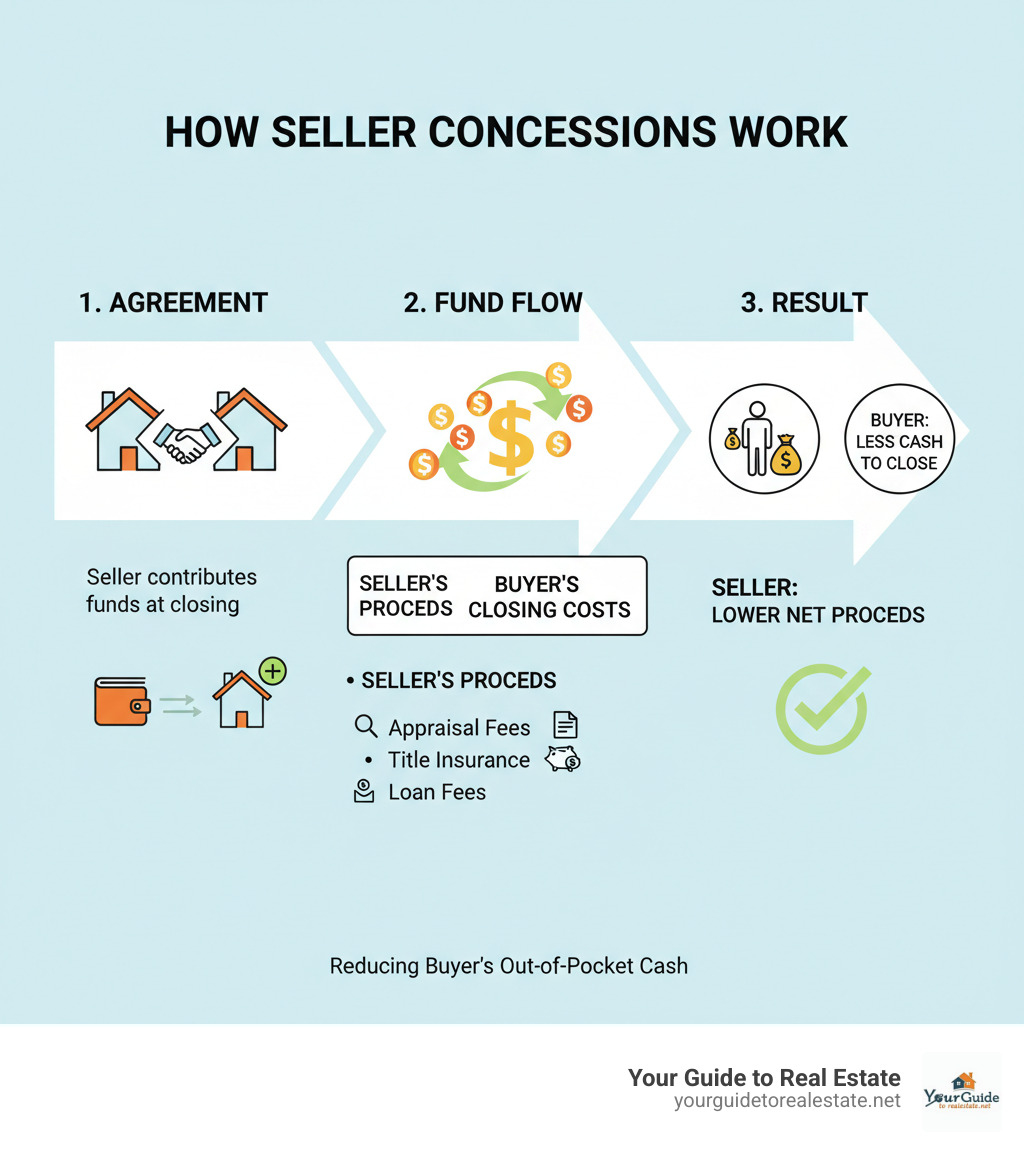
What are concessions terms explained:
So, What Are Concessions in a Real Estate Deal?
In a real estate transaction, what are concessions? At their core, they are financial contributions from the seller to the buyer to help with closing costs. Also known as a seller assist or closing cost credit, this incentive makes it easier for a buyer to complete the purchase. For general background on the concept of concessions in contracts, see Concession (contract)).
This isn’t cash handed to the buyer. Instead, it’s a credit on the closing documents that reduces the amount of cash needed at signing. The money comes from the seller’s proceeds and is applied directly to the buyer’s fees. These contributions are transparent, documented in the purchase agreement, and regulated by lenders. For more context, see our guide on Understanding Title Insurance, a common cost covered by concessions.
Common Costs Covered by Seller Concessions
Seller concessions are valuable because they cover closing costs, which typically range from 2% to 5% of the purchase price. On a $300,000 home, that’s an extra $6,000 to $15,000 beyond the down payment.
Concessions can cover a wide range of these expenses, including:
- Appraisal fees: The cost to determine the home’s value.
- Loan origination fees: Lender charges for processing the loan.
- Title insurance: Protects against future ownership disputes.
- Property taxes: Upfront payments required at closing.
- Attorney fees: For legal representation at closing.
- Inspection fees: For the professional home inspection.
- Mortgage discount points: Upfront payment to lower your interest rate.
Concessions can also be applied to a home warranty, prepaid homeowners insurance, or initial HOA fees. Their flexibility helps buyers who have saved for a down payment but need assistance with these additional closing expenses.
Seller Concessions vs. a Price Reduction
Should you ask for concessions or a lower price? Both save you money, but they affect your finances differently.
Consider a home listed at $300,000 where you want to save $9,000.
-
Price Reduction: You negotiate the price down to $291,000. This lowers your loan amount, down payment, and monthly payment. You’ll pay less in long-term interest because you borrowed less. This is ideal if you have sufficient cash for closing costs.
-
Seller Concession: You offer the full $300,000 but ask for a $9,000 concession. The purchase price remains $300,000, so your loan is based on that higher amount. Your monthly payment will be slightly higher, and you’ll pay more interest over time. However, you need significantly less cash at closing because the seller is covering those closing funds.
The choice depends on your upfront cash needs versus long-term costs. If you’re short on cash for closing, concessions are a great tool. If you have ample cash reserves, a price reduction may be more financially beneficial over the life of the loan. Your buyer’s financial situation is the deciding factor. For more on how this affects your loan, read our guide: Understanding Mortgages: A Beginner’s Guide to Home Loans.
What are concessions for you depends on your financial picture. They are a strategic tool, and knowing when to use them provides real negotiating power.
Why and When Sellers Offer Concessions
Sellers offer concessions for strategic reasons, not out of generosity. Understanding what are concessions from a seller’s viewpoint reveals they are a tool to make a deal happen, especially when the alternative is a home that sits on the market.
A seller’s motivation often stems from market conditions or personal circumstances. Here are common reasons for offering concessions:
- A Buyer’s Market: When there are more homes for sale than buyers, sellers face stiff competition. Offering to cover closing costs can make a property stand out.
- A Home Sitting on the Market: A property that has been sitting on the market too long can develop a negative reputation. Concessions can attract buyers without the seller having to slash the asking price.
- An Overpriced Home: If a home was overpriced from the start and isn’t getting offers, concessions are a way to make the deal more attractive without an official price reduction.
- Home Inspection Issues: If an inspection reveals problems, a seller might offer a concession for repairs instead of managing contractors themselves. This is often faster and easier for a seller who is trying to move. (See common Things That Fail a Home Inspection).
- Need for a Quick Sale: A seller who has been transferred for work or is facing financial pressure may offer concessions to secure a quick sale and avoid carrying costs.
- A Low Appraisal: If a home appraises for less than the purchase price, a seller might offer a concession to help bridge the financial gap and save the deal.
Reading the Market: Buyer’s vs. Seller’s Market
Your power to negotiate concessions depends heavily on market conditions.
In a buyer’s market, high housing inventory and low demand give buyers negotiation leverage. Sellers are more willing to offer incentives to compete for a limited pool of buyers.
In a seller’s market, high buyer demand and low inventory mean sellers have the upper hand. They can often choose from multiple offers, making a request for concessions less likely to be accepted. A home’s property’s time on market is a key indicator: homes selling in days suggest a seller’s market, while homes sitting for months indicate a buyer’s market. A Competitive Market Analysis Real Estate report provides data on local conditions.
Non-Monetary Concessions: More Than Just Cash
Not all concessions are about money. Some of the most valuable incentives are non-monetary.
- Personal Property: A seller might agree to leave behind furniture, high-end appliances, or custom window treatments. This can save a buyer thousands of dollars and the hassle of shopping.
- Repair Credits: Instead of making repairs before closing, a seller can offer a credit. This gives the buyer control over home improvements and contractor choice.
- Flexible Closing Date: A seller who can accommodate the buyer’s timeline—whether it’s closing quickly or extending the date—is offering a valuable, non-financial concession.
The Rules of the Game: Seller Concession Limits
Sellers can’t offer an unlimited amount in concessions. Lenders set strict rules on what are concessions and how much can be contributed.
Lenders impose these limits to ensure the loan-to-value (LTV) ratio reflects the home’s actual market value. Excessive concessions can signal that the sales price has been artificially inflated to cover the credits. If a home is listed for $300,000 with a $20,000 concession but is only worth $280,000, it creates a risk for the lender. If the home doesn’t appraise for the inflated price, the deal can collapse. These safeguards are a standard part of Real Estate Financing that protects all parties.
Concession Limits by Loan Type
The maximum seller contribution depends on the buyer’s loan type. Each program has its own rules.
-
Conventional Loans: Limits are tied to the down payment. With less than 10% down, the limit is 3% of the purchase price. For 10% to 25% down, it’s 6%. With 25% or more down, the limit is 9%.
-
FHA Loans: Backed by the Federal Housing Administration, these loans allow seller concessions up to 6% of the sales price, regardless of the down payment. This is a major benefit for buyers with limited funds. Our guide on FHA Loan Requirements has more details.
-
VA Loans: Available to eligible service members and veterans, these loans cap seller concessions at 4% of the home’s value. However, sellers can also pay for certain other customary closing costs beyond this limit.
-
USDA Loans: For buyers in eligible rural areas, these loans allow seller concessions up to 6% of the purchase price.
Here is a quick reference table:
| Loan Type | Down Payment Percentage | Maximum Seller Concession |
|---|---|---|
| Conventional | Less than 10% | Up to 3% |
| 10% to 25% | Up to 6% | |
| 25% or more | Up to 9% | |
| FHA Loans | Any | Up to 6% |
| VA Loans | Any | Up to 4% |
| USDA Loans | Any | Up to 6% |
Understanding these limits is crucial. A request for concessions beyond what the loan allows will be rejected by the lender, potentially derailing the transaction. Your agent and lender will help you steer these rules.
Weighing the Options: Pros and Cons for Buyers and Sellers
Now that you know what are concessions, are they a good idea for your situation? The answer depends on your specific goals and financial picture. Concessions are a tool that can be highly effective in some scenarios but less so in others. A knowledgeable agent can help you decide, as discussed in our How to Choose the Right Real Estate Agent: A Complete Buyer’s Guide.
Understanding the Pros and Cons: What are concessions for buyers?
For buyers, the benefits and drawbacks are clear.
Pros for Buyers:
- Less Cash at Closing: The primary advantage is reducing the out-of-pocket cash needed for closing costs. This allows you to preserve your emergency fund or save for other moving-related expenses.
- Increased Affordability: Concessions can make a home more accessible by lowering the immediate financial barrier to entry.
- Funds for Repairs: A concession can provide the money needed to handle minor repairs or updates after you move in.
Cons for Buyers:
- Higher Loan Amount: Since the purchase price isn’t reduced, you’re financing a larger amount. This results in a higher monthly mortgage payment.
- More Interest Paid Over Time: A larger loan means you’ll pay more in total interest over the life of the mortgage.
- Appraisal Risk: If the price is inflated to cover the concession, the home may not appraise at that value. This can create a funding gap or jeopardize the deal, and it means you start with less equity.
The Seller’s Side: What are concessions from their perspective?
Sellers must also weigh the strategic advantages against the financial costs.
Pros for Sellers:
- Attract More Buyers: In a competitive market, offering to help with closing costs can make your home stand out and lead to a faster sale.
- Maintain List Price: Some sellers prefer offering a concession to dropping the price, as it can be psychologically easier and avoids signaling desperation to the market.
- Simplify Repairs: Offering a credit for inspection-related issues is often easier and faster than managing the repairs yourself before closing.
Cons for Sellers:
- Lower Net Proceeds: Every dollar given as a concession comes directly from your profit from the sale.
- Negotiation Complexity: Juggling price and concessions can add another layer to negotiations, potentially complicating the deal.
- Appraisal Risk: Just as for the buyer, if an inflated price doesn’t appraise, the seller may be forced to lower the price anyway, negating the initial strategy.
Frequently Asked Questions about Seller Concessions
Understanding what are concessions often leads to more questions. Here are answers to the most common ones we hear from buyers and sellers.
How do I ask for seller concessions?
Asking for concessions is a formal part of your purchase offer, best handled by your real estate agent. The process involves:
- Market Research: Your agent will analyze comparable sales and market conditions to determine if a concession request is reasonable.
- Formal Offer: The request is written directly into the purchase agreement, specifying the exact dollar amount or percentage you’re asking for (e.g., \”$6,000 in seller concessions toward buyer’s closing costs\”).
- Justification: Sometimes, it helps to justify the request, such as citing issues from the home inspection (see Things That Fail a Home Inspection) or the home’s time on the market.
- Negotiation: Be prepared for the seller to counter-offer. This back-and-forth is a normal part of the process. Our First-Time Homebuyer Tips can help you prepare.
Your agent is your advocate and will guide you on the best strategy for your situation.
Can concessions be used for the down payment?
No, seller concessions cannot be used for your down payment. Lenders have strict rules requiring the down payment to come from the buyer’s own verified funds (savings, documented gifts, etc.). This ensures you have a genuine financial stake in the property.
Concessions are specifically for closing costs and prepaid expenses like appraisal fees, title insurance, and property taxes. If you need help with a down payment, look into separate down payment assistance programs, which your lender can help you find.
Do concessions affect the home’s appraisal?
Yes, concessions can significantly affect the appraisal. If you negotiate a purchase price of $290,000 with a $10,000 concession on a home that’s only worth $280,000, you may face an appraisal gap.
An appraiser determines the home’s market value based on comparable sales, not the contract price. If the appraisal comes in low, the lender will only finance the loan based on the lower appraised value. This creates a shortfall that must be covered by the buyer, negotiated with the seller, or the deal may fall apart. An Appraisal Contingency in your offer provides protection in this scenario.
Concessions work best when the final purchase price still reflects the home’s true market value. An experienced agent can help you structure an offer that is both competitive and realistic.
Conclusion
Understanding what are concessions empowers you to make smarter real estate decisions. They are a versatile strategic tool that can reshape the financial landscape of a home purchase for both buyers and sellers.
For buyers, concessions lower upfront cash needs, making homeownership more accessible. However, it’s crucial to remember the trade-off of a potentially higher loan balance and the risk of appraisal issues.
For sellers, offering concessions can attract more buyers, lead to a faster sale, and help maintain a home’s list price, especially in a competitive market. This strategy comes at the cost of reduced net proceeds but can be what’s needed to close a deal.
The rules and limits set by lenders exist to protect all parties and maintain market integrity. This is why working with experienced real estate professionals is so important. They ensure your concessions are structured correctly and work in your favor.
At Your Guide to Real Estate, our mission is to provide expert insights and stress-free guidance. By understanding the nuances of concessions, you gain a strategic advantage in one of life’s biggest financial transactions.
Ready to make an informed move? Get a professional market analysis for your property to understand its true value and see how concessions might play a role in your next transaction. We’re here to guide you every step of the way.