Why a Free Garage Sale Pricing List Makes All the Difference
A free garage sale pricing list can transform your cluttered home into cash while making your move or decluttering project much easier. Whether you’re preparing to sell your house or simply clearing out years of accumulated items, knowing how to price your belongings correctly is the difference between a successful sale and boxes of unsold items.
Quick Garage Sale Pricing Guide:
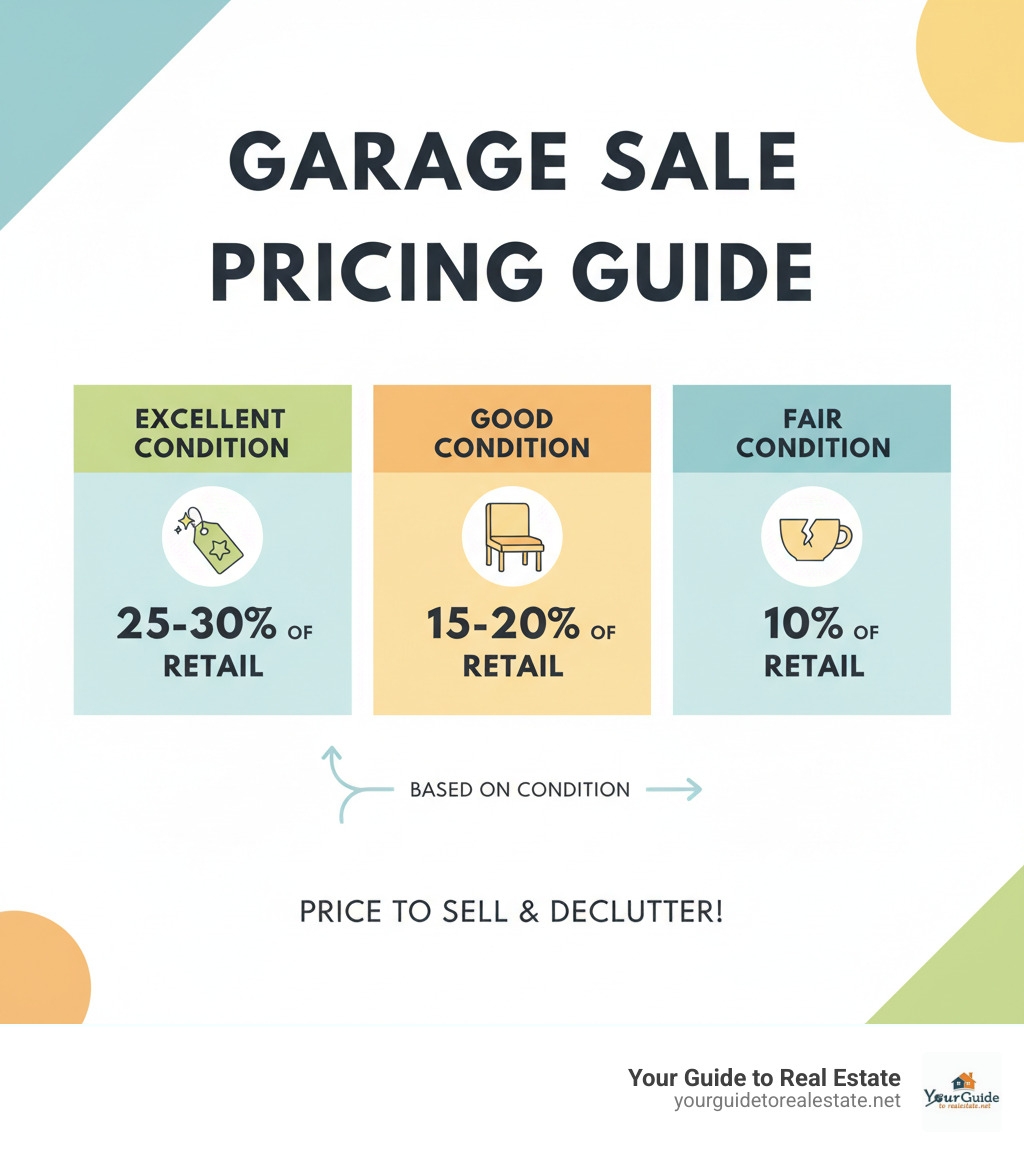
- Excellent condition items: 25-30% of original retail price
- Good condition items: 15-20% of original retail price
- Fair condition items: 10% of original retail price
- Adult clothing: $3-$5 for most items, up to $10 for designer pieces
- Children’s clothing: $1-$3 per item or bundle deals
- Books: $0.50-$1 for paperbacks, $1-$3 for hardcovers
- Small appliances: $5-$20 depending on condition
- Furniture: $10-$30 for small pieces, $40-$100 for larger items
The key is understanding what garage sale shoppers expect. They’re looking for bargains – not retail prices. As one garage sale expert notes, “The goal of a garage sale is to declutter and make some extra cash, so be willing to let go of items for less than their perceived value.”
There are an estimated 165,000 garage sales held every week across the United States. The most successful ones follow proven pricing strategies that move items quickly while still generating decent returns.
The golden rule? Price most items at 10-30% of their original retail value, adjusting based on condition and demand. This approach helps you clear out your home efficiently while putting money in your pocket for your next real estate venture.
Basic free garage sale pricing list terms:
The Golden Rules of Garage Sale Pricing
Pricing garage sale items is like finding the sweet spot between getting a fair return and actually moving your stuff out the door. When you’re decluttering for a move or just clearing out years of accumulated treasures, a solid free garage sale pricing list becomes your roadmap to success.
Here’s the reality: garage sale shoppers are bargain hunters. They expect prices that make them feel like they’ve finded hidden gems, not items priced like they’re still sitting on store shelves. This means we need to shift our mindset from “what did I pay for this?” to “what will someone happily pay to take this home today?”
The magic formula that most successful garage sale hosts swear by is the 10-30% rule. This means pricing your items between 10% to 30% of their original retail value, depending on condition and demand. Think of it as your pricing compass – it keeps you oriented toward realistic expectations while still putting money in your pocket.
For those pricier items over $100, here’s a clever trick: price them slightly higher than your rock-bottom price. This gives you wiggle room when buyers inevitably ask “Will you take $40 for this?” You’ll feel good about the negotiation, and they’ll feel like they scored a deal. Win-win!
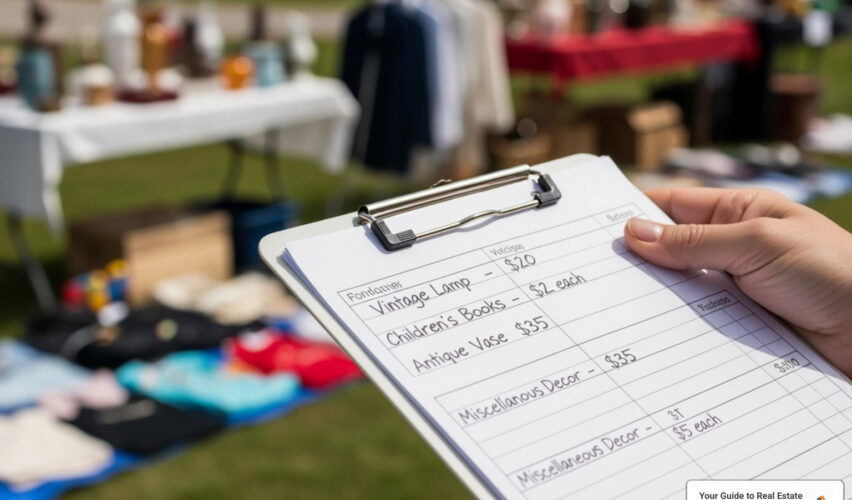
Highlighting the original retail price next to your sale price can work wonders too. When someone sees “Originally $80, now $20,” that savings jumps out and makes your price feel like a steal.
The Handy Garage Sale Pricing Guide from Sonoma Family Life Magazine offers additional insights that many seasoned garage sale hosts have found invaluable for fine-tuning their pricing strategy.
How Item Condition Affects Value
The condition of your items tells the whole pricing story. A well-loved book with coffee stains isn’t going to command the same price as one that looks like it just left the bookstore. Let’s break down how condition translates to dollars.
Excellent or like-new condition items are your garage sale superstars. These barely-used treasures that might still have tags or look fresh out of the box can fetch 25-30% of their original retail price. If that original price tag is still attached, you’ve got pricing gold – buyers see that tag and immediately understand the value they’re getting.
Good condition items show they’ve been enjoyed but still have plenty of life left. Maybe there’s a tiny scuff on those shoes or the book has been read once. These reliable finds typically sell well at 15-20% of their original retail price. They’re the bread and butter of most garage sales.
Fair condition pieces have stories to tell – visible wear, some fading, or minor damage that doesn’t affect function. These items still deserve a chance at a new home, usually priced around 10% of their original retail value. Sometimes the imperfections add character that buyers actually appreciate.
Items with heavy wear, stains, or damage need special consideration. Price them at just a few quarters, or better yet, create a “free box” that draws people in and often leads to other purchases. Sometimes the best strategy is simply getting these items to someone who can use them.
Cleanliness makes all the difference. A quick wipe-down or wash can bump an item up a condition category and justify a higher price. Buyers are much more likely to purchase something that looks cared for.
How to Determine the ‘Going Rate’ for Your Items
Setting the right price means becoming a bit of a detective in your local market. While our free garage sale pricing list gives you the framework, local demand and pricing can vary quite a bit from neighborhood to neighborhood.
Online marketplaces are your best research tool. eBay’s completed sales (not just current listings) show what people actually paid for similar items. Facebook Marketplace and Craigslist reveal what’s selling in your local area right now. When you can’t remember what you originally paid for something, these sites help you establish a baseline for current used values.
Local thrift stores offer another pricing reality check. Take a quick walk through your neighborhood Goodwill or consignment shop to see how they price similar categories. Their prices often represent the upper end of what used items can command in a more formal retail setting.
Neighborhood garage sales provide the most direct comparison. If there are other sales happening nearby, take a friendly stroll and observe. What’s moving quickly? What items are sitting untouched? This real-time market research can be incredibly valuable for adjusting your own pricing strategy.
The Salvation Army’s donation value guide offers another useful reference point. While these are donation values rather than sale prices, they provide a baseline for what various items are considered worth, which can inform your minimum pricing decisions.
When you’re unsure about an item’s value, price it slightly above what your research suggests. This builds in that crucial negotiation buffer that garage sale shoppers expect and enjoy.
Your Ultimate Free Garage Sale Pricing List by Category
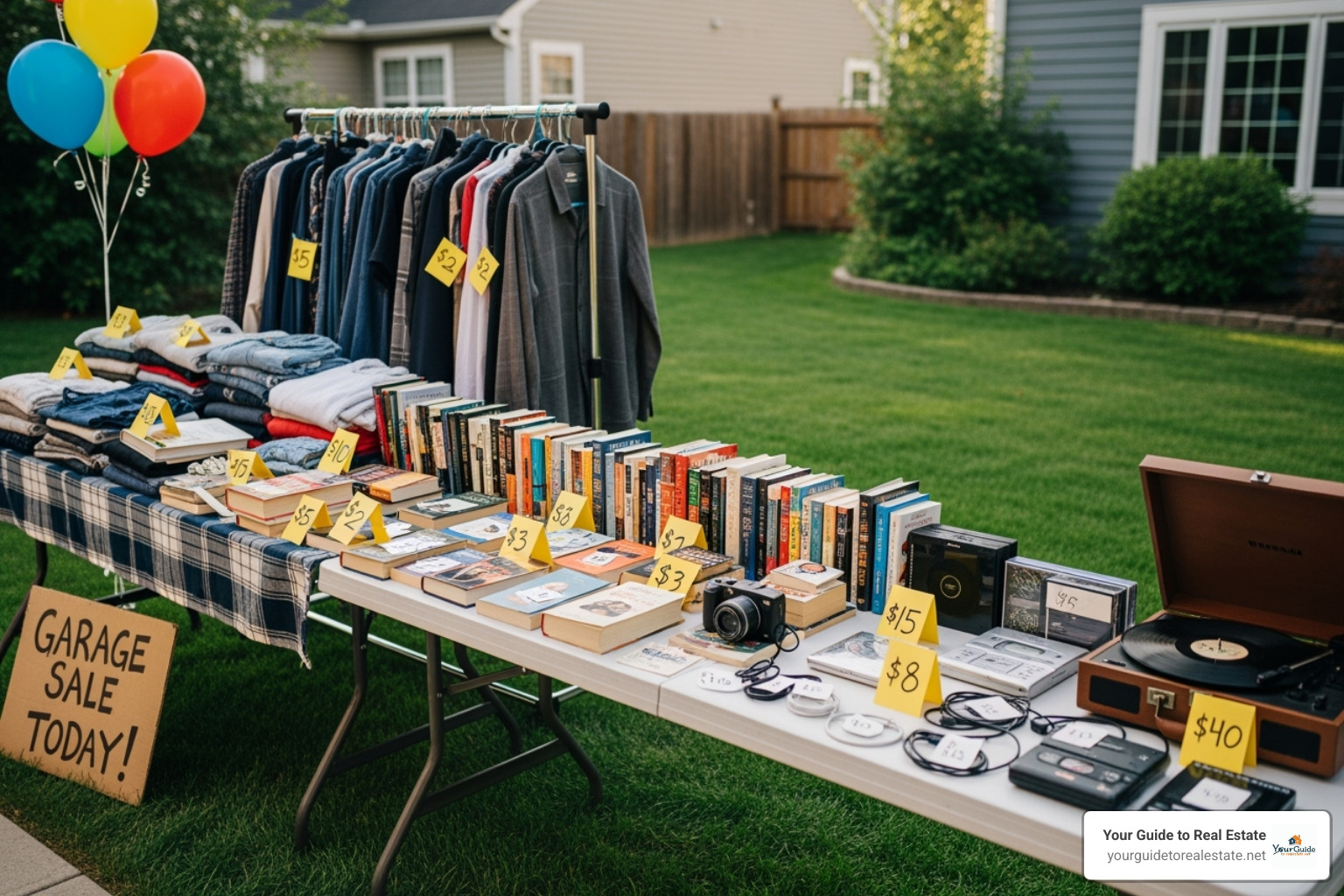
Here’s where the rubber meets the road – your comprehensive free garage sale pricing list broken down by category. Think of this as your pricing cheat sheet that’ll help you move items quickly while still putting decent money in your pocket. These are starting points that you can adjust based on your local market and the item’s exact condition.
Pricing Clothing, Shoes, and Accessories
Clothing is often the bread and butter of garage sales. The key is pricing to move while recognizing that brand names and condition make a real difference.
For adult clothing, you’ll want to price most basic items between $1 to $5. Plain t-shirts can go as low as $0.25 to $0.50, while brand-name polos might fetch $5. Jeans are popular sellers – price plain blue jeans around $1 and brand-name denim at $3. Dresses and skirts typically sell well at $5 to $15, depending on style and condition.
Winter gear deserves special attention since it’s often more expensive originally. Fleeces, jackets, and coats can be priced at $4 to $15 for good condition items. Sweatshirts are usually quick sellers at $1 to $2.50.
Children’s clothing moves fast when priced right. Most items should be $1 to $3 per piece, but consider creating bundles like “5 items for $10” to move inventory quickly. Baby clothes are popular with new parents – price individual pieces at $1 to $3 or create complete outfits for $4 to $5. High-end brands like Baby Gap or Gymboree with tags can go up to $5 or more.
Shoes are straightforward to price. Adult dress shoes typically sell for $5, while tennis shoes go for around $3. Children’s shoes should be priced at $1 to $3, with baby shoes at the lower end and older kids’ shoes and boots at $3 to $5.
For accessories, keep it simple. Hats, scarves, and belts work well at $1 to $5. Hair accessories are quick sellers at $0.50 to $1 each. Costume jewelry can range from $0.25 to $10 depending on the piece. Purses vary widely – generic bags might sell for $10, while designer or brand-name purses can go up to $70.
Pricing Furniture from Small to Large
Furniture pricing requires more thought since these are bigger-ticket items. The condition and brand matter significantly here.
Small furniture pieces are easier to sell and transport. Office chairs typically go for around $5, while end tables can range from $10 to $40 depending on quality. Coffee tables usually sell between $10 to $50, and small bookshelves can be priced $15 to $50.
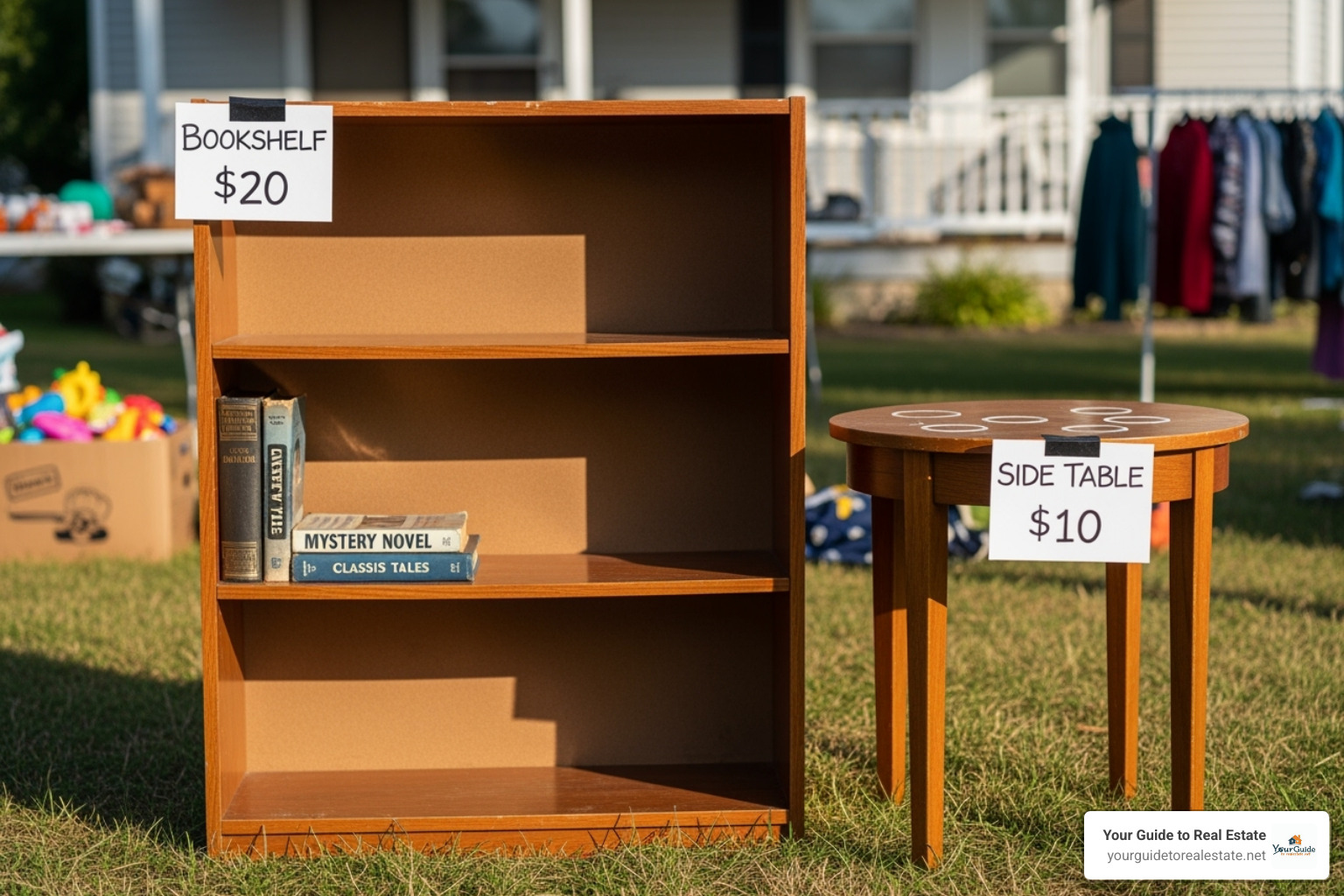
Larger furniture requires more strategic pricing. Couches can range dramatically from $35 to $200 based on condition and style. Love seats typically sell for $15 to $125. Dressers are popular items that can fetch $25 to $75, while desks usually go for $15 to $50.
Dining furniture sells well to young families and college students. A simple kitchen table might sell for $25, while a complete table and chair set can bring $50 to $150.
Bedroom furniture has steady demand. Twin beds typically sell for $25 to $50, while full, queen, or king beds can go for $50 to $75. Headboards are usually priced around $5.
IKEA furniture has its own pricing category since buyers know the original costs. Price these items at 30% to 50% of the original retail price.
For valuable antique or high-quality pieces, do your homework first. Check out this helpful resource: How To Determine If Your Used Furniture Is Worth Selling
Pricing Electronics and Appliances
Electronics can be goldmines or headaches, depending on their age and functionality. Always make sure items work before pricing them, and have power cords available for testing.
Small kitchen appliances are consistent sellers. Toasters typically go for around $7, while coffee makers can fetch $12. George Foreman-style grills usually sell for $10, and microwaves can be priced at $10 to $15.
Entertainment electronics vary widely by age. Older TVs might only bring $10 to $30, while newer models can go up to $100. DVD players typically sell for $10 to $20, while Blu-ray players can fetch $25 to $40. VHS players, despite their age, still find buyers at $10 to $15.
Computers need careful pricing. Desktop systems can range from $50 to $150 depending on age and included software. Laptops have a broader range of $20 to $150. Printers are usually priced around $10.
Gaming consoles have dedicated buyers. Older systems like PS1 might only bring $5, while PS2 systems can fetch $25. Nintendo classics like NES, SNES, or N64 typically sell for $20 to $35. Original Xbox systems usually go for around $35.
Small electronics round out this category. Extension cords and chargers are easy sellers at $0.50 to $2. Computer speakers typically go for $10, while landline phones sell for around $5.
Pricing Media: Books, DVDs, and Games
Media items have lost significant value due to digital alternatives, but they still sell well when priced attractively. Bundle deals work particularly well in this category.
Books remain popular garage sale items. Paperback novels should be priced at $0.50 to $1, while hardcover books can go for $1 to $3. Non-fiction books might fetch $1 to $5 depending on the topic. Children’s books are quick sellers at $0.25 to $2, and even textbooks can find buyers at $0.50 to $1.
Movies still have an audience despite streaming services. DVDs typically sell for $1 to $4, with newer releases potentially reaching $4 to $6. Blu-rays can be priced at $3 to $5. VHS tapes are nostalgic items that sell for $0.25 to $0.75, though rare or collectible titles might warrant higher prices.
Music has a dedicated following. CDs usually sell for $1 to $3 each, and bundle deals like “10 for $5” work well. Cassette tapes are mostly priced at $0.10 to $0.25, unless they’re collectible items that might fetch $1 to $5.
Video games depend heavily on the system and age. Individual games typically range from $1 to $10. Older console games might only bring $0.50 to $2, while Xbox games can fetch $3 to $5. Newer games that originally sold for $50 or more can be priced at around $15.
Board games and puzzles are family favorites. Complete board games typically sell for $1 to $5, while jigsaw puzzles usually go for $1 to $2.
Pricing Kitchenware, Tools, and Home Decor
These diverse categories require flexibility in pricing since quality and brand recognition vary significantly.
Kitchenware basics sell steadily. Small utensils like spatulas and colanders typically go for $1 to $3. Individual pots and pans can be priced $3 to $10, while complete sets might fetch $5 to $25. Drinking glasses usually sell for $0.10 to $1.50 each, and plates go for $1 to $3. Complete silverware sets can bring $10 to $20.
Tools have dedicated buyers who know quality. Hand tools like drills, wrenches, and screwdrivers typically sell for $2 each. Power tools require more research but can range from $10 to $100 depending on the tool and condition. Lawn equipment like push mowers can fetch $30 to $75, while riding mowers might bring $200 to $500. Tool boxes themselves can sell for $20 to $75.
Home decor items help people personalize their spaces affordably. Picture frames range from $0.50 to $15 depending on size and quality. Lamps and lighting fixtures typically sell for $5 to $20. Artwork and wall hangings can go from $5 to $30 or more for unique pieces. Small decorative items like vases usually sell for $1 to $10. Throw pillows are popular at $1 to $3, and rugs can range from $2 to $25.
Seasonal items like Christmas decorations have their own market. Ornaments, lights, and wreaths typically sell for $0.25 to $10 depending on the item and condition.
Smart Strategies to Maximize Sales
Your free garage sale pricing list is just the foundation – the real magic happens when you use smart strategies that turn browsers into buyers and maximize every dollar from your sale.

The key is thinking like both a seller and a shopper. What makes you stop at one garage sale versus driving right past another? It’s often the clever bundling, clear price displays, and that irresistible “everything must go” energy that draws people in and keeps them buying.
How to Price Collectibles and Antiques
Collectibles and antiques are where your free garage sale pricing list gets interesting – and where a little extra homework can pay off big time. These aren’t your everyday household items, so they need special attention.
Start by researching their actual value online. eBay’s “sold listings” feature is your best friend here – it shows what people actually paid, not just what sellers hoped to get. Check Etsy for vintage items and specialized collector websites for anything that looks unique or old.
For truly special pieces, consider getting a professional appraisal. Yes, it costs money upfront, but imagine finding that dusty vase is worth $500 when you were about to price it at $5! We’ve seen people accidentally sell valuable items for pennies because they didn’t know what they had.
Once you know the market value, price your collectibles at 50-70% of that amount for garage sale purposes. Even collectors shopping at garage sales expect a bargain. If you’re not in a rush to sell, consider online auctions or antique shops for higher-value pieces.
For deeper insights into whether your collectibles are worth the effort, check out: Should You Turn Your Collectibles Into Cash?
How to Use This Free Garage Sale Pricing List for Bundling
Bundling is like the garage sale version of “buy one, get one free” – it makes shoppers feel smart while helping you move inventory faster. The trick is grouping items that naturally belong together or appeal to the same buyer.
Baby clothes bundles work beautifully – parents know babies grow fast, so they’re happy to buy multiple onesies at once. Try “5 for $5” deals on children’s clothing or “fill a bag for $10” on adult clothes that aren’t moving individually.
Books and media are perfect for bulk pricing. Once someone buys one DVD, they’re often interested in more. Create clear signs like “Any 3 DVDs for $8” or “All paperback books $0.50 each or 10 for $4.”
Kitchen items bundle well too. Group measuring cups with measuring spoons, or create a “starter kitchen” bundle with basic utensils for college students or new homeowners.
The psychology is simple: people love feeling like they’re getting a deal, and you love clearing out more items per transaction. It’s a win-win that turns your pricing list into a sales strategy.
When and How to Reduce Prices During the Sale
Pricing flexibility is your secret weapon for a successful garage sale. Start with your planned prices, but be ready to adjust as the day unfolds.
The final hours are prime time for markdowns. About two hours before closing, start announcing “half-price on everything” or “make an offer” deals. Shoppers who’ve been circling back to think about items will suddenly become buyers.
If certain items aren’t attracting attention during peak morning hours, quietly lower their prices. That $15 lamp that nobody’s touched? Try $8 and see what happens. You can always start high and come down, but raising prices mid-sale feels awkward for everyone.
End-of-sale discounts create urgency and excitement. Put up signs announcing “Everything must go – 75% off original prices!” The bargain hunters will appear like magic, and you’ll clear inventory that might otherwise end up back in your closet.
Remember your ultimate goal: if you’re moving or decluttering, getting rid of items is often more valuable than squeezing out every possible dollar. Sometimes the best price is the one that gets things off your hands and into someone else’s home.
Common Pricing Mistakes to Avoid
Even with a comprehensive free garage sale pricing list in hand, it’s surprisingly easy to make mistakes that can tank your sale. After helping countless homeowners successfully declutter before their big moves, we’ve seen these same pricing pitfalls over and over again. Let’s talk about the most common ones so you can avoid them entirely.
Why You Shouldn’t Price Based on Sentimental Value
Here’s the hard truth: your buyers don’t care that you paid $200 for that beautiful lamp or that the rocking chair belonged to your grandmother. It sounds harsh, but understanding this mindset shift is crucial for a successful garage sale.
From the buyer’s perspective, they’re hunting for functional items at rock-bottom prices. They see that $1,500 dining room set and think about what it’s worth today in its current condition – not what you invested in it five years ago. They’re not buying memories; they’re buying practical solutions for their own homes.
Market reality dictates that used goods are valued based on current demand and condition, period. That designer purse gathering dust in your closet? Its garage sale value has nothing to do with the boutique price you paid. The market for secondhand items operates on completely different principles than retail.
When you price based on emotional attachment, you almost always overprice everything. We’ve watched sellers sit with tables full of unsold items simply because they couldn’t let go of what they originally paid. If your goal is decluttering – especially when you’re preparing to move – you need to emotionally detach from your belongings and price them to actually sell.
Every item that doesn’t sell is something you’ll need to deal with later. Sometimes accepting a lower price and seeing your things go to someone who will use them is more valuable than holding onto unrealistic expectations.
The Pros and Cons of a ‘Fill a Bag for $X’ Strategy
The “fill a bag” approach can be absolutely brilliant for certain situations, but it’s not always the right choice. Let’s break down when it works and when it might backfire.
This strategy shines when you’re focused on clearing clutter quickly. If you have bins of children’s clothing, old toys, or miscellaneous household items that would be tedious to price individually, letting people stuff a grocery bag for $5 can move mountains of inventory fast. It’s particularly effective as an end-of-day strategy when you’d rather see everything go than pack it all back up.
Buyers love the perceived value of getting “a lot for a little.” There’s something psychologically satisfying about filling a bag to the brim, and it encourages people to dig through your bins more thoroughly.
However, there are definite downsides. You might experience potential profit loss if you include items that could have sold individually for more money. The key is being strategic about what goes into your “bag sale” bins.
Managing bag sizes becomes important too – decide upfront whether you mean a standard grocery bag or a large shopping bag, and stick to it. This strategy works best for soft goods like clothing or small, unbreakable items. Never throw valuable or fragile pieces into a bag sale.
Other Mistakes: No Prices and Awkward Numbers
Some of the biggest sale-killers are actually the smallest details. Avoid “make an offer” pricing at all costs. While it might seem like a good way to handle unique items, it creates frustration for shoppers, especially during busy periods. People don’t want to hunt you down to ask about every price, and shy shoppers will often just walk away rather than negotiate.
Complex pricing systems are equally problematic. We’ve seen people create elaborate color-coded sticker systems that require buyers to reference a chart. Keep it simple – clear price tags or stickers work best.
Here’s a practical tip that makes a huge difference: use round numbers or stick to 25-cent increments. Pricing items at $1.99 or $0.77 slows down every transaction because you need exact change. Instead, price things at $0.25, $0.50, $1.00, or $1.25. This makes giving change infinitely easier and keeps your checkout line moving smoothly.
Stock up on small bills and quarters before your sale starts. Nothing kills momentum like having to break a $20 bill for a $0.50 purchase when you don’t have proper change ready.
Frequently Asked Questions about Garage Sale Pricing
After helping countless homeowners steer their garage sales, we’ve noticed the same questions come up time and again. Let’s tackle the most pressing ones that can make or break your free garage sale pricing list strategy.
How should I price items that are new or still have tags?
This is one of our favorite questions because it highlights a real opportunity! Items with original tags are absolute gold at garage sales. They carry an authenticity that shoppers can’t ignore.
For tagged items in excellent condition, you can confidently price them at 50% of the original retail price. Sometimes even higher if it’s a sought-after brand or seasonal item. The key is leaving that tag visible – it’s your best marketing tool.
Here’s the thing though: even with tags, garage sale shoppers still expect a significant discount compared to store prices. They’re not just buying the item; they’re buying the thrill of finding a deal. So while you can price higher, 60-70% off retail is often the sweet spot that gets items moving.
What is the best way to display prices on my items?
Clear pricing can make the difference between a frustrated shopper who leaves empty-handed and a happy customer who buys multiple items. We always recommend using bright, easy-to-read price tags or stickers that contrast with the item color.
For similar items, large category signs are your best friend. Think “All T-Shirts $2” or “All Paperbacks $1” – these save you from individually pricing every single book or piece of clothing. It also makes browsing much more enjoyable for shoppers who can quickly scan and decide.
Pro tip: Use masking tape for delicate items that might be damaged by sticky labels. And always write prices large enough to read from arm’s length – squinting shoppers often become walking-away shoppers!
Should I be willing to negotiate prices with shoppers?
Absolutely! Haggling is not just expected at garage sales – it’s part of the fun. Many shoppers actually enjoy the friendly negotiation process, and it can lead to them buying more items than they originally planned.
The secret is building in a negotiation buffer when you first price items. If you’re hoping to get $5 for something, price it at $7 or $8. This gives you room to come down and makes the buyer feel like they’ve scored a victory.
Don’t take negotiations personally – it’s not about your item being worthless. It’s about finding that magic price point where both you and the buyer feel good about the transaction. A sold item at a slightly lower price is always better than an unsold item at full price sitting in your garage afterward!
The most successful garage sales we’ve seen accept the negotiation dance. It creates connections with buyers and often leads to them purchasing additional items they might have otherwise passed on.
Conclusion
Your garage sale journey doesn’t have to end with boxes of unsold items and a sense of defeat. With the right approach and a solid free garage sale pricing list as your foundation, you can transform that overwhelming pile of belongings into both cash in your pocket and the breathing room your home desperately needs.
The magic really happens when you accept the mindset that garage sales are about moving forward, not looking back. Those items gathering dust in your closets and storage areas? They’re not just clutter – they’re stepping stones to your next chapter, whether that’s downsizing for retirement, preparing for a big move, or simply creating space for new experiences.
Successful garage sale pricing isn’t about getting every last dollar out of each item. It’s about finding that sweet spot where buyers feel they’re getting amazing deals while you accomplish your real goal: clearing out your space efficiently. When you price items at 10-30% of their original retail value and stay flexible with negotiations, everyone walks away happy.
The strategies we’ve covered – from understanding how condition affects value to mastering the art of bundling – work because they’re based on what garage sale shoppers actually want. They’re not looking to pay retail prices or hear about your emotional attachment to items. They want functional goods at prices that make them feel smart about their purchases.
As you prepare for your own sale, think of it as practice for bigger decisions ahead. The same skills that help you evaluate what a used coffee maker is worth can serve you well when it’s time to assess your home’s value or understand market dynamics in real estate. Both require honest evaluation, market research, and realistic expectations.
Your garage sale success story starts with preparation, continues with fair pricing, and ends with a cleaner home and extra money for whatever comes next. Whether you’re planning a move, downsizing, or just reclaiming your space, this process gets you one step closer to your goals.
For more expert insights into understanding value and making informed decisions about your most important asset, explore our resources on Valuation and market analysis in real estate. Happy selling!