

Understanding the True Cost of Condo Insurance
How much is condo insurance typically costs between $300 to $600 per year, or about $25 to $50 per month, according to industry data. However, your actual premium depends on several key factors including your location, coverage limits, and the value of your personal belongings.
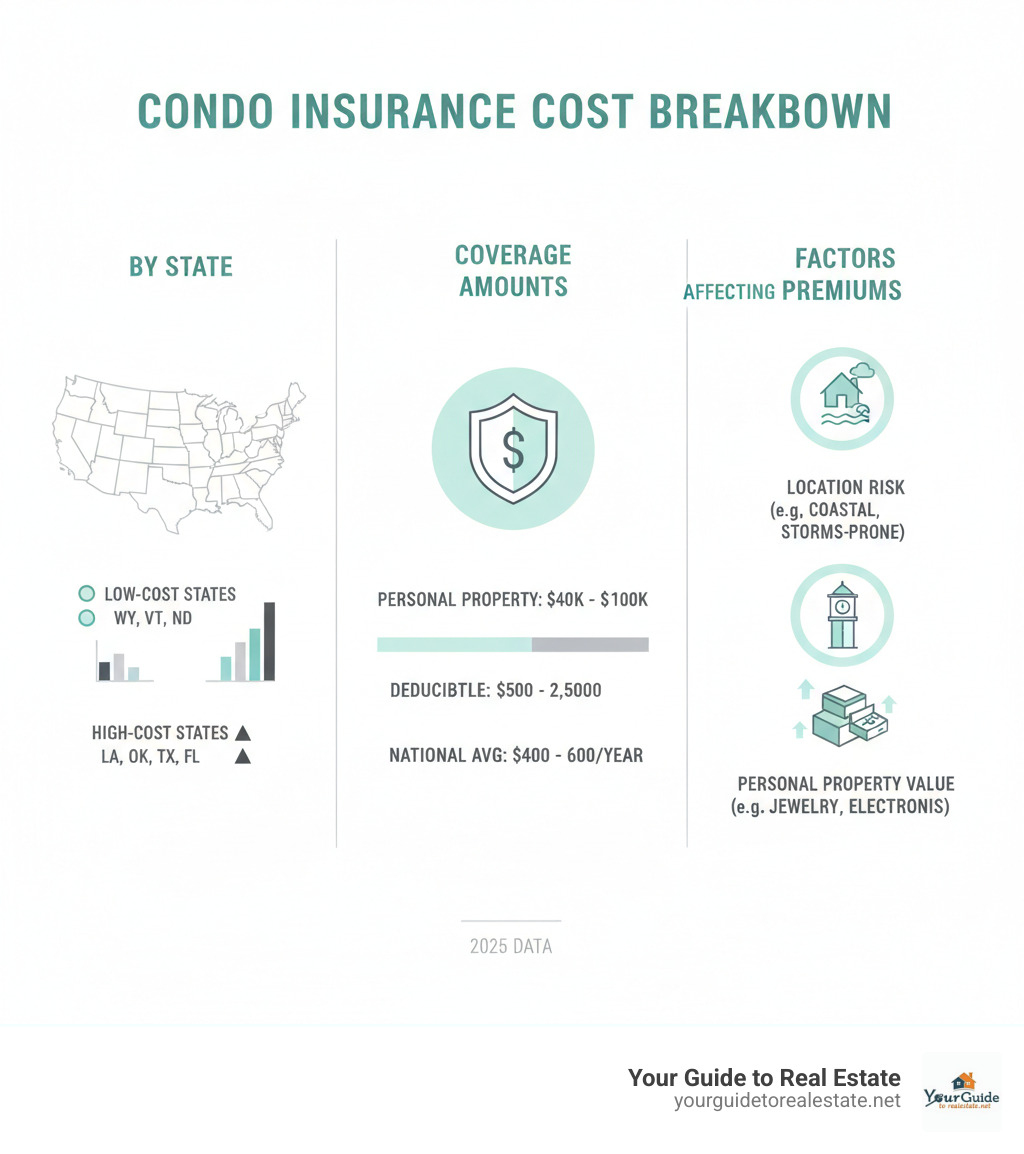
Quick Answer – Condo Insurance Cost Breakdown:
- National Average: $400-$600 annually ($33-$50 monthly)
- Low-Cost States: $225-$310 per year (Wyoming, Vermont, North Dakota)
- High-Cost States: $880-$1,300 per year (Louisiana, Oklahoma, Texas, Florida)
- Typical Coverage: $40,000-$100,000 in personal property protection
- Common Deductible: $500-$2,500
Condo ownership offers a maintenance-free lifestyle and urban convenience, but it also requires a specialized type of insurance protection. Unlike traditional homeowners insurance, condo insurance (also called HO-6 insurance) works alongside your condo association’s master policy to fill crucial coverage gaps.
Your condo association’s master insurance policy covers the building structure and common areas like lobbies, pools, and parking garages. But it doesn’t protect your personal belongings, interior improvements, or liability within your unit. That’s where your individual condo insurance policy becomes essential.
The cost of this protection varies significantly based on where you live and what you need to protect. A condo owner in Miami might pay $2,280 annually, while someone in Minneapolis could pay just $430 for similar coverage.
How much is condo insurance word roundup:
Understanding Condo Insurance: What It Is and What It Covers
Think of condo insurance like a puzzle piece that fits perfectly with your building’s master policy. Condo insurance, also known as an HO-6 policy, is specifically designed for people who own the inside of their unit but not the whole building.
Here’s where it gets interesting: your condo association already has a master insurance policy that covers the big stuff. We’re talking about the roof over your head, the exterior walls, those fancy elevators, and all the common areas like the pool where you pretend to exercise. The building structure itself? That’s covered too.
But here’s the catch – that master policy usually stops right at your front door. Everything inside your unit? That’s your responsibility. Your beautiful furniture, that expensive coffee maker you can’t live without, and those custom kitchen cabinets you saved up for? The master policy won’t help you there.
This shared responsibility approach means you need your own protection for what matters most to you. Without condo insurance, you could end up paying thousands out of your own pocket if something goes wrong inside your unit. To understand how this differs from other types of coverage, check out what is the primary difference between homeowners insurance and renters insurance?
Standard Coverages in Your Policy
Your condo insurance policy comes loaded with several types of protection that work together to keep you covered. Let’s break down what you’re actually paying for when you’re wondering how much is condo insurance.
Personal Property coverage is your safety net for everything you own inside your unit. This contents coverage protects your belongings against problems like fire, theft, and certain types of water damage. Most people need around $40,000 in coverage for their first 1,000 square feet, plus another $5,000 for each additional 500 square feet. So if you live in a 1,500-square-foot condo, you’d want about $45,000 in personal property coverage.
Unit Improvements & Betterments coverage is where things get really important. Did you install granite countertops or hardwood floors? Put in custom lighting or upgraded appliances? The master policy will only restore your unit to its original, builder-grade condition. This coverage pays the difference to get your upgrades back.
Personal Liability protection is your financial shield if someone gets hurt in your unit or if you accidentally cause damage somewhere else in the building. Picture this: your washing machine hose bursts and floods the unit below you. This coverage handles the bodily injury costs if someone slips on the water, plus any property damage to your neighbor’s belongings. Most people choose between $1 million and $2 million in liability coverage because lawsuits can be expensive.
Additional Living Expenses, also called Loss of Use coverage, kicks in when your condo becomes unlivable due to a covered loss. If a fire forces you out of your home, this coverage pays for your hotel, restaurant meals, and other extra costs while repairs are happening. It’s like having a financial cushion during one of the most stressful times you could face.
Loss Assessment coverage protects you from surprise bills from your condo association. Sometimes the master policy doesn’t cover everything, and the association has to charge each owner for their share of the remaining costs. This coverage typically provides $5,000 to $10,000 to help with these unexpected assessments.
Optional Coverages and Endorsements
Beyond the basics, you can add extra protection that makes sense for your specific situation. Think of these as insurance upgrades that can save you major headaches later.
Sewer backup coverage is especially important if you’re on a lower floor or in an older building. When sewers back up, the mess and smell are just the beginning – the cleanup costs can be enormous. This coverage handles both the cleanup and replacing anything that gets ruined.
Overland water protection covers flooding from outside sources like heavy rain or melting snow. If you’ve ever seen news footage of flooded streets, you know this water has to go somewhere – and sometimes that somewhere is your condo.
Water damage protection gives you broader coverage for the most common condo insurance claim. Whether it’s a burst pipe or a leaking appliance, water damage can happen fast and cost a lot to fix.
For high-value items like expensive jewelry or art collections, standard policies often have low limits – sometimes just $1,000 or $2,000 total. If you own valuable pieces, you’ll want to add specific coverage that protects their full appraised value.
These optional coverages help create a complete protection plan for your investment. For more insights on protecting your property investment, visit our guide on protecting your property investment.
How Much is Condo Insurance on Average?
When you’re wondering how much is condo insurance, you’ll find that most condo owners pay somewhere between $300 to $600 per year. That breaks down to roughly $25 to $50 per month – less than most people spend on their morning coffee habit!
The national average sits around $490 annually, or about $40 monthly, according to industry data. But here’s the thing: averages only tell part of the story. Your actual cost could be significantly higher or lower depending on where you live and what you need to protect.

Think of condo insurance costs like real estate prices – location matters tremendously. A condo owner in Wyoming might pay just $225 per year, while someone in Miami could face annual premiums of $2,280. That’s a huge difference for essentially the same type of coverage!
These variations aren’t random. Insurance companies use decades of data to calculate risk, and some areas simply face more challenges than others. Coastal regions deal with hurricanes, tornado-prone states see severe weather damage, and urban areas might have higher theft rates.
Key Factors That Influence Your Premium
Your condo insurance premium isn’t pulled out of thin air. Insurance companies look at several specific factors to determine your risk level and calculate your cost.
Location is the biggest game-changer. If you live in an area with high crime rates, frequent natural disasters, or dense urban populations, you’ll likely pay more. For example, Florida’s hurricane risk drives up premiums significantly, while Wyoming’s low disaster risk keeps costs down.
Your building’s age and construction materials also play a major role. Older buildings often have outdated electrical or plumbing systems that increase the likelihood of claims. Meanwhile, concrete buildings typically cost less to insure than wood-frame structures because they’re more resistant to fire damage.
Coverage limits and deductible choices directly impact your premium. The more coverage you want, the more you’ll pay. But here’s a money-saving tip: choosing a higher deductible (the amount you pay before insurance kicks in) can lower your monthly premium. Raising your deductible from $1,000 to $2,500 typically saves about 7% on your annual cost.
Your personal belongings and unit upgrades matter too. If you’ve installed granite countertops, hardwood floors, or own expensive electronics and jewelry, you’ll need higher coverage limits. More coverage means higher premiums, but it also means better protection for your investments.
Your claims history and credit score can significantly affect your rates. People with poor credit pay about 54% more than those with good credit. Similarly, a history of insurance claims signals higher risk to insurers. That’s why it often makes sense to pay for small repairs out of pocket rather than filing claims for minor damage.
Understanding these factors helps you see the bigger picture of property ownership costs. For deeper insights into how various elements affect real estate values, check out our guide on real estate valuation.
How much is condo insurance in different locations?
The difference in how much is condo insurance costs across different locations can be eye-opening. What you pay depends heavily on your state, city, and even your specific neighborhood’s risk factors.
The most expensive states for condo insurance include Florida ($995-$1,291 annually), Louisiana ($880-$1,337), and Texas ($855-$1,257). These states face frequent severe weather events like hurricanes, tornadoes, and flooding, which drive up insurance costs for everyone.
The cheapest states offer much more affordable options. Wyoming leads the pack at just $225-$315 per year, followed by Vermont ($230-$353) and Maine ($245-$472). These states typically have lower crime rates, fewer natural disasters, and less dense populations.
City-specific costs can vary even more dramatically. Miami residents might pay $2,280 annually due to hurricane exposure and urban density, while Minneapolis condo owners typically pay around $430 per year. That’s more than a five-fold difference for similar coverage!
Urban areas generally cost more than rural locations due to higher crime rates, more traffic accidents, and increased liability risks. However, urban areas might also offer better access to emergency services and newer construction standards, which can sometimes balance out the costs.
Regional weather patterns play a huge role too. Coastal areas face hurricane and flood risks, the Midwest deals with tornadoes and severe storms, and earthquake-prone regions have their own unique challenges. Each of these factors gets calculated into your premium.
The key takeaway? Don’t assume your costs will match national averages. Get quotes specific to your location and situation. To understand how these location factors tie into broader market trends, explore our condominium market report for current insights.
Smart Strategies to Lower Your Condo Insurance Costs
Nobody enjoys paying more than they need to for insurance, and the good news is that how much is condo insurance costs you doesn’t have to break the bank. With some smart planning and proactive steps, you can secure excellent protection while keeping your premiums manageable.
The key is understanding that insurance companies reward responsible behavior and lower-risk situations. When you demonstrate that you’re less likely to file claims or that your property is well-protected, insurers are happy to pass those savings along to you.

Discounts and Savings Opportunities
The easiest way to save money on condo insurance is through bundling your policies. Most insurance companies offer substantial discounts when you combine your condo insurance with your auto insurance. We’re talking about savings of 15% or more in many cases. Plus, you’ll only have one company to deal with, which makes managing your insurance much simpler.
Increasing your deductible is another straightforward way to lower your monthly payments. If you can comfortably handle paying $2,500 out of pocket instead of $1,000 in the event of a claim, you could save around 7% on your annual premium. Just make sure you have enough in your emergency fund to cover that higher deductible if needed.
Your home’s security features can also work in your favor. Installing monitored security systems that connect to a central monitoring station often qualifies you for discounts up to 5%. Fire alarms, burglar alarms, sprinkler systems, and carbon monoxide detectors all signal to insurers that you’re serious about protecting your property.
Here’s something many people don’t realize: maintaining good credit can significantly impact your insurance rates. Insurance companies use credit-based insurance scores to predict claim likelihood, and the difference can be substantial. People with poor credit pay about 54% more on average than those with good credit. Paying your bills on time and managing debt responsibly isn’t just good for your financial health – it’s good for your insurance rates too.
Avoiding small claims might seem counterintuitive, but it’s actually a smart long-term strategy. Filing multiple small claims can lead to higher premiums down the road. For minor damages that are just slightly above your deductible, consider paying out of pocket. Maintaining a claim-free record often qualifies you for no-claims discounts that add up to significant savings over time.
The most important step you can take is comparing quotes from multiple insurers. Insurance rates can vary dramatically between companies, even for identical coverage. Getting quotes from at least three different highly-rated insurance companies annually is essential. The process is easier than ever with digital tools that let you compare options in minutes.
Don’t forget to ask about other potential savings opportunities. Loyalty discounts reward long-term customers, while professional membership discounts might apply if you belong to certain organizations. Some insurers offer retiree discounts or savings for living in a gated community. Non-smoker discounts are common since smoking increases fire risk. Even simple things like enrolling in auto-pay or living in a newly constructed building can sometimes qualify you for additional savings.
The bottom line is that a little effort upfront can lead to substantial savings on your condo insurance without sacrificing the protection you need. These strategies work together – the more you can implement, the more you’ll save.
Navigating the Claims Process
When life throws you a curveball and damage strikes your condo, knowing how to handle the claims process can turn a stressful situation into a manageable one. Think of it as your roadmap through what might otherwise feel like unfamiliar territory.
The moment you find damage or experience a loss, contact your insurance provider immediately. Most policies have strict notification requirements, and delaying this call could complicate your claim. While you’re on the phone with them, start documenting everything you can see. Take photos or videos of all damage from multiple angles, jot down the date and time everything happened, and keep every receipt for immediate repairs you make to prevent further damage.
Here’s something many condo owners don’t realize: you’ll likely be working with two insurance policies during your claim. Your HO-6 policy covers your personal belongings and interior improvements, while your condo association’s master policy might cover structural elements or damage that affects common areas. Understanding how these two policies work together is crucial for getting full coverage.
Your insurance company will assign an adjuster to assess the damage and determine what’s covered under your specific policy terms. Don’t be afraid to ask questions during this process – it’s their job to help you understand what happens next. If your unit becomes uninhabitable, start tracking all your additional living expenses right away, from hotel bills to restaurant meals. Your Additional Living Expenses coverage is there to help, but you’ll need documentation.

Most Common Condo Insurance Claims
Understanding what typically goes wrong in condos helps us appreciate why how much is condo insurance costs what it does – and why it’s worth every penny when you need it.
Water damage tops the list by a wide margin, and it’s easy to see why. In Ontario, the average water claim costs $6,267, which gives you an idea of how quickly water damage can add up. Burst pipes are the classic culprit, especially during those brutal winter months when temperatures plummet. Old plumbing doesn’t help matters either. Then there are appliance leaks – your dishwasher, washing machine, or water heater can turn from helpful household companion to expensive problem in a matter of hours.
Roof leaks present an interesting challenge because they often involve both insurance policies. While the condo association’s master policy typically covers the actual roof repair, the water damage inside your unit – your soaked furniture, ruined flooring, and damaged electronics – falls under your HO-6 policy. This is where having sewer backup and overland water endorsements becomes invaluable, especially as our infrastructure ages and severe weather becomes more common.
Theft and burglary claims average around $3,000, according to industry data. Your policy protects your belongings whether they’re stolen from your unit, your car in the parking garage, or even your storage locker. It’s a reminder that even though condos often feel more secure than standalone homes, they’re not immune to break-ins.
Fire and smoke damage might be less frequent, but when it happens, it can be devastating. Your policy covers rebuilding your unit’s interior and replacing your personal property. What many people don’t consider is the liability aspect – if a fire starts in your unit and causes smoke damage to neighboring units, your personal liability coverage steps in to handle those claims.
Liability claims themselves are surprisingly common. A guest might slip and fall on your freshly mopped bathroom floor, or your overflowing bathtub might flood the unit below you. These situations show why personal liability coverage isn’t just a nice-to-have – it’s essential protection against the unexpected costs of accidents that happen in everyday life.
The beauty of understanding these common scenarios is that it helps us make informed decisions about our coverage limits and endorsements. When you know that the average flood claim costs $10,000, suddenly that water damage endorsement doesn’t seem like an unnecessary expense – it seems like smart financial planning.
Frequently Asked Questions about Condo Insurance
As we work with condo owners every day, we hear the same questions come up again and again. Let’s tackle the most common concerns to help you feel confident about your insurance decisions.
Is condo insurance mandatory?
Here’s the thing – while your state probably doesn’t have a law requiring condo insurance, you’ll almost certainly need it anyway. It’s one of those “technically optional but practically essential” situations.
Your mortgage lender will be the first to insist on coverage. They’ve invested a lot of money in your property, and they want to protect that investment. No insurance policy means no mortgage approval – it’s that simple. You’ll need to show proof of coverage before you can close on your condo.
Your condo association is the second party that typically requires coverage. Most associations write this requirement right into their bylaws or community declarations. They’re protecting everyone in the building by making sure each unit owner takes responsibility for damages within their own space and any liability issues that might arise.
Even if nobody required it, we’d still strongly recommend having condo insurance. The master policy covers the building structure and common areas, but it leaves a huge gap when it comes to your personal belongings and liability. Without your own policy, you could face thousands of dollars in out-of-pocket costs for damages or accidents within your unit.
How much personal liability coverage do I need?
This is where we need to get personal about your financial situation. The right amount of liability coverage depends on what you have to protect and what risks you face.
Most condo owners start with coverage between $100,000 and $500,000, but that might not be enough if you have significant assets. In fact, many of our clients choose much higher limits. In Ontario, for example, 80% of condo owners opt for $1 million in liability coverage, while 20% go even higher with $2 million.
Think about it this way – if someone gets seriously injured in your unit, or if you accidentally cause major damage to neighboring units, you could face a lawsuit that goes well beyond basic coverage limits. Your savings, investments, home equity, and even future earnings could be at risk if your insurance falls short.
We always recommend taking a close look at your total net worth when deciding on liability limits. The good news is that bumping up from $300,000 to $1 million in coverage often costs just a few extra dollars per month – it’s usually one of the best insurance bargains you’ll find.
Don’t forget to check your condo association’s requirements too. Many associations specify minimum liability coverage amounts that all unit owners must carry. Make sure your policy meets or exceeds these requirements to stay in good standing with your community.
Does my policy cover items in a storage unit?
Yes, your condo insurance typically extends beyond your four walls to protect your belongings wherever they are – including that storage unit where you keep your seasonal decorations and extra furniture. This protection is called off-premises coverage.
But here’s what you need to know about the limits. Most policies only cover a percentage of your total personal property coverage when items are stored off-site – often around 10%. So if you have $50,000 in personal property coverage, you might only have $5,000 in protection for items in your storage unit.
The coverage still applies to the same perils listed in your policy – fire, theft, vandalism, and other covered events. However, it won’t protect against things like mold, pest damage, or general wear and tear that might happen in a storage facility.
If you have valuable items in storage, like antiques, collectibles, or expensive electronics, you might want to schedule them separately on your policy. This ensures they’re fully protected at their actual value rather than being subject to the lower off-premises limits.
Every policy is a bit different, so it’s worth reviewing your specific coverage details or chatting with your insurance agent about what’s included. For more detailed information about protecting stored belongings, check out our guide on storage unit insurance.
The key is making sure you understand exactly what’s covered and what isn’t, so there are no surprises if you ever need to file a claim.
Conclusion
Owning a condo is an exciting milestone, but it comes with important responsibilities—and understanding how much is condo insurance costs is absolutely essential for protecting your investment. Throughout this guide, we’ve walked through how your specialized HO-6 policy works hand-in-hand with your condo association’s master coverage to create a complete safety net around your personal belongings, interior improvements, and potential liability.
The costs we’ve discussed—ranging from around $300 to $600 annually in most areas, with significant variations based on your location and coverage needs—represent more than just another monthly expense. They’re your financial peace of mind wrapped up in a policy. Whether you’re facing the higher premiums common in Florida or Texas due to weather risks, or enjoying the lower rates available in states like Wyoming or Vermont, the key is finding coverage that fits both your budget and your protection needs.
We’ve also explored practical ways to make your coverage more affordable without sacrificing protection. Bundling policies, increasing your deductible, and maintaining good credit can all lead to meaningful savings. Installing safety devices and avoiding small claims help too—every bit counts when you’re managing your overall housing costs.
This isn’t just about meeting lender requirements or satisfying your condo association’s rules (though those are important too). Real-world claims like water damage, theft, and liability issues happen to condo owners every day. Having the right coverage means you can focus on enjoying your home instead of worrying about financial catastrophe if something goes wrong.
At Your Guide to Real Estate, we believe that informed decisions are confident decisions. Whether you’re a first-time condo buyer or a seasoned owner reviewing your coverage, understanding your insurance options is just as important as understanding market values and investment potential.
Ready to dive deeper into the financial side of real estate ownership? Get a deeper understanding of valuation and market analysis in real estate to make your next property decision with complete confidence.