

Why Competitive Market Analysis is Your Strategic Advantage
A competitive market analysis is a systematic process of researching and evaluating your competitors to identify opportunities, threats, and gaps in the market that can inform your business strategy.
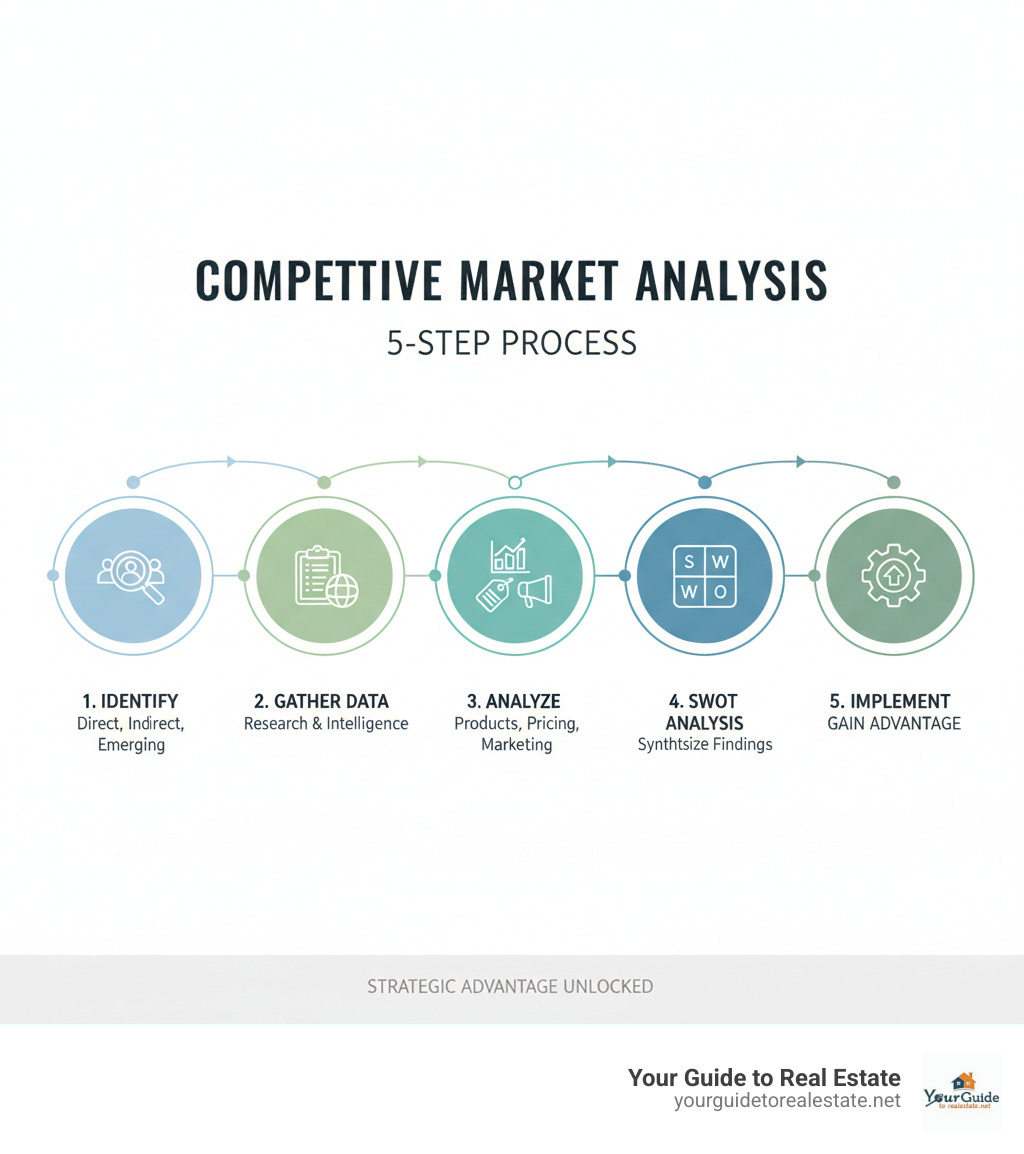
Key steps to perform competitive analysis:
- Identify your competitors – Direct, indirect, and emerging players
- Gather intelligence – Collect data on their products, services, and strategies
- Analyze their approach – Study pricing, marketing, and customer experience
- Conduct SWOT analysis – Assess strengths, weaknesses, opportunities, threats
- Take action – Use insights to improve your positioning and offerings
In today’s fast-moving real estate market, understanding your competition isn’t just helpful – it’s essential. Whether you’re a real estate agent trying to stand out in a crowded market, a brokerage looking to capture more market share, or an investor seeking the best opportunities, competitive analysis gives you the strategic edge you need.
The stakes are high. Without knowing what your competitors are doing, you’re essentially flying blind. You might miss emerging trends, price yourself out of deals, or fail to capitalize on gaps in the market that could drive significant growth.
But here’s the good news: most businesses do competitive analysis poorly or not at all. This creates a huge opportunity for those who take the time to do it right.
Competitive market analysis basics:
Understanding Competitive Market Analysis: The Foundation of Strategy
Think of business like a chess match. You wouldn’t make your next move without understanding what your opponent is planning, right? In real estate, a competitive market analysis is your strategic planning tool that helps you see the whole board. It’s what transforms guesswork into smart decisions and gives you that crucial market advantage you need to reach your business goals.

What is a Competitive Market Analysis?
A competitive market analysis is your strategic evaluation of what other players in your market are doing. It’s like being a detective, gathering clues about your competitors’ strengths and weaknesses, their pricing, their marketing tactics, and how they treat their customers.
But here’s the thing – this isn’t about copying what everyone else is doing. That’s a recipe for blending into the background. Instead, it’s about understanding the landscape so well that you can find your own unique path to success.
When you dive deep into competitor assessment, you start identifying opportunities they’re missing. Maybe there’s a neighborhood they’re ignoring or a type of client they’re not serving well. These gaps become your golden chances to shine.
The real power comes from informed decision-making. Instead of reacting to whatever happens, you’re staying ahead of the game. You’re mitigating threats before they become problems and spotting opportunities while they’re still fresh.
Competitive vs. Comparative Market Analysis (CMA): A Key Distinction
Here’s where things get a bit confusing. In real estate, “CMA” can mean two completely different things, and mixing them up is like bringing a hammer to fix a computer.
A competitive market analysis (what we’re talking about here) is all about business strategy. It’s perfect for brokerage strategy, investor analysis, or any time you need to understand your business environment. Think big picture questions like “How can we stand out from other brokerages?” or “What services are competitors missing?”
A Comparative Market Analysis (the other CMA) is purely about property valuation. Real estate agents use this to figure out what a specific house is worth by looking at similar homes that recently sold. It’s a numbers game focused on one property, not your entire business strategy.
Both are important, but they solve different problems. If you want to dive deeper into the property valuation side, check out our guide on Valuation and Market Analysis in Real Estate. For your real estate business growth, though, you need the strategic version we’re covering here.
The Primary Goals: Why It’s Worth Your Time
You might be wondering if all this analysis is really worth the effort. The short answer? Absolutely. A well-done competitive market analysis pays for itself many times over.
Finding market gaps is like finding hidden treasure. When you see what competitors aren’t offering, you’ve found your chance to fill that void. Maybe they’re all focused on luxury homes while first-time buyers feel ignored. That’s your opening.
Benchmarking success keeps you grounded in reality. How do you know if you’re doing well if you don’t know what “well” looks like? By comparing your performance to others in your market, you can set realistic goals and celebrate real achievements.
Improving your offerings becomes so much easier when you can learn from both successes and failures around you. Why reinvent the wheel when you can see what’s working (and what’s not) for others? This saves you time, money, and headaches.
The ultimate goal is defining a competitive edge that makes clients choose you over everyone else. Maybe it’s your deep neighborhood knowledge, your innovative use of technology, or your stress-free approach to real estate transactions. Whatever it is, competitive analysis helps you identify and sharpen that advantage.
All of this work leads to one beautiful outcome: sustainable revenue. When you understand your market inside and out, you make smarter decisions that protect and grow your business for the long haul. That’s not just survival – that’s thriving in any market condition.
The 5-Step Process for a Comprehensive Competitive Market Analysis
Let’s be honest – diving into a competitive market analysis can feel overwhelming at first. But here’s the thing: we’ve broken it down into five manageable steps that will turn you from confused to confident. Think of this as your roadmap for smart data gathering, using proven analysis frameworks, and applying strategic tools that transform raw information into actionable insights.

Step 1: Identify Your Competitors
Before you can outsmart your competition, you need to know who you’re up against. This isn’t just about the obvious players – there are actually three types of competitors you should be tracking.
Direct competitors are the most straightforward. These are businesses offering nearly identical services to the same customers you’re targeting. In real estate, this means other brokerages in your area, agents who specialize in the same property types, or investment firms chasing similar deals. They’re your most obvious rivals, and understanding their every move is crucial.
Indirect competitors are trickier to spot but equally important. These businesses solve the same customer problem but in a different way. Think about online listing platforms that let homeowners sell directly, or home-flipping companies that bypass traditional agents entirely. They might not do exactly what you do, but they’re still competing for your customers’ attention and money.
Emerging competitors are the wild cards. These new market entrants – often innovative startups – might be small today but could disrupt everything tomorrow. Keeping an eye on new technologies, fresh business models, and creative service offerings helps you stay ahead of potential threats.
So how do you find all these competitors? Start with keyword research. What terms do your potential clients search for when looking for real estate services? The businesses ranking at the top are often your main competition.
Don’t overlook customer feedback either. Simply ask your clients: “Who else did you consider before choosing us?” Their answers will reveal competitors you might have missed. Industry events, trade publications, and local business directories are also goldmines for spotting both established players and newcomers.
The Small Business Administration offers excellent guidance on Market research and competitive analysis to help you get started.
Step 2: Gather Key Intelligence and Data
Now comes the detective work. Once you know who your competitors are, it’s time to dig deep and gather intelligence about how they operate. This step involves two main approaches to data collection.
Primary research means collecting fresh information directly from the source. Yes, it takes more time, but the insights you’ll gain are incredibly valuable. Start with direct observation – visit their websites, follow their social media accounts, sign up for their newsletters, and attend their open houses. Experience their services by engaging as a potential client.
Talk to people who’ve used their services. What did past clients love about working with them? What frustrated them? These conversations often reveal gaps in their service that you can capitalize on.
Secondary research involves gathering information that’s already been compiled and published. It’s faster and usually less expensive than primary research. Online reviews on Google, Yelp, or Zillow provide unfiltered customer feedback – pay attention to recurring themes in both positive and negative reviews.
Social media listening reveals a lot about their brand personality and customer engagement. Website analysis tools can show you their traffic patterns and SEO strategies. Industry publications and local realtor associations publish market reports that provide valuable context.
Government resources like the U.S. Census Business Builder offer demographic and economic data that helps you understand market trends and opportunities.
The key is being thorough but strategic. Focus on gathering data that directly helps you understand their strengths, weaknesses, and market positioning. Don’t get lost in the weeds – collect information that will actually inform your decision-making.
Step 3: Analyze Competitors’ Products, Pricing, and Marketing
With your data collected, it’s time to put on your analyst hat and dig into what really matters: what your competitors offer, how they price it, and how they tell their story to the market.
Start by examining their product features and service quality. What specific real estate services do they provide? Are they focused on residential sales, commercial leasing, property management, or investment consulting? Look for unique features they highlight – maybe they offer virtual staging, drone photography, AI-powered property matching, or guaranteed sale programs.
Pay attention to how they deliver their services. Do they emphasize a highly personalized approach, or are they more tech-driven and efficient? Customer reviews often reveal consistent patterns about service quality, whether clients consistently praise their responsiveness or complain about communication delays.
Pricing models in real estate can vary dramatically, so understanding each competitor’s approach is crucial. Do they use traditional commission structures, flat fees, or tiered service packages? What discounts or incentives do they offer? More importantly, how does their pricing align with the value they deliver? Are they positioned as premium, budget-friendly, or somewhere in between?
Their marketing channels and brand messaging tell you a lot about their strategy and effectiveness. Where do they focus their marketing efforts – social media platforms like Facebook and Instagram, Google Ads, local print advertising, or direct mail campaigns?
What story are they telling about their brand? Do they position themselves as local experts, technology innovators, or trusted advisors? Analyze their online presence – how strong is their SEO? Are they actively blogging or building social media engagement?
Understanding their marketing approach helps you refine your own strategies. For deeper insights into reaching your audience effectively, our guide on Marketing Fundamentals provides valuable context.
This analysis isn’t just about cataloging what they do – it’s about understanding why they do it and how effective their approach is. What messages seem to resonate with their audience? Which marketing efforts appear to fall flat? This intelligence becomes the foundation for shaping your own offerings and communication strategies.
Step 4: Use a SWOT Analysis to Synthesize Your Findings
Here’s where all your detective work pays off. It’s time to organize your competitor intelligence using a SWOT analysis – a powerful framework that helps you see the big picture clearly. SWOT stands for Strengths, Weaknesses, Opportunities, and Threats.
Strengths are internal factors where your business excels. Maybe you have deeper local market knowledge, stronger customer relationships, innovative technology, or a stellar reputation. The key is evaluating your strengths relative to your competitors. If they have a good digital presence but yours is exceptional, that’s a competitive strength.
Weaknesses are internal areas where you struggle or could improve. Perhaps you have a smaller marketing budget, limited team size, or less experience in emerging market segments. Be honest about these gaps – acknowledging them is the first step to addressing them.
Opportunities are external factors you can leverage for growth. These might include a booming local economy, new development projects attracting residents, demographic shifts creating demand for specific housing types, or even a competitor’s strategic misstep that opens up market space.
Threats are external factors that could negatively impact your business. In real estate, this could mean rising interest rates, market downturns, new regulations, well-funded new competitors entering your market, or existing competitors launching aggressive pricing strategies.
By systematically working through each area, you gain a clear view of your market position. This isn’t just about understanding your own capabilities – it’s about seeing how they stack up against the competition and broader market forces.
The SWOT framework helps you move from simply collecting data to truly understanding what it means for your strategic direction. For practical templates to guide your analysis, resources on creating a SWOT analysis matrix can help structure your thinking and ensure you don’t miss important insights.
This synthesis step transforms your research into a strategic roadmap, showing you exactly where to focus your efforts for maximum competitive advantage.
Turning Insights into Action: Gaining Your Competitive Advantage
Here’s where things get exciting. All that research and analysis you’ve done? It’s about to pay off big time. The real magic of a competitive market analysis isn’t in the spreadsheets or fancy charts—it’s in what happens next. This is where you transform those insights into real strategic moves that drive business growth and help you claim your spot in the market.
Think of it like finally getting to play your hand after studying everyone else’s cards. You know their strengths, their blind spots, and exactly where you can make your move.

Informing Your Product and Service Development
Your competitive market analysis becomes your roadmap for creating better services. When you understand what others are offering—and more importantly, what they’re not offering—you can spot golden opportunities to improve customer value.
Identifying market needs becomes much clearer when you see the gaps. Maybe everyone in your area focuses on luxury homes, but first-time buyers are struggling to find patient, educational guidance. Or perhaps commercial investors need specialized support that no one’s providing. These gaps are your invitation to step in.
Service differentiation is where you get to shine. Instead of offering the same cookie-cutter approach as everyone else, you can craft something unique. If competitors rush through transactions, you might focus on thorough education and support. If they’re all going digital-only, perhaps there’s value in combining high-tech tools with high-touch personal service.
The key is enhancing customer value by learning from both successes and failures you’ve observed. Take the best practices you’ve seen and make them even better. Address the pain points that others ignore. This is how you develop your unique selling proposition—that special something that makes clients choose you over anyone else.
For real estate professionals looking to sharpen their competitive edge, developing essential Real Estate Agent Skills can be the foundation of your differentiation strategy.
Refining Your Pricing and Marketing Strategies
Now you can make smart decisions about pricing and promotion instead of just guessing. Your competitive insights give you the confidence to price strategically and market effectively.
Value-based pricing becomes possible when you know exactly what others charge and what they deliver. If you’re offering superior service or solving problems others can’t, you can justify premium pricing. If you’ve found a way to be more efficient, you might compete on value while maintaining healthy margins.
Your promotional tactics can be laser-focused now. You know which marketing channels your competitors are using—and which ones they’re ignoring. Maybe everyone’s stuck in the past with newspaper ads while social media remains wide open. Or perhaps they’re all fighting over Google Ads while neglecting local community engagement.
Targeting audiences becomes much more strategic. You can focus on the segments where you have natural advantages or where competitors are underperforming. Crafting resonant messaging means speaking directly to the frustrations and dreams that others aren’t addressing.
The real estate world is changing fast, and staying ahead means understanding how innovation shapes client expectations. Learning about How Technology is Revolutionizing Real Estate: 2025 Trends to Watch can inform your marketing strategy and help you position yourself for the future.
A Real-World Example in Real Estate
Let’s walk through a hypothetical case study to see how this works in practice. Imagine you’re running a mid-sized real estate business in a competitive market, and you’ve just completed your competitive market analysis.
Your Research Revealed:
- Large Established Firm: Huge marketing budget, lots of TV ads, but their website is outdated and client reviews mention slow response times. They focus on volume over personal attention.
- New Tech Startup: Offers flat-fee services through a slick app, appeals to cost-conscious sellers, but lacks the personal guidance many clients still want.
Your Strategic Response:
Instead of trying to outspend the big firm or match the startup’s low prices, you decide to own the middle ground with superior service.
You launch a “Client Concierge” program that combines the best of both worlds—modern efficiency with personal attention. Your digital marketing strategy focuses on local SEO and video testimonials showcasing your responsive, educational approach.
Your messaging becomes clear: “We give you the personal attention you deserve with the modern tools you expect.” You target clients who’ve been frustrated by impersonal service or overwhelmed by DIY approaches.
The result? You start capturing market share from both directions—clients leaving the big firm for better service and those finding the startup approach too hands-off.
This approach to strategic growth aligns perfectly with proven methods to Build Real Estate Business sustainably and effectively.
The goal isn’t to copy what others are doing—it’s to use their moves to inform your own winning strategy.
Frequently Asked Questions about Competitive Analysis
We know that diving into competitive market analysis can feel overwhelming at first. That’s why we’ve gathered the most common questions we hear from real estate professionals just like you. Let’s tackle these head-on so you can move forward with confidence.
What are the three main types of competitors?
Understanding your competitive landscape starts with recognizing that not all competitors are created equal. There are actually three distinct types you need to keep on your radar.
Direct competitors are the most obvious ones – they’re offering essentially the same product or service to the exact same audience you’re targeting. In real estate, this might be another brokerage in your area specializing in the same property types, or an agent who focuses on the same neighborhoods and client demographics. These are the folks directly vying for your potential customers.
Indirect competitors are trickier to spot but equally important. They solve the same customer problem you do, but they do it with a completely different solution. Think of it this way: if you’re helping people buy homes, an indirect competitor might be a rent-to-own company or even a home builder offering direct sales. They’re not doing exactly what you do, but they’re still competing for your customers’ attention and dollars.
Emerging competitors are the wild cards. These are new players who might be small today but could become major threats tomorrow. They often bring fresh ideas, innovative technology, or disruptive business models that could shake up your industry. Keeping an eye on these emerging players helps you stay ahead of market shifts before they catch you off guard.
What is a competitive analysis framework?
Think of a competitive analysis framework as your roadmap for making sense of all that competitor data. Without a structured approach, you’d be drowning in information with no clear way to turn it into actionable insights.
A solid framework gives you a systematic way to organize everything you’re learning about your competitors. It typically walks you through identifying who your competitors actually are, gathering intelligence about their operations, analyzing their products and pricing strategies, and examining their marketing approaches.
The beauty of using a framework is that it ensures you don’t miss anything important. It helps you stay focused on what matters most and gives you a consistent way to compare different competitors. Most frameworks also include tools like SWOT analysis to help you synthesize all your findings into clear strategic insights.
This structured approach transforms what could be an overwhelming research project into a manageable, step-by-step process that actually leads to better business decisions.
Is a SWOT analysis the same as a competitive analysis?
This is one of the most common mix-ups we see, and it’s totally understandable. While these two tools are closely related, they’re definitely not the same thing.
A competitive market analysis is the big picture – it’s the entire comprehensive process of researching and evaluating your competitors. You’re gathering data, studying their strategies, understanding their strengths and weaknesses, and figuring out how they position themselves in the market.
A SWOT analysis, on the other hand, is just one specific tool that you use within that broader competitive analysis. It’s your way of taking all that information you’ve collected and organizing it into four clear categories: your strengths, your weaknesses, the opportunities you can capitalize on, and the threats you need to watch out for.
Think of it this way: if competitive analysis is like conducting a thorough investigation, then SWOT analysis is like writing the final report that summarizes your key findings. The SWOT helps you make sense of everything you’ve learned and figure out what to do next.
You absolutely need both. The competitive analysis gives you the raw material, and the SWOT analysis helps you turn that material into a clear action plan for your business.
Conclusion
You’ve now got the complete roadmap for conducting a competitive market analysis that can transform your real estate business. But here’s the thing – this isn’t a “set it and forget it” kind of deal. The market is constantly evolving, new players are entering the game, and your existing competitors are always adjusting their strategies.
Think of competitive analysis as your business’s regular health checkup. Just like you wouldn’t skip your annual physical, you shouldn’t skip your quarterly or bi-annual competitive reviews. Markets shift, customer preferences change, and what worked six months ago might not work today.
The beauty of this process lies in how it moves you from reactive to proactive. Instead of scrambling to respond when a competitor launches a new service or drops their prices, you’ll see these moves coming. You’ll be ready with your own strategic response, or better yet, you’ll be the one making the first move that others have to respond to.
The ongoing process of competitive analysis creates a cycle of informed decisions that compound over time. Each analysis builds on the last, giving you deeper insights into market patterns and competitor behaviors. This accumulated knowledge becomes one of your most valuable business assets.
At Your Guide to Real Estate, we believe a deep understanding of the market is the first step to success. We’ve seen countless real estate professionals transform their businesses by simply taking the time to truly understand their competitive landscape. It’s not about copying what others do – it’s about finding your unique space in the market and owning it completely.
Your competitive advantage isn’t just about being different; it’s about being strategically different in ways that matter to your clients. When you understand what everyone else is doing, you can identify the gaps, the opportunities, and the unmet needs that become your pathway to strategic growth.
Ready to dive deeper and put these insights to work in your real estate business? Learn more with our in-depth guide to competitive analysis in real estate. Your future self – and your bottom line – will thank you for the investment you make in understanding your market today.