
Why Understanding Property Value Matters for Every Real Estate Decision
Real estate valuation is the process of determining what a property is actually worth in today’s market. Whether you’re buying your first home, selling an investment property, or refinancing your mortgage, knowing how properties are valued gives you the power to make smart financial decisions.
Quick Answer: Real estate valuation uses three main approaches:
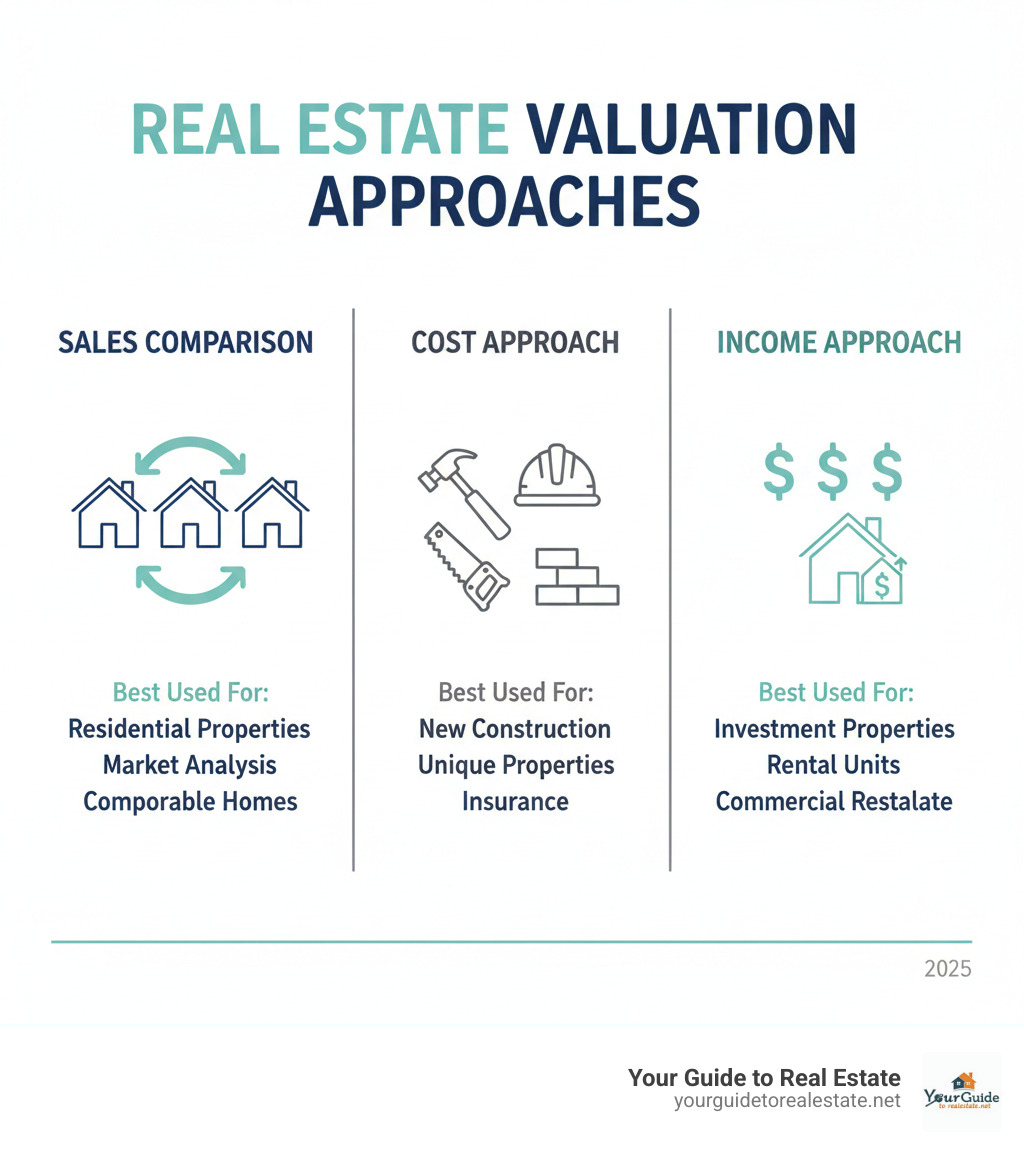
- Sales Comparison Approach – Compares your property to similar homes that recently sold
- Cost Approach – Calculates what it would cost to rebuild the property from scratch
- Income Approach – Estimates value based on the income the property can generate
Understanding property valuation helps you avoid overpaying as a buyer, price correctly as a seller, and secure proper financing from lenders. The process combines hard data with market knowledge – it’s both science and art.
Property values don’t stay the same. They change based on market conditions, economic trends, and local factors like new schools or shopping centers. In healthy markets, home values typically grow 3-4% each year, but this can vary dramatically by location and timing.
Key players who rely on accurate valuations include homebuyers, sellers, real estate investors, mortgage lenders, and property tax assessors. Each has different needs, but all depend on understanding what properties are truly worth.
The valuation process might seem complex, but breaking it down into these core methods makes it much easier to understand. Once you grasp these fundamentals, you’ll be better equipped to steer any real estate transaction with confidence.
Real estate valuation vocabulary:
The 3 Primary Methods of Real Estate Valuation
Think of real estate valuation like solving a puzzle – but instead of one solution, we have three different ways to find the answer. Each method tells us something unique about a property’s worth, and smart investors often use all three to get the complete picture.
The beauty of these approaches is that they complement each other beautifully. While one method might be perfect for your cozy suburban home, another could be the key to valuing that commercial building you’ve been eyeing. Let’s explore each one and find when they work best.
The Sales Comparison Approach (Market Approach)
This is the method that feels most natural to most of us. When you drive through a neighborhood and wonder, “What’s that house worth?” you’re already thinking like the sales comparison approach. It’s simply looking at what similar homes have sold for recently and using that information to estimate value.
Here’s how it works in the real world: We hunt down “comparable properties” or “comps” – homes that share key characteristics with the property we’re valuing. We’re talking similar square footage, age, style, condition, and neighborhood. The magic number is finding sales from the last three to six months, when the market conditions were most similar to today.
But here’s where it gets interesting – no two homes are exactly alike. Maybe your comp has granite countertops and yours has laminate. Or perhaps your property has that gorgeous finished basement that the comp lacks. We make adjustments to account for these differences, bumping prices up or down to level the playing field.
When does this approach shine? It’s absolutely perfect for residential homes in established neighborhoods where there’s plenty of sales activity. If you’re in a typical suburban area with lots of similar homes trading hands, this method will give you rock-solid results.
The Comparative Market Analysis (CMA) is how real estate agents put this approach into action. They’ll typically find three or more recently sold homes that match your property’s profile, then make those crucial adjustments to arrive at a realistic market value. Want to learn the ins and outs of this process? Check out our detailed guide on how to do a competitive market analysis real estate.
The Cost Approach
Imagine you had to rebuild your property from the ground up tomorrow. What would that cost you? That’s exactly what the cost approach asks. It’s like being your own general contractor on paper, calculating every nail, board, and hour of labor needed to recreate what you see.
The process breaks down into three key steps: First, we estimate what it would cost to build a brand-new replica of the existing structure. This includes everything from materials and labor to the builder’s profit and permits. If you’re curious about construction costs in today’s market, our guide on how much it costs to build a house is a great starting point.
Next comes the tricky part – subtracting depreciation. This isn’t just about peeling paint or worn carpets. We’re looking at physical deterioration (the actual wear and tear), functional obsolescence (like having just one bathroom in a four-bedroom house), and external obsolescence (factors outside the property that hurt its value, like a new airport flight path overhead).
Finally, we add the land value, treating it as if it were vacant and ready for development.
Where this approach really shines: New construction properties, unique buildings that don’t have many comparable sales, and specialized properties like churches or schools. It’s also incredibly useful when you’re dealing with insurance claims or tax appeals.
The biggest challenge? Estimating depreciation accurately can feel more like art than science, especially for older or unique properties where wear and obsolescence are harder to quantify.
The Income Approach
For properties that put money in your pocket every month, the income approach is often your best friend. This method looks at real estate as a business investment – what matters most is how much income it can generate over time.
The heart of this approach is the Net Operating Income (NOI). We start with the total rental income the property could generate if fully occupied, then subtract realistic vacancy allowances and all the operating expenses needed to keep the property running smoothly. Think property taxes, insurance, maintenance, utilities, and property management fees – but not mortgage payments or income taxes.
Once we have that NOI figure, we divide it by something called a capitalization rate (or cap rate) to arrive at the property’s estimated value. It’s like asking, “If this property generates $50,000 per year in net income, and similar properties in this market are selling at a 6% cap rate, what should this property be worth?”
This approach is perfect for apartment buildings, office spaces, retail properties, and any real estate you’re buying primarily for investment returns. Whether you’re exploring how to invest in real estate online or considering a buy and hold real estate strategy, understanding the income approach is absolutely essential.
The beauty of this method is that it directly connects a property’s value to its ability to generate wealth – which is exactly what most real estate investors care about most.

Key Metrics and Alternative Valuation Techniques
While the three primary approaches give you a solid foundation for real estate valuation, sometimes you need tools that work a bit faster or dig deeper into specific aspects of investment properties. Think of these as your quick-reference guides and specialized instruments that complement the main valuation methods.
These alternative techniques are particularly valuable when you’re screening multiple investment opportunities or need to make rapid comparisons in a competitive market. They won’t replace a thorough valuation, but they’ll help you separate the promising prospects from the time-wasters.
Understanding the Capitalization Rate (Cap Rate)
The capitalization rate – or cap rate for short – is like the heartbeat of investment property valuation. It’s a single number that tells you volumes about both the property’s value and the market’s perception of risk.
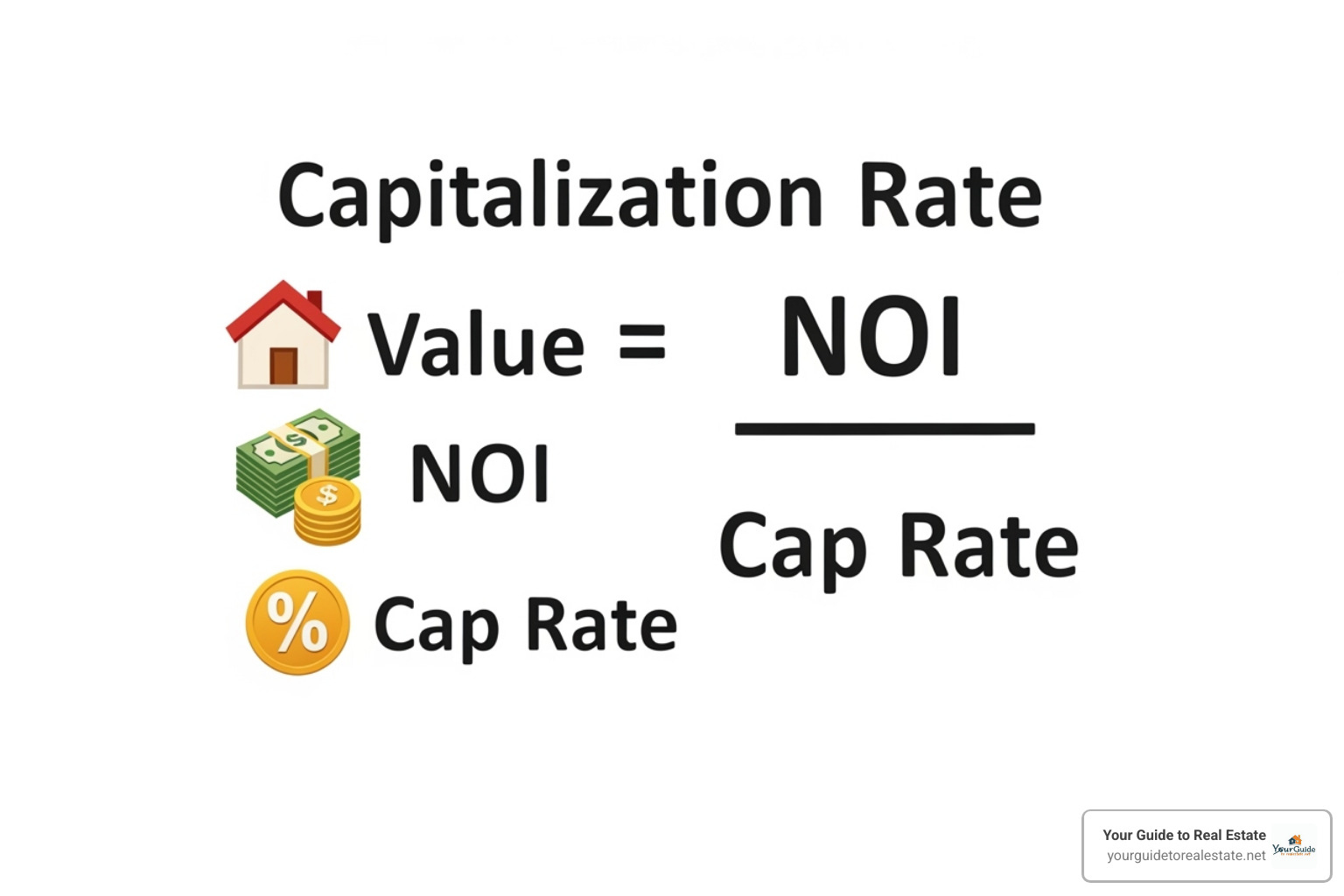
Here’s how the math works: Cap Rate = Net Operating Income (NOI) ÷ Property Value. You can flip this formula around too: Property Value = Net Operating Income (NOI) ÷ Cap Rate. This second version is incredibly powerful because it lets you estimate what a property should be worth based on its income.
Let’s say you’re looking at an apartment building that generates $100,000 in NOI annually. If similar properties in your area are selling at a 7% cap rate, you’d estimate the building’s value at $100,000 ÷ 0.07 = $1,428,571. Pretty straightforward, right?
But cap rates tell you more than just value – they’re also a market risk indicator. A lower cap rate typically means investors see the property as less risky or expect strong future growth. Higher cap rates suggest either higher risk or slower growth expectations. In markets like Dallas or Oklahoma City, understanding these local cap rate trends helps you spot good deals and avoid overpriced properties.
The tricky part is finding accurate comparable cap rates. You need recent sales data from similar investment properties, which isn’t always easy to come by. This is where Your Guide to Real Estate’s investment analysis resources become invaluable for understanding your local market dynamics.
Other Valuation Metrics for Quick Analysis
Sometimes you need to cut through the complexity and get a quick read on whether a property deserves deeper investigation. That’s where these simpler metrics shine – they’re not perfect, but they’re fast and surprisingly useful for initial screening.
The Gross Rent Multiplier (GRM) is probably the most popular quick-analysis tool. You simply divide the property’s price by its annual gross rental income. If a property sells for $1,000,000 and generates $140,000 in gross annual rents, the GRM is 7.14. Lower GRMs often indicate better potential returns, but remember – this metric completely ignores operating expenses and vacancy rates.
For multifamily properties, Value Per Door gives you instant comparison power. Take a $4,000,000 apartment building with 20 units, and you get a value per door of $200,000. This makes it easy to spot when one property is significantly over or under market compared to similar complexes.
These relative valuation methods work best when you’re scanning multiple opportunities or trying to quickly assess whether a property is in the right ballpark. They’re particularly handy when you’re exploring how to invest in property strategy options and need to narrow down your choices.
The catch? Their simplicity is both their strength and weakness. They don’t account for crucial factors like property condition, operating efficiency, or local market nuances. A property might have a great GRM but terrible maintenance issues that will eat into your returns. That’s why these metrics should always be your starting point, not your final answer.
For serious property investment decisions, follow up these quick analyses with a detailed income approach or professional appraisal. Think of them as your screening tools – they help you decide which properties deserve your full attention and detailed analysis.
External Factors That Influence Property Value
Think of real estate valuation like a recipe – the property itself is just one ingredient. The final value depends heavily on everything happening around it. Market forces, economic shifts, and neighborhood characteristics can make or break a property’s worth, often in ways that have nothing to do with the building itself.
Market Conditions and Economic Trends
The bigger economic picture shapes property values in profound ways. Understanding these forces helps you make smarter decisions whether you’re buying, selling, or investing.
Supply and demand drives everything in real estate. When lots of buyers compete for few homes, prices climb. When inventory sits unsold, prices soften. It’s basic economics, but the effects can be dramatic.
Interest rates act like a volume dial for the housing market. When rates drop, more people can afford to buy, heating up demand. When they rise – like we saw in 2022 and 2023 when rates jumped from around 3% to over 7% – many buyers get priced out, cooling the market significantly.
Inflation creates a tricky situation for property values. Rising costs for materials and labor push up construction expenses, which can boost existing home values. But if your purchasing power shrinks faster than home prices rise, you might actually be worse off financially.
Employment growth in your local area matters enormously. Strong job markets attract new residents, creating housing demand. Cities with diverse, growing economies typically see steadier property value appreciation over time.
Valuing properties during market downturns requires extra care and different strategies. The 2008-2011 housing crash, when home values fell over 33% nationally, taught us that even solid properties can lose value quickly. During tough times, focus on properties with strong fundamentals – good locations, steady rental income potential, and minimal debt.
Our housing market forecast and real estate market projections for 2025 can help you steer these changing conditions with confidence.
Location, Zoning, and Neighborhood Desirability
Location isn’t just a catchy real estate phrase – it’s the foundation of property value. A modest home in a prime spot often outperforms a mansion in a declining area.
Proximity to amenities makes daily life easier and more enjoyable. Properties near good schools, shopping, restaurants, parks, and public transit command higher prices because buyers value convenience. A 10-minute walk to the grocery store or subway can add thousands to your home’s value.
School district quality often trumps everything else for family buyers. Parents will pay significantly more for a home in an excellent school district, even if the house itself is smaller or older. This factor alone can create huge value differences between neighboring areas.
Zoning regulations shape what can and can’t happen around your property. Residential zoning protects you from having a factory built next door, while mixed-use zoning might bring convenient shops within walking distance. Understanding local zoning helps predict future neighborhood changes.
Future development plans can dramatically impact property values. A new light rail station, shopping center, or highway can boost nearby values – or sometimes hurt them if the development brings noise or traffic. Smart investors research municipal planning documents to spot these opportunities early.
Walkability scores matter more than ever, especially in urban and suburban markets. Properties where you can accomplish daily tasks on foot appeal to younger buyers and aging populations alike. High walkability often translates to higher property values and faster sales.

The beauty of understanding these external factors is that they help you see the bigger picture. A property might look perfect on paper, but if it’s in a declining area with poor schools and limited amenities, its value could stagnate or fall. Conversely, a property with some flaws in a rapidly improving neighborhood might be a hidden gem.
From Estimates to Appraisals: Achieving an Accurate Valuation
When it comes to determining a property’s worth, we encounter a spectrum of valuation tools and services, from quick online estimates to comprehensive professional appraisals. Each has its place, pros, and cons.
Market Value vs. Assessed Value: A Crucial Distinction for Real Estate Valuation
It’s vital to understand that not all “values” are created equal. Two key terms often confused are market value and assessed value.
| Criteria | Market Value | Assessed Value Real Estate Valuation is a complex but essential process. Our goal is to empower you with the knowledge to approach property valuation with confidence.
What are the primary methods used to determine the value of a property?
We use three primary methods to determine a property’s value: the Sales Comparison Approach, the Cost Approach, and the Income Approach. Each method offers a unique perspective and is best suited for different property types and valuation purposes. As we discussed, the Sales Comparison is great for residential, the Cost Approach for new or unique builds, and the Income Approach for commercial and investment properties.
How does the sales comparison approach work, and when is it most effective?
The Sales Comparison Approach works by comparing the subject property to recently sold, similar properties (comps) in the same area. We then adjust the sale prices of these comps to account for any differences, such as size, age, condition, or features, to arrive at an estimated value for our property. This method is most effective for residential properties in active markets with a good supply of comparable sales data, as it directly reflects current buyer behavior and market trends.
What is the cost approach to property valuation, and what are its limitations?
The Cost Approach estimates a property’s value by calculating the current cost to replace or reproduce the improvements, subtracting depreciation, and adding the value of the land. It’s particularly useful for newer properties, unique structures, or properties where comparable sales data is scarce. Its main limitation lies in accurately estimating depreciation, which can be subjective and challenging, especially for older or complex properties. Also, it may not fully capture market demand or location desirability.
How does the income approach estimate a property’s value, and for what types of properties is it best suited?
The Income Approach estimates a property’s value based on its ability to generate income. We calculate the Net Operating Income (NOI) by subtracting operating expenses from the property’s gross income (after accounting for vacancies). This NOI is then divided by a market-derived capitalization rate to determine the property’s value. This method is best suited for income-producing properties, such as apartment buildings, commercial office spaces, retail centers, and other investment properties, where the primary motivation for purchase is the return on investment.
What is a capitalization rate (cap rate) and how is it used in real estate valuation?
A capitalization rate (cap rate) is a ratio used to estimate a property’s value based on its Net Operating Income (NOI) and current market conditions. It’s calculated as NOI divided by the property’s value (or vice versa). Investors use cap rates to compare the relative value of income-producing properties. A lower cap rate generally indicates a higher property value and potentially lower risk, while a higher cap rate suggests a lower value and potentially higher risk. It’s a crucial metric for evaluating investment potential and is often derived from comparable property sales in the market.
What are some other, less common, valuation methods like Gross Rent Multiplier (GRM) or value per door?
Beyond the three main approaches, other methods offer quicker, though less comprehensive, insights. The Gross Rent Multiplier (GRM) is calculated by dividing a property’s price by its annual gross rental income. It’s a simple tool for comparing investment properties based on their income potential but doesn’t account for expenses. “Value per door” is another straightforward metric, primarily used for multifamily properties, where the total property price is divided by the number of units. These methods are useful for initial screening but should be followed by more detailed analysis.
What factors influence a property’s value beyond its physical characteristics?
Beyond physical characteristics (size, condition, age), many external factors influence a property’s value. These include its location (proximity to amenities, school quality), market conditions (supply and demand, inventory levels), economic trends (interest rates, inflation, employment growth), zoning regulations, and future development plans for the area. Even seemingly minor neighborhood changes can shift property values, making it essential to keep a watchful eye on local trends.
How do market conditions and economic trends affect property valuation?
Market conditions and economic trends profoundly affect property valuation. A strong economy with job growth and low interest rates typically boosts buyer demand, leading to higher property values. Conversely, rising interest rates or economic downturns can reduce affordability and demand, causing values to stagnate or decline. For example, during 2022, the U.S. economy expanded by 2.1% (a slowdown from 5.9% in 2021), and mortgage interest rates rose rapidly, influencing home prices and sales volumes. Understanding these broader trends is vital for accurate valuation, especially in dynamic markets like Dallas and Oklahoma City. We regularly publish insights on top 7 real estate trends shaping 2025 and beyond.
What is the difference between market value and assessed value?
Market value is the estimated price a property would sell for in a competitive and open market, where both buyer and seller are well-informed and acting voluntarily. It reflects current supply and demand. Assessed value, on the other hand, is a value assigned to a property by a local government assessor for property tax purposes. This value may be lower than the market value and is typically updated less frequently (e.g., every 3 years in some areas). The assessed value is used to calculate your property tax bill, not necessarily what your home would sell for.
How can homeowners or investors improve the accuracy of a property’s valuation estimate?
Homeowners and investors can improve valuation accuracy by:
- Maintaining detailed records: Keep track of all renovations, upgrades, and maintenance performed on the property.
- Updating online tools: If using AVMs like Zestimate or Redfin Estimate, update your home’s facts and photos to reflect recent improvements.
- Conducting thorough research: Compare your property to recently sold homes and understand local market trends.
- Consulting professionals: Engage a real estate agent for a Comparative Market Analysis (CMA) or a certified appraiser for a professional appraisal.
- Addressing minor repairs: Before any professional valuation, fix minor issues and ensure the property is presentable.
- Highlighting unique features: Make sure any unique or value-adding aspects of your property are known.
What role do professional appraisals play in the real estate valuation process?
Professional appraisals play a pivotal role in the real estate valuation process by providing an unbiased, objective assessment of a property’s value. Conducted by certified and licensed appraisers, they are often required by mortgage lenders for purchases, refinances, and other financial transactions to ensure the loan amount is adequately secured by the property’s value. Appraisers conduct thorough inspections, gather detailed property information, and apply the most appropriate valuation methods to determine the market value at a specific point in time. Their expert opinion helps ensure fairness and mitigate risk for all parties involved.
How do online valuation tools like Zestimate or Redfin Estimate work, and what are their pros and cons?
Online valuation tools, often called Automated Valuation Models (AVMs), like Zestimate or Redfin Estimate, use proprietary algorithms that analyze vast amounts of data. This data includes public records (property transfers, deeds, tax assessments), property characteristics (bedrooms, bathrooms, square footage), and recent sales of comparable properties.
- Pros: They are fast, free, and provide a convenient starting point for understanding a property’s potential value. They can be useful for initial research or tracking general market trends.
- Cons: AVMs can have significant limitations. Their accuracy depends heavily on the availability and quality of data. They may not account for recent renovations, unique features, specific property conditions, or subjective market perceptions. For instance, Zestimate’s median error rate for on-market homes is 1.83%, but for off-market homes, it jumps to 7.01%. This means a $1 million home could be off by $70,100 if it’s not currently listed. They should always be considered estimates, not official appraisals.
What are the key considerations when valuing real estate during a market downturn?
Valuing real estate during a market downturn requires careful consideration. We must be conservative in our estimates and focus on fundamental strengths. Key considerations include:
- Undervalued assets: Look for properties with solid fundamentals in prime locations that may be temporarily undervalued.
- Cash flow potential: Prioritize properties that can generate consistent income, even in a challenging market.
- Debt levels: Properties with low debt or favorable loan terms are less vulnerable.
- Long-term perspective: Understand that downturns are often cyclical and focus on a property’s long-term potential.
- Updated data: Rely on the most current sales data, as older comparables may no longer reflect the market reality.
- Don’t follow the crowd: Avoid relying on hearsay and ensure your valuation models are robust and updated.
How does the valuation process differ for residential versus commercial properties?
The valuation process differs significantly for residential versus commercial properties primarily due to their purpose.
- Residential properties (single-family homes, condos) are typically valued using the Sales Comparison Approach, focusing on comparable sales and factors like livability, school districts, and neighborhood amenities.
- Commercial properties (office buildings, retail spaces, apartment complexes) are primarily valued using the Income Approach, as their worth is largely tied to their income-generating potential. Metrics like Net Operating Income (NOI) and capitalization rates are central. The Cost Approach is also more frequently applied to unique or specialized commercial structures. While physical characteristics matter for both, the emphasis shifts from personal enjoyment to financial returns for commercial real estate.
What are the potential roadblocks or challenges in real estate valuation?
Real estate valuation isn’t always a smooth road; several roadblocks can complicate the process:
- Lack of comparable data: In rural areas, unique properties, or slow markets, finding recent, truly comparable sales can be difficult.
- Market volatility: Rapidly changing market conditions, interest rates, or economic shifts can make it hard to pin down a current value.
- Subjectivity: Elements like property condition, level of finish, or perceived neighborhood quality can introduce subjectivity, even in professional assessments.
- Undisclosed information: Sometimes, crucial details about a property (e.g., hidden defects, special circumstances of a sale) might not be readily available.
- Reliance on outdated data: Using old sales data or national averages without local context can lead to inaccurate valuations.
- Unique property features: Properties with unusual designs, specialized uses, or extensive custom work can be challenging to value accurately with standard methods.
- External factors: Unforeseen events like natural disasters, changes in local zoning, or major economic shifts can quickly alter a property’s value.
Conclusion: Mastering Your Property’s Value
We’ve journeyed through the fascinating world of real estate valuation together, and what a journey it’s been! From understanding the three core approaches to exploring the subtle art of cap rates, we’ve uncovered how properties get their value in today’s market.
Think of real estate valuation as both science and art. The science comes from the hard data – comparable sales, construction costs, and rental income. The art emerges when we interpret market conditions, neighborhood trends, and those intangible factors that make one property more desirable than another.
You’re now equipped with powerful knowledge. Whether you’re a first-time homebuyer nervously checking Zillow estimates, a seasoned investor analyzing cap rates in Dallas, or a homeowner in Oklahoma City considering a refinance, you understand the fundamentals that drive property values.
Remember the key takeaways from our exploration. The Sales Comparison Approach works beautifully for residential homes when you have good comparable data. The Cost Approach shines for new construction or unique properties where comparables are scarce. The Income Approach becomes your best friend when evaluating investment properties based on their money-making potential.
Don’t forget about those external factors we discussed. Market conditions change, interest rates fluctuate, and neighborhoods evolve. A great property in a declining area might struggle, while a modest home in an up-and-coming neighborhood could become a goldmine.
While online valuation tools offer convenient starting points, we’ve seen their limitations. For major financial decisions, a professional appraisal remains your most reliable option. These certified experts bring objectivity, thorough analysis, and market expertise that algorithms simply can’t match.
Knowledge is your competitive advantage in real estate. Understanding how properties are valued helps you spot opportunities others might miss, negotiate from a position of strength, and make decisions based on facts rather than emotions or guesswork.
The real estate market will continue evolving, but these fundamental valuation principles remain your North Star. Stay curious, keep learning, and remember that every expert was once a beginner who decided to understand how the game really works.
** Get a complete overview of Valuation and Market Analysis in Real Estate and continue building your real estate expertise with Your Guide to Real Estate. We’re here to support your journey every step of the way.