

Why Understanding Contingent Meaning Matters in Real Estate and Beyond
Contingent meaning shifts dramatically depending on whether you’re reading a real estate contract, discussing military deployments, or exploring philosophical concepts. This single word carries two completely different definitions that can make or break your understanding of important documents and conversations.
Quick Answer: The Two Primary Meanings of “Contingent”
- As an adjective: Dependent on something else happening first (Example: “Our offer is contingent on financing approval”)
- As a noun: A group of people representing an organization or country (Example: “A large contingent of buyers attended the auction”)
The word traces back to the Latin contingere, meaning “to touch” or “to happen.” Today, it appears everywhere from real estate contracts to news reports about international delegations.
Why does this matter? If you’re buying or selling property, misunderstanding “contingent” could cost you thousands. When a listing shows “contingent,” it means the sale depends on specific conditions being met – not that the deal is final.
As Ralph Waldo Emerson once noted: “All salaries are reckoned on contingent as well as on actual services.” This captures the essence of contingency – outcomes that depend on future events or conditions.
Whether you’re navigating a home purchase, reading business contracts, or simply wanting to communicate more precisely, mastering both meanings of “contingent” gives you clarity in situations where uncertainty reigns.
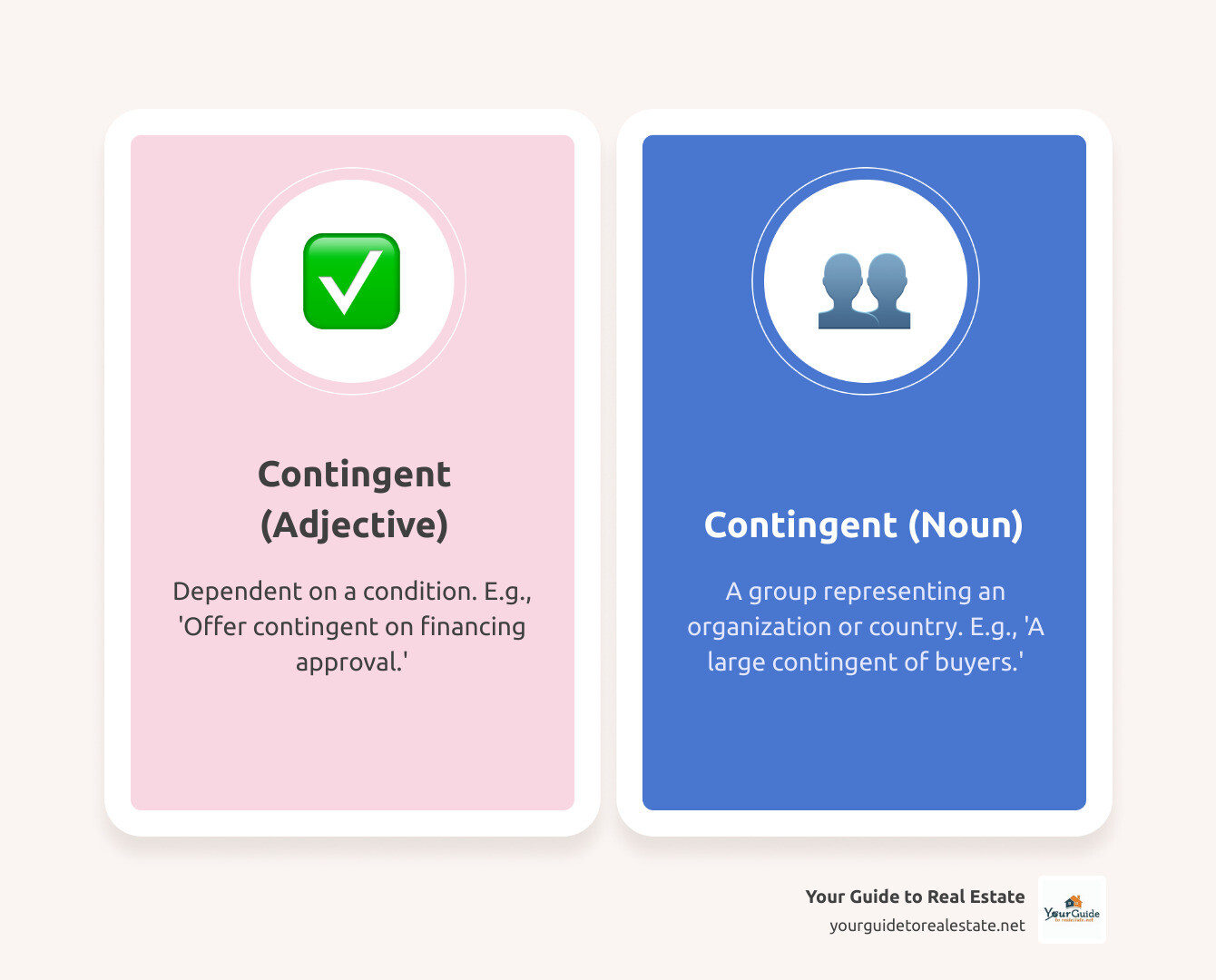
Easy contingent meaning word list:
The Core Definitions of Contingent
Have you ever wondered why the same word can mean both “depending on something else” and “a group of people”? The answer lies in the fascinating history of contingent meaning.
The word ‘contingent’ comes from the Latin ‘contingere’, which means ‘to touch’ or ‘to happen’. Think of it this way: when something “touches upon” another event, it depends on it. When something “happens” together, it forms a group. Pretty clever how one root word captures both ideas!
Today, ‘contingent’ works double duty in English. It can be an adjective (describing dependency) or a noun (describing a group). Let’s explore what major dictionaries tell us about these meanings.
The Cambridge Dictionary explains that as an adjective, ‘contingent’ means “depending on something else in the future in order to happen.” As a noun, it refers to “a group of people representing an organization or country.”
Merriam-Webster agrees, defining the adjective form as “dependent on or conditioned by something else” and the noun as “a representative group or delegation.” The consistency across dictionaries shows just how established these dual meanings are.

The Adjective: Dependent and Conditional
When contingent meaning functions as an adjective, it’s all about if-then relationships. Something contingent can only happen if something else happens first. It’s like a domino effect – one piece must fall before the next can move.
Picture planning a backyard barbecue. Your party is contingent on good weather. No sunshine? No barbecue. That’s the essence of contingent as an adjective – outcomes that depend entirely on other conditions being met.
This usage captures three key ideas: conditionality (it depends on something), possibility (it could happen), and uncertainty (but it might not). When your job offer is contingent upon passing a background check, you’re in limbo until that condition is satisfied.
You’ll most often see the phrases “contingent on” and “contingent upon” in everyday writing. While they mean exactly the same thing, “contingent upon” sounds slightly more formal – like the difference between “depends on” and “is dependent upon.”
Think of conditional, dependent, and subject to as close cousins to contingent. On the flip side, certain, unconditional, and absolute represent the complete opposite – things that will definitely happen, no strings attached.
The Noun: A Group or Delegation
The noun form of contingent meaning takes us in a completely different direction. Here, we’re talking about people – specifically, a distinct group that represents something larger.
Imagine the Olympics opening ceremony. You’ll see each country’s contingent of athletes marching together. Or picture a business conference where the French contingent sits together at lunch. These groups are parts of bigger wholes, but they maintain their own identity.
This meaning often appears in formal settings. A military contingent might be deployed overseas. A diplomatic contingent could attend peace talks. The key idea is representation – these groups speak for or act on behalf of larger organizations.
The beauty of this usage is its flexibility. You might read about “a large contingent of fans” at a concert or “the student contingent” at a protest rally. The group size can vary, but the concept remains the same.
Words like detachment, delegation, group, and squad capture similar meanings, though each carries slightly different connotations depending on the context.

Grammatical Rules and Usage
Getting the grammar right with ‘contingent’ is simpler than you might think, but there are a few rules worth knowing.
When using contingent as an adjective, you’ll almost always need either “on” or “upon” afterward. You can’t just say “our plans are contingent” – contingent what? The sentence needs completion: “our plans are contingent on the weather” or “contingent upon approval.”
The choice between “on” and “upon” is mostly about style. “Upon” sounds more formal, like something you’d see in a legal contract. “On” feels more conversational and natural for everyday writing.
As a noun, contingent follows normal counting rules. One contingent, two contingents, several contingents – you get the idea. You might say “The company sent three different contingents to the trade show.”
There’s also an adverb form – “contingently” – though you won’t see it very often. It means doing something in a way that depends on other conditions. For example, “The bonus will be paid contingently based on sales performance.”
For deeper grammar insights, the Cambridge Dictionary’s contingent entry offers excellent examples and usage notes.
Understanding these grammatical patterns helps you use contingent meaning correctly in both professional and casual writing. Whether you’re drafting a real estate contract or explaining weekend plans, getting the structure right makes your communication clearer and more precise.
Understanding the Nuances of Contingent Meaning
The versatility of the word ‘contingent’ extends beyond general conversation into specialized fields, where its contingent meaning takes on specific, often profound, implications. From the abstract fields of philosophy to the concrete world of finance, understanding these contextual shifts is crucial for precise communication. It’s like having a special lens that reveals deeper concepts hidden in plain sight.
“Contingent” in Logic and Philosophy
In logic and philosophy, the term ‘contingent’ digs into the very nature of truth and existence. Here, a ‘contingent proposition’ is one that is true only under certain conditions; its truth or falsity is not a matter of logical necessity but depends on how the world happens to be.
Consider the statement “The sky is blue.” This is a contingent truth because it could conceivably be otherwise (e.g., if there were different atmospheric conditions or if we were on another planet). It’s true as a matter of fact, not logical necessity. This contrasts with a ‘necessary truth’, such as “2 + 2 = 4,” which is true in all possible circumstances.
Philosophers also grapple with “future contingents,” propositions about events that may or may not happen in the future. For example, “It will rain tomorrow.” Before tomorrow arrives, this statement is neither necessarily true nor necessarily false. The very idea challenges our understanding of determinism and free will. As one source notes, “the problem is that ethical truths are necessarily true, and you can can’t account for necessary truths without in some way going beyond the contingent states of the physical world.” This highlights the distinction between what must be and what might be. This philosophical debate has deep roots, as seen in various scientific research on contingent truths.
“Contingent” in Business and Finance
In the dynamic worlds of business and finance, contingent meaning is all about risk, planning, and potential obligations or assets. Here, the term refers to something that might occur but isn’t guaranteed, often with significant financial implications.
- Contingent Liability: This is a potential obligation that may arise depending on the outcome of a future event. For instance, a company facing a lawsuit has a contingent liability; if they lose the case, they will owe money, but if they win, they won’t. These are not yet actual liabilities but are disclosed in financial statements because they could become real.
- Contingent Asset: Conversely, this is a potential economic benefit that may arise from a future event not wholly within the entity’s control. An example might be a company awaiting the outcome of a patent infringement lawsuit where they are the plaintiff; if they win, they gain financially.
- Contingent Worker: This refers to an individual who works for an organization on a non-permanent basis, such as a freelancer, contractor, or temporary employee. Their employment is “contingent” on project needs or specific agreements, rather than a traditional, open-ended employment contract.
- Contingent Fee: Common in legal services, a contingent fee means the lawyer’s payment is “contingent on” winning the case or reaching a settlement. If the client loses, the lawyer doesn’t get paid (beyond expenses).
Financial planning often involves accounting for “contingent expenses” – costs that are possible but not certain to occur, requiring a buffer in the budget. Understanding these terms is vital for sound financial management and risk assessment. For a deeper dive into these concepts, explore resources on understanding financial terms.
“Contingent” in Real Estate: A Buyer’s and Seller’s Guide
When you’re house hunting or selling your home, understanding contingent meaning in real estate can save you thousands of dollars and prevent major headaches. It’s one of those terms that sounds fancy but is actually your best friend in the real estate world.
Picture this: you find your dream home, make an offer, and the seller accepts. Exciting, right? But wait – the deal isn’t actually done yet. That’s where contingencies come in. They’re like safety nets that protect both you and the seller while everyone makes sure this big financial decision is the right one.
A contingent listing means someone has made an offer and the seller said yes, but the sale depends on certain conditions being met first. Think of it as a handshake deal that needs a few more boxes checked before it becomes official. This isn’t a bad thing – it’s actually smart business that protects everyone involved.
For buyers, contingencies give you time to make sure you’re not walking into a money pit or taking on more than you can handle financially. For sellers, accepting a contingent offer means you have a serious buyer lined up, though you might need to be patient while they dot their i’s and cross their t’s.

What is a Contingent Offer?
A contingent offer is basically saying “I’ll buy your house, but only if these specific things work out.” These conditions get written right into the purchase agreement, and if any of them fall through, the buyer can usually walk away without losing their earnest money deposit.
The most common contingency is financing – where the purchase depends on the buyer actually getting approved for a mortgage. Makes sense, right? You don’t want to promise to buy a house if the bank won’t lend you the money. This is often the first step people learn about in the easy steps to buying your first home process.
Another popular contingency is the home inspection. This gives buyers a chance to bring in a professional who can spot problems that might not be obvious during a casual walkthrough. Found out the foundation has issues or the electrical system is from the 1950s? The buyer can negotiate repairs, ask for money off the price, or decide this isn’t the house for them after all.
Appraisal contingencies protect both buyers and their lenders by making sure the house is actually worth what everyone agreed to pay for it. If the appraiser says the house is only worth $250,000 but you agreed to pay $275,000, you’ve got options to renegotiate or walk away.
Then there’s the sale of current home contingency. This one’s tricky because it means the buyer needs to sell their existing house before they can buy the new one. While it protects the buyer from juggling two mortgages, sellers often prefer offers without this contingency since it adds another layer of uncertainty to the deal.
Navigating the Contingent Meaning in a Real Estate Contract
Understanding how contingencies work from both sides of the transaction helps everyone set realistic expectations and avoid surprises.
From the buyer’s perspective, contingencies are your protection plan. You’ll need to stay on top of deadlines – submitting loan applications quickly, scheduling inspections promptly, and working with your agent to handle any issues that come up. If something goes wrong with a contingency, you have the power to renegotiate terms or exit the deal without penalty. Having an experienced agent makes this process much smoother, which is why learning how to choose the right real estate agent is so important.
From the seller’s perspective, accepting a contingent offer feels good – you have a buyer! – but it’s not quite time to start packing boxes yet. The property isn’t truly sold until all those contingencies get resolved. This waiting period can feel nerve-wracking since there’s always a chance the deal might not work out.
Smart sellers often include a kick-out clause in contingent contracts, especially when dealing with “sale of current home” contingencies. This clause lets the seller keep marketing their home. If a stronger, non-contingent offer comes along, they can give the original buyer a short window (usually 24 to 72 hours) to remove their contingency or lose the deal. It’s like having a backup plan for your backup plan.
One thing that confuses many people is the difference between contingent and pending status. When a home is contingent, conditions still need to be met and there’s a moderate chance the deal could fall through. The seller might still show the home and accept backup offers. When a home goes pending, all contingencies have been cleared and the sale is moving toward closing with very little chance of problems. At that point, sellers typically stop showing the home because the deal is essentially done.
| Feature | Contingent | Pending |
|---|---|---|
| Definition | Seller has accepted an offer, but the sale is conditional on specific contingencies being met (e.g., inspection, financing, appraisal, sale of buyer’s home). | All contingencies have been met or waived, and the contract is now firm. The sale is moving towards closing, with minimal chance of falling through. |
| Risk of Fall-Through | Moderate to High, depending on the number and nature of contingencies. | Low, as most problems have been cleared. |
| Seller’s Options | May continue to show the home and accept backup offers, especially with a kick-out clause. | Typically, the seller no longer accepts showings or backup offers, as the deal is nearly finalized. |
| Buyer’s Status | Still has conditions to fulfill and potential exit points. | Fully committed to the purchase, awaiting closing. |
Understanding these distinctions helps you interpret real estate listings accurately and know exactly where any potential home purchase stands in the process. Both statuses mean the home is under contract, but contingent offers more uncertainty while pending means you’re probably too late to make an offer.
Frequently Asked Questions about “Contingent”
Even after diving deep into contingent meaning, you might still have some lingering questions. That’s perfectly normal! This word has so many different uses that it can feel like learning a whole new language sometimes. Let’s tackle the most common questions we hear from folks trying to master this versatile term.
What is the difference between ‘contingent on’ and ‘contingent upon’?
Here’s some good news: you really can’t go wrong with either choice! “Contingent on” and “contingent upon” mean exactly the same thing. Both express that one thing depends on another happening first.
You could say either:
- “Our beach trip is contingent on sunny weather.”
- “Our beach trip is contingent upon sunny weather.”
The main difference is tone. “Upon” sounds a bit more formal and traditional, like something you’d see in a legal document or academic paper. “On” feels more conversational and natural in everyday speech.
Think of it this way: if you’re chatting with friends about weekend plans, “contingent on” flows better. If you’re writing a business contract or formal letter, “contingent upon” adds that extra touch of professionalism. But honestly? Most people won’t even notice which one you choose.
What is a ‘contingent beneficiary’?
A contingent beneficiary is your backup plan for important financial documents like wills, insurance policies, and retirement accounts. They’re the person who steps in if your first choice (the primary beneficiary) can’t or won’t accept the inheritance or benefits.
Let’s say you have a life insurance policy. Your spouse is the primary beneficiary, but what happens if something unexpected occurs and they pass away before you do? That’s where your contingent beneficiary comes in – maybe your adult children or a trusted sibling.
This setup ensures your hard-earned assets go exactly where you want them to, even when life throws curveballs. It’s like having a safety net for your safety net. Without a contingent beneficiary, your benefits might end up in probate court, which nobody wants.
The contingent meaning here is all about “what if” scenarios. Your contingent beneficiary’s inheritance depends entirely on the primary beneficiary being unable to receive it first. For the official legal definition, you can check out the legal definition of contingent beneficiary.
Can ‘contingent’ describe something that happens by chance?
Absolutely! While we’ve spent most of our time talking about contingent meaning “dependent on conditions,” the word has another fascinating side. It can describe events that happen purely by accident or chance – those random moments that nobody could have predicted.
Think about “contingent events that shaped history.” These are the unexpected twists and turns that changed everything. Maybe a chance meeting between two people led to a world-changing invention, or a random storm altered the course of a famous battle. These events were possible, but nobody saw them coming.
In philosophy, this idea gets even deeper. Philosophers talk about things that are true in our world but could easily have been different. The fact that you’re reading this article right now is contingent – it depends on a chain of choices and circumstances that could have gone another way.
This meaning captures something beautiful about life: so much of what happens to us depends on timing, luck, and those wonderful accidents that make each person’s story unique. It reminds us that while we can plan and prepare, there’s always room for the unexpected to surprise us.
Conclusion
What a journey we’ve taken together exploring the rich world of contingent meaning! We’ve finded how this single word carries two completely different definitions that can dramatically change your understanding of everything from real estate contracts to philosophical debates.
The beauty of “contingent” lies in its versatility. As an adjective, it captures the uncertainty we face every day – those moments when our plans depend on something else happening first. As a noun, it brings people together, representing groups and delegations working toward common goals.
This knowledge becomes your superpower in real estate transactions. When you see a “contingent” listing, you now understand it’s not a closed door but a conditional opportunity. You know that specific conditions need to be met before the deal becomes final. This understanding can save you thousands of dollars and countless hours of frustration.
For buyers, recognizing contingent meaning helps you protect your interests with smart contingencies while understanding what you’re competing against. For sellers, it means knowing when to accept a contingent offer and when to hold out for something stronger.
The real world rewards precision. Whether you’re reading a business contract, discussing military deployments, or exploring philosophical concepts, understanding both meanings of “contingent” gives you the clarity to steer uncertainty with confidence.
At Your Guide to Real Estate, we believe that mastering real estate terms like this is part of our proven framework for success. Knowledge eliminates stress and empowers smart decisions. When you understand the language of real estate, you’re no longer just hoping for the best – you’re making informed choices based on solid understanding.
Ready to put this knowledge to work? Understanding your property’s current market value is the perfect next step. We invite you to perform a competitive market analysis for your property and see how your newfound expertise can guide your real estate journey!