

The Shocking Fall of a Former Child Star
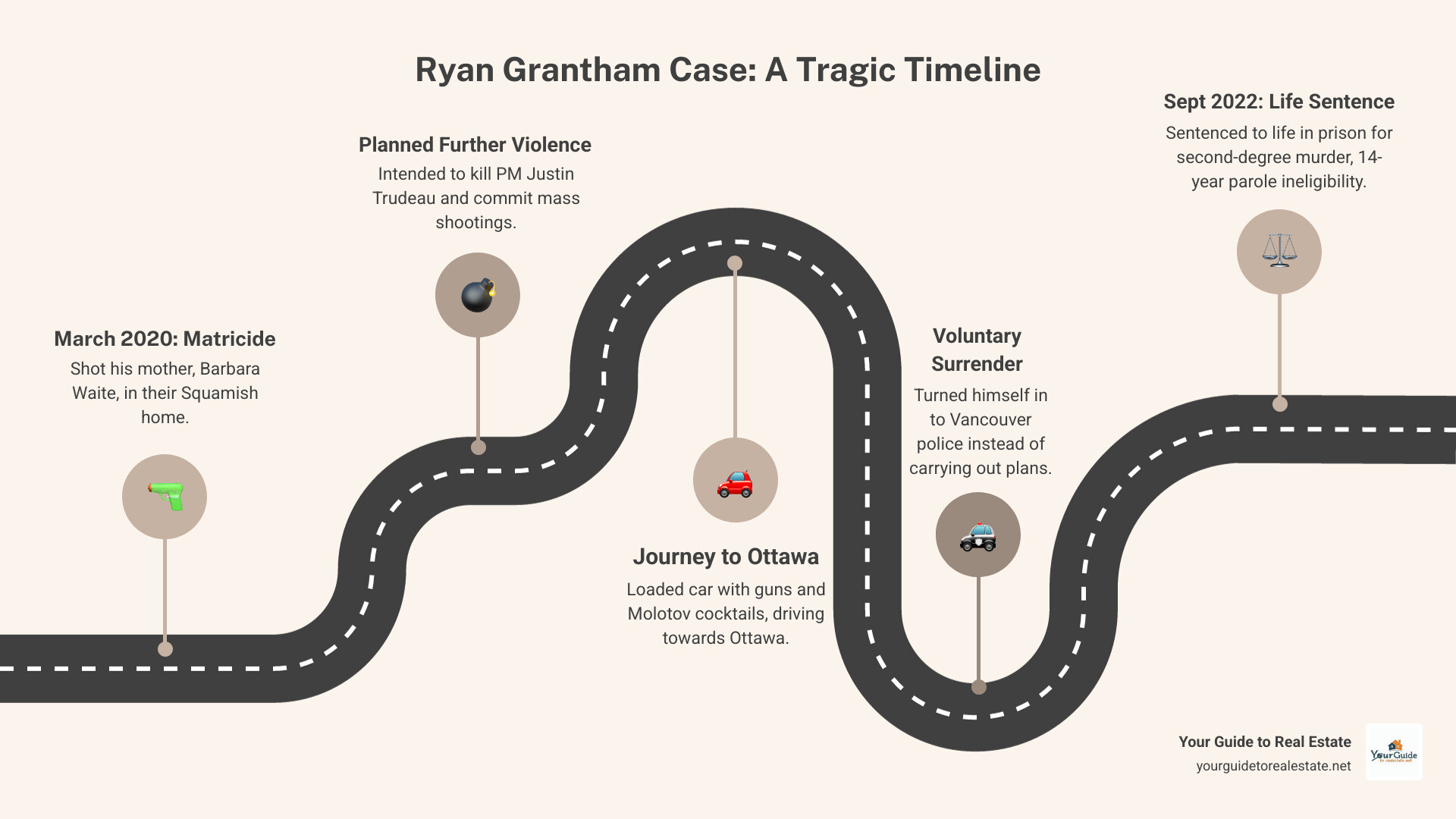
Ryan Grantham is a Canadian former child actor who was sentenced to life in prison in September 2022 for the second-degree murder of his mother, Barbara Waite. The 24-year-old, known for roles in “Riverdale,” “Diary of a Wimpy Kid,” and “Supernatural,” committed the crime in March 2020 and had planned to assassinate Canadian Prime Minister Justin Trudeau.
Key Facts About Ryan Grantham:
- Who: Former child actor from Squamish, British Columbia
- Crime: Second-degree murder of his 64-year-old mother
- Date: March 31, 2020
- Method: Shot Barbara Waite in the back of the head with a .22 rifle
- Additional Plans: Intended to kill Prime Minister Justin Trudeau and commit mass shootings
- Sentence: Life in prison with parole eligibility after 14 years
- Current Age: 26 years old (born November 30, 1998)
The case shocked the entertainment industry and the public. Grantham began acting at age nine and accumulated 37 acting credits over his career. His descent into violence included mental health struggles, isolation, cannabis use, and consuming violent content from the dark web.
After murdering his mother while she played piano, Grantham drove toward Ottawa with three guns, ammunition, and 12 Molotov cocktails. He ultimately turned himself in to Vancouver police instead of carrying out his planned attack on the Prime Minister.
From Child Actor to Convicted Killer
The change of Ryan Grantham from beloved child star to convicted murderer remains one of the most shocking falls from grace in recent entertainment history. His story serves as a heartbreaking reminder of how mental health struggles can devastate even the most promising lives.
A Promising Start in Hollywood
Ryan Grantham entered acting when he was just nine years old, landing his first role in 2007’s TV movie The Secret of the Nutcracker. What started as a childhood adventure quickly blossomed into a legitimate career that would span over a decade.
The young actor built an impressive resume with 37 acting credits across film and television. His most recognizable role came as Jeffery Augustine in the hit CW series Riverdale, where he appeared alongside the show’s main cast. He also charmed audiences in the family comedy Diary of a Wimpy Kid and earned spots on popular shows like Supernatural and iZombie.
His talent extended to more serious projects as well, including a role in Terry Gilliam’s critically acclaimed film The Imaginarium of Doctor Parnassus. Throughout his career, Ryan Grantham earned 3 awards and 5 nominations, recognition that suggested a bright future ahead in Hollywood.
For those interested in exploring his complete filmography, this Variety article provides a detailed look at his career credits and the shocking turn his life would take.
The Descent into Violence
Behind the cameras and red carpets, Ryan Grantham was fighting a private battle that few around him fully understood. Court documents and psychiatric evaluations later revealed the depth of his struggles with clinical depression, a condition that gradually isolated him from the world he once thrived in.
As his mental health deteriorated, Grantham began experiencing both suicidal and homicidal urges that grew stronger over time. His isolation became more pronounced as he withdrew from friends, family, and eventually his career. The promising young actor who once lit up screens was becoming someone entirely different.
His problems were compounded by a cannabis use disorder and a disturbing habit of consuming violent content from the dark web. These elements created a toxic combination that fed his darkening thoughts and pushed him further from reality.
The warning signs became impossible to ignore when Grantham dropped out of Simon Fraser University, abandoning his education as his mental state continued to spiral. What had started as manageable depression had transformed into something far more dangerous – a psychological crisis that would ultimately lead to unthinkable tragedy.
The contrast between his public success and private torment shows how mental health struggles can remain hidden even from those closest to us. For Ryan Grantham, this internal battle would soon explode into violence that would destroy multiple lives forever.
The Matricide and Its Aftermath
The spring of 2020 brought unimaginable tragedy to a quiet home in British Columbia. What happened next would shock both the entertainment world and law enforcement across Canada.
The Murder of Barbara Waite
On March 31, 2020, Ryan Grantham committed an act that forever changed everything. In their peaceful suburban townhouse in Squamish, British Columbia, he shot his 64-year-old mother, Barbara Waite, in the back of the head with a .22 rifle. She had been doing something she loved – playing piano – when her life was suddenly and violently taken.

What Ryan Grantham did immediately after the murder was equally disturbing. He set up a GoPro camera and recorded himself confessing to what he had just done. The video showed his mother’s body, creating undeniable evidence of his crime.
But the strange behavior didn’t stop there. Grantham covered his mother’s body with a sheet and arranged lit candles around her. He even hung a rosary from the piano where she had been playing. These ritualistic actions painted a picture of someone whose grip on reality had completely slipped away.
A Foiled Plot of Mass Violence
The murder of Barbara Waite was just the beginning of Ryan Grantham’s terrifying plans. After killing his mother, he loaded his car with an arsenal that would have made headlines across the country. He packed three guns, boxes of ammunition, and 12 Molotov cocktails.
His main target was shocking: Canadian Prime Minister Justin Trudeau. Grantham had mapped out a route to Rideau Cottage, the Prime Minister’s official residence in Ottawa. He was planning nothing less than an assassination.
During his drive toward Ottawa, Grantham’s plans kept shifting in disturbing ways. He considered turning his weapons on innocent people instead. The Lions Gate Bridge in Vancouver crossed his mind as a potential target for a mass shooting. So did Simon Fraser University, the school he had recently dropped out of.
Thankfully, none of these additional horrors came to pass. Something – whether it was a moment of clarity, overwhelming guilt, or simple exhaustion – made Grantham change course entirely. Instead of continuing toward Ottawa or any other target, he drove straight to the Vancouver Police Department.
There, he walked in and surrendered himself to authorities, confessing to his mother’s murder. This decision, while it couldn’t undo the tragedy that had already occurred, likely saved countless other lives.
Justice Served: The Trial and Sentencing of Ryan Grantham
The legal proceedings that followed Barbara Waite’s tragic death brought some measure of closure to this heartbreaking case. The courts faced the difficult task of balancing justice with understanding the complex mental health issues that contributed to such a devastating crime.
The Court’s Findings on the former actor Ryan Grantham
When Ryan Grantham appeared in court, he took responsibility for his actions by pleading guilty to second-degree murder. This plea spared his family the trauma of a lengthy trial, though it couldn’t undo the immense pain his actions had caused.
The motive he provided was deeply disturbing. Grantham claimed he killed his mother to protect her from witnessing the violent acts he was planning to commit. In his twisted thinking, murdering Barbara Waite was somehow an act of mercy before he carried out his plans to assassinate Prime Minister Justin Trudeau and potentially commit mass shootings.
His sister’s victim impact statement was one of the most heartbreaking moments of the proceedings. She had been the one to find their mother’s body, and her words painted a vivid picture of the devastating ripple effects of Ryan Grantham’s actions on their family.
The court hearing details reveal how thoroughly the case was examined. The evidence painted a chilling picture of premeditation and severe mental illness.
Key evidence presented during the trial included:
- The disturbing GoPro confession video Grantham recorded immediately after killing his mother
- Detailed journal entries revealing his dark thoughts and violent plans
- Multiple psychiatric evaluations documenting his severe mental health disorders
- Forensic evidence from the crime scene
- His sister’s testimony about finding their mother’s body
- Weapons and explosives found in his car, proving his intent for further violence
The psychiatric reports were particularly revealing. They showed Ryan Grantham had been struggling with clinical depression, anxiety, and a severe dissociative disorder long before the murder occurred. While these mental health issues didn’t excuse his actions, they provided crucial context for understanding how a once-promising young actor could commit such a horrific crime.
The Final Sentence for Ryan Grantham
On September 23, 2022, Ryan Grantham received a life sentence for second-degree murder. In Canada’s justice system, this sentence is automatic for this type of conviction. The key decision the judge had to make was how long he would have to wait before becoming eligible for parole.
The court determined that Grantham would be eligible to apply for parole after serving 14 years. This decision reflected careful consideration of both the severity of his crime and the circumstances surrounding it.
Several factors worked in his favor during sentencing. He was only 21 years old when he committed the murder, and he had no previous criminal record. Most importantly, Ryan Grantham showed genuine remorse for his actions throughout the legal proceedings. His cooperation with authorities and his guilty plea demonstrated his acceptance of responsibility.
The psychiatric reports also played a significant role in the sentencing. They documented his severe mental health struggles and showed that he was making progress in treatment while in custody. This suggested he was committed to getting the help he desperately needed.
However, the judge couldn’t ignore the horrific nature of the crime. The betrayal of trust involved in murdering his own mother, combined with his elaborate plans for further violence, weighed heavily in the sentencing decision. The judge’s comments reflected this delicate balance between accountability and recognition of mental illness.
Today, Ryan Grantham remains in federal prison, beginning what will be a very long journey toward possible rehabilitation. His case serves as a stark reminder of how untreated mental health issues can lead to unthinkable tragedies, even among those who seem to have everything going for them.
Frequently Asked Questions about the Case
Many people have questions about this shocking case that transformed a promising young actor into a convicted killer. Let’s explore the most common concerns people have about Ryan Grantham and what happened.
What was Ryan Grantham’s motive for killing his mother?
This question haunts many who followed the case. According to court testimony, Ryan Grantham’s stated motive was deeply disturbing and reflected his fractured mental state. He claimed he killed his mother, Barbara Waite, to spare her from witnessing the violence he planned to commit afterward.
Grantham told the court he believed his mother would suffer unbearable pain if she saw him assassinate Prime Minister Justin Trudeau or carry out mass shootings. In his distorted thinking, murdering her was an act of mercy that would protect her from future trauma.
Psychiatric experts who examined him described a young man whose grip on reality had severely deteriorated. His logic, while horrifying to most people, seemed rational within his deeply troubled mind. The combination of clinical depression, isolation, and consuming violent content had warped his ability to think clearly.
What movies and TV shows was Ryan Grantham in?
Before his conviction, Ryan Grantham had built an impressive acting resume that spanned over a decade. He started performing when he was just nine years old and accumulated 37 acting credits throughout his career.
His most recognizable role was probably Jeffery Augustine in the hit CW series Riverdale. Many fans also remember him from the family comedy Diary of a Wimpy Kid, where he played Rodney James. His television work extended to popular supernatural shows like Supernatural, where he portrayed Todd, and iZombie as a zombie character.
Film enthusiasts might recall his appearance in The Imaginarium of Doctor Parnassus, the critically acclaimed movie directed by Terry Gilliam. His range as a young actor was evident in how he moved between family-friendly projects and darker, more dramatic television series.
The tragedy is that his promising career, which had earned him 3 awards and 5 nominations, was completely derailed by his mental health crisis and subsequent crimes.
How long is Ryan Grantham’s prison sentence?
Ryan Grantham received a life sentence for second-degree murder, which is the automatic punishment for this crime in Canada. However, the key detail many people want to understand is when he might be eligible for release.
The judge set his parole ineligibility period at 14 years. This means Grantham must serve at least 14 years before he can even apply to the parole board for consideration. Eligibility doesn’t guarantee release.
When that time comes, the parole board will carefully examine many factors. They’ll look at his rehabilitation progress, his mental health treatment, whether he poses a risk to public safety, and how he’s conducted himself in prison. The board will also consider the severity of his original crime and the impact on victims’ families.
Given the shocking nature of his crimes and his original plans for mass violence, his path to parole will likely be extremely challenging, even after those 14 years pass.
Conclusion: The Tragic Legacy and Broader Questions

The story of Ryan Grantham serves as a heartbreaking reminder of how quickly a promising life can spiral into tragedy. What began as a successful child acting career, with memorable roles in Riverdale and Diary of a Wimpy Kid, ended with a life sentence for the murder of his own mother. The change from beloved young actor to convicted killer shocked fans and left an entire community struggling with difficult questions.
The impact on Barbara Waite’s family has been devastating. His sister, who finded their mother’s body, delivered a powerful victim impact statement that highlighted the profound grief and trauma that will last a lifetime. The ripple effects extend far beyond his immediate family, touching everyone who knew them in their close-knit Squamish, British Columbia community.
This case forces us to examine the mental health crisis that too often goes unnoticed, especially among young people in high-pressure environments. The entertainment industry, with its demanding schedules and public scrutiny, can be particularly challenging for child actors who are still developing emotionally. Ryan Grantham’s struggles with clinical depression, isolation, and disturbing thoughts needed professional intervention long before they escalated to violence.
The tragedy also raises important questions about support systems and early intervention. How many warning signs were missed? Could better mental health resources have changed the outcome? These are difficult questions without easy answers, but they’re conversations we must have as a society.
While this case represents an extreme and tragic outcome, it reminds us that everyone faces major life decisions and challenges. Whether dealing with personal struggles or navigating complex choices, having the right guidance and support makes all the difference. Just as we believe in providing clear, stress-free guidance for real estate decisions, we recognize the importance of seeking expert help for all of life’s significant moments. You can find guidance on making major life decisions that help you build a stable and secure future.
The legacy of Ryan Grantham is ultimately one of loss – the loss of Barbara Waite, a beloved mother, and the loss of a young man’s potential. While justice has been served through his life sentence, the broader lessons about mental health awareness and support systems remain as relevant as ever.