
Why 30-Year Mortgages Dominate American Homebuying
30 year mortgage options are the most popular choice for American homebuyers, with over 90% of borrowers choosing this loan term according to Freddie Mac data.
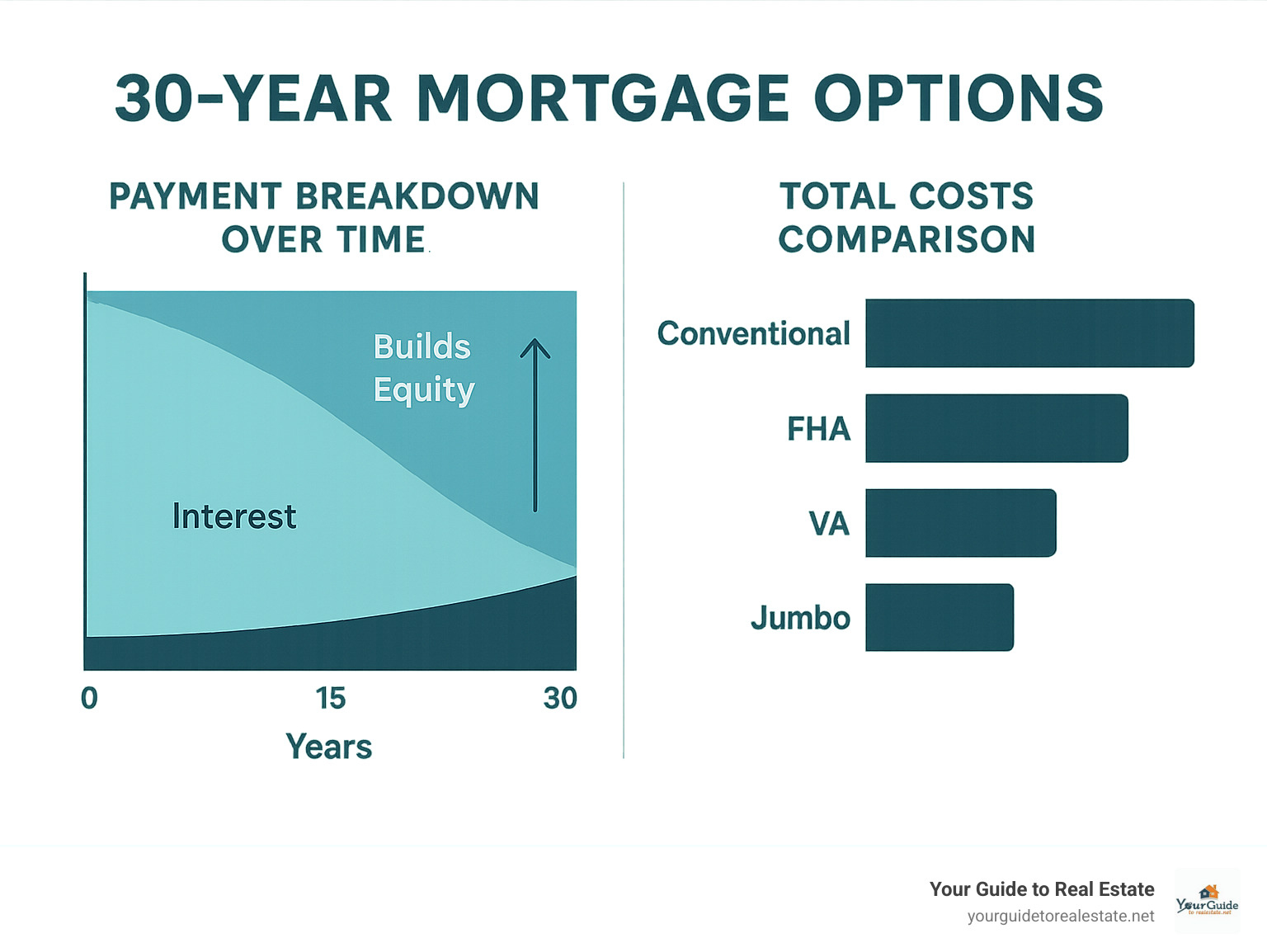
Main 30-Year Mortgage Options:
- Conventional Fixed – 5% down minimum, best rates for strong credit
- FHA 30-Year – 3.5% down, credit scores as low as 580
- VA 30-Year – $0 down for veterans, no PMI required
- USDA 30-Year – $0 down in rural areas, income limits apply
- Jumbo 30-Year – For loans above $766,550 in most areas
- 30-Year ARM – Lower initial rates that adjust after 5-10 years
The appeal is simple: lower monthly payments. A 30-year loan spreads your payments over more time, making homeownership affordable for more people. As of June 2025, the national average 30-year fixed rate sits at 6.69%.
But there’s a trade-off. You’ll pay significantly more interest over the life of the loan compared to shorter terms. A $300,000 mortgage at 6% costs about $347,515 in total interest over 30 years.
The key is understanding which 30-year option fits your situation. First-time buyers often benefit from FHA loans with their lower down payment requirements. Veterans can access VA loans with zero down payment. High earners might need jumbo loans for expensive markets.
Quick 30 year mortgage options terms:
How a 30-Year Fixed-Rate Mortgage Works
A 30-year fixed-rate mortgage locks in your interest rate for three decades – no surprises, no sudden payment jumps, just predictable monthly payments.
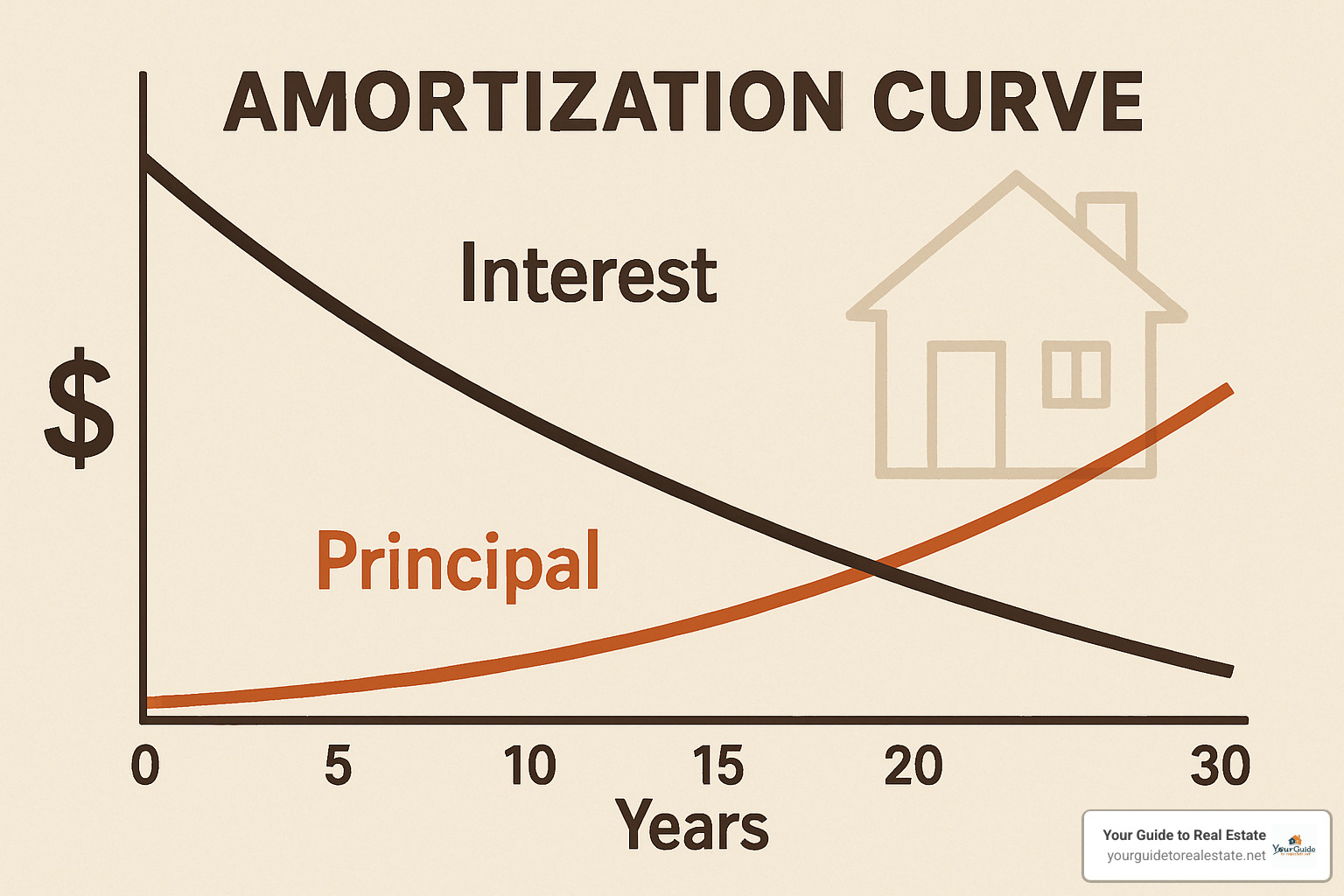
Your monthly payment stays the same, but what you’re actually paying for changes dramatically over time through amortization.
Let’s say you borrow $300,000 at 6% interest. Your monthly payment of $1,799 never changes, but watch how it splits:
Year 1: You’re paying about $1,500 in interest and only $299 toward your loan balance.
Year 15: The split becomes more balanced – roughly half and half.
Year 30: Nearly your entire $1,791 payment goes toward principal, with just $9 in interest.
This front-loaded interest structure explains why making extra payments early saves you so much money. Every extra dollar you pay in those first few years directly attacks the principal balance.
Always compare APRs versus interest rates. That shiny 6.5% rate might actually cost you 6.8% annually once you factor in origination fees, points, and other closing costs. The APR gives you the real picture.
Want to dive deeper? Our understanding mortgages: a beginner’s guide to home loans breaks down everything you need to know.
Who should choose 30 year mortgage options?
Budget-conscious buyers love the breathing room that lower payments provide. That extra $600-800 per month (compared to a 15-year loan) can mean the difference between comfortable homeownership and financial stress.
Long-term residents benefit most from the stability. If you’re planning to stay in your home for seven years or more, locking in today’s rate protects you from future interest rate increases.
First-time buyers often need the lower payments while they adjust to homeownership costs. Property taxes, maintenance, utilities, and that inevitable first-year “honey-do” list can strain budgets.
How do 30 year mortgage options compare to 15-year loans?
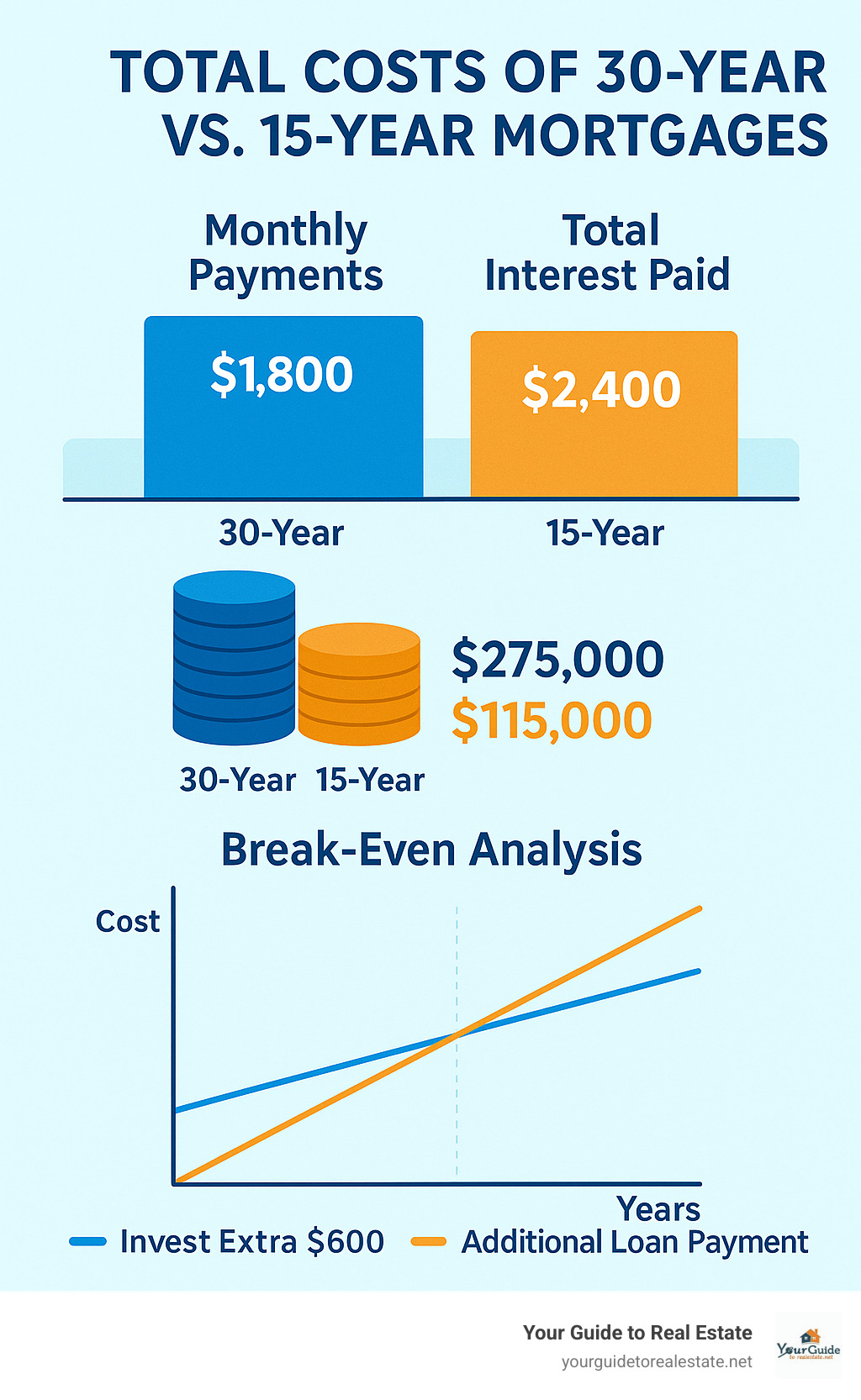
The math is eye-opening when you see it side by side. Let’s compare that same $300,000 mortgage:
30-year fixed at 6.5% gives you monthly payments of $1,896 but costs $382,633 in total interest over the life of the loan.
15-year fixed at 6.0% bumps your monthly payment to $2,533 but saves you a whopping $226,694 in interest compared to the 30-year option.
That’s real money – enough to fund a comfortable retirement or pay for your kids’ college education. But consider the $637 monthly difference. Can you comfortably afford that higher payment even if your income drops or unexpected expenses arise?
Most financial experts suggest sticking with 30 year mortgage options if you have other high-interest debt, an unstable income, or limited emergency savings. The flexibility is worth more than the interest savings if it prevents financial stress.
30 year mortgage options: Conventional, FHA, VA, Jumbo & ARM
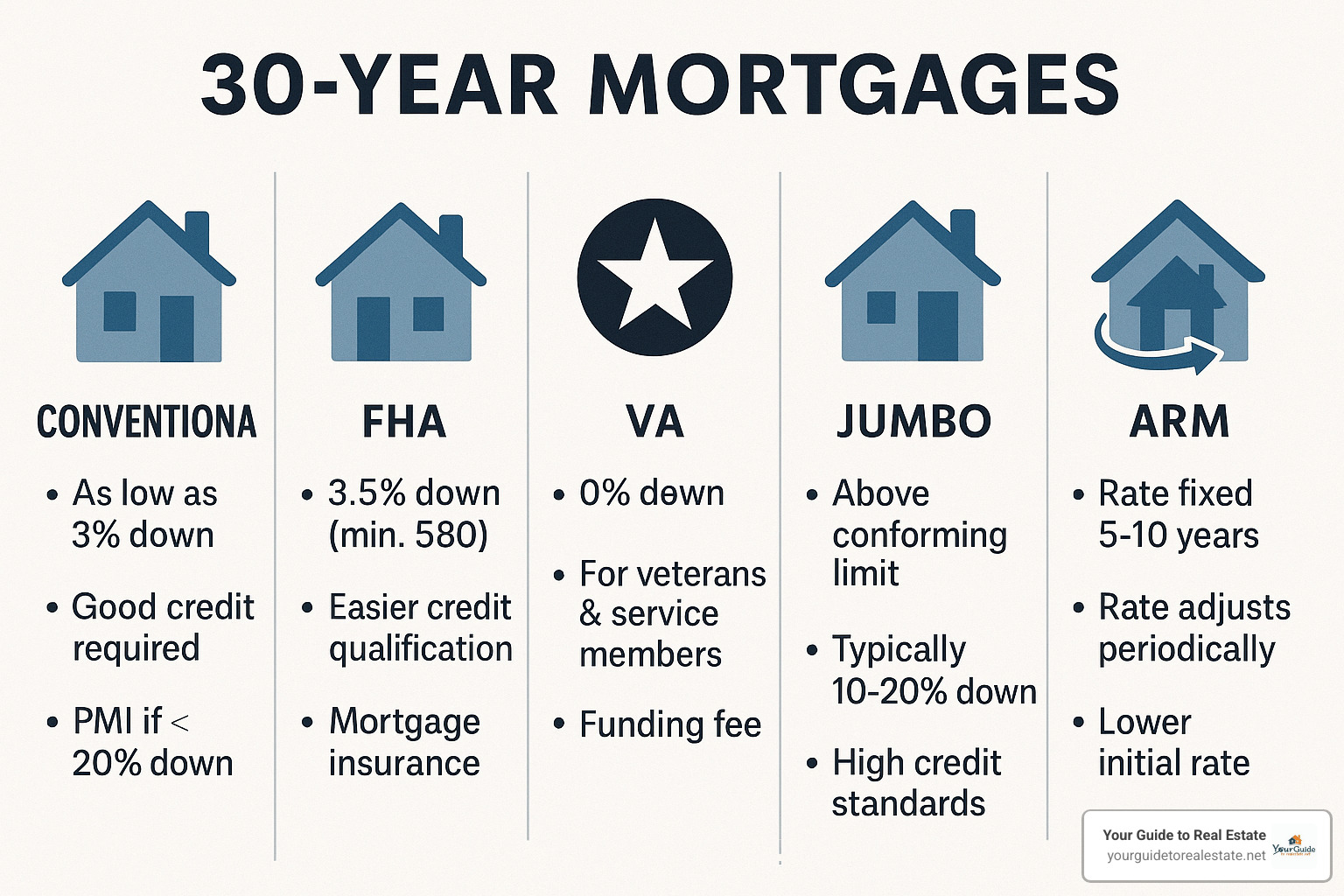
30 year mortgage options are like different flavors – they’re all 30-year mortgages, but each one has unique features perfect for different people.
Conventional loans are straightforward and great for most people. You’ll need at least 5% down (or just 3% if you’re a first-time buyer) and a credit score of 620 or higher. The sweet spot for the best rates? A credit score of 740 or above. These loans max out at $766,550 in most areas, and you’ll pay PMI if you put down less than 20%.
FHA loans are designed for people who need extra help getting started. With just 3.5% down and credit scores as low as 580, they’re incredibly accessible. The trade-off? You’ll pay mortgage insurance for the life of the loan if you put down less than 10%. For all the details on qualifying, check out our comprehensive guide on FHA loan requirements.
VA loans offer something almost magical: zero down payment and no PMI required. While there’s no official credit score minimum, most lenders want to see at least 620. You will pay a 2.15% funding fee, but you can roll it into your loan amount. Check out current VA rates for up-to-date pricing.
USDA loans are the hidden gem for rural buyers. Like VA loans, they require no down payment, but you’ll need a credit score around 640 and your income can’t exceed 115% of the area median. Your home needs to be in an eligible rural area.
Jumbo loans step in when you’re shopping in expensive markets where home prices exceed $766,550. You’ll typically need 10-20% down and a credit score of 700 or higher. Expect rates about 0.25% to 0.5% higher than regular conventional loans.
30-year ARMs offer lower initial rates – often 0.5% to 1% below fixed rates. Your rate stays fixed for the first 5, 7, or 10 years, then adjusts based on market conditions.
Conventional vs Government-backed Loans
Conventional loans are backed by Fannie Mae and Freddie Mac, which means they can be pickier about who they’ll lend to. The upside? You get competitive rates, faster processing, and the ability to remove PMI once you hit 20% equity.
Government-backed loans have Uncle Sam’s backing, which means lenders can take bigger risks. That translates to lower down payments and more flexible credit requirements for you. The trade-off is usually higher fees and longer-lasting mortgage insurance.
Conforming loan limits set the boundary between conventional and jumbo loans. In 2025, that magic number is $766,550 in most areas, though it’s higher in expensive markets.
Special 30-year programs for first-time buyers & vets
First-time buyers have fantastic options beyond the standard programs. The Conventional 97 program lets you put down just 3% with no income restrictions.
Many states and cities offer their own programs with down payment assistance or below-market rates. These programs often have income limits, but they can be game-changers for qualifying buyers.
Veterans get some of the best deals in the mortgage world. Beyond standard VA loans, there are state veteran programs that stack additional benefits on top of federal VA benefits.
The key is knowing these programs exist and asking your lender about them.
Getting the Best 30-Year Mortgage Rate
Landing the best rate on your 30 year mortgage options can save you tens of thousands of dollars. Drop your rate by just 0.25% on a $300,000 loan, and you’ll save about $19,000 over 30 years.
Your credit score acts like a golden ticket to better rates. Borrowers with scores between 760-850 get the lowest available rates. Drop into the 700-759 range, and you’ll typically pay about 0.2-0.3% more. Fair credit scores of 680-699 face roughly 0.4% higher rates, while scores between 620-679 mean higher rates and fewer loan options.
Your debt-to-income ratio matters enormously. Lenders love seeing DTI ratios under 43%, though some stretch to 50% for strong borrowers. Remember to count all your monthly debts when calculating this.
Your down payment size directly impacts your rate too. Put down 20% or more, and you’ll access the best rates while avoiding PMI. Drop to 10-19% down, and you’ll face slightly higher rates plus mortgage insurance.
Discount points can buy you a lower rate, but they’re not always worth it. Each point costs 1% of your loan amount and typically drops your rate by 0.25%. Points make sense only if you’ll stay in the home long enough for the monthly savings to exceed the upfront cost.
For detailed strategies on comparing lenders and rates, check out our comprehensive guide on how to shop for a mortgage.
Want to explore adjustable-rate alternatives? Learn more about ARM rates and how they work.
Qualifying for the lowest 30-year APR
Lenders dig deep into your financial life when determining your rate. Employment history tops their checklist – they want to see 2+ years of stable work.
Your loan-to-value ratio (LTV) significantly impacts pricing. This calculation divides your loan amount by the home’s value. An 80% LTV means you’re putting 20% down, which typically opens up the best rate tier.
Cash reserves beyond your down payment show lenders you can handle financial bumps. Having 2-6 months of mortgage payments in savings demonstrates stability and can improve your rate or approval odds.
Timing your lock-in
Mortgage rates change daily based on factors beyond your control. Federal Reserve meetings can trigger significant rate swings, especially when policy changes are announced.
The bond market drives much of what happens with mortgage rates. When 10-year Treasury yields rise, mortgage rates typically follow. Economic data releases – employment reports, inflation numbers, GDP growth – all influence rate trends.
Your rate lock strategy should balance timing with security. Once you find a competitive rate and have a home under contract, lock it in. Most lenders offer 30-60 day locks at no charge.
The key is acting decisively when you find a good rate. Waiting for the “perfect” rate often means missing out on very good rates.
Paying Off & Refinancing Your 30-Year Mortgage
Your 30 year mortgage options don’t actually have to take 30 years to pay off. With the right strategies, you can slash years off your loan and save tens of thousands in interest.
The math is amazing when you see it in action. Take a $300,000 loan at 6% – if you add just $100 extra to your monthly principal payment, you’ll save $63,000 in interest and finish paying five years early.
Bi-weekly payments offer another powerful approach. Instead of making 12 monthly payments, you make 26 bi-weekly payments (half your monthly amount every two weeks). This gives you the equivalent of 13 monthly payments per year instead of 12, shaving about 6 years off a typical 30-year loan.
Some homeowners prefer the annual lump sum method – using tax refunds, work bonuses, or inheritance money for extra principal payments. Others like the round-up approach, turning a $1,896 payment into an even $2,000 each month.
Before you start throwing extra money at your mortgage, check for prepayment penalties in your loan documents. Most modern mortgages don’t have them, but it’s worth confirming.
One clever strategy many homeowners miss is loan recasting. After making a large principal payment (usually $5,000 or more), you can ask your lender to recalculate your monthly payments based on the new, lower balance.
For comprehensive refinancing strategies, check our mortgage refinancing explained guide. You can also explore lower interest costs to see current refinance rates.
Smart refinance triggers
Refinancing isn’t just about getting a lower rate. The old rule said you needed at least a 2% rate drop to make refinancing worthwhile, but today’s streamlined processes mean a 0.75% improvement often makes financial sense.
If your credit score has jumped 50 points or more since you got your original loan, you might qualify for significantly better rates.
Term shortening through refinancing can be incredibly powerful. If rates have dropped since you bought your home, you might be able to refinance from a 30-year to a 15-year loan without dramatically increasing your monthly payment.
The break-even calculation is crucial for any refinance decision. Add up all your closing costs and divide by your monthly payment savings. If you’ll stay in the home longer than the break-even period, refinancing probably makes sense.
Strategies to ditch PMI faster
Private mortgage insurance feels like throwing money away because it protects the lender, not you. The good news? You have several ways to eliminate it faster.
Your loan servicer must automatically cancel PMI when you reach 22% equity through regular payments, but you can request removal at 20%. Many homeowners don’t realize they can be proactive about this.
Home appreciation often provides the fastest path to PMI removal. If your neighborhood has seen significant price increases, order a new appraisal (typically $300-500) to prove you now have 20% equity.
Strategic home improvements can accelerate the process by increasing your home’s value. Kitchen renovations, bathroom updates, or adding square footage might push you over the 20% equity threshold faster.
FHA loans have different rules – their mortgage insurance typically stays for the life of the loan if you put down less than 10%. In these cases, refinancing to a conventional loan might be your only option to eliminate mortgage insurance payments.
Frequently Asked Questions about 30 year mortgage options
Let’s tackle the most common questions about 30 year mortgage options.
What affects my 30-year mortgage rate?
Your mortgage rate is based on several key factors that lenders evaluate when pricing your loan.
Your credit score is the heavyweight champion here. Borrowers with excellent credit (760+) get the lowest available rates. If your score sits in the fair range (680-699), expect to pay about 0.5% more. On a $300,000 loan, that’s roughly $90 more per month.
The loan type you choose also plays a big role. Government-backed loans like VA and FHA often offer competitive rates despite their lower credit requirements.
Discount points let you “buy down” your rate by paying extra upfront. Each point typically costs 1% of your loan amount and reduces your rate by about 0.25%.
Economic factors beyond your control – like Federal Reserve decisions and bond market movements – set the overall rate environment.
Can I pay off a 30-year mortgage early?
Absolutely! Almost all modern mortgages allow unlimited extra principal payments without penalties.
Extra principal payments are incredibly powerful. Every extra dollar you pay toward principal saves you about $3 in total interest over the loan’s life (assuming a 6% rate). Even small amounts add up – an extra $100 monthly on a $300,000 loan saves over $63,000 in interest and cuts five years off your term.
Refinancing to a shorter term is another option. If rates have dropped since you got your loan, you might be able to switch to a 15-year mortgage without dramatically increasing your payment.
Don’t rush to pay off a low-rate mortgage if you have credit card debt or other high-interest obligations. Tackle those first.
When is it smart to refinance a 30-year loan?
Refinancing isn’t always about getting the lowest possible rate – it’s about improving your overall financial situation.
The break-even calculation is your best friend here. Add up all your refinancing costs (typically $2,000-$5,000) and divide by your monthly payment savings. If you’ll stay in the home longer than this break-even period, refinancing probably makes sense. Most experts suggest refinancing when you can drop your rate by at least 0.75%.
Cash-out refinancing can be smart when you need significant funds for home improvements, debt consolidation, or other major expenses. You’ll often get better rates than personal loans or credit cards.
Refinancing isn’t a one-time decision. As your financial situation improves or market conditions change, it might make sense to refinance again down the road.
Conclusion
Choosing the right 30 year mortgage options doesn’t have to be overwhelming. Whether you’re a first-time buyer or a seasoned homeowner looking to refinance, there’s a loan type designed for your situation.
The beauty of today’s mortgage market is its flexibility. Conventional loans reward borrowers with strong credit with competitive rates and the ability to remove PMI. FHA loans open doors for buyers who might not qualify elsewhere, accepting credit scores as low as 580 and down payments of just 3.5%.
Veterans have perhaps the best deal with VA loans – zero down payment, no PMI, and rates that often beat conventional options. Jumbo loans provide financing for expensive markets, while ARMs can save money if you’re planning a shorter stay.
Your first mortgage choice isn’t your last. Life changes, markets shift, and better opportunities arise. You might refinance for a lower rate, make extra payments to build equity faster, or even switch loan types entirely. The key is starting with what works for you right now.
Your credit score will likely improve over time. Your income may grow. Market rates will fluctuate. What matters most is taking that first step toward homeownership with confidence, knowing you understand your options and have chosen wisely.
At Your Guide to Real Estate, we’ve seen countless buyers transform their lives through smart mortgage decisions. The families who started with FHA loans and later refinanced to conventional. The veterans who maximized their VA benefits. The first-time buyers who built wealth through homeownership they thought was out of reach.
Your journey starts with understanding these 30 year mortgage options and getting pre-approved with lenders who offer the programs that fit your profile. Check your credit, calculate your debt-to-income ratio, and start shopping. The home you’ve been dreaming about might be more affordable than you think.
For more comprehensive guidance on all your mortgage choices, explore our mortgage options explained resource center. We’re here to make your path to homeownership as clear and straightforward as possible.